

What if the chronic tension in your jaw isn't actually a problem with your joints, but a protective habit your nervous system refuses to let go of? If you're one of the more than 10 million Americans living with TMJ disorders, you know the frustration of waking up with a heavy ache that traditional mouthguards just can't reach. You might feel like your face looks perpetually stressed or aged by the sheer force of your own grip. It's exhausting to search for relief only to find temporary fixes that ignore why your body is holding on so tightly in the first place.
We understand that true relief requires more than just masking the symptoms. By exploring somatic therapy for tmj, you can begin to address the root cause of your discomfort by retraining your nervous system to release chronic tension. This article will show you how to move beyond invasive procedures and toward a path of natural facial balance and pain-free movement. We'll preview how the Face Up Method™ approach facilitates a deep jaw release; giving you the tools to transform your relationship with stress and rediscover a relaxed, youthful expression that feels as good as it looks.
Key Takeaways
- Learn why your jaw tension is a neurological habit and how somatic therapy for tmj offers a "bottom-up" solution for permanent relief.
- Discover the hidden connection between fascia and "body armoring" that keeps your face locked in a state of perpetual stress.
- Compare the long-term benefits of somatic release against temporary beauty interventions to reclaim your natural facial proportions.
- Access practical, three-minute awareness rituals designed to identify tension levels and soothe your cranial nerves on demand.
- Find out how the Face Up Method™ provides a comprehensive ecosystem, including the Jaw Release course, to support your path to facial balance.
What is Somatic Therapy for TMJ? Beyond the Jaw Joint
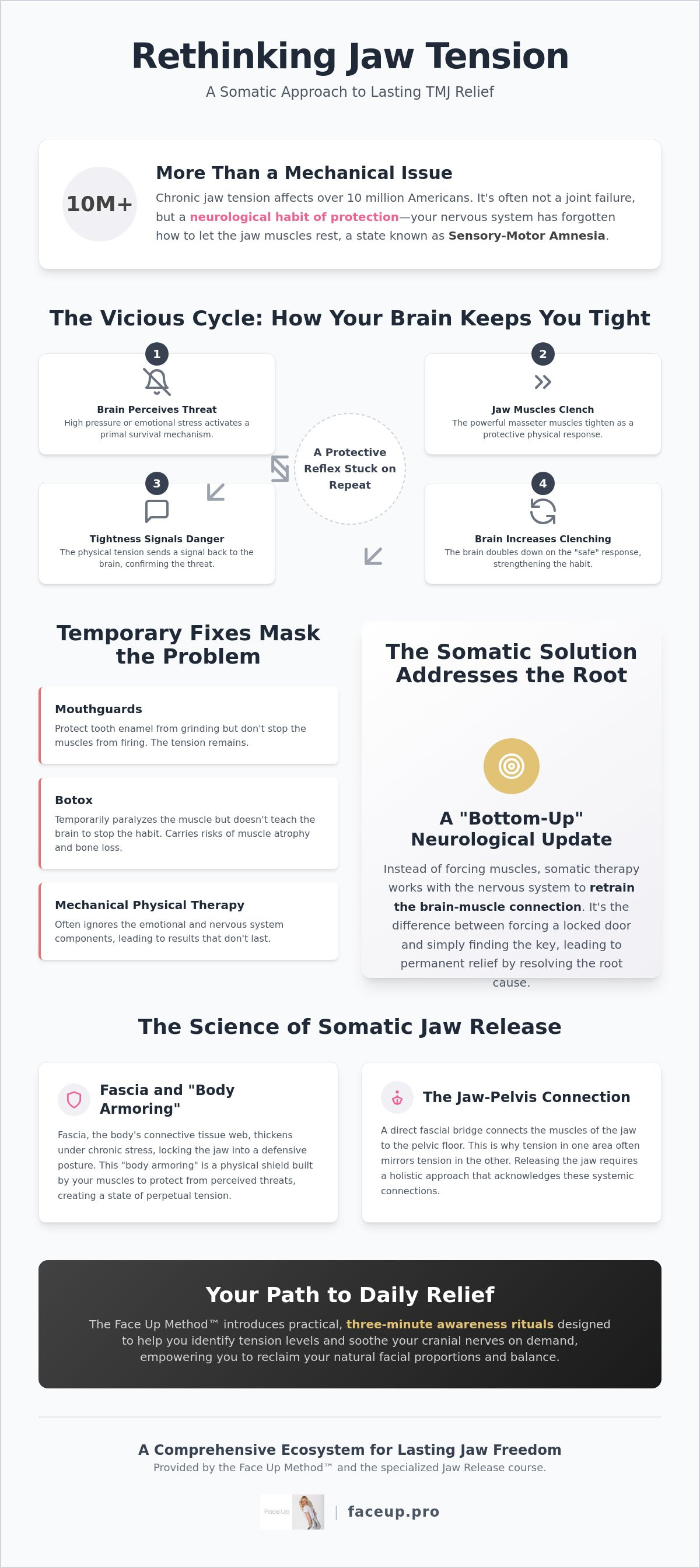
Somatic therapy for tmj represents a fundamental shift in how we approach chronic facial tension. Most people view jaw pain as a localized mechanical failure; however, it's more accurately described as a neurological habit of protection. Unlike traditional methods that focus solely on the joint, somatic therapy is a "bottom-up" approach. It prioritizes the internal experience of the body and the signals sent by the nervous system over external manipulation. This method addresses the root cause: the brain has effectively "forgotten" how to let the jaw muscles rest.
This state of forgetfulness is known as Sensory-Motor Amnesia. When the body experiences repetitive stress, the brain keeps certain muscles in a state of constant contraction. Over time, this becomes the new "normal," and you lose the conscious ability to relax those fibers. While traditional stretching feels like a mechanical tug-of-war that the fascia often resists, somatic release is a neurological update. It's the difference between forcing a door open and simply finding the key. Within this framework, the jaw often acts as a container for emotional stress, holding the tension we cannot verbally express. This body-oriented perspective aligns with the principles of Somatic Experiencing, focusing on how the nervous system stores and eventually resolves high-stress responses.
The 'Stress-Jaw' Loop: How Your Brain Keeps You Tight
Your nervous system is designed to protect you. During periods of high pressure, the brain defaults to a "clench" response as part of a primal survival mechanism. This creates a feedback loop between the masseter muscles, the strongest muscles in the body relative to their size, and the amygdala. When the jaw tightens, it signals to the brain that you're under threat, which in turn causes more tightening. This is why conscious "relaxing" rarely works for chronic sufferers. You can't simply think your way out of a reflex that your brain believes is keeping you safe.
Why Traditional TMJ Treatments Often Fail
Many people spend years cycling through temporary fixes that fail to address the underlying neurological signal. Consider these common interventions:
- Mouthguards: These are excellent for protecting your tooth enamel from grinding, but they don't stop the muscles from firing. The tension remains; it just has a plastic buffer.
- Botox: While it provides temporary relief by paralyzing the muscle, it carries risks of muscle atrophy and bone density loss in the jaw. Crucially, it masks the symptom without teaching the brain to stop the clenching habit.
- Mechanical Physical Therapy: Purely mechanical exercises often ignore the emotional and nervous system components, leading to results that don't last once the sessions end.
True freedom comes from retraining the system, a journey we facilitate through the Face Up Method™ and our specialized Jaw Release course. By addressing the neurological roots of somatic therapy for tmj, we move beyond the limitations of purely physical fixes.
The Science of Somatic Jaw Release: Fascia and the Nervous System
Understanding the internal mechanics of somatic therapy for tmj requires looking beyond the bones and teeth to the connective tissue known as fascia. Fascia is a continuous, three dimensional web that encases every muscle fiber and organ. When you experience chronic stress, your fascia doesn't just sit still; it adapts by thickening and "locking" your jaw into a defensive posture. This phenomenon is often referred to as Body Armoring. It's a physical shield constructed by your facial muscles to protect you from perceived emotional or physical threats. While the National Institute of Dental and Craniofacial Research provides extensive data on Temporomandibular Disorders (TMD), somatic work focuses on the neurological signals that keep this armor in place.
The jaw doesn't exist in a vacuum. A fascial bridge connects the muscles of the mouth directly to the pelvic floor. This developmental and structural link means that tension in the hips often mirrors tension in the jaw. If you've ever noticed yourself clenching during a heavy workout or a stressful drive, you've felt this bridge in action. By recognizing this global connection, we can address the jaw through a more holistic lens, ensuring that the release is deep and systemic rather than just a local fix.
Pandiculation vs. Stretching: The Neurological Difference
Most people try to fix a tight jaw by pulling on the muscles. This passive stretching often fails because it triggers the stretch reflex; a safety mechanism where the brain tells the muscle to contract even harder to avoid tearing. Pandiculation is different. It's the brain's natural way of resetting muscle length through a voluntary, conscious contraction followed by an extremely slow, controlled release. This process re-boots the nervous system's control over the muscle. You shouldn't force the movement. Instead, focus on feeling the muscle fibers lengthen under your own conscious command.
The Emotional Anatomy of the Jaw
The jaw is frequently the center of unspoken expression. It's where we store suppressed anger, unsaid words, and the "bite" we didn't take. Somatic therapy for tmj provides a safe environment to process these stored micro-traumas. As the physical grip of the masseter muscles softens, many people report a broader sense of emotional ease. Releasing the jaw is often the first step in releasing a lifetime of held tension. For those ready to begin this journey, exploring a Somatic Bodywork Session can provide the professional guidance needed to navigate these deep releases and restore natural facial harmony.
Somatic Therapy vs. Traditional Beauty Interventions
Many people seek out jawline fillers or Botox to address a "heavy" lower face or a loss of definition. While these interventions offer immediate changes, they often fail to address the physiological reality of why the face looks stressed. Chronic tension in the masseter muscles causes "facial shortening," a process where the jaw is pulled upward and backward into a perpetual clench. This compresses the soft tissues, creating a jowly appearance and making the neck seem shorter. Research into the link between TMD and somatization suggests that these physical changes are deeply tied to how our bodies process psychological distress. By choosing somatic therapy for tmj, you're opting for a natural alternative that restores your face's original architecture rather than simply masking its collapse.
The Aesthetic Benefits of Somatic Jaw Release
When the masseter muscles are overworked, they undergo hypertrophy, becoming larger and creating a square, aggressive look to the jawline. Releasing this tension through somatic work allows these muscles to return to their natural, slender state. This shift provides a "sculpting" effect that no needle can truly replicate because it works with the body's own biological harmony. Additionally, a relaxed jaw significantly improves lymphatic drainage. Chronic clenching acts like a dam, trapping fluid in the facial tissues and contributing to morning puffiness. By softening the jaw, you allow the lymphatic system to clear away metabolic waste, resulting in a clearer, more vibrant complexion. Somatic practices also address facial asymmetry, balancing the uneven tension that often causes one side of the face to look more "drooped" or tight than the other.
Why Somatic Work is the Foundation of Holistic Beauty
You cannot effectively sculpt a face that is neurologically locked in a state of defense. Attempting to apply topical treatments or superficial massages to a jaw gripped by Sensory-Motor Amnesia is like trying to iron a shirt while someone is still wearing it and pulling at the sleeves. The Face Up Method™ prioritizes neurological safety as the first step in any beauty ritual. We believe that true rejuvenation is an internal process. For a deeper look at how manual techniques support this journey, you can explore the ultimate guide to tmj massage therapy. By integrating somatic therapy for tmj into your routine, you move beyond the "quick fix" culture and toward a sustainable, high-standard model of care that respects your body’s intelligence.
Practical Somatic Rituals for Daily TMJ Relief
Integrating somatic therapy for tmj into your daily life doesn't require hours of dedicated practice. It begins with a simple three minute awareness ritual that you can perform anywhere. Close your eyes and notice the current position of your teeth. If they're touching, your masseters are active and consuming energy. Try to "soften the palate" by imagining the roof of your mouth becoming wider and more fluid. This subtle internal shift helps relax the cranial nerves that often drive unconscious jaw tension. Proper tongue posture is also essential; rather than forcing the tongue upward, allow it to rest gently against the roof of the mouth like a soft leaf. For those who want to deepen this tactile feedback, choosing the best tmj massage tool can provide the support needed for a more profound release.
Intra-oral (Buccal) Awareness: Releasing from the Inside Out
Some of the most powerful muscles involved in chewing and clenching, such as the lateral pterygoids, are nearly impossible to reach from the outside. This is why the Face Up Method™ incorporates intra-oral, or buccal, awareness as a core pillar of its practice. To explore this safely, ensure your hands are clean and gently place a thumb inside your cheek. Feel for areas of density or "knots" in the muscle tissue. Instead of applying heavy pressure, simply maintain a light touch and breathe into the area. You aren't trying to "break" the tension; you're providing the brain with new sensory information. This allows the nervous system to recognize the chronic contraction and choose to let it go.
Vagus Nerve Toning for Jaw Relaxation
The Vagus nerve serves as the primary highway for the parasympathetic nervous system, and it's intimately connected to the muscles of your face, throat, and jaw. You can "flip the switch" from a stress response to a "rest and digest" state through simple vocalizations. Low frequency humming creates a vibration that stimulates the Vagus nerve, signaling to your brain that the environment is safe. A regulated nervous system makes somatic therapy for tmj significantly more effective because you're no longer trying to release a jaw that your brain thinks needs to be clenched for survival. This holistic regulation ensures that the physical releases you achieve actually stick.
If you're ready to move beyond self-practice and experience a professional application of these techniques, you can explore a Somatic Bodywork Session to accelerate your journey toward jaw freedom and facial balance.
Mastering the Face Up Method™ for Lasting Jaw Freedom
The journey toward permanent jaw release isn't a single event; it's a commitment to a new way of inhabiting your body. The Face Up Method™ provides the structured framework necessary to move beyond trial and error. While individual exercises provide temporary relief, a comprehensive approach to somatic therapy for tmj ensures that the nervous system receives consistent, high-quality signals for change. This proprietary ecosystem is designed to guide you from initial awareness to a state of lasting facial harmony and professional expertise. We've built this environment to be both a sanctuary for those in pain and a gold standard for those seeking to master the craft of somatic facial work.
We invite you to step into an environment where your professional advancement and personal well-being are treated with equal importance. The Face Up Method™ isn't just a set of techniques; it's a global standard for facial somatic work. Whether you are a sufferer looking for relief or a professional looking to expand your reach, our ecosystem provides a clear path forward. By moving beyond transactional treatments, we foster a community of practitioners and individuals dedicated to the art of somatic release. This high-standard approach ensures that every participant, regardless of their starting point, has the resources to achieve professional-grade results.
The Jaw Release Course: Your 5-Step Path to Relief
Our Jaw Release Course serves as the immediate entry point for those seeking a guided home transformation. This five-step curriculum takes you from understanding your unique facial anatomy to mastering advanced somatic release techniques. Unlike generic tutorials found elsewhere, this course offers lifetime access and community support, emphasizing the development of a body-led habit rather than a quick fix. It's designed for those who are tired of temporary fixes and ready to invest in their long-term facial harmony. To maintain this progress, the Face Up App Subscription provides a library of daily rituals that ensure your nervous system stays regulated and responsive throughout your professional day.
Professional Certification: Become a Somatic Facial Specialist
For beauty and wellness professionals, the demand for specialized, body-based modalities is growing rapidly. Standard treatments often miss the neurological depth required for true facial rejuvenation and pain relief. By pursuing a facial sculpting certification, you position yourself as a leader in this high-standard niche. This training sets you apart from traditional estheticians by providing the tools to address the root causes of tension through the Face Up Method™. As a certified practitioner, you join a global community and gain visibility through our practitioner directory, connecting you with clients who are specifically searching for somatic therapy for tmj. This is more than a certification; it's an invitation into a specialized professional landscape where integrity and results are the primary currency.
Reclaim Your Natural Facial Harmony
Reclaiming your facial harmony begins with a fundamental shift from fighting tension to understanding it. We've explored how somatic therapy for tmj addresses the neurological roots of Sensory-Motor Amnesia, allowing your brain to finally release the protective armoring that restricts your movement and ages your expression. By prioritizing the nervous system and fascia, you move beyond the limitations of mouthguards and temporary injections toward a sustainable, natural solution that restores your original architecture.
This transformation is exactly what Olga Newman, a specialist in somatic bodywork, designed the Face Up Method™ to facilitate. You don't have to navigate this journey alone. You can join over 5,000 students worldwide who are already using these tools to rediscover a pain-free life and a more relaxed, youthful appearance. Our ecosystem provides the professional structure needed to turn these insights into a permanent, body-led habit.
Enroll in the Jaw Release Course for lasting relief and gain access to the Face Up App for daily guided rituals that keep your progress on track. Your body is ready to let go of the stress it's been carrying. It's time to give your jaw the freedom it deserves and step into a future of calm efficiency.
Frequently Asked Questions
How long does it take to see results with somatic therapy for TMJ?
You'll likely feel a noticeable shift in your jaw's "grip" after a single fifteen minute session. However, retraining the nervous system to abandon chronic clenching habits usually requires consistent practice over four to six weeks. This timeframe allows the brain to establish new motor patterns and replace Sensory-Motor Amnesia with conscious control. Lasting facial balance is a cumulative process of neurological updates rather than a one time fix.
Can I do somatic jaw release if I have dental implants or veneers?
Somatic jaw release is entirely safe for those with dental implants, veneers, or crowns. Since the method focuses on muscle lengthening and nervous system regulation rather than applying heavy mechanical force to the teeth, there's no risk to dental hardware. We recommend waiting for full clearance from your dentist after any recent surgery before beginning intra-oral work, but external somatic rituals can often start much sooner.
Is somatic therapy safe to use alongside Botox for jaw clenching?
It's perfectly safe to practice somatic therapy for tmj alongside Botox, though the physical sensations may feel slightly muted. While Botox temporarily paralyzes the muscle fibers, somatic work addresses the brain's underlying command to clench. Many clients find that as they master somatic release, they can gradually extend the time between their Botox appointments or eventually move away from injections entirely as the neurological habit dissolves.
What is the difference between somatic therapy and a regular face massage?
The primary difference lies in the neurological direction of the work. A regular face massage is a passive, "top-down" treatment where a practitioner manipulates your tissue from the outside. In contrast, somatic therapy for tmj is a "bottom-up" neurological process. It uses active techniques like pandiculation to help your brain regain voluntary control over muscle length, leading to permanent changes that a standard massage cannot achieve.
Can somatic exercises for the jaw help with tinnitus or ear ringing?
Somatic exercises can often alleviate tinnitus if the ear ringing is caused by muscular tension near the jaw joint. The temporomandibular joint sits in close proximity to the ear canal; chronic tightness in the pterygoid muscles can create pressure that manifests as ringing. By releasing this deep-seated tension through somatic awareness, you may find a significant reduction in the intensity or frequency of these ear symptoms.
Do I need special tools to practice somatic TMJ release at home?
You don't need any specialized equipment to begin your somatic practice. Your own hands and a heightened sense of internal awareness are the most effective tools for this work. While some individuals choose to incorporate specialized massage tools to provide deeper sensory feedback, the core of the Face Up Method™ relies on the brain's ability to perceive and release tension through conscious movement and breath.
How often should I practice somatic rituals to stop grinding my teeth?
We recommend practicing somatic rituals at least once a day, ideally right before you go to sleep. Spending five to ten minutes on "palate softening" or gentle pandiculation helps reset your nervous system's tension levels before you enter the nocturnal grinding phase. This daily consistency is what prevents the brain from defaulting to a clench response during the night, leading to a more restful, pain-free morning.


