

What if the chronic tightness in your jaw isn't actually a muscle problem, but a sophisticated defense mechanism your nervous system refuses to turn off? You've likely tried the mouthguards, the aggressive masseter stretches, or even considered injectables, yet the morning headaches and that "stuck" feeling in your face persist. It's exhausting to feel like your body is permanently braced for a battle that never arrives. If you've been searching for effective somatic exercises for jaw tension, you've likely realized that conventional methods often ignore the emotional root of the clench. We understand that this tension is more than just physical; it's a reflection of your internal state and an obstacle to your daily well-being.
In this guide, you'll discover how to deprogram chronic clenching and emotional stress through the science of somatic re-education and the Face Up Method™. We're moving beyond temporary fixes to address the root cause of your discomfort. By integrating these body-based techniques into your routine, you can finally transition out of a fight-or-flight state. We'll show you how to achieve a tension-free jaw and a naturally sculpted facial appearance, guiding you toward a path of lasting relief and professional-grade self-care that honors both your physical and emotional health.
Key Takeaways
- Understand how somatic exercises for jaw tension work by retraining the brain to release subconscious bracing patterns rather than relying on temporary stretches.
- Learn the science of "Pandiculation," a biological reset that helps your nervous system overcome sensory-motor amnesia and restore natural jaw function.
- Discover why movement-based somatic release is a superior alternative to invasive procedures, avoiding muscle atrophy while naturally sculpting your jawline.
- Gain access to foundational techniques like the Conscious Hinge to ease chronic TMJ discomfort and shift your body out of a fight-or-flight state.
- Explore the path from personal relief to professional mastery through the Jaw Release Course and the proprietary Face Up Method™ ecosystem.
What are Somatic Exercises for Jaw Tension?
To truly understand What are Somatic Exercises, we must look beyond the mechanical movement of the jaw. These are not your typical gym stretches. Somatic exercises are slow, conscious movements designed to engage the brain's motor cortex, effectively resetting the resting length of your muscles. When we talk about somatic exercises for jaw tension, we're addressing what we call the "Unseen Clench." This is the subconscious bracing pattern where your brain keeps the masseter and temporalis muscles in a state of constant readiness. You might not even realize you're doing it until the familiar ache of TMJ sets in.
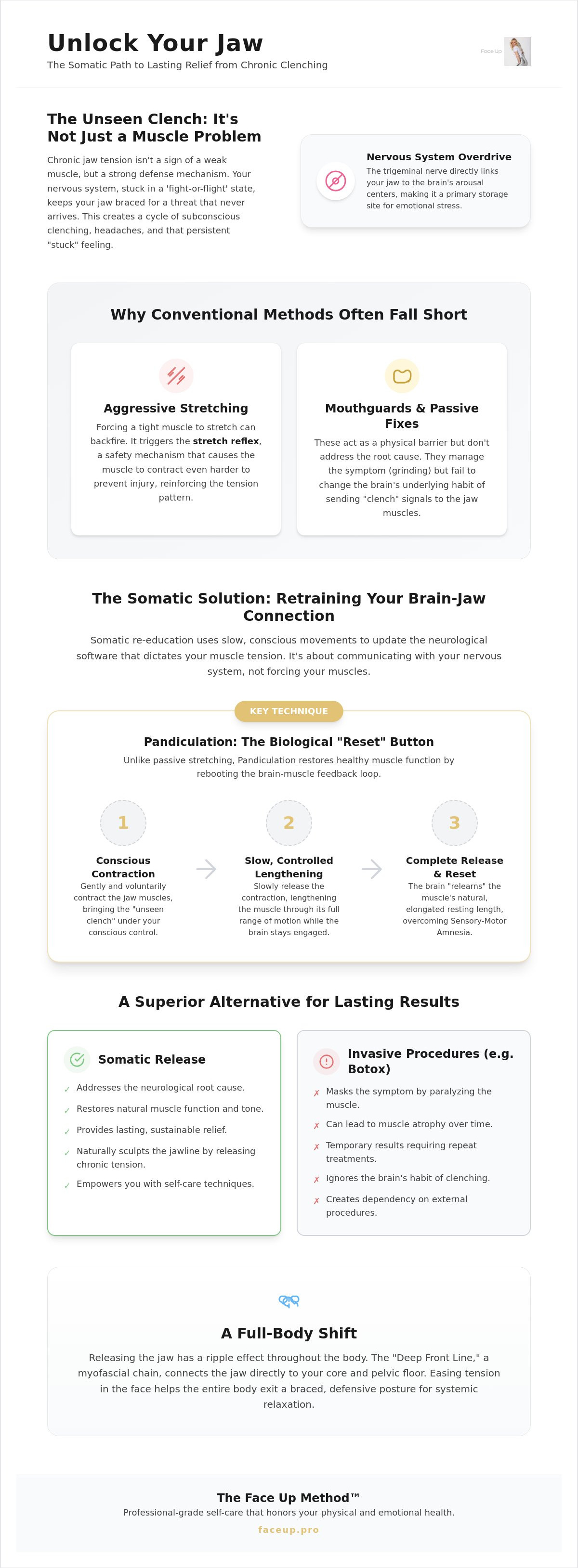
Most people respond to this tightness by pulling or aggressively stretching the jaw. This often backfires. When you pull a muscle that the brain is trying to protect, you trigger the stretch reflex. This biological safety mechanism causes the muscle to contract even harder to prevent injury. The Face Up Method™ views the jaw as a primary gateway to your entire nervous system. We don't just see a tight muscle; we see a system that needs permission to let go. By using somatic exercises for jaw tension, we communicate directly with the nervous system to stop the cycle of chronic bracing.
The Nervous System Connection
The jaw is uniquely wired into your survival architecture. The trigeminal nerve, which controls the muscles of mastication, has a direct line to the brain's arousal centers. When you're in a "fight or flight" state, your jaw naturally tightens to protect your airway and stabilize your skull. This physical response is often linked to the vagus nerve, the powerhouse of your parasympathetic system. Because of this deep connection, your jaw becomes the primary storage site for suppressed emotional stress. It's where the words you didn't say and the frustration you didn't express live.
Somatic vs. Traditional TMJ Exercises
Traditional TMJ relief often focuses on passive stretching or external devices like mouthguards. While these can offer temporary comfort, they don't change the brain's habit of clenching. Somatic work is about active brain-to-muscle re-education. You aren't "pushing through the pain" here; that only reinforces the threat response. Instead, we use interoception, the ability to sense your body from the inside out. Through the Face Up Method, you learn to feel the subtle shift from contraction to release, teaching your nervous system that it's finally safe to relax.
The Science of Somatic Re-education: How to Reprogram Your Jaw
Why does your jaw refuse to relax even when you're ostensibly resting? The answer often lies in Sensory-Motor Amnesia (SMA). This is a neurological state where the brain has effectively "forgotten" how to inhibit a muscle, keeping it in a state of chronic, partial contraction. The Science of Somatic Re-education suggests that chronic tension isn't a muscle failure, but a communication error between the motor cortex and the masseter. When you perform somatic exercises for jaw tension, you aren't just moving bone; you're updating the neurological software that dictates your resting muscle tone.
Within the Face Up Method™, we also look at the "Deep Front Line," a myofascial chain that connects the jaw directly to the pelvic floor. It's common to find that jaw clenching is a mirror image of pelvic tension. By utilizing slow-motion release techniques to lengthen the masseter, we don't just address the face; we help the entire body exit a braced, defensive posture. This holistic approach ensures that the relief you feel isn't just a fleeting sensation, but a fundamental shift in how your body carries itself.
The Role of Pandiculation
Pandiculation is a voluntary muscle contraction followed by a slow, controlled lengthening. It is the biological "reset" button used by all mammals to restore muscle function after a period of stillness or stress. Unlike passive stretching, which can trigger a protective contraction, pandiculation brings the muscle under conscious control before slowly releasing it. This slow "release" phase is where the real healing happens. It forces the brain to stay engaged through the entire range of motion, effectively "teaching" the muscle its new, elongated resting length. If you're looking for a structured way to master this, the Face Up Method™ ecosystem offers guided protocols for this exact purpose.
Emotional Release through Somatic Bodywork
Many individuals carry "armouring" in the face and neck, a physical shield built from years of suppressed stress or unexpressed emotions. Because the jaw is so closely linked to our survival instincts, releasing this physical tension often triggers a significant parasympathetic shift. You move out of "fight or flight" and into a state of "rest and digest." Learn more about the connection between facial tension and emotions to see how your subconscious bracing might be affecting your overall well-being and facial aesthetics.
5 Essential Somatic Exercises for Immediate Jaw Relief
Before you begin these somatic exercises for jaw tension, it's vital to create a "Face Up" environment. This is a space where your internal sensing takes precedence over external performance. Find a quiet corner, dim the lights if possible, and sit or lie down in a position that requires zero effort to maintain. The goal here isn't to complete a set of repetitions; it's to inhabit the movement. Unlike generic 10-minute follow-along routines that prioritize speed, the Face Up Method™ focuses on the quality of your awareness throughout each micro-movement.
- Exercise 1: The Conscious Hinge. Allow your jaw to hang slightly open. Very slowly, begin to open your mouth even further, moving at a pace that feels almost imperceptible. As you do this, notice if the movement is smooth or "jumpy." If you feel a skip, stop, and slowly return to the start. This slow-motion release retrains the brain to control the muscles through their entire range.
- Exercise 2: The Soft Palette Lift. Imagine there's a balloon gently inflating at the back of your throat. Feel the soft palette at the roof of your mouth lift while your jaw remains heavy. This subtle action stimulates the vagus nerve, signaling your nervous system to exit a high-alert state.
- Exercise 3: Masseter Melt. Place your fingertips lightly on your masseter muscles. Instead of rubbing or kneading, simply let the warmth of your hands sink in. Visualize the muscle tissue melting like butter. This gentle somatic pressure encourages the muscle to release from the inside out.
- Exercise 4: The Vagus Nerve Ear Pull. Gently grasp your earlobes and pull them slightly down and away from your skull. This aural-somatic release targets the nerves surrounding the jaw, often providing an immediate sense of spaciousness in the temporomandibular joint.
- Exercise 5: Tongue Posture Reset. While many know this as "mewing," the somatic connection is what matters. Gently rest the entire surface of your tongue against the roof of your mouth, keeping the tip just behind the front teeth. This provides internal structural support for the jaw, preventing the collapse that leads to chronic clenching.
The "Softening the Grip" Ritual
This practice is designed to target the deep masseter. Close your eyes and focus entirely on the space between your back molars. Imagine that space widening with every exhale. Even if your teeth aren't touching, your brain may still be "gripping." By consciously softening this specific area, you break the cycle of the Unseen Clench. Remember that consistency is your greatest ally. Five minutes of daily mindful practice is significantly more effective than a 60-minute session once a week, as it provides the frequent "neurological updates" your brain needs to stay relaxed.
Using the Right Support
While your hands are your primary tools, there are times when you might incorporate a tmj massage tool to deepen the release. The key is to choose an instrument that supports somatic sensing rather than one that "attacks" the muscle with aggressive vibration or pressure. Integrating these exercises into your morning or evening skincare routine transforms a mundane task into a sophisticated ritual of self-care. This approach doesn't just relieve pain; it naturally sculpts the face by reducing the bulk of overactive muscles.
Somatic Release vs. Cosmetic Procedures: Why Your Jawline Needs Movement, Not Botox
Many individuals seek out masseter Botox as a rapid solution for TMJ discomfort and a square, tension-heavy jawline. While paralyzing the muscle provides temporary relief, it often ignores the underlying neurological habit. This "quick fix" carries hidden costs that are rarely discussed in aesthetic consultations. Over time, repeated injections can lead to significant muscle atrophy and even concerns regarding bone density in the jaw. By contrast, somatic exercises for jaw tension address the root cause by retraining the nervous system. Instead of silencing the muscle, we teach it how to function without the "stress-induced" bulk of chronic clenching.
A common question we encounter is whether these somatic changes are permanent. The answer is a definitive yes, provided the brain successfully adopts the new habit. Unlike a drug that wears off, somatic re-education updates your "body map." When your motor cortex learns that it no longer needs to brace for impact, the resting length of the muscle remains elongated. This transition from a state of constant contraction to one of fluid movement is the hallmark of the Face Up Method. To begin your journey toward a naturally relaxed and functional jaw, explore the Face Up Method™ ecosystem for guided support.
The Aesthetic Benefits of Somatic Release
True facial beauty is often a byproduct of a regulated nervous system. When you release chronic jaw tension, you notice an immediate reduction in facial puffiness. This happens because relaxed muscles allow for better lymphatic drainage, clearing the "sludge" that often accumulates around a tight jawline. Additionally, somatic exercises for jaw tension help restore symmetry to the face. Most people clench more on one side, leading to an uneven appearance. By balancing bilateral tension, you create a more harmonious, "lifted" look in the mid-face that no filler can truly replicate.
Buccal Massage and the Face Up Method
For those with deep-seated tension, intraoral work is the ultimate "secret weapon." Buccal massage allows us to access the masseter and lateral pterygoid muscles from inside the mouth, reaching layers of tissue that external massage simply cannot touch. The Face Up Method™ combines internal sculpting with external somatic release. This dual-access approach ensures that every fiber of the jaw musculature receives the signal to let go. If you are a professional looking to integrate these advanced techniques into your practice, you can Explore our professional buccal massage training online to elevate your service offerings.
Taking the Next Step: Professional Mastery and Daily Rituals
Achieving a tension-free face is not a destination but a continuous practice of nervous system regulation. While individual somatic exercises for jaw tension provide immediate comfort, moving toward mastery requires a structured environment. This is where the Face Up ecosystem becomes an essential partner in your wellness journey. We've designed a clear path forward, whether you're seeking personal relief or looking to lead others through this transformative process. By shifting from reactive stretching to proactive somatic re-education, you ensure that your jaw remains a source of ease rather than a site of stored stress.
The Jaw Release Digital Course serves as a comprehensive entry point for home users, offering a 5-step journey that moves you from acute discomfort to a state of sustained relaxation. To maintain these gains, the Face Up App provides daily guided somatic rituals tailored for the busy professional. These bite-sized sessions ensure that your brain continues to receive the "safety signals" it needs to prevent the return of the Unseen Clench. It's about creating a lifestyle where your facial health is managed with the same calm efficiency you apply to your professional obligations.
For movement and wellness instructors who use ReformerFlow by Ginty to manage their professional obligations, you can find out more about Monthly or Annual SaaS Subscription Fees to understand how it fits into your business budget.
The Face Up Method™ Certification
As the wellness industry shifts toward non-invasive, holistic therapies, many beauty and health professionals are seeking to bridge the gap between aesthetics and somatic healing. Our facial sculpting certification offers a unique opportunity to master the Face Up Method™ and join a global community of high-standard practitioners. Unlike traditional, clinical somatic trainings that can be overly dry, our program is specifically designed for the modern aesthetic landscape. We focus on the intricate relationship between facial structure, emotional release, and nervous system health. By becoming a certified practitioner, you add a proprietary modality to your business that addresses the root cause of client tension while delivering visible, sculpted results.
Your Daily Ritual for a Relaxed Face
Consistency is the cornerstone of somatic re-education. Your brain requires frequent, gentle reminders to stay out of a defensive posture. By using the Face Up app, you can build a robust somatic habit in less than 10 minutes a day. These rituals are designed to fit seamlessly into your existing morning or evening schedule, ensuring that your face remains as relaxed as it is radiant. If you're ready to deprogram years of clenching and reclaim your facial well-being, Join the Jaw Release Course and start your journey today. Your path to lasting relief and a naturally sculpted appearance begins with a single, conscious movement and a commitment to your body's internal wisdom.
Reclaim Your Facial Freedom and Vitality
True relief from chronic clenching requires a fundamental shift in how your brain communicates with your body. By prioritizing somatic exercises for jaw tension, you move beyond the limitations of temporary fixes and address the neurological root of your discomfort. You now understand that the Face Up Method™ is more than a beauty ritual; it's a sophisticated gateway to regulating your nervous system and unlocking a naturally relaxed, sculpted appearance.
Founded by world-renowned expert Olga Newman, this proprietary approach is utilized by a global community of certified practitioners for non-invasive facial rejuvenation. We've established an ecosystem where professional authority meets welcoming accessibility, providing you with a clear path toward lasting ease. It's time to stop bracing for the day and start inhabiting your body with confidence and calm efficiency.
Experience the Face Up Method™: Join the Jaw Release Course
Your journey toward a tension-free life is a courageous step toward overall well-being. We're here to support you as you rediscover the freedom of a truly relaxed face.
Frequently Asked Questions
How long does it take for somatic exercises to work on jaw tension?
Most individuals experience an immediate sensory shift and a reduction in perceived tightness during their very first session. However, achieving permanent neurological changes typically requires three to six weeks of consistent daily practice. This timeframe allows the brain's motor cortex to establish new neural pathways, moving beyond temporary relief to a fundamental reset of your resting muscle tone.
Can somatic exercises help with clicking or popping in the jaw?
Yes, somatic exercises for jaw tension are highly effective at reducing joint sounds by balancing the muscular pull on the temporomandibular joint. Clicking often occurs when overactive muscles, such as the lateral pterygoid, pull the joint's disc out of alignment. By retraining these muscles to release their chronic grip, the disc can glide more smoothly, which often resolves mechanical popping over time.
Are these exercises safe if I have had dental implants or Botox?
These techniques are non-invasive and generally safe, though it's best to wait at least two weeks after receiving Botox to allow the treatment to settle. Somatic work actually serves as an excellent companion to dental implants. By reducing the habit of clenching, you decrease the mechanical stress placed on your dental work, potentially extending the longevity of your implants and improving overall comfort.
What is the difference between somatic jaw exercises and face yoga?
While face yoga often focuses on repetitive muscle strengthening and active posing to "work out" the face, somatic exercises prioritize the release of chronic contraction through sensory-motor re-education. Face yoga typically targets superficial aesthetics. In contrast, the Face Up Method™ works directly with the nervous system to deprogram the "stress-induced" bulk and tension that originate deep within the facial architecture.
How often should I do these exercises for permanent results?
Practicing for five to ten minutes every day is the most effective way to secure lasting results. Because we're updating the brain's "body map," the frequency of the stimulus is more important than the duration of the session. Short, daily rituals provide the consistent neurological updates your brain needs to stay out of a fight-or-flight state and maintain a relaxed jawline.
Can I do somatic jaw release while I am at work?
You can easily integrate several somatic techniques into your professional day without anyone noticing. Movements like the Tongue Posture Reset or the Soft Palette Lift are internal and subtle, making them perfect for use during meetings or while responding to emails. These micro-rituals are essential for modern professionals who need to manage stress-induced tension in real time before it accumulates.
Why does my jaw feel tighter after I try to stretch it?
Your jaw feels tighter because traditional, aggressive stretching often triggers the "stretch reflex," a biological safety mechanism that causes muscles to contract harder to prevent tearing. Somatic exercises for jaw tension avoid this pitfall by using slow, conscious movements. This approach communicates safety to the nervous system, allowing the muscle to lengthen voluntarily rather than forcing it against its own protective instincts.
Do I need any special tools for the Face Up somatic rituals?
No specialized equipment is required to begin your journey, as your own awareness and hands are your most powerful tools. While we do offer guidance on incorporating specific instruments that support deeper sensing, the core of the Face Up Method™ relies on your internal ability to feel and release. We prioritize the development of your interoceptive skills over the use of external gadgets.


