

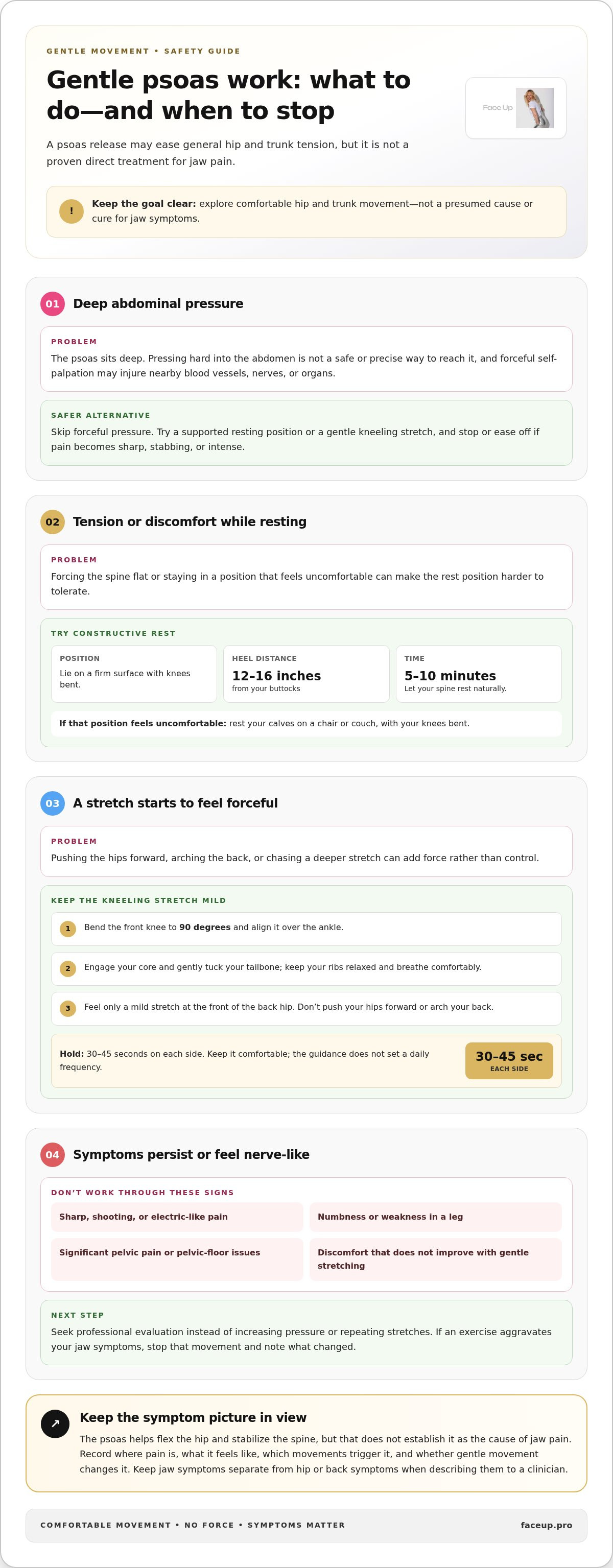
Releasing the psoas may ease general hip and trunk tension, but it isn’t a proven direct treatment for jaw pain. If you’re wondering how to release the psoas muscle for jaw pain, try gentle constructive rest: lie on a firm surface with your knees bent and heels about 12-16 inches from your buttocks, and let your spine rest naturally for 5-10 minutes.
It’s understandable to look beyond the jaw when discomfort keeps returning. The psoas helps move the hip and stabilize the spine, so tension elsewhere in the body may be worth noticing. But that does not establish the psoas as the cause of jaw symptoms. This guide explains the possible connection, how to explore gentle movement without force, what weakness or irritation may affect, and when professional evaluation is appropriate.
Key Takeaways
- The psoas helps flex the hip and stabilize the spine, but its role doesn’t prove it is the cause of jaw pain.
- Try constructive rest on a firm surface for 5-10 minutes, letting your spine rest naturally instead of forcing it flat.
- Avoid forceful pressure when releasing the psoas; stop or ease off if you feel sharp, stabbing, or intense pain.
- Notice the wider pattern of tension and movement rather than treating one tight muscle as the sole explanation for discomfort.
- Seek professional evaluation for shooting or electric-like pain, leg numbness or weakness, significant pelvic symptoms, or pain that doesn’t improve with gentle stretching.
Psoas anatomy and function
- Begin by locating the psoas in relation to familiar landmarks. You have two psoas muscles, one on each side of your lower spine. Each runs from the lumbar vertebrae through the pelvis toward the upper thigh. The psoas major joins the iliacus in the pelvis, forming the iliopsoas before attaching to the femur. This deep position matters: pressing hard into the abdomen does not give you a safe or precise way to reach it.
Notice how sitting changes your hip position. With the hip bent, your thigh moves closer to your trunk; standing and walking take the hip through a broader range of movement. Sitting alone does not prove the psoas is shortened or causing pain. Instead, observe whether changing position affects your comfort or movement, and use that information to guide gentle activity.
- Think of the psoas as a hip mover and trunk stabilizer. Its primary actions include hip flexion, which brings your knee toward your stomach, and helping stabilize the spine. It also contributes to hip adduction and lateral rotation. When one side acts, it can side-bend the trunk toward that side at the hip. These functions connect the lumbar spine, pelvis, and legs, but they do not establish a direct cause of jaw pain.
Lifting a knee to step onto a low stair is an everyday example of hip flexion. The psoas works with other muscles, including the iliacus, so no single movement isolates it completely. Consider the whole movement pattern rather than assuming tightness in one muscle explains chronic discomfort or restricted function.
- Choose gentle alternatives to deep pressure or massage. Lie on your back on a firm surface, with your heels about 12-16 inches from your buttocks, and let your spine rest naturally for 5-10 minutes. If that position feels uncomfortable, rest your calves on a chair or couch with your knees bent. Avoid forceful psoas self-palpation; nearby blood vessels, nerves, and organs may be injured.
For a home stretch, try a gentle kneeling position. Bend the front knee to 90 degrees, align it over the ankle, engage your core, and gently tuck your tailbone. Keep the stretch mild at the front of the back hip; don’t push your hips forward or arch your back. Stop or ease off if pain becomes sharp, stabbing, or intense.
- Combine a gentle kneeling stretch with breathing and pelvic positioning by keeping the ribs relaxed, breathing comfortably, and maintaining the small tailbone tuck. Hold for 30-45 seconds on each side, without forcing a deeper stretch. This pairs controlled breathing with a stable pelvis instead of adding pressure to the abdomen.
For pain relief, the research guidance gives a 30-45-second hold on each side for this stretch, but doesn’t set a daily frequency. Keep each repetition comfortable and pay attention to how your body responds rather than increasing duration or intensity automatically.
- For jaw pain or TMJ disorders, a psoas stretch should not be treated as a proven jaw treatment. Focus evaluation on the jaw symptoms themselves; a psoas release cannot identify or diagnose their cause. If pain is sharp, shooting, electric-like, or persists despite gentle stretching, seek professional evaluation. Leg numbness or weakness and significant pelvic symptoms also warrant assessment.
Understanding how to release the psoas muscle for jaw pain starts with separating gentle movement from claims about cause or cure. Use psoas exercises to explore hip and trunk comfort, not as a substitute for evaluating persistent jaw pain.
When to seek professional evaluation
Yes. Forceful self-palpation of the psoas can injure nearby blood vessels, nerves, and organs. Pain during a release is a reason to stop or ease off. If an exercise aggravates your jaw symptoms, stop that movement and note what changed.
- Arrange an assessment for persistent or worsening symptoms. If gentle stretching does not improve the discomfort, seek evaluation rather than increasing pressure or adding more exercises. A medical professional, such as a GP, physiotherapist, or osteopath, can assess suspected psoas issues alongside your symptoms, movement, and health history. Describe whether the pain is in your jaw, hip, back, or several areas, and which activities affect it.
- Seek prompt evaluation for nerve-like symptoms. Sharp, shooting, or electric-like pain deserves professional attention, as do numbness or weakness in a leg. Record where the sensation starts, where it travels, and which movement changes it. For example, note whether walking, sitting, or a hip-flexor stretch brings it on. Do not try to work through these symptoms with deeper pressure or repeated stretching.
- Get support for pelvic symptoms or postpartum recovery. Significant pelvic pain and pelvic-floor issues are reasons to seek professional evaluation. During postpartum recovery, get guidance before treating discomfort as a tight psoas or starting a new exercise routine. Explain when symptoms began and how they affect daily movement. This helps a clinician assess the whole pattern rather than focusing on one muscle.
- Use a clear symptom record at your appointment. Before seeing a GP, physical therapist, or osteopath, write down where the pain is, what it feels like, which movements trigger it, and whether gentle exercises change it. Record jaw symptoms separately from hip or back symptoms. Clear notes help distinguish a sore hip flexor from symptoms that need broader assessment, keeping care focused on what you actually experience.
- Keep jaw care focused on the jaw. Psoas release is not a diagnosis or a substitute for evaluating persistent jaw pain. If you want guided facial self-practice alongside appropriate assessment, the Jaw Release Course offers a learning option focused on jaw release, not psoas treatment. Stop any practice that provokes sharp or intense pain, and share that response with your healthcare professional.
The psoas flexes the hip, bringing your knee toward your stomach when it contracts. Describe whether symptoms change during this motion to support an evaluation.
Psoas anatomy and location
- Use your hip crease as a surface landmark, not a pressure target. The psoas is deep, so pressing into your abdomen cannot reliably assess it. Its location is easier to understand through movement: lifting your thigh toward your trunk uses hip flexion, an action the psoas helps perform. For example, notice the front of your hip working as you raise one knee while standing.
There are two psoas muscles, one on each side of the lower spine. Compare a gentle knee lift on each side, but do not assume different sensations prove a tight psoas or identify the source of pain.
- Trace the psoas major’s route on a simple body map. It runs from the lumbar vertebrae through the pelvis and joins the iliacus. Together, these muscles form the iliopsoas, which attaches to the lesser trochanter near the head of the femur. This path explains why the psoas connects the lower back and pelvis with the upper thigh.
Use a drawing or anatomical model to follow the psoas from the spine to the femur. Do not push deeply into your abdomen to trace it by touch. Blood vessels, nerves, and organs lie nearby, so forceful self-palpation can cause injury.
- Observe how your hip and trunk move together. The psoas helps stabilize the spine while flexing the hip. It also contributes to hip adduction and lateral rotation. When it acts at the hip, it can side-bend the trunk toward the same side. These functions involve more than one body region, but they do not show that psoas tension causes jaw pain.
Try a controlled comparison: stand tall, lift one knee, then lower it and repeat on the other side. Notice whether your trunk leans or rotates forward. Keep the movement comfortable. This observation helps you describe function, not diagnose a muscle problem.
- Choose movement over attempts to force a release. If you sit with your hips bent for long periods, take a brief standing or walking break and notice how your hip movement feels afterward. Sitting alone does not establish that the psoas is shortened, and stretching it cannot be assumed to relieve jaw symptoms.
For a gentle option, try a supported hip-flexor stretch without pushing your pelvis forward or arching your back. A mild sensation at the front of the back hip is enough. Stop if the pain becomes sharp, stabbing, or intense. This approach respects the muscle’s deep location and avoids treating one area as the explanation for every symptom.
Stress and muscle contraction
- Notice when tension appears instead of assuming stress has tightened one specific muscle. Stress can coincide with bracing, shallow breathing, or a guarded position, but those signs do not identify the psoas as their cause. For example, notice whether your jaw clenches during a demanding task, then observe whether your shoulders, abdomen, or hips also feel tense. Tracking several areas gives a more useful picture than focusing only on the psoas.
Write down the situation, the body areas involved, and what changes when you move. A simple record can help you describe the pattern to a therapist without treating an observation as a diagnosis.
- Use a comfortable position to reduce effort before stretching. Lie on your back with your knees bent and feet supported, then let your lumbar spine rest naturally. Do not force it flat or press your lower back into the floor. Notice whether your abdomen softens as you breathe comfortably. If lying down feels uncomfortable, place your calves on a chair or couch, keeping your knees bent.
This supported position lets you pause and notice tension; it is not a test of psoas length. If holding it increases pain, change position or stop. The useful signal is whether you can rest without forcing your body into a deeper stretch.
- Try pandiculation instead of forcing a muscle to lengthen. Pandiculation means gently contracting and then releasing muscles, giving the nervous system feedback about muscle tension. For example, gently press your feet into the floor while lying down, then release the effort and notice the change. Keep the contraction light; do not strain or hold your breath. This explores control and release rather than using deep pressure on the psoas.
Pair the movement with easy breathing and a relaxed jaw. If your jaw tightens as you press, reduce the effort. Stop if the movement causes sharp, stabbing, or intense pain, and avoid forceful self-palpation near the abdomen.
- Break up prolonged sitting with brief movement. If desk work keeps you in one position, stand and walk around about every hour. A short walk changes your hip position and gives you a chance to notice how your back and pelvis feel. Do not interpret stiffness after sitting as proof of a tight psoas; movement involves several muscles and joints.
Stretching alone may not maintain a change: muscles can start tightening again within a few hours after stretching. Include comfortable movement and hip-flexor-strengthening activities over time. Address the full pattern of tension rather than treating one muscle as the sole cause of pain or limited movement.
What is the evidence linking psoas tension, posture, and jaw pain?
- Separate anatomical connection from proof of cause. The psoas connects the lumbar spine, pelvis, and thigh through its role in hip movement and spinal stability. That connection explains why people may consider it when exploring whole-body tension. It does not show that psoas tightness causes jaw pain. Jaw clenching and hip stiffness during a stressful workday, for example, are observations, not proof that one symptom causes the other.
Write down what you notice in each area, such as jaw soreness after chewing and hip discomfort after sitting. Keeping those observations separate helps you avoid treating a possible relationship as an established diagnosis.
- Observe posture without treating it as a diagnosis. Posture describes how you hold your body during an activity, such as sitting at a desk or standing in line. A forward-leaning position might coincide with discomfort, but posture alone cannot identify the psoas as the source. Compare how you feel after changing position, walking, or resting. Record the activity and symptom rather than labelling your posture “bad.”
The psoas contributes to hip movement and spinal stability, but those functions do not establish a direct pathway to the jaw. Feeling more comfortable in your hips after standing is useful information about movement, not evidence that it will relieve jaw pain.
- Use a simple, low-force observation plan. Choose one comfortable activity, such as a short walk, and notice how your jaw, hips, and back feel before and afterward. Repeat the observation on another occasion without adding deep pressure or forceful stretching. If a movement provokes sharp, stabbing, or intense pain, stop or ease off. This approach helps you identify patterns without assuming one response confirms the cause.
Track what you did, where you felt discomfort, and whether the symptom changed. For example, distinguish jaw pain while chewing from hip tightness after prolonged sitting. A clear description is more useful to a healthcare professional than claiming one muscle explains both.
- Keep jaw symptoms central in your next step. Persistent jaw pain deserves attention as a jaw concern, even if you also notice hip or back tension. A psoas exercise is not a substitute for assessing the jaw, and an apparent posture pattern doesn’t diagnose a temporomandibular disorder. If you want structured facial self-practice, explore the Jaw Release Course as an educational option focused on jaw release, not proof of a psoas-jaw connection.
Bring your symptom notes to a healthcare professional if pain persists or affects activities such as eating. Describing jaw symptoms and hip symptoms separately supports a clearer assessment of what needs attention.
Face Up: Face Up Method Certification
Face Up Method Certification is a professional learning pathway for practitioners interested in facial sculpting and somatic bodywork. It is distinct from psoas treatment, so consider it when your goal is to develop skills in Face Up’s method, rather than diagnose hip or jaw symptoms.
For guided jaw-focused self-practice, Jaw Release by Face Up™ offers a direct next step. Face Up Club supports daily self-practice, while Bodywork sessions offer a practitioner-led option. These offerings focus on facial tension and practice, not on proving that psoas tension causes jaw pain.
Choose the option that matches your goal, and keep professional evaluation central for persistent or concerning symptoms. Visit Face Up’s website to explore the learning and practice options.
Choose a Next Step That Fits Your Goal
If you’re still exploring how to release the psoas muscle for jaw pain, focus your next step on what you want to address. Track jaw symptoms and hip tension separately so you can make informed choices without assuming one explains the other. The right route depends on whether you need symptom assessment, guided self-practice, or professional training.
For guided jaw-focused practice, consider Jaw Release by Face Up™ or Face Up Club. Practitioners interested in learning Face Up’s approach can explore Face Up™ Training. These options support facial practice and learning; they do not establish the cause of jaw pain or replace evaluation when symptoms warrant it.
Choose the path that aligns with your goals, and keep your observations about symptoms and movement close at hand. For support exploring Face Up’s offerings, contact Face Up. A thoughtful next step can begin with simple, attentive practice.
Frequently Asked Questions
Why does it help?
Gentle psoas-related movement can help you explore hip comfort and body tension, but it is not established as a direct way to relieve jaw pain. For example, a supported resting position may help you notice whether your hips feel more comfortable after sitting. Treat that response as information about your movement, not proof that the psoas caused jaw symptoms or that releasing it treats a TMJ disorder.
Can tight psoas muscles cause jaw pain or TMJ symptoms?
A tight psoas has not been established here as a cause of jaw pain or TMJ symptoms. You might notice jaw clenching and hip tightness during the same activity, such as a stressful work session, but that timing alone does not show that one causes the other. Track each symptom separately, including what you were doing when it began. Persistent jaw pain needs attention as a jaw concern, not just a psoas issue.
When should you stop psoas exercises and see a doctor or physical therapist?
Stop or ease an exercise if it causes sharp, stabbing, or intense pain, and seek evaluation if pain does not improve with gentle stretching. Arrange professional assessment for shooting or electric-like pain, leg numbness or weakness, significant pelvic pain, or pelvic-floor issues. Postpartum recovery is also a reason to seek guidance before continuing a new routine. Note which movement triggered symptoms and where you felt them.


