

The most stubborn wrinkles aren't caused by time; they're the physical architecture of stored stress. You likely recognize the moment a client looks in the mirror and sees only a cosmetic flaw, while you can feel the years of jaw tension and emotional weight held within their fascia. It can be challenging when you're capable of providing deep, transformative healing, but find yourself stuck explaining somatic therapy benefits to clients who initially seek only a traditional aesthetic fix. You understand that true beauty isn't just skin deep, it's a reflection of a regulated nervous system.
Bridging the gap between emotional release and visible results requires a sophisticated, science-backed vocabulary that builds immediate professional trust. This guide provides the framework to justify your premium sessions and maintain clear boundaries while delivering profound change. We'll explore how the Face Up Method™ connects facial sculpting with somatic bodywork to create a proprietary ecosystem of care. By the end of this article, you'll have the confidence to position yourself as an advanced practitioner, ensuring higher client retention through results that transcend the surface.
Key Takeaways
- Explore the biological connection between the vagus nerve and facial aesthetics to provide clients with science-backed reasons for their skin concerns.
- Master the art of explaining somatic therapy benefits to clients by shifting the consultation focus from surface-level flaws to stored emotional architecture.
- Distinguish your professional practice from traditional massage by understanding the difference between passive relaxation and active fascial release.
- Learn how the Face Up Method™ Certification establishes a global standard for practitioners seeking to bridge the gap between clinical somatic work and premium beauty.
- Gain specific communication scripts to reframe nervous system fatigue and stored tension into professional language that builds immediate client trust.
What is Somatic Therapy in a Wellness Context?
The term "Soma" originates from the Greek word for the living body. It refers to the body as perceived from within, rather than an object viewed from the outside. In a professional wellness setting, somatic therapy is the practice of listening to the body’s internal signals to release physical and emotional blockages. While many associate Somatic psychology purely with clinical trauma recovery, its application in the beauty industry represents a sophisticated shift in how we approach rejuvenation and self-care.
The face is arguably the most somatic part of the human body. It's the primary interface where our internal world meets our external reality. Every day, we balance the need for expression with the necessity of suppression. We might smile when we're exhausted or clench our teeth when we're frustrated. Over time, these micro-expressions become habitual physical patterns. When explaining somatic therapy benefits to clients, it's helpful to describe the session as a transition from "doing" to "being." Instead of "doing" a treatment to the skin, we're allowing the client to "be" in a state where the body can finally let go of these habitual contractions.
The 'Body Keeps the Score' Phenomenon
Modern clients are increasingly aware of how stored stress impacts their physical health. They've likely encountered the idea that the body holds onto what the mind tries to forget. This cultural shift makes it much easier to transition a client's mindset from simply fixing a wrinkle to releasing a deep-seated pattern. In the context of modern beauty standards, the nervous system is the ultimate influencer. A regulated nervous system creates a natural radiance that no topical cream can replicate. This holistic perspective is mirrored in the work of the Quantum Resonant Healing Center, where proprietary resonant therapy is used to address the body's internal state. By focusing on the Face Up Method™, practitioners help clients address the biological root cause of their aesthetic concerns rather than just the surface symptoms.
Emotional Architecture: How Stress Sculptures the Face
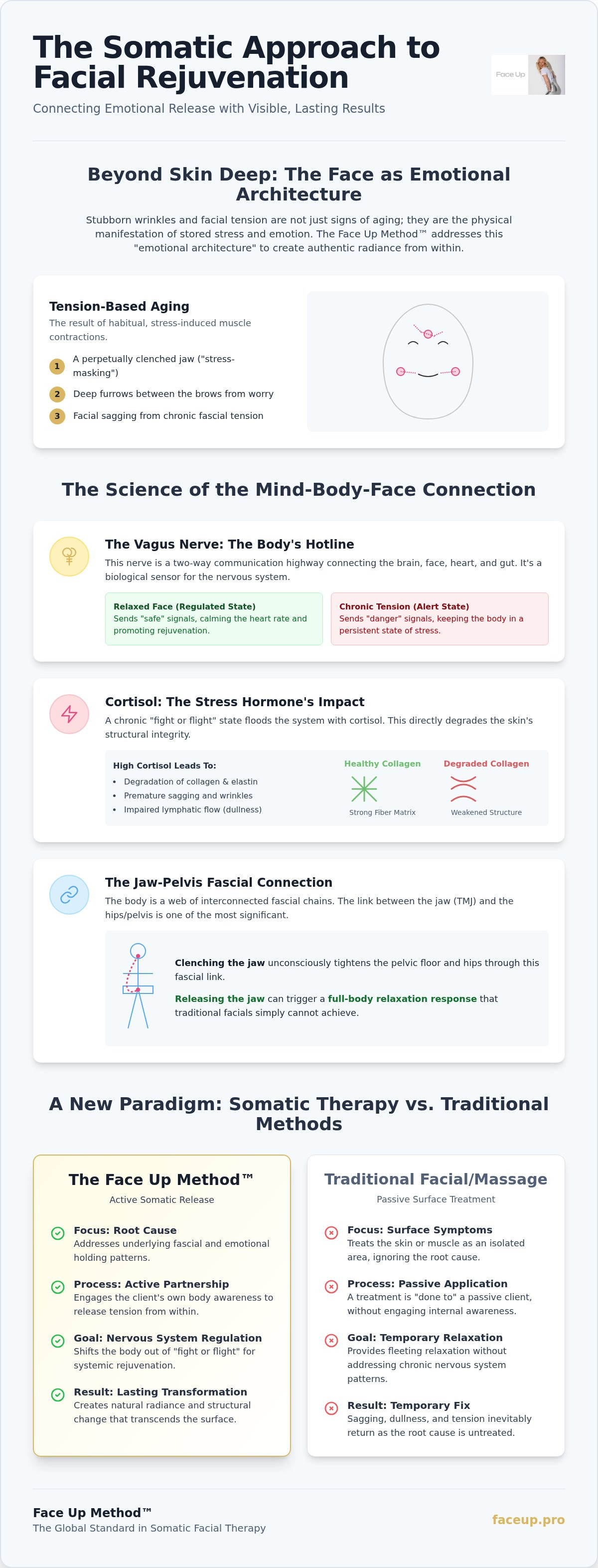
Stress leaves a physical footprint. We call this "emotional architecture." You can see it in the "stress-masking" of a perpetually clenched jaw or the deep furrows between the brows. These aren't just signs of chronological aging; they are somatic evidence of tension-based aging. Traditional facials often fail to provide lasting results because they treat the skin as an isolated surface. Without addressing the underlying fascial and emotional holding, facial sagging and dullness will inevitably return. Explaining somatic therapy benefits to clients involves showing them how their face has been "sculpted" by their life experiences. We then work to gently reshape that narrative through specialized, science-backed bodywork.
The Science of the Mind-Body-Face Connection
The science of rejuvenation begins with the Vagus nerve. Often called the "hotline" of the body, this nerve acts as a bidirectional communication highway between the face, heart, and gut. When explaining somatic therapy benefits to clients, you can describe the Vagus nerve as a biological sensor. It connects the muscles of facial expression directly to the autonomic nervous system. This connection is why a relaxed face often leads to a calmer heart rate, while chronic tension sends "danger" signals back to the brain, keeping the body in a state of persistent alert.
Chronic "fight or flight" states flood the system with cortisol. High levels of this hormone are known to degrade collagen and elastin fibers, which leads to premature sagging and a dull complexion. By facilitating deep muscular release, you aren't just relaxing a muscle; you're lowering the body's chemical stress load. This physiological shift improves lymphatic flow, as tension often acts like a physical dam against fluid movement. When the muscles soften, metabolic waste clears more efficiently, resulting in a clearer, more vibrant skin tone.
Teaching clients to develop proprioception, the sense of self-movement, and interoception, the sense of the internal state of the body, is a core part of the somatic process. Most people are unaware they're clenching their faces until a practitioner brings it to their attention. Once a client can "feel" their own tension, they gain the agency to release it. This awareness is the first step toward lasting aesthetic change.
The Jaw-Pelvis Connection
The body operates through interconnected fascial chains. One of the most significant is the link between the temporomandibular joint (TMJ) and the hips. When a client clenches their jaw, they often unconsciously tighten their pelvic floor and hips. Releasing the jaw can trigger a full-body relaxation response that traditional facials simply cannot reach. For practitioners looking to master these technical nuances, our tmj massage therapy guide offers deeper insights into restoring this physical balance.
Neuroplasticity and Muscle Memory
Habitual expressions eventually become "locked" in the fascia, creating what we see as permanent lines. Muscle memory isn't just for athletes; it's the reason why stress patterns persist long after the stressful event has passed. Through the specialized touch of the Face Up Method™, we can break these cycles of habitual tension. This process involves retraining the muscles and the nervous system for a naturally lifted appearance. Professionals who focus on explaining somatic therapy benefits to clients in this way often find it easier to transition them into a Face Up Method™ Certification pathway to achieve these high-level results.
Somatic Facial Therapy vs. Traditional Massage
Traditional massage often prioritizes the sensory experience of the skin's surface. While beneficial for circulation, it typically offers a passive form of relaxation where the client is a recipient of a standardized protocol. Somatic facial therapy represents a fundamental shift toward active participation. In this context, the client isn't just "getting a facial." They are engaging in a process of internal discovery. This modality focuses on bottom-up processing, where the physical release of the muscles informs the brain that it's safe to downregulate the nervous system.
When explaining somatic therapy benefits to clients, it's helpful to highlight that while a standard massage provides a temporary "glow," somatic work targets the long-term structural changes that dictate how the face ages. A technician follows a map; a facilitator interprets the body's unique language of tension. By moving beyond surface-level skin treatment, you address the deep fascial and emotional holding patterns that traditional methods often overlook. This results in a transformation that is visible in the mirror and felt in the client's overall state of being.
Why 'Pampering' Isn't Enough Anymore
The wellness industry is seeing a significant rise in the conscious consumer. These individuals aren't just looking for a "spa day" or an hour of escapism. They seek results that feel as good as they look. When explaining somatic therapy benefits to clients who are used to traditional pampering, emphasize that you are treating the root of the tension, not just the symptom of the wrinkle. Positioning somatic work as a functional service rather than a luxury indulgence creates a different kind of professional value. It moves the conversation from "wanting" a treat to "needing" a restoration of physical and emotional balance.
The Power of Intra-Oral (Buccal) Work
Intra-oral or buccal massage is perhaps the most profound tool in the somatic toolkit. By accessing the facial muscles from the inside out, you can reach layers of the masseter and pterygoids that are inaccessible through the skin's surface. This technique is often intense because it touches the very center of where we hold our "unspoken" stress. Reaching these muscles from both sides accelerates somatic release and provides immediate structural lifting. It's a high-level skill that requires precision and a deep understanding of anatomy. Obtaining a facial sculpting certification ensures you can deliver these results safely while maintaining the professional boundaries necessary for such intimate work.
How to Frame Somatic Benefits: Scripts for Practitioners
Success in the treatment room depends as much on your communication as your technical skill. When explaining somatic therapy benefits to clients, the intake process is your first opportunity to establish professional authority. Instead of starting with "What are your skin concerns?", try asking "Where do you hold your stress?". This simple shift immediately invites the client to scan their body and acknowledge the internal state that dictates their external appearance. It moves the conversation from a superficial fix to a functional restoration.
Language matters when navigating the delicate intersection of beauty and emotion. While somatic work often touches on past experiences, it's vital to stay within your professional scope. Reframe "trauma" as "stored tension" or "nervous system fatigue." These terms are science-backed and less intimidating for a client who may not be ready for a clinical psychological conversation. You are not "fixing" their past; you are helping their body release the physical "emotional holding" that currently restricts their facial movement and blood flow. For clients whose tension is deeply rooted in relational dynamics, attending a couples retreat Australia can be a valuable recommendation to help them address these patterns at the source.
Managing expectations is equally critical. Before beginning the Face Up Method™, explain that physical releases often manifest as sighs, tremors, or even tears. Tell them: "As the fascia softens, your body might complete a stress cycle it has been holding for years. If you feel a need to sigh or twitch, allow it. It's a sign your nervous system is shifting into a state of safety." This preparation creates a bridge of trust, ensuring the client feels supported rather than surprised by their body's response.
You may encounter clients who are skeptical of the "mind-body" aspect. If a client asks, "I just want a relaxing massage, why are we doing this breathing?", try this script: "Breathing is the remote control for your nervous system. By regulating your breath, we signal the deep muscles to soften, allowing me to reach the structural layers that cause sagging without using painful force." For those who claim they don't hold stress in their face, explain that tension often becomes a "silent baseline" we no longer notice. To support their journey between sessions, you can suggest the value of a tmj massage tool to maintain the fascial openness you've achieved together.
Creating a Somatic 'Safe Container'
A "safe container" is the professional environment where deep release becomes possible. This involves more than just scent and lighting; it requires "invitational touch." This means checking in with the client's physical boundaries and ensuring they feel in control of the session. By holding space with calm efficiency, you position yourself as a specialized mentor. Mastery of these communication nuances is a hallmark of the Face Up Method™ Certification, which prepares you to handle complex client needs with global standards of integrity.
Mastering the Face Up Method™ for Professional Success
The Face Up Method™ represents a unique synergy between Olga Newman’s precision facial sculpting and the scientific principles of somatic bodywork. This proprietary approach doesn't treat the face as an isolated surface. Instead, it acknowledges the face as a dynamic reflection of the body's internal state. By integrating these modalities, you provide a service that is both aesthetically transformative and neurologically grounding. When you're explaining somatic therapy benefits to clients, you can point to the immediate structural lift as evidence of the deeper fascial release occurring beneath the skin.
Achieving Face Up Method™ Certification elevates your professional status from a traditional facialist to a specialized practitioner. This distinction is vital. Modern clients are increasingly savvy about the mind-body connection and seek experts who understand it. As a certified specialist, you gain access to a global Practitioner Directory Listing. This positions you within a community of high-standard professionals. It makes it easier for clients seeking advanced somatic care to find your services in cities worldwide, from Sydney to London, where over 200 practitioners are already established.
To ensure lasting results, the Face Up ecosystem includes the Face Up App Subscription. This tool allows you to integrate specific rituals into your client's aftercare plan. By providing clients with guided somatic practices they can do at home, you extend the life of your in-office treatments. You empower them to maintain their own nervous system regulation between sessions. This holistic support cycle builds deep trust and significantly improves client retention because they see you as a partner in their long-term wellness journey.
Expanding Your Practice with Buccal and Somatic Training
There is a growing global demand for high-results, non-invasive therapies that respect the body's natural architecture. The Face Up Method™ is at the forefront of the 'Slow Beauty' movement, prioritizing long-term health over quick, invasive fixes. Professional accreditation in this method provides the tools to meet this demand with confidence. If you're ready to advance your career, the next steps involve joining a certification cohort. You'll master the technical and communicative skills necessary for this specialized field. It's a journey that transforms your practice and your results.
The Face Up Ecosystem: Supporting the Practitioner
The journey doesn't end with initial certification. Practitioners can further specialize by accessing the Jaw Release Course, a targeted protocol for addressing the chronic tension discussed earlier in this guide. Leveraging the brand’s global reputation for calm efficiency allows you to build a practice based on integrity and scientific foundation. Olga Newman’s background in somatic bodywork ensures every protocol is rooted in proven physiological principles. We invite you to join our community of professionals who choose to 'Face Up' to the body's truth, bridging the gap between clinical somatic work and premium aesthetic excellence.
Elevating the Standard of Holistic Rejuvenation
The journey from a traditional aesthetician to a somatic specialist is a significant professional evolution. You've discovered that true rejuvenation requires more than surface treatments; it demands an understanding of the nervous system and the stored tension within the fascia. By mastering the science of the mind-body-face connection, you provide results that are both visually stunning and deeply restorative. Success in this specialized field relies on your ability to build professional trust, and explaining somatic therapy benefits to clients with clarity is the foundation of that relationship.
You now possess the framework to reframe beauty as a direct reflection of internal regulation. This approach doesn't just address a cosmetic concern; it restores a client's physical and emotional architecture. If you're ready to join an elite community of global professionals, the next step is formal accreditation. You can Become a Certified Face Up Method™ Practitioner to gain specialized training in buccal and somatic techniques. This globally recognized certification grants you exclusive access to the Face Up Practitioner Directory, connecting you with clients who seek your advanced expertise. Embrace this opportunity to lead the future of holistic wellness.
Frequently Asked Questions
Is somatic therapy the same as psychotherapy?
No, somatic therapy in a wellness context is a body-based approach that focuses on physical tension and nervous system regulation. While somatic psychotherapy is a licensed mental health field, the Face Up Method™ focuses on facial sculpting and somatic bodywork. It's a non-invasive wellness practice rather than a clinical treatment for psychiatric disorders. Practitioners should always maintain these clear boundaries when explaining somatic therapy benefits to clients.
Can I perform somatic facial work if I'm not a licensed therapist?
You can perform somatic facial work as a wellness professional without a mental health license. However, you must stay within your professional scope of practice. The Face Up Method™ Certification provides the specific training needed to facilitate these specialized sessions safely. It's vital to position yourself as a somatic bodywork specialist rather than a clinical therapist to maintain professional integrity and legal standards.
What should I tell a client who starts crying during a session?
Validate their experience with a calm and reassuring tone. You might say: "It's completely normal for the body to release stored emotions as the muscles soften. You're in a safe space; allow your body to complete this cycle." Avoid trying to "fix" the emotion or overstepping into counseling. Simply hold space and allow the physical release to happen naturally as part of the somatic process.
How many sessions does it take for a client to feel somatic benefits?
Most clients report a sense of profound relaxation and physical "lightness" after their very first session. For lasting structural changes and nervous system regulation, a series of five to ten sessions is typically recommended. This frequency allows the body to break habitual tension patterns and retrain the muscles. Consistency is key, and you can support this by recommending the Face Up App for daily home rituals.
Is somatic facial therapy safe for clients with Botox or fillers?
Somatic facial therapy is generally safe, but specific timing precautions are necessary. You should avoid deep pressure or intra-oral work directly on areas with recent injectables for at least two to four weeks. While the Face Up Method™ serves as a non-invasive alternative to these procedures, many clients use it to maintain facial health. Always consult with the client about their recent treatments during the intake.
How do I price somatic sessions compared to standard facials?
Somatic sessions should be priced at a premium compared to standard facials. You're providing a specialized, high-results service that requires advanced training and global certification. Explaining somatic therapy benefits to clients helps them understand they're paying for structural change and nervous system health rather than just a surface-level skin treatment. Many practitioners increase their rates significantly after completing their professional accreditation to reflect this specialized expertise.
What are the physical signs of a successful somatic release in the face?
Look for immediate changes in facial symmetry and muscle tone. A successful release often manifests as a softening of the jawline, a lift in the brow area, and a more vibrant complexion due to improved lymphatic flow. You may also observe the client taking deeper, spontaneous breaths or experiencing micro-tremors in the facial muscles. These signs indicate that the nervous system is successfully shifting out of a high-tension state.


