

What if the key to unlocking your mental exhaustion isn't found in your thoughts, but in the subtle architecture of your face? You've likely felt that persistent tightening in your jaw or the heavy weight of a long day reflected in the mirror. It's frustrating to feel stuck in a constant state of fight-or-flight, where traditional relaxation techniques barely scratch the surface of your fatigue. You aren't alone in seeking a more profound sense of ease that reaches the very core of your physical being.
This guide shows you how to move beyond surface-level fixes to truly recalibrate your nervous system and find lasting peace. You'll discover how somatic exercises for tension release can dissolve deep-seated stress through the proprietary techniques of the Face Up Method™. By addressing the emotional blueprint held within your muscles, you can achieve immediate physical relief and a more defined facial contour. We'll explore the science of bottom-up healing and provide a clear path toward a deeper, more resilient mind-body connection.
Key Takeaways
- Learn how somatic exercises for tension release reprogram your nervous system by focusing on internal sensations rather than external goals.
- Discover why the jaw serves as the body's primary emotional exhaust valve and how releasing it can break the cycle of chronic stress.
- Master the technique of pandiculation to reset your muscles naturally, moving beyond the limitations of traditional stretching.
- Create a sustainable daily ritual using the Face Up App to ensure your nervous system remains regulated from morning until sleep.
- Understand the professional journey toward Face Up Method™ Certification for those ready to lead others in the wellness and beauty industry.
What are Somatic Exercises for Tension Release?
To understand What are Somatic Exercises, we must first shift our perspective on how the body processes stress. Most traditional fitness routines focus on external results, such as muscle growth or cardiovascular endurance. In contrast, somatic exercises for tension release are gentle, internally focused movements designed to reprogram the nervous system's response to chronic stress. They prioritize the "felt sense" of the movement over how the movement looks to an observer.
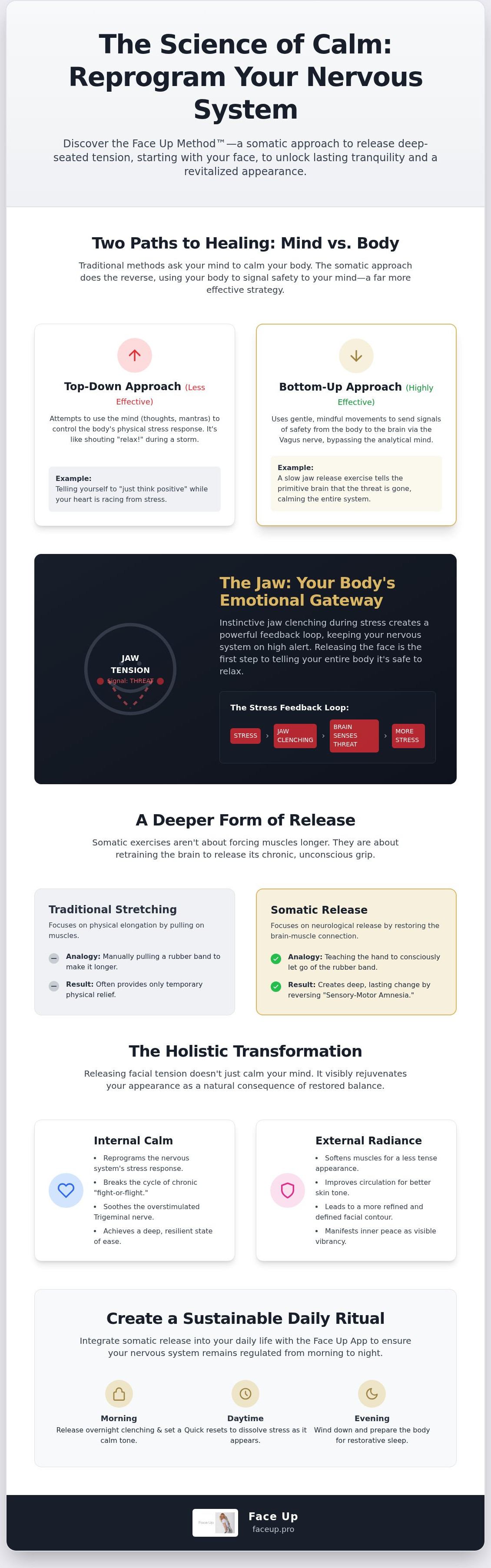
The efficacy of this approach lies in its "bottom-up" methodology. Traditional wellness often relies on "top-down" processing, which is the attempt to use the mind to control the body's physical state. If you've ever told yourself to "just think positive" while your heart is racing, you know how ineffective this can be. Somatic work reverses this flow. By moving the body in specific, mindful ways, you send a direct signal through the Vagus nerve to the brain, confirming that the environment is safe. This physiological signal is far more persuasive to your nervous system than any mantra. It bypasses the analytical mind to reach the primitive parts of the brain where the fight-or-flight response actually lives.
It's also vital to distinguish these movements from traditional stretching. While stretching often involves pulling on a muscle to force it into a longer state, somatic exercises focus on the brain's control over muscle length. It is the difference between pulling a rubber band and teaching the hand to let go of the band entirely. This neurological approach ensures that the release is deep and lasting rather than a temporary physical elongation.
The Science of Somatic Experiencing
The brain acts as a storage device for proprioceptive memories. When we experience stress, our muscles contract as a protective measure. Over time, the brain can lose the ability to fully relax these muscles, a state known as Sensory-Motor Amnesia. Somatic exercises reverse this by using slow, deliberate movements. This measured pace allows the motor cortex to regain conscious control over previously "frozen" tissues, facilitating a deep neurological recalibration that restores the body's natural state of ease.
Identifying Tension Patterns in 2026
Our bodies face unique challenges in a digital-first world. We carry the physical weight of "Zoom-face" and "tech-neck," where hours of digital engagement keep our facial muscles and cervical spine in a state of rigid alertness. In professional environments, we often suppress emotional responses to maintain decorum. This suppression doesn't disappear; it settles into the jaw and brow. A quick self-assessment often reveals that you are "holding" your posture as if preparing for a physical impact that never arrives, leading to persistent exhaustion.
The Facial Connection: Why Your Jaw is the Gateway to Calm
The jaw acts as the body's primary emotional exhaust valve. When we encounter stress, we instinctively clench, a survival mechanism designed to protect the skull during a perceived threat. However, when this clenching becomes chronic, it creates a feedback loop that keeps your nervous system on high alert. Your brain interprets the persistent tension in your masseter muscles as a signal that a threat is still present, even if you're simply sitting at your desk. This physical state makes it nearly impossible to feel truly relaxed, regardless of how many "top-down" mental techniques you apply.
The Face Up Method™ philosophy recognizes that you cannot fully relax your body if your face remains "armored." By focusing on the face first, we can effectively signal safety to the entire system. This process provides more than just mental relief. As muscles soften and circulation improves, you'll notice natural rejuvenation in the form of improved skin tone and a more refined facial contour. It's a holistic transformation where internal calm manifests as external radiance. Releasing the face isn't just about aesthetics; it's about giving your nervous system permission to stand down.
Facial Tension and the Nervous System
The trigeminal nerve, which controls the muscles used for chewing, has a direct line to the brain's emotional centers. When this nerve is overstimulated by constant jaw tension, it contributes to what many call "resting stress face." This isn't a permanent personality trait or a sign of aging; it's a somatic symptom of a system that's lost its ability to reset. Understanding The Connection Between Facial Tension and Emotions is the first step toward breaking this cycle. By utilizing somatic exercises for tension release, you can begin to soothe the trigeminal nerve and restore a sense of ease to your expression.
The Impact of TMJ on Total Body Tension
The influence of the jaw extends far beyond the face. Jaw misalignment and TMJ dysfunction often ripple down the body, affecting your posture and even creating pelvic floor tension. This happens because the body's fascial lines are interconnected. A "stuck" jaw often mirrors a "stuck" pelvis, leading to chronic discomfort that feels impossible to pin down. Standard massage often fails to provide lasting jaw relief because it treats the muscle in isolation without addressing the neurological root. Our Jaw Release Course offers a specialized approach to this deep-seated cranial stress, teaching you how to unwind these complex tension patterns for total body freedom.
5 Essential Somatic Exercises for Daily Release
Implementing somatic exercises for tension release requires a shift from "doing" to "feeling." Unlike traditional gym workouts that demand effort and repetition, somatic practice relies on pandiculation. This is the natural biological process you see when a cat wakes from a nap and slowly lengthens its limbs. It is a conscious contraction followed by a slow, controlled release. This specific sequence resets the resting length of your muscles by updating the brain's internal map of the body. It is the most efficient way to dissolve the "armoring" we discussed in the previous sections.
To begin your practice, create an environment of calm efficiency. You don't need a yoga mat or special equipment; a quiet chair or a clear space on the floor is sufficient. Focus on your breath, allowing it to be soft and natural rather than forced. The goal is to maintain an internal focus, noticing the subtle shifts in sensation as you move through each sequence.
Exercise 1: The Cranial Cradle
The suboccipital muscles at the base of your skull often bear the brunt of digital fatigue. To release them, lie on your back and gently interlace your fingers behind your head. Allow the weight of your skull to settle fully into your hands. Slowly, almost imperceptibly, tilt your chin toward your chest and then back. As you do this, imagine your head is floating rather than being held up by your neck. This movement provides immediate relief for "brain fog" and eye strain by signaling the nervous system to let go of the rigid "forward head" posture common in professional life.
Exercise 2: The Face Up Jaw Decompression
This proprietary technique targets the masseter and pterygoid muscles, the primary drivers of jaw clenching. Place your clean fingertips gently on the hinge of your jaw. Slowly open your mouth while simultaneously imagining an "internal smile" spreading across the back of your throat. This mental cue encourages neurological softening that physical pressure alone cannot achieve. While standard tmj massage therapy often focuses on external manipulation, this somatic approach teaches the brain to release the clench from the inside out, providing a more sustainable path to comfort.
Exercise 3: Pelvic-Jaw Integration
The body's "stress map" creates a fascinating link between the jaw and the hips. When one tightens, the other follows. To break this connection, stand with soft knees and begin a slow, fluid swaying of the pelvis. As your hips move, let your jaw hang slightly open and relaxed. The movement should be non-linear and exploratory. By connecting these two areas, you address the total body tension patterns that often keep us stuck in a state of high alert. It's a powerful way to integrate the calm of the face with the stability of the core. This physical alignment is also a cornerstone of reproductive health, where reducing pelvic tension can support hormonal balance; for those seeking specialized nutritional support, read more about the approach taken by ah! fertility nutrition.
Building on this foundation of reproductive well-being, the transition into parenthood offers a unique opportunity to use somatic principles for bonding and recovery. To discover how these techniques of gentle touch and movement can support you and your infant, learn more about Mother And More.
Integrating these movements into a busy schedule is simpler than it seems. You don't need an hour of dedicated time. A three minute "Cranial Cradle" between meetings or a "Jaw Decompression" during a transition period can prevent tension from accumulating. It's about consistent, small recalibrations that maintain your nervous system's health throughout the day.
Building a Somatic Ritual: From Jaw Release to Daily Calm
There is a fundamental difference between performing a set of movements and living somatically. While "doing exercises" often feels like another task on a professional to-do list, living somatically is about cultivating a continuous internal dialogue with your nervous system. It means noticing the moment your shoulders creep toward your ears during a stressful email and having the tools to reset instantly. To achieve this, consistency is far more effective than intensity. Your nervous system learns through frequent, gentle reminders of safety. Five minutes of somatic exercises for tension release performed daily will create more lasting neurological change than a grueling one hour session once a week.
Structuring your day around these moments of recalibration helps maintain a state of calm efficiency. A morning ritual serves to calibrate your system for the day ahead, ensuring you meet challenges from a place of regulation rather than reactivity. In contrast, an evening ritual focuses on decompression, signaling to your brain that the "threat" of the workday is over and it is safe to enter restorative sleep. To enhance this sensory feedback, many find that using a tmj massage tool helps pinpoint areas of stubborn holding, making the internal release more tangible and effective.
Guided Practice with the Face Up App
Maintaining the correct "somatic pace" is often the greatest challenge for high achievers. We're conditioned to move fast and push hard, but somatic healing requires the opposite. The Face Up App provides the necessary digital guidance to ensure you move slowly enough for your brain to actually register the change. These daily guided rituals take the guesswork out of habit formation, allowing you to simply follow the flow. Over time, you'll begin to track progress not just in physical comfort, but in visible shifts in your facial appearance, improved sleep quality, and a more resilient mood. You can start your daily practice with the Face Up App to begin this journey toward lasting regulation.
Overcoming the 'Resistance to Relax'
It's a common paradox: the more we need to relax, the more our bodies might fight it. This "resistance to relax" occurs because the nervous system has lived in a state of high alert for so long that stress feels like safety. Letting go can feel vulnerable or even frightening. During your practice, you might experience sudden emotional releases, such as a wave of sadness or a deep sigh. This is a natural part of the process. By creating a "safe container" for your practice, perhaps a quiet corner of your home or a dedicated time of day, you give your body permission to process these stored responses without judgment. This patience is what eventually transforms "resting stress face" into a genuine expression of ease.
Beyond Self-Care: Professional Mastery with the Face Up Method™
Transitioning from a personal ritual to a professional career is a natural progression for those who have experienced the profound benefits of somatic exercises for tension release. As the global somatic therapy market is projected to reach a value of US$17.1 Billion by 2034, the demand for specialists who understand the intersection of aesthetics and nervous system health has never been higher. Beyond specialized techniques, you can explore Level 5 Professional Practice to gain accredited qualifications in health coaching or therapy. Professionals who can bridge the gap between physical appearance and internal regulation are becoming the new standard in the beauty and wellness industries.
Integrating somatic bodywork into an existing aesthetic or wellness business allows you to offer more than just surface-level treatments. Standard massage training often stops at muscle manipulation and surface relaxation. However, a facial sculpting certification provides the tools to address the emotional blueprint held in the face. This specialized knowledge positions you as a high-standard partner for clients seeking deep, non-invasive rejuvenation. It transforms a standard service into a proprietary experience that clients cannot find in traditional clinical settings.
The Face Up Method™ Certification Journey
The curriculum for professional mastery is designed to be comprehensive and modern, moving far beyond basic facial massage. It covers advanced techniques such as buccal massage and lymphatic drainage, while grounding them in the principles of somatic emotional release. By mastering these proprietary methods, you can create high-ticket service offerings that deliver immediate physical results and long-term emotional ease. Graduates gain entry into our global practitioner directory, which serves as a linguistic and professional anchor for clients seeking verified quality. This directory connects you with a worldwide community of professionals who value order, reliability, and a clear path forward in their careers.
Join a Global Community of Somatic Specialists
The year 2026 marks a significant shift toward healing-centered engagement in the beauty industry. Professionals are moving away from high-pressure, performance-based models in favor of methods that prioritize nervous system regulation. Within the Face Up ecosystem, you'll find ongoing education and networking opportunities that ensure your practice remains at the forefront of global standards. It's an invitation to join a specialized community that values integrity and proactive management. You can explore the Face Up Method Certification to lead the future of holistic beauty and bring the power of somatic exercises for tension release to a global audience seeking authentic, lasting change.
Embrace a Future of Regulated Ease
True tension release isn't about forcing the body into submission. It's about a sophisticated dialogue between your movements and your nervous system. By recognizing the jaw as a primary exhaust valve for stress, you've unlocked a gateway to total body calm. Consistent daily rituals, even just five minutes of somatic exercises for tension release, create the neurological pathways needed for lasting physical and aesthetic rejuvenation. You've moved beyond surface-level fixes into the realm of deep, bottom-up healing. For those who want to apply this physical freedom to artistic expression, learn more about how vocal coaching can help you channel this ease into your singing voice.
The Face Up Method™ provides the structured environment you need to thrive. Whether you're exploring our expert-led Jaw Release Course or seeking support from our Global Practitioner Directory, you're entering a community built on professional integrity and Red Dot-calibre design excellence. This journey isn't just about self-care; it's about a professional standard of well-being that reflects in every contour of your face. Discover the Face Up Method™ and start your journey to a tension-free life today. Your body is ready to let go; it's simply waiting for the right signal.
Frequently Asked Questions
How often should I perform somatic exercises for tension release?
You'll achieve the best results by practicing daily for approximately five to ten minutes. Consistency is vital because your nervous system requires frequent, gentle reminders to maintain a state of relaxation. Short, frequent sessions are more effective than long, occasional workouts for neurological reprogramming. This approach prevents stress from accumulating throughout your professional day.
Can somatic exercises help with chronic jaw pain or TMJ?
Yes, these movements are specifically designed to address the root causes of TMJ by releasing the masseter and pterygoid muscles. Unlike temporary fixes, somatic exercises for tension release teach your brain to let go of the clenching reflex from the inside out. Our specialized Jaw Release Course provides a targeted path for those dealing with persistent cranial discomfort.
Do I need any special equipment or a tmj massage tool to start?
No special equipment is required to begin, though a tmj massage tool can significantly enhance your sensory feedback. These tools help you pinpoint areas of stubborn holding and provide a tangible anchor for your internal focus. While your hands are sufficient for most techniques, incorporating a tool can deepen the somatic experience and accelerate the release of deep tissue tension.
What is the difference between somatic exercise and yoga?
Somatic exercise focuses entirely on the internal "felt sense" rather than achieving a specific external pose or stretch. While yoga often emphasizes flexibility and alignment, somatic movement prioritizes the neurological reset of muscle length through pandiculation. There are no "correct" shapes to make; the goal is simply to regain conscious control over your muscular system.
How long does it take to see results from somatic movement?
Many individuals experience immediate physical relief after their first session, particularly in the jaw and suboccipital muscles. However, lasting neurological change typically requires two to three weeks of consistent daily practice. This timeframe allows your brain to overwrite old stress patterns and establish a new, more relaxed baseline for your nervous system.
Can somatic exercises improve the appearance of my face?
Yes, releasing chronic facial tension often leads to a more refined contour and improved skin tone. When you dissolve "resting stress face," your features appear more open and vibrant because circulation is no longer restricted by tight muscles. It's a non-invasive way to achieve rejuvenation by simply allowing your natural aesthetics to emerge from beneath layers of tension.
Are somatic exercises safe for everyone?
These movements are generally safe for all individuals due to their gentle and slow nature. However, if you have acute injuries, severe trauma, or recent surgeries, it's wise to consult with a medical professional first. The practice is inherently self-limiting because you're encouraged to move only within a range that feels completely comfortable and safe for your body.
How do I know if I am doing the movements correctly?
You're doing it correctly if the movement feels easy, fluid, and internally focused. If you feel you're straining or "trying too hard," you've likely moved back into a traditional exercise mindset. The Face Up App provides guided pacing to help you maintain the slow, deliberate rhythm necessary for success. Trust your internal sensations more than any external visual cue.


