
What if the reason your facial techniques keep delivering temporary results has nothing to do with your pressure, your tools, or your product selection? Most practitioners searching for an online facial sculpting course are asking the right question in the wrong direction. They want better techniques, when what their clients actually need is a deeper release.
You already know this feeling. A client leaves looking lifted and luminous, then returns two weeks later with the same chronic jaw tension, the same stress carved into their face, the same disappointment. Traditional facial massage works at the surface because it treats the skin as a structure rather than a map of the nervous system. That's a fundamental gap no amount of repetition will close, and it's also the source of the physical burnout so many skilled practitioners quietly carry.
This guide will show you exactly what separates a genuinely transformative facial sculpting education from one that simply adds another technique to your existing toolkit. You'll learn what to look for in a certification programme, why somatic bodywork is the missing piece for lasting client results, and how the Face Up Method™, founded by somatic specialist Olga Newman, is redefining what professional facial sculpting can achieve.
Key Takeaways
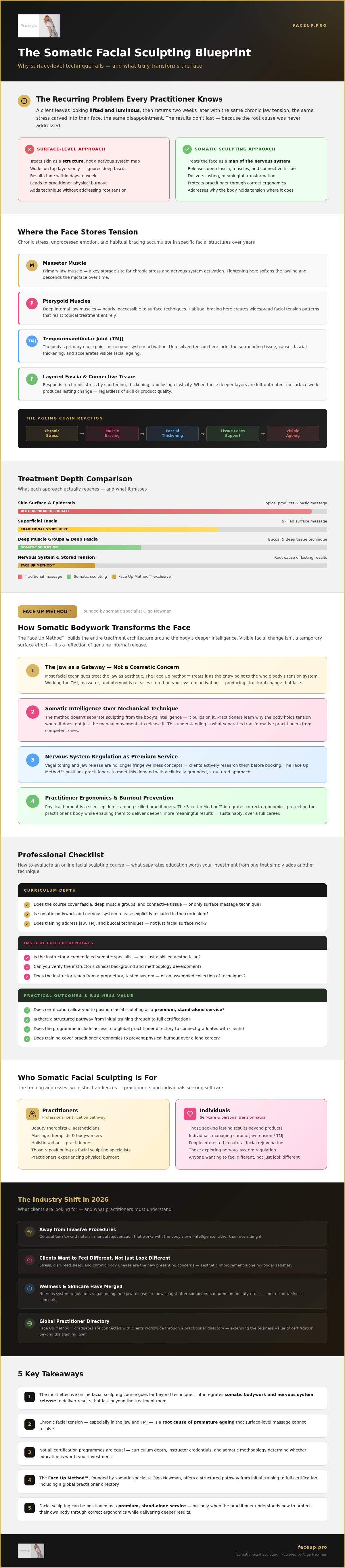
- The most effective online facial sculpting course goes far beyond technique — it integrates somatic bodywork and nervous system release to deliver results that last beyond the treatment room.
- Chronic facial tension, particularly in the jaw and TMJ, is a root cause of premature ageing that surface-level massage cannot resolve; understanding fascia and the nervous system is what separates transformative practitioners from competent ones.
- Not all certification programmes are equal — a professional checklist covering curriculum depth, instructor credentials, and somatic methodology will help you identify education worth your investment.
- The Face Up Method™, founded by somatic specialist Olga Newman, offers a structured pathway from initial training to full certification, including a global practitioner directory that connects graduates with clients worldwide.
- Facial sculpting can be positioned as a premium, stand-alone service — but only when the practitioner understands how to protect their own body through correct ergonomics while delivering deeper, more meaningful results.
The Evolution of Facial Rejuvenation: Why Somatic Sculpting is the New Standard in 2026
Something fundamental has shifted in how clients relate to their faces. The conversation has moved well beyond wrinkle reduction. Clients arriving at treatment rooms in 2026 are carrying something heavier than aesthetic concerns; they're carrying chronic stress, disrupted sleep, and a body that hasn't felt at ease in years. They don't just want to look better. They want to feel different when they leave.
This shift is reshaping the entire professional landscape. The rise of natural, manual rejuvenation reflects a broader cultural turn away from invasive procedures toward treatments that work with the body's own intelligence rather than overriding it. Somatic facial therapy sits at the heart of this movement, addressing the internal state of the body as the primary driver of how the face looks and ages. Tension patterns, emotional holding, and nervous system dysregulation leave visible signatures on the face long before any topical product can reach them.
Moving Beyond the Traditional Facial Massage
Surface-level relaxation served a purpose, but it was never designed to address the structural reality of facial ageing. The face is supported by layered fascia, deep muscle groups, and connective tissue that respond to chronic stress by shortening, thickening, and losing elasticity. When these deeper layers are left untreated, no amount of skilled surface work will produce lasting change. Practitioners who understand this distinction are already repositioning themselves, not as beauty therapists offering a relaxing hour, but as facial sculpting specialists who work with the full architecture of the face.
The Rise of the Holistic Practitioner
The wellness industry and professional skincare are no longer parallel tracks. They've merged into a single client expectation. Nervous system regulation, once considered the domain of yoga teachers or therapists, is now a legitimate and sought-after component of premium beauty rituals. Clients are researching somatic work, vagal toning, and jaw release before they even book their first appointment.
A holistic practitioner, in this context, is a professional who understands that the face reflects the whole person, and who uses that understanding to guide clients toward genuine, lasting transformation rather than a temporary aesthetic result. For practitioners exploring an online facial sculpting course, this framing matters enormously. The most valuable training available right now doesn't just teach you what to do with your hands; it teaches you why the body holds tension where it does, and how to release it with precision and care.
This is the standard the Face Up Method™ was built to meet, and it's why somatic sculpting has become the benchmark against which all modern facial education is now measured.
Inside the Face Up Method™: How Somatic Bodywork Transforms the Face
Most facial techniques treat the jaw as a cosmetic concern. The Face Up Method™ treats it as a gateway. Founded by somatic specialist Olga Newman, this methodology doesn't separate sculpting from the body's deeper intelligence; it builds the entire treatment architecture around that connection. The result is a system where visible facial change isn't a temporary surface effect but a reflection of genuine internal release.
Understanding why this matters requires looking at how the face actually holds tension. Chronic stress, unprocessed emotion, and habitual bracing patterns accumulate in the facial muscles over years, particularly in the masseter, pterygoids, and temporomandibular joint. These aren't just sites of physical tightness; they're the body's primary storage locations for unresolved nervous system activation. When that tension remains locked in place, the overlying tissue loses support, the jawline softens, and the midface begins to descend. No topical treatment reaches this layer.
The Power of Buccal and Deep Tissue Techniques
Intraoral buccal massage works from inside the mouth to access the deep muscles of the jaw directly, bypassing the superficial tissue layers that external massage can never fully penetrate. When these muscles release, the structural consequences are immediate and visible: the jawline sharpens, facial puffiness reduces as lymphatic flow improves, and the cheeks lift naturally because the underlying architecture has shifted rather than been temporarily manipulated. This is precisely the approach at the core of the Face Up Method Certification, which positions this integrated skill set as the professional gold standard for practitioners seeking lasting, meaningful client outcomes.
Where competitors offer buccal massage as an isolated technique module, the Face Up Method™ integrates it within a complete system. The technique isn't the point; the release it enables is.
Somatic Bodywork: The Missing Link
Somatic bodywork, applied to the face, means working with the body's own signals rather than imposing external change. The neck and shoulders are rarely treated as part of a facial protocol, yet chronic tension in the sternocleidomastoid and upper trapezius directly contributes to facial sagging by pulling the soft tissue downward and restricting circulation. Releasing these areas as part of a facial treatment isn't a bonus; it's foundational.
The vagus nerve runs through this same territory. When it's activated through specific touch, breath cues, and the quality of the practitioner-client connection, the nervous system shifts from sympathetic activation into parasympathetic rest. That shift is visible on the face within minutes: softened lines, reduced redness, a quality of ease that no sculpting technique alone can produce.
This is the distinction that makes the Face Up Method™ genuinely different from anything else available in an online facial sculpting course format. It's not a collection of techniques. It's a coherent philosophy of how the face changes when the whole person is treated. Practitioners ready to work at this level can explore the full Face Up Method™ training pathway and understand what a methodology-led education actually looks like in practice.
How to Evaluate an Online Facial Sculpting Course: A Professional Checklist
Not every certification is worth the investment. The facial sculpting education market has expanded rapidly, and with that growth comes a wide spectrum of quality. Some programmes deliver genuine professional transformation; others offer a collection of loosely connected technique videos dressed up as a curriculum. Knowing the difference before you enrol is the most important decision you'll make.
Use these criteria as your filter:
- Curriculum depth: Does the course address facial anatomy, fascial layers, and the nervous system, or does it jump straight to technique? A programme that skips the foundational science is building on sand. You need to understand why a movement creates change, not just how to perform it.
- Instructor credentials: Is the course led by a recognised specialist with a demonstrable clinical background? Olga Newman, founder of the Face Up Method™, brings somatic bodywork expertise that most facial educators simply don't have. The instructor's depth of knowledge shapes the entire learning experience.
- Video production quality: Manual therapy is spatial. If you can't clearly see hand placement, depth of pressure, and tissue response, the demonstration is effectively useless. High-definition, multi-angle filming isn't a luxury; it's a baseline requirement, often achieved through professional media production from WS FM.
- Student support structures: Does the programme include practical assessments, feedback mechanisms, or a professional community? Learning in isolation produces isolated results. Access to expert feedback and peer connection accelerates mastery in ways that passive video consumption never can.
- Certification versus accreditation: These aren't the same thing. Accreditation means a third-party body has validated the curriculum. Certification means you've completed a programme and received a credential. Both matter, but what matters more is whether the credential is recognised by insurers, professional associations, and, crucially, by clients searching for qualified practitioners.
Technique vs. Methodology: Which One Do You Need?
A technique is a single tool. A methodology is an entire framework for how you think, work, and communicate your value. Learning buccal massage as a standalone skill adds one item to your menu. Learning the Face Up Method™ gives you a coherent clinical philosophy that informs every treatment decision you make. That distinction matters enormously when you're marketing your services; a proprietary method is something clients can find, research, and specifically request. A generic technique is not.
Ask yourself whether the training you're considering will still be relevant in five years. Methods built around anatomy, somatic principles, and the nervous system age well because they're grounded in how the body actually works. Trend-driven technique courses don't carry the same longevity.
Online Learning Logistics for Manual Therapists
The practical challenge of learning hands-on work through a screen is real, and a quality online facial sculpting course addresses it directly. Look for programmes that include case study requirements, self-assessment checkpoints, and structured feedback rather than simply marking completion by video views. Access period matters too; mastering manual therapy takes repetition over time, and a programme that locks you out after sixty days isn't designed for genuine skill development. Twelve-month or lifetime access isn't a bonus feature. It's a signal that the course was built for actual mastery rather than a quick enrolment metric.
The Face Up Method™ Certification is structured with exactly this in mind, offering practitioners a pathway that supports learning at depth rather than rewarding speed. For those newer to somatic facial work, the Jaw Release Course provides a focused entry point into the methodology before progressing to full certification.
Integrating Facial Sculpting into Your Practice or Self-Care Routine
Completing an online facial sculpting course is only the beginning. What separates practitioners who generate consistent premium income from those who add a new technique and wait is how deliberately they integrate that knowledge into their professional identity, their treatment room, and their own body. This section addresses the practical architecture of that integration.
From Esthetician to Somatic Specialist
Repositioning yourself on your treatment menu isn't cosmetic. It's strategic. A session described as "facial massage" sits in the same mental category as a relaxation treatment. A session described as "somatic facial sculpting with jaw release" signals clinical depth, specialist training, and a different calibre of result. That distinction alone justifies premium pricing without requiring any additional explanation.
Educating clients is part of the service. Many people carrying chronic jaw tension have no framework for understanding why their face looks the way it does. Introducing them to the connection between TMJ dysfunction, fascial compression, and visible facial ageing opens a conversation that positions you as a trusted specialist rather than a service provider. The TMJ massage therapy guide is a practical resource for explaining jaw health in language clients can absorb and act on. Use it as a reference point in consultations, not just as background reading for yourself.
Sculpting works best when it isn't buried inside a longer facial as a finishing step. Position it as a stand-alone appointment with its own consultation structure, its own treatment arc, and its own follow-up protocol. When clients book a dedicated session, they arrive with different expectations and leave with different results.
Daily Rituals: The Power of Self-Practice
There's a practical truth that most training programmes don't address directly: you cannot teach release if you haven't experienced it yourself. Practitioners who work through the Face Up Method™ on their own face and jaw develop a quality of touch that passive learning simply doesn't produce. Self-practice builds proprioceptive intelligence, the ability to feel what's happening beneath the tissue and respond to it rather than applying a memorised sequence regardless of what the body is communicating.
For ongoing personal maintenance, tools like the TMJ massage tool support the kind of consistent self-care that prevents the practitioner from absorbing the tension they're releasing in others. This isn't a wellness bonus. It's professional sustainability.
The Face Up App extends this ecosystem beyond the treatment room, giving clients guided home rituals that reinforce professional results between sessions. That continuity matters for client retention and for the depth of change that becomes possible over time.
Ergonomics carries equal weight. Protecting your hands, wrists, and posture during intraoral and deep tissue work isn't optional. Poor mechanics accumulate quietly until they become injuries, and injuries end careers. Building correct body mechanics into your practice from the start is as important as any technique you'll learn.
Practitioners ready to build this level of integration into their work can explore the full Face Up Method™ ecosystem and understand how professional training, personal practice, and client education work together as a coherent whole.
Mastering the Art: The Face Up Certification Ecosystem
Earning a credential is straightforward. Building a professional identity around it is something else entirely. The Face Up Method™ Certification is designed to do both, creating a structured pathway from initial training through to recognised practitioner status, supported by an ecosystem that continues to deliver value long after the final module is complete.
The Certification Process: What to Expect
The curriculum moves through a logical progression, beginning with the anatomical foundations of the face, fascia, and nervous system before advancing into sculpting technique, somatic integration, and buccal work. This sequencing matters. Each layer of knowledge supports the next, so by the time you're working through advanced protocols, you're not memorising steps; you're making informed clinical decisions. The practical assessment component is what separates this from programmes that issue a certificate after a multiple-choice quiz. Demonstrating competency through observed practice maintains the standard that makes the credential meaningful to clients and insurers alike. The Face Up community functions as an active support network, connecting graduates with peers and mentors who share a commitment to practising at the highest level of somatic facial therapy.
For practitioners new to this approach, the Jaw Release Course offers a focused entry point before committing to full certification. It's a natural first step into the methodology, and it delivers immediate clinical value in its own right.
Your Future in Facial Sculpting
Certified practitioners are finding genuine market differentiation across a range of career paths. Studio owners are repositioning their entire treatment menu around somatic sculpting. Mobile therapists are commanding premium rates by bringing a methodology clients can research and specifically request. Some graduates are building digital coaching practices, training other practitioners or offering guided self-care programmes through platforms like the Face Up App.
Being among the first practitioners in your local market to hold a recognised somatic facial sculpting certification carries real commercial weight. Clients searching for an online facial sculpting course graduate, or looking for a practitioner who goes beyond surface-level work, will find you through the Face Up Practitioner Directory, a searchable global resource that connects certified graduates directly with prospective clients. That visibility isn't available to practitioners who hold generic credentials from programmes without a professional community behind them.
The broader landscape of somatic beauty is still forming. Practitioners who invest in rigorous, methodology-led education now will define what the standard looks like as the field matures. That's not a small opportunity.
If you're ready to move from competent to genuinely transformative, explore the Face Up Method Certification today and take the first step toward building a practice that delivers results clients remember.
Your Next Step Toward Transformative Facial Sculpting
The gap between practitioners who deliver temporary results and those who create lasting change comes down to one thing: depth of understanding. Choosing the right online facial sculpting course means investing in a methodology grounded in anatomy, fascia, and nervous system regulation, not just a new set of hands-on techniques to cycle through.
The Face Up Method™, founded by somatic specialist Olga Newman, offers exactly that foundation. From the focused entry point of the Jaw Release Course through to full certification, the pathway is structured for genuine mastery. Graduates don't just earn a credential; they join a global directory of recognised practitioners and carry a proprietary method that clients can specifically seek out.
The somatic beauty field is still forming. Practitioners who commit to rigorous, methodology-led education now will be the ones defining the standard as it matures. For those looking to further empower their professional journey, you can visit Trainetics Academy to explore a wide range of educational programs.
You already have the drive to go deeper. The training exists to match it. Become a Certified Face Up Practitioner and build a practice that delivers results clients don't forget.
Frequently Asked Questions
Can I really learn facial sculpting through an online course?
Yes, provided the programme is built specifically for manual therapy delivery. High-definition, multi-angle video that clearly shows hand placement, depth of pressure, and tissue response makes the difference between useful instruction and a frustrating experience. The practical challenge is real, which is why quality programmes include self-assessment checkpoints, case study requirements, and structured feedback rather than simply tracking video views.
The Face Up Method™ Certification addresses this directly. The learning pathway is designed for genuine skill development over time, not rapid completion, which is why extended course access is built into the structure rather than treated as an add-on.
What is the difference between buccal massage and facial sculpting?
Buccal massage is a single technique; facial sculpting is a complete treatment system. Buccal work accesses the deep muscles of the jaw from inside the mouth, which no external massage can fully replicate. Facial sculpting integrates that technique within a broader protocol that addresses fascia, lymphatic flow, neck and shoulder tension, and nervous system regulation together.
Learning buccal massage in isolation adds one tool to your practice. Learning it within a methodology like the Face Up Method™ means every technique decision is informed by a coherent clinical framework, which is what produces results that hold between sessions.
Do I need to be a licensed esthetician to take an online facial sculpting course?
Prerequisites vary by programme and by the jurisdiction in which you intend to practise. Some courses require a background in beauty therapy, massage, or a related health profession; others are designed to accommodate practitioners from adjacent fields. What matters most is checking your local regulatory requirements before enrolling, particularly for intraoral techniques, which carry specific scope-of-practice considerations in certain regions.
If you're newer to somatic facial work, the Jaw Release Course offered within the Face Up ecosystem provides a focused entry point that builds foundational understanding before progressing to full certification.
How long does it take to complete the Face Up Method Certification?
Completion time depends on your existing background and the pace at which you move through the practical assessment components. The programme is structured for depth rather than speed, meaning the curriculum sequences from anatomical foundations through to advanced somatic protocols in a way that rewards thorough engagement over rapid completion. Extended course access is built in to support that approach.
For practitioners who want to begin immediately, the Jaw Release Course offers a self-contained starting point with its own clinical value, making it a practical first step while you plan your full certification pathway.
Is facial sculpting the same as Face Yoga?
No. Face Yoga involves self-directed muscle exercises aimed at toning facial tissue through repetitive movement. Facial sculpting, particularly within a somatic framework, works with the deep structural layers of the face, including fascia, the masseter, pterygoids, and the temporomandibular joint, through precise manual techniques that require trained hands and a clinical understanding of how tension accumulates and releases.
The distinction matters professionally. Face Yoga is a self-care practice; somatic facial sculpting is a specialist treatment that addresses the root causes of facial ageing at a structural and nervous system level. They're not interchangeable, and clients researching lasting results are increasingly aware of that difference.
Will I get a certificate that I can use for insurance purposes?
A certificate confirms you've completed a programme; accreditation means a third-party body has validated the curriculum to a recognised standard. Both affect insurability, but they're not the same thing. Before enrolling in any online facial sculpting course, confirm directly with your professional insurer which credentials they accept, particularly for intraoral and deep tissue techniques, which often carry separate coverage requirements.
The Face Up Method™ Certification is designed to meet professional standards, but verifying current insurer requirements in your specific country or region is always the right first step before making any enrolment decision.
How much can I charge for a professional facial sculpting session?
Pricing varies considerably by location, practitioner experience, and the depth of the treatment offered. What's consistent across markets is that somatic facial sculpting commands a meaningfully higher rate than standard facial massage because it delivers a different category of result. Practitioners holding a recognised certification in a proprietary methodology have a concrete basis for premium positioning that generic technique training doesn't provide.
Rather than quoting a figure that may not reflect your market, the more useful question is what justifies the rate you want to charge. A specialist credential, a documented methodology, and visible client outcomes are the three factors that consistently support higher pricing regardless of geography.
What tools do I need to start an online facial sculpting course?
The core requirement for somatic facial sculpting is your hands, and a quality programme will teach you to use them with precision before introducing any additional equipment. For intraoral buccal techniques, medical-grade nitrile gloves are standard. A supportive treatment surface and correct body positioning matter from the start, since building sound ergonomics early protects your hands, wrists, and posture over a full career.
Beyond the treatment room, tools like a dedicated TMJ massage tool support the self-practice that builds the proprioceptive intelligence no passive learning can replicate. The Face Up App extends this further, offering guided rituals for both practitioners and clients that reinforce the work done in sessions.


