

What if the plastic night guard you've worn for years is actually preventing you from addressing the true source of your jaw pain? While dental hardware protects your teeth, it does little to quiet the overactive nervous system that triggers clenching. By integrating somatic exercises for bruxism into your routine, you can finally move beyond symptom management and start rewiring the brain's response to stress.
You likely know the frustration of waking up with a heavy, square-looking jawline and a persistent headache that suggests your body never truly rested. It's exhausting to feel like tension is physically trapped in your face, but there's a more sustainable path to relief than simply masking the discomfort. This approach focuses on communicating safety to your muscles to release deep-seated patterns of holding.
In this 2026 guide, we'll explore how to use somatic movement and facial sculpting rituals to achieve a relaxed, pain-free jaw and improved facial symmetry. You'll learn how the Face Up Method helps you reclaim better sleep quality and a more defined, tension-free appearance naturally. It's time to stop fighting your body and start listening to its signals.
Key Takeaways
- Understand why bruxism is a protective mechanism of your nervous system rather than just a dental habit.
- Discover how somatic exercises for bruxism use active "pandiculation" to create lasting neural pathways for relaxation.
- Learn how releasing jaw tension acts as a natural facelift, restoring facial symmetry and reducing a heavy lower face appearance.
- Master the "Teeth Apart, Lips Together" rule and other daily rituals designed to signal safety to your body.
- Explore the professional opportunities within the Face Up Method Certification for those looking to facilitate deep somatic healing for others.
Understanding Bruxism as a Somatic Response (Not Just a Dental Habit)
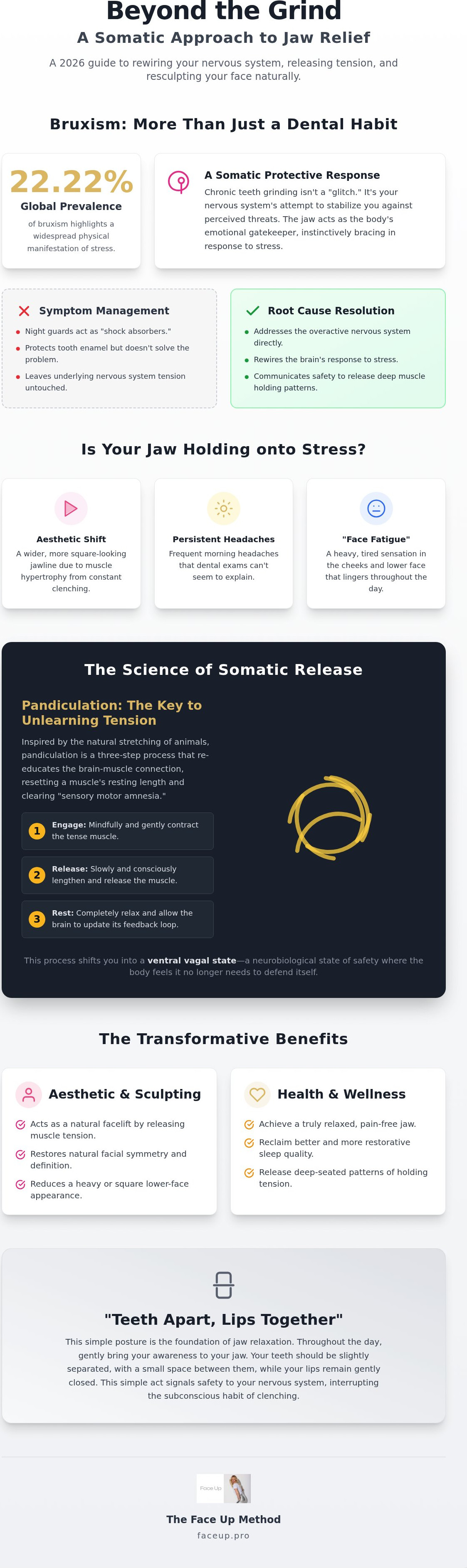
Many people view Bruxism as a purely mechanical issue, a frustrating dental habit to be managed with plastic night guards. However, in 2026, we understand that chronic teeth grinding is a sophisticated somatic protective response. A recent systematic review found the global prevalence of bruxism to be 22.22%, highlighting how widespread this physical manifestation of stress has become. Your jaw acts as the emotional gatekeeper of the body, instinctively bracing against perceived threats. This bracing isn't a "glitch" in your system; it's your nervous system trying to stabilize you. While mouthguards protect your tooth enamel, they don't address the root cause. They are essentially shock absorbers that leave the underlying tension patterns untouched. To find lasting relief, we must look at how somatic memory stores stress directly in the masseter and temporalis muscles.
The Fight-or-Flight Connection
Somatic tension often manifests in ways that go beyond a simple clicking sound. You might experience "face fatigue," a heavy sensation in the cheeks, or persistent morning headaches that dental exams can't quite explain. Over time, chronic clenching even creates an aesthetic shift, leading to a wider, more square-looking jawline as the muscles hypertrophy from constant use. Identifying these signs is the first step toward a holistic recovery, where somatic exercises for bruxism work in tandem with professional support. While self-practice is vital, many find that specialized somatic massage therapy is essential for long-term relief. This work helps "unlearn" the physical memories of stress that have become baked into your facial structure, restoring both comfort and natural symmetry.
The Science of Somatic Exercises for Bruxism
Somatic movement doesn't just stretch tissue; it updates the internal software of your nervous system. While traditional stretching often triggers a "stretch reflex" that causes muscles to contract even tighter, somatic work utilizes the brain's neuroplasticity to create new pathways for relaxation. Somatic exercises are gentle, mindful movements that re-educate the brain-to-muscle connection. This approach is central to the Face Up Method™, which prioritizes "unlearning" the clench. Instead of fighting against your body, you're teaching it that the habit of holding tension is no longer necessary for your safety.
The primary difference between standard physical therapy and somatic exercises for bruxism lies in a process called pandiculation. Think of how a cat stretches after a nap. They don't just pull on their limbs; they engage the muscle, then slowly and consciously release it. This controlled lengthening signals the motor cortex to reset the muscle's resting length. By practicing these mindful rituals, you're effectively clearing the "sensory motor amnesia" that keeps your jaw in a state of perpetual contraction.
Rewiring the Masseter Muscle
The masseter is the strongest muscle in the human body relative to its weight. It's capable of exerting immense pressure, and when you're stressed, it often gets stuck in a "shortened" state. Over time, your brain forgets how to fully relax this hinge. To break this cycle, you must use techniques that signal the brain to "let go." This involves very small, slow movements that require your full attention. When you move with this level of awareness, you bypass the automatic clench reflex and begin to restore the natural, supple state of the jaw. If you're ready to deepen this practice, the Face Up App Subscription offers daily guided rituals to help you master these subtle releases.
The Role of the Pterygoid Muscles
While the masseter gets most of the attention, the deep medial and lateral pterygoid muscles are often the true culprits behind side-to-side grinding. These muscles sit deep within the skull, making them nearly impossible to reach through external massage alone. This is why many people find only temporary relief from traditional face rubs. Somatic exercises for bruxism allow you to access these deep stabilizers through internal awareness and specific directional movements. By integrating these into your daily "Jaw Release" ritual, you address the grinding at its anatomical source, ensuring a more comprehensive and lasting release of tension.
Aesthetic Benefits: Sculpting the Face Through Release
While the primary goal of somatic work is often pain relief, the aesthetic transformation is a significant benefit for many. Chronic clenching leads to a "heavy" lower face and gradual facial widening as the muscles adapt to the constant workload of grinding. By using somatic exercises for bruxism, you aren't just relaxing; you're performing a "Natural Facelift" from the inside out. Releasing these deep muscular blockages also improves lymphatic drainage. When the masseter and neck muscles are perpetually tight, they act like a dam, trapping fluid in the tissues. Clearing this tension helps eliminate morning puffiness and reveals more defined contours. This holistic approach is why our facial sculpting certification includes deep jaw work as a foundational skill for practitioners.
Slimming the Jawline Naturally
Reducing masseter hypertrophy is a key outcome of consistent somatic practice. When the masseter is constantly engaged, it builds bulk, much like any other muscle under heavy load. This often results in a square jawline that can feel at odds with your natural features. By teaching the brain to release this clench through somatic exercises for bruxism, the muscle returns to its natural, lean state. This process helps restore the "V-shape" of the face and enhances cheekbone definition. You'll notice a more balanced profile as the muscles of the lower face stop competing with your natural bone structure, allowing your inherent symmetry to shine through.
The Neck and Jaw Connection
You can't address the jaw without considering the neck. The 2026 phenomenon of "Tech Neck" creates a forward-head posture that puts immense strain on the jaw, making bruxism worse and blurring your side profile. Releasing the platysma, the thin muscle covering the front of the neck, is vital for a smoother, tighter appearance. The link between posture, jaw freedom, and aesthetic radiance is undeniable. Consider these benefits of a released neck and jaw:
- Improved posture aligns the jaw, reducing the mechanical drive to clench and grind.
- Releasing neck tension prevents the "pulling down" effect on the corners of the mouth and jawline.
- Freedom in the jaw and neck allows for better circulation and a natural, healthy glow.
This connection is a core pillar of the Face Up Method. When you free the jaw, you don't just feel better; you look more rested and vibrant because your face is no longer holding the physical weight of stress.
4 Essential Somatic Exercises for Bruxism and Jaw Release
Success with somatic exercises for bruxism begins with your environment. This isn't another item on a "to-do" list; it's a dedicated ritual to communicate safety to your nervous system. Find a quiet space where you can sit or lie down without interruption. The foundational mindset for this practice is the "Teeth Apart, Lips Together" rule. By maintaining this posture throughout the day, you prevent the mechanical habit of clenching before it starts. To deepen your release, many practitioners find that integrating specific TMJ massage tools helps target stubborn trigger points that fingers alone might miss.
The "Gentle Hinge" Release
Sit comfortably and close your eyes. Bring your full attention to the temporomandibular joint where your jaw meets your skull. Instead of trying to force your mouth open, imagine the hinge is like ice melting slowly in the sun. Use micro-movements, shifting the jaw just a few millimeters down and back up. As you inhale, visualize the breath expanding the space between your upper and lower molars. This visualization helps your brain recognize that the jaw doesn't need to be locked to keep you safe. Repeat this five times, moving so slowly that the movement is almost invisible to an observer.
The Temporal Decompression
The temporalis muscle, which fans out above your ears, often holds the tension that leads to morning headaches. Place the heels of your palms gently against your temples. Apply light pressure and slowly slide your hands upward toward the top of your head. This somatic palm-sliding technique encourages the fascia to hydrate and release its grip. Notice the direct connection between your temples and your jaw hinge. When the temples soften, the jaw often follows. This exercise creates a full upper-face release that feels like a physical weight being lifted from your brow.
The "Buccal Breath" Ritual
Intra-oral awareness is a vital part of the Face Up Method. Gently place the tip of your tongue on the roof of your mouth, just behind your front teeth, ensuring they don't touch. Soften your cheeks from the inside out, imagining them becoming heavy and supple. Use your tongue as a somatic tool to explore the inner boundaries of your jaw, moving it slowly along the inside of your teeth without any pressure. This ritual helps rewire the buccal area, which is the epicenter of subconscious clenching. If you're ready to commit to a daily practice, you can access the Face Up App for guided morning and evening rituals that make these releases second nature.
Beyond Self-Care: Professional Somatic Facial Training
The global somatic therapy market is estimated to reach $4.72 billion in 2026, marking a significant shift in how we approach chronic conditions like jaw tension and facial pain. As more people discover the efficacy of somatic exercises for bruxism, the need for skilled facilitators has grown beyond traditional dental or massage practices. Transitioning from a personal journey of healing to a professional career in somatic facial work allows you to address the root causes of tension that others often overlook. This professional path is ideal for those who want to move beyond surface-level aesthetics to offer a holistic, nervous-system-based solution. For those who prefer to receive care, our global practitioner directory provides a gateway to high-standard partners who can facilitate your progress through specialized in-person sessions.
The Face Up Method™ Certification
Standard facial training often fails to address the emotional and neurological layers that contribute to chronic clenching. The Face Up Method™ Certification fills this gap by offering a deep dive into the science of nervous system regulation and its impact on facial structure. You'll learn sophisticated techniques such as buccal massage and internal jaw release, alongside protocols for stabilizing the trigeminal nerve. This program invites you into a proprietary ecosystem of learning where you're supported by a community of global-minded facilitators who prioritize integrity and results. By mastering these specialized skills, you position yourself as a reliable expert in a rapidly expanding field, ready to guide clients toward lasting relief and facial harmony.
Start Your Journey Today
Your entry into this professional landscape begins with your own commitment to daily practice. You can start today by accessing the "Jaw Release" digital course for immediate home relief or by using the Face Up App Subscription to guide your daily somatic rituals. These resources provide the foundational knowledge needed to understand how somatic exercises for bruxism can transform a person's life and appearance. Once you've experienced the results firsthand, you'll be better equipped to mentor others through their own transformations. We invite you to explore our Professional Certification programs and join a specialized community that values integrity, professional advancement, and the power of somatic movement.
Reclaim Your Natural State of Ease
Moving beyond the temporary protection of dental guards represents a significant advancement in holistic jaw health. By recognizing that clenching is a nervous system signal rather than a simple mechanical habit, you've gained the insight needed to address the root cause of your tension. Integrating somatic exercises for bruxism into your routine allows you to move past symptom management toward a state of genuine physical and aesthetic freedom. You've learned how mindful rituals can restore facial symmetry, improve sleep quality, and quiet the overactive reflexes that drive chronic grinding.
Founded by somatic expert Olga Newman, the proprietary Face Up Method™ provides a specialized environment for those ready to transform their relationship with stress. Whether you're practicing at home or seeking support through our global directory of certified practitioners, you're part of a community dedicated to professional standards and lasting results. We invite you to Join the Face Up App for Your Daily Jaw Release Ritual and begin rewiring your body for comfort today. Your path to a relaxed, radiant, and pain-free jaw starts with a single mindful movement.
Frequently Asked Questions
Can somatic exercises really stop nighttime teeth grinding?
Yes, somatic exercises for bruxism address the autonomic nervous system's response to stress. While night guards act as a physical buffer for your enamel, they don't stop the brain's signal to clench. By practicing mindful movements during the day, you signal safety to the motor cortex. This reduces the subconscious drive to grind during sleep; eventually rewiring the neural pathways that trigger nighttime tension as we move through 2026.
How long does it take to see results from somatic jaw exercises?
Most individuals notice an immediate reduction in perceived tension after a single session. However, significant changes in muscle memory and facial shape typically emerge within four to six weeks of daily ritual. Lasting relief requires consistency to override years of habit. The Face Up App provides structured morning and evening routines to ensure these new patterns become your body's default state of rest and relaxation.
Are somatic exercises safe if I have a diagnosed TMJ disorder?
Somatic exercises are generally safer than traditional stretching because they never involve force or pushing past discomfort. They focus on micro-movements that stay within your comfortable range of motion. If you have a severe TMJ diagnosis, we recommend starting with the Jaw Release Course or consulting a practitioner from our global directory. These professionals ensure your movements are tailored to your specific anatomical needs without ever aggravating the joint.
What is the difference between a somatic exercise and a regular stretch?
Regular stretching is a passive action that pulls on muscle tissue, which can often trigger a protective contraction. In contrast, somatic exercises for bruxism involve pandiculation, a conscious contraction followed by a slow, controlled release. This process requires your full sensory attention to re-educate the brain-to-muscle connection. You aren't just lengthening the tissue; you're teaching the nervous system how to let go of the muscle tension entirely.
Can I do these exercises if I have dental implants or veneers?
Yes, somatic work is perfectly safe for those with dental work because it focuses on muscle and nerve regulation rather than external pressure on the teeth. Since the movements are internal and gentle, there's no risk of damaging veneers or implants. In fact, reducing the force of your clench can actually extend the lifespan of your dental investments by preventing the excessive mechanical pressure that often leads to cracks.
Do I need any special tools to perform somatic exercises for bruxism?
You can perform most somatic rituals using only your hands and your internal awareness. However, as your practice deepens, you might choose to incorporate specialized TMJ massage tools to target deeper fascia layers. While not mandatory, these tools can enhance the sensory feedback to your brain during a session. The primary requirement is a quiet environment where you can focus entirely on the subtle sensations within your jaw.
Why is the Face Up Method™ different from regular face yoga?
Face yoga often focuses on repetitive muscle strengthening to achieve aesthetic goals, which can unintentionally increase tension in an already overactive jaw. The proprietary Face Up Method™ prioritizes nervous system regulation and deep muscular release. It's a bottom-up approach that treats the face as an extension of your internal state. By combining somatic bodywork with non-invasive rejuvenation, we ensure that beauty results are a natural byproduct of health.
How often should I practice these rituals for lasting relief?
We recommend a little and often approach rather than long, infrequent sessions. Practicing for five to ten minutes twice daily is ideal for most people. Using the Face Up App for a morning reset and an evening release ensures that you don't accumulate tension throughout the day. Consistency is the key to signaling to your brain that it's safe to remain relaxed, eventually making jaw freedom your natural baseline.


