

What if the persistent tightness in your jaw isn't just a physical knot, but a somatic map of every stressor you have carried lately? For many, waking up with a dull headache or a sore, clicking jaw has become an exhausting morning ritual. You might have noticed your lower face appearing wider or more tense, a direct result of overactive masseter muscles that never truly switch off. It often feels as though stress is physically stuck in your face, making traditional self massage for jaw pain feel like a temporary distraction rather than a lasting solution.
We believe that true relief comes from addressing the nervous system alongside the muscle. You deserve a sophisticated path to comfort that restores both your physical well-being and your natural aesthetic. In this guide, you will discover how to release deep-seated tension and emotional stress using the proprietary Face Up Method™ for a pain-free, sculpted face. We will preview the transformative techniques found in our Jaw Release Course and explain how a simple, somatic daily ritual can transition your expression from one of chronic strain to one of youthful, calm efficiency.
Key Takeaways
- Understand how your jaw functions as a somatic record for suppressed emotions and why the "fight or flight" response triggers chronic clenching.
- Identify the specific roles of the masseter and temporalis muscles to target the root causes of both jaw tightness and tension headaches.
- Discover the difference between basic mechanical rubbing and the Face Up Method™, which integrates nervous system regulation for lasting results.
- Master a five-minute daily ritual for self massage for jaw pain designed to provide immediate relief and restore a relaxed, youthful facial expression.
- Learn the specific signs that indicate when professional somatic support or a guided course is necessary to break deep-seated patterns of tension.
Why Your Jaw Stores Stress: The Somatic Connection
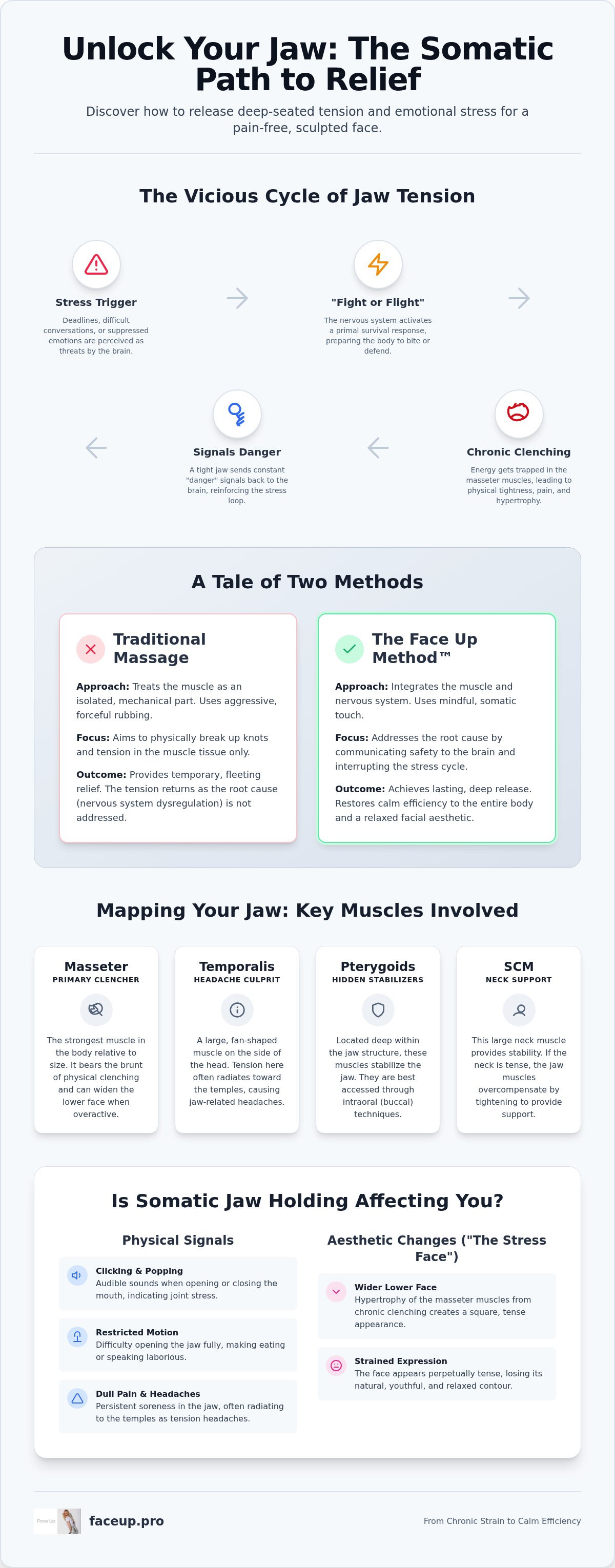
The human jaw is far more than a mechanical hinge for chewing. It acts as a sophisticated somatic record, archiving every unexpressed frustration, suppressed word, and survival instinct we experience. When the brain perceives a threat, the body's "fight or flight" response immediately engages the masseter muscles. This primal reaction prepares us to bite or defend, but in a modern professional environment, that threat is usually a deadline or a difficult conversation. Because we cannot literally bite our way through a boardroom meeting, that energy remains trapped in the facial tissues.
While clinical Temporomandibular joint dysfunction focuses on the structural misalignment of the joint, somatic tension is often the silent precursor. Traditional self massage for jaw pain frequently fails because it treats the muscle as an isolated machine. If you don't address the dysregulated nervous system driving the clench, the relief will be fleeting. True release begins with the realization that your jaw is holding a story your mind hasn't finished processing. By shifting from mechanical rubbing to somatic awareness, you begin to treat the cause rather than just the symptom.
The Vagus Nerve and Jaw Tension
Your jaw is neurologically linked to the brain's stress centers via the vagus nerve and other cranial pathways. This connection creates a powerful feedback loop. When you are stressed, your jaw tightens. Conversely, when your jaw is tight, it sends a constant signal of danger back to the brain. By utilizing mindful touch rather than aggressive, forceful pressure, you can interrupt this cycle. Softening the jaw muscles communicates a profound sense of safety to the entire body. This shift allows the nervous system to move from a state of high alert to one of calm efficiency, facilitating a deeper physical release than manual force ever could.
Symptoms of Somatic Jaw Holding
Somatic tension manifests in ways that extend far beyond simple discomfort. You might experience clicking, popping, or a restricted range of motion that makes eating or speaking feel laborious. There is also a distinct aesthetic component often called "The Stress Face." Chronic clenching causes the masseter muscles to hypertrophy, leading to a visible widening of the lower face and a perpetually strained expression. From a somatic lens, these trigger points aren't just knots to be rubbed out. They are physical signals that your body is stuck in a defensive posture, requiring a holistic approach to restore both comfort and your natural, youthful facial contour.
Mapping Your Jaw: Key Muscles for Self-Massage
To effectively practice self massage for jaw pain, you must first understand the landscape of your own tension. The face is a complex network of muscles, but four key areas deserve your focused attention. The Masseter, located along the side of the jaw, is the strongest muscle in the body relative to its size. It bears the brunt of physical clenching. Just above it sits the fan-shaped Temporalis muscle. If you suffer from jaw-related headaches, the Temporalis is likely the culprit, as it radiates tension toward the temples.
Beyond these visible structures lie the Pterygoid muscles. These are the "hidden" stabilizers located deep within the jaw structure. Accessing them often requires a more nuanced approach than external rubbing. Finally, we cannot ignore the Sternocleidomastoid (SCM) in the neck. Your jaw doesn't exist in a vacuum; if your neck is unstable, your jaw muscles will overcompensate by tightening to provide support. Integrating TMJ self-care into your routine involves acknowledging this entire interconnected system.
Finding the Masseter and Temporalis
Locating these muscles is an intuitive process. Place your fingers on the soft area between your cheekbone and the corner of your jaw, then clench your teeth together. You will feel a firm bulge beneath your skin; this is your Masseter. To find the Temporalis, move your fingers to your temples and repeat the clenching motion. You'll feel the muscle pulse under your fingertips. The Masseter muscle serves as the primary driver of jaw closure and becomes the focal point of chronic clenching, often leading to the structural and muscular imbalances associated with TMJ pain. As you explore these areas during self massage for jaw pain, look for knots or spots that feel unusually tender. These are often somatic storage points where the muscle has forgotten how to rest.
The Role of the Buccal (Intraoral) Space
External massage is a valuable starting point, yet it only addresses half of the equation. To reach the deep Pterygoids and the internal fibers of the Masseter, you must work from the "inside out." This is known as buccal or intraoral massage. By placing a clean thumb inside the cheek and fingers on the outside, you can compress the muscle from both sides for a far more profound release. If you're looking to enhance this experience, choosing the right tmj massage tool can help you navigate these sensitive internal spaces with precision. For those who prefer a guided experience, the Face Up App offers step-by-step rituals to ensure your technique is both safe and effective.
The Face Up Method™ vs. Traditional Jaw Massage
Traditional approaches to jaw discomfort often treat the body like a machine with a broken part. You find a knot, you apply pressure, and you hope the pain subsides. While manual therapy can improve mouth opening, it often feels like a clinical chore. The Face Up Method™ transcends this limited view by integrating somatic bodywork, facial sculpting, and nervous system regulation. Instead of merely managing a symptom, this approach transforms your practice of self massage for jaw pain into a sophisticated daily ritual that honors the body's internal state.
When you release the deep muscular tension in your jaw using this method, the results are both internal and external. Beyond the immediate physical relief, many practitioners notice a natural lifting effect. Chronic clenching pulls the facial features downward and creates a heavy, widened appearance in the lower face. By restoring the natural length and elasticity of the masseter, you allow your cheekbones to appear more defined and your jawline more sculpted. You aren't just fixing a problem; you are cultivating a more youthful, relaxed expression that reflects a regulated nervous system. To complement this process, incorporating high-end anti-aging skincare essentials into your daily routine can help nourish the skin and maintain its resilience as your facial structure resets.
Many people turn to Botox as a quick fix for jaw pain, yet this choice carries significant long-term drawbacks. Paralysing the masseter can lead to muscle atrophy and a subtle loss of natural facial expression over time. Our philosophy prioritizes natural rejuvenation that respects your unique anatomy. By mastering non-invasive techniques, you work with your body's biological intelligence rather than against it. Those who wish to deepen their understanding of these professional standards can explore our facial sculpting certification, which provides the expertise needed to master these advanced somatic protocols for yourself or your clients.
The Power of Somatic Intention
The "Face Up" approach distinguishes itself through the presence of the sophisticated facilitator. Even when practicing on yourself, your mindset matters. We utilize targeted breathwork to signal safety to the brain, allowing the muscles to melt rather than resisting the touch. Creating a calm environment is essential; your nervous system cannot fully regulate if you are rushed or distracted. By pairing self massage for jaw pain with intentional stillness, you move from the "fight or flight" response discussed earlier into a state of restorative healing. This is the difference between a temporary mechanical fix and a lasting somatic transformation.
A 5-Minute Daily Ritual for Jaw Release
Consistency is the cornerstone of somatic transformation. While a single session of self massage for jaw pain provides immediate relief, a structured daily ritual prevents tension from re-accumulating. Before you begin, take a moment to ground your energy. Sit upright and allow your shoulders to drop away from your ears. This simple preparation signals to your nervous system that you're moving out of a survival state and into a space of active facilitation.
Your ritual begins with the External Masseter Melt. Use the pads of your fingers to apply firm but respectful circular pressure to the masseter muscles you located earlier. Move slowly; the goal is to melt the tissue rather than friction it. Don't rush the process. Next, perform the Temporalis Sweep by placing your palms on your temples and gently drawing them upward and outward toward the hairline. This step is particularly effective for those who experience tension headaches alongside jaw tightness. By creating space in these areas, you allow the entire facial structure to reset.
Step-by-Step Self-Massage Sequence
Effective release requires precise finger placement and a deep connection to your breath. For the "Inside-Out" release, place a clean thumb inside your cheek and your index finger on the outside. The 'hook and pull' technique involves using your thumb to gently anchor the internal muscle fibers while your external fingers glide downward to stretch the fascia. As you work, focus on your exhales. Imagine each breath softening the muscle from within, allowing it to yield to your touch without resistance. This internal awareness ensures that your practice of self massage for jaw pain remains a somatic experience rather than just a physical task.
Maximizing Results with the Face Up App
Maintaining a daily habit can be challenging without the right support. The Face Up App serves as your digital mentor, providing guided rituals that ensure your technique remains accurate and effective. By following these sophisticated protocols, you can track your progress as your morning soreness fades and your natural facial glow returns. For those who require a more comprehensive approach, our Jaw Release Course offers advanced techniques and deeper somatic insights to help you master the art of non-invasive rejuvenation. Consistency transforms a simple exercise into a powerful ritual of self-care.
Beyond Self-Care: Professional Somatic Support
While establishing a consistent ritual of self massage for jaw pain is a foundational step toward relief, certain chronic patterns require the intervention of a sophisticated facilitator. You might find that despite your best efforts, your jaw clicking persists or your range of motion remains restricted. These are often signs that tension has moved into the deeper layers of the fascia or that the nervous system requires a more intensive "reset" than you can provide alone. Seeking a professional Somatic Bodywork Session allows you to experience the Face Up Method™ in its most potent form, where an expert guides your body back to a state of equilibrium.
A professional Face Up Sculpting Treatment goes beyond the surface. A certified practitioner utilizes advanced buccal massage techniques, working intraorally to release the deep-seated muscular and emotional tension that often remains untouched by external work. This approach doesn't just manage discomfort; it restores the face's natural symmetry and youthful lift. By addressing the masseter and pterygoid muscles from the inside out, the practitioner helps you achieve a level of release that transforms both how you feel and how you look. It's a transition from simple maintenance to a profound somatic recalibration.
Finding a Certified Face Up Practitioner
Navigating the path to professional care is made simple through our global ecosystem. You can utilize our Practitioner Directory Listing to find local experts who have been trained in our non-invasive, somatic protocols. When you're searching for a somatic facial therapist, look for a professional who prioritizes nervous system regulation alongside physical technique. To better understand the depth of these professional treatments, we invite you to read our comprehensive guide to tmj massage therapy, which explains how we restore balance and fluidity to the entire facial structure.
The Journey to Professional Mastery
For some, the experience of personal relief sparks a desire to facilitate healing for others. The Face Up Method Certification is designed for aestheticians, massage therapists, and dedicated seekers who wish to master the art of somatic facial sculpting. This curriculum offers a deep dive into facial anatomy, the science of the vagus nerve, and the nuances of somatic emotional release. By joining our global community, you don't just learn a new modality; you become part of a high-standard network of professionals dedicated to natural rejuvenation. Whether you're looking to enhance your current practice or embark on a new professional path, this certification provides the tools to help clients move from chronic strain to radiant, pain-free expression.
Reclaiming Your Natural Ease
Embracing a somatic approach means acknowledging that your jaw tension is a message from your nervous system, not just a mechanical failure. By moving away from aggressive force and toward the intentional, mindful touch of the Face Up Method™, you create a pathway for both physical comfort and aesthetic rejuvenation. You've learned how to map your masseters and integrate a simple five-minute ritual that signals safety to your entire body. This daily practice of self massage for jaw pain is your first step toward a more relaxed, sculpted, and expressive face.
Olga Newman's non-invasive, holistic method is designed to respect your unique anatomy while delivering lasting results. You're now part of a global movement, joining over 10,000 women who use the Face Up App to restore their natural radiance. With certified practitioners in over 20 countries, professional support is always within reach for those seeking deeper transformation. It's time to release the weight of chronic clenching and step into a state of calm efficiency. Release your tension today with the Face Up Jaw Release Course.
Frequently Asked Questions
Is it safe to do intraoral (buccal) massage on myself for jaw pain?
Intraoral massage is perfectly safe and highly effective when performed with clean hands and a gentle touch. This technique allows you to access the deep pterygoid muscles and the internal fibers of the masseter that external work cannot reach. We advise following a guided protocol, such as the rituals found in our Face Up App, to ensure you're applying the correct level of pressure. Always move slowly and stop if you experience sharp or radiating pain.
How often should I perform self-massage for TMJ relief?
Daily consistency is the most effective approach for achieving lasting results. We recommend a focused five-minute ritual once per day, ideally during your evening wind-down to signal safety before sleep. While it's tempting to repeat the self massage for jaw pain multiple times, over-stimulating the tissues can lead to temporary soreness or inflammation. Listen to your body's feedback and prioritize the quality of your somatic presence over the frequency of the sessions.
Can jaw massage help slim my face or define my jawline?
Releasing chronic tension can lead to a more defined and slender facial appearance. When the masseter muscles are constantly engaged through clenching, they can become hypertrophied, creating a wider or more squared lower face. By practicing self massage for jaw pain, you encourage these muscles to return to their natural, relaxed state. This process reduces the appearance of bulkiness and allows your underlying bone structure and cheekbones to become more visible and elegantly defined.
What is the difference between a jaw massager tool and manual self-massage?
The primary difference lies in the level of somatic feedback and precision. While a dedicated tool can provide consistent vibration or cooling relief, your own hands offer a direct neurological connection to the tissue. Manual massage allows you to feel subtle knots and adjust your pressure in real-time based on your body's response. We view tools as excellent supplements to a manual practice, but they shouldn't replace the intuitive, healing power of your own touch.
Why does my jaw feel tighter after I try to massage it?
Increased tightness often occurs when the massage is too aggressive or lacks somatic intention. If the brain perceives the pressure as a threat, it triggers a guarding response, causing the muscles to contract further for protection. This is why we emphasize the Face Up Method™ principle of melting into the tissue rather than forcing it. To avoid this, focus on slow, gentle movements and deep diaphragmatic breathing to keep your nervous system in a regulated state.
Can somatic therapy help with chronic teeth grinding (bruxism)?
Somatic therapy is highly effective for bruxism because it addresses the neurological root of the habit. Teeth grinding is often a physical manifestation of a dysregulated nervous system stuck in a survival loop. By using bottom-up processing to regulate stress, you teach your body that it's safe to let go. This holistic approach moves beyond the mechanical protection of a night guard to actually resolve the internal tension and emotional triggers driving the grinding behavior.
How long does it take to see results from a jaw release ritual?
You will likely feel an immediate sense of lightness and improved mobility after your first five-minute ritual. However, lasting structural changes and aesthetic improvements, such as a more sculpted jawline, typically require four to six weeks of consistent daily practice. This timeframe allows the fascia to remodel and the nervous system to adopt new, relaxed patterns. Patience is a key component of the somatic journey as your body unlearns years of stored tension.


