

What if the reason you wake up with a "heavy" jaw isn't just about your teeth, but a nervous system that forgot how to feel safe? It's exhausting to start every morning with a tension headache or the lingering anxiety that you're slowly wearing down your enamel while you sleep. You've likely tried the bulky night guards or standard stress management, yet the grinding persists because the underlying signal of tension remains active in your body.
At Face Up, we believe that lasting relief comes from a bottom-up approach. By integrating a targeted massage for jaw clenching at night with somatic nervous system regulation, you can finally break the cycle of nocturnal bruxism. This article provides a repeatable night-time ritual designed to signal safety to your facial muscles before you hit the pillow. You'll learn the root causes of your tension and gain a clear path to waking up feeling refreshed and pain-free.
Key Takeaways
- Understand how nocturnal bruxism acts as a somatic response to accumulated stress, keeping your jaw muscles in a state of "fight or flight" while you sleep.
- Learn why traditional night guards protect your enamel but may inadvertently stimulate more clenching activity through the "chew toy" effect.
- Discover how to perform a targeted massage for jaw clenching at night to release the masseter and temporalis muscles before bed.
- Master the "Ear Tug" technique, a proprietary somatic practice designed to release the fascia surrounding the temporomandibular joint (TMJ).
- Establish a consistent five-minute nightly ritual using the Face Up App to reprogram your nervous system for lasting, pain-free relief.
The Science of Nocturnal Bruxism: Why Your Jaw Clenches at Night
Many people view teeth grinding as a simple mechanical error or a frustrating habit. In reality, nocturnal bruxism is a complex somatic response to the weight of accumulated daily stress. It isn't just about your teeth touching; it's about your body holding onto a story of survival. When stress accumulates without a proper outlet, the jaw becomes a primary storage site for tension. This state of "body armoring" happens when suppressed emotions like frustration or persistent worry manifest as physical rigidity. This physical guarding acts as a protective shield, yet it eventually leads to the very pain and dental wear we seek to avoid.
During sleep, your brain should ideally transition into a restorative, parasympathetic state. However, if you've spent your day in a high-alert "fight or flight" mode, your jaw muscles remain "primed" for action. While casual grinding might happen during periods of acute stress, chronic clenching involves a static, high-pressure hold that restricts blood flow and traps metabolic waste within the tissue. This persistent pressure often evolves into complex TMJ disorders, making a proactive massage for jaw clenching at night a vital tool for maintaining long-term structural health.
The Nervous System Connection
The trigeminal nerve is the central hub governing your jaw muscles, and it's also deeply intertwined with your body's threat-detection system. If your nervous system doesn't feel fundamentally safe, standard relaxation techniques will often fail. You can't simply tell a muscle to let go if the brain believes it needs to stay guarded against perceived threats. Effective relief requires more than just physical rubbing; it requires a neurological shift.
Somatic jaw release is the process of neurologically de-escalating muscle tension.
Common Triggers for Night-time Tension
Modern life is filled with micro-stressors that keep us in a sympathetic state long after the workday ends. Exposure to blue light, checking late-night emails, or the constant frantic pace of rushing woman syndrome prevents the body from entering the parasympathetic rest and digest state. When you don't make this shift, your body stays in a defensive posture throughout the night, leading to that familiar heavy sensation in the morning.
For those seeking a deeper clinical understanding of these patterns, exploring tmj massage therapy can provide additional perspective on restoring balance to the facial structures. Incorporating a massage for jaw clenching at night helps bridge the gap between a chaotic day and a peaceful night, allowing your system to finally stand down.
Targeting the Key Muscles: Where We Store Stress
The masseter is frequently cited as the strongest muscle in the human body relative to its size. When you experience chronic jaw clenching, this muscle is doing the heavy lifting. It sits at the back of the jaw, and its primary job is closing the mouth with immense force. However, the masseter doesn't work alone. The temporalis muscle, which fans out across the side of your head, is often the culprit behind the classic "waking headache." If you wake up with throbbing at your temples, it's likely because your temporalis has been working overtime through the night.
While most treatments focus only on these outer muscles, the lateral and medial pterygoids are the hidden drivers of side-to-side grinding. These internal muscles are difficult to reach but essential to address if you want a truly effective massage for jaw clenching at night. Tension in these areas often radiates outward, affecting the neck and scalp. A tight jaw rarely exists in isolation; it usually involves the sternocleidomastoid (SCM) in the neck and the fascia of the scalp, creating a "helmet" of tension that persists throughout the day.
The Masseter-Emotional Link
In somatic bodywork, the masseter is frequently called the "anger muscle." It is the physical site where we bite back our words or suppress frustration. Releasing this muscle isn't just a physical act; it can often trigger a profound emotional release. When these physical manifestations are linked to deeper emotional struggles, Simplicity Psychotherapy can offer support in addressing the underlying anxiety or self-esteem issues that keep the body in a state of alert. The Face Up Method™ emphasizes a gentle, non-aggressive approach to this sensitive area. Instead of forcing the muscle to submit, we use slow, intentional palpation to invite the tissue to soften. This respectful dialogue with your body ensures that you don't trigger a secondary defensive response.
Identifying Your Tension Pattern
Finding your specific "hot spots" is the first step toward relief. Take 30 seconds to run your fingers along your jawline while gently opening and closing your mouth. You might feel muscular knots, which are localized areas of tightness, or trigger points that send referred pain to your ears or teeth. If you find that manual massage isn't reaching the deeper layers, using a specialized tmj massage tool can help provide the precision needed for those stubborn internal muscles. For a structured approach to these techniques, our Jaw Release Course offers a comprehensive curriculum for deep, lasting change. Consistent application of these targeted techniques ensures that your massage for jaw clenching at night becomes a powerful tool for neurological reset.
Beyond Night Guards: Why Physical Protection Isn’t a Cure
For many, the first line of defense against bruxism is a custom night guard. These devices are essential for protecting tooth enamel from the physical wear of grinding, acting as a sacrificial barrier for your smile. However, they rarely address why the clenching occurs in the first place. A guard is a dental solution to a dental problem, but nocturnal clenching is a muscular and neurological habit. If you find yourself thinking, "I've tried everything, but my jaw still hurts," it's likely because your treatment plan has been purely reactive. Relying solely on a guard is like wearing a helmet to stop a headache; it might prevent the impact, but it doesn't solve the internal pressure.
Many users actually find that their jaw pain increases after they start wearing a guard. This is known as the "chew toy" effect. When the brain senses a foreign object between the teeth, it often triggers a primal instinct to chew or clench harder. This effectively turns your protective device into a resistance trainer for your masseters. Integrating a massage for jaw clenching at night shifts the focus from managing damage to deactivating the drive to clench. By working directly with the tissue and the nervous system, you address the root cause rather than just muffling the symptoms.
The Limitations of Dental Solutions
In the search for relief, some professionals turn to clinical interventions like Botox. While neurotoxins can temporarily quiet the masseter muscles, this approach carries long-term aesthetic and functional risks. Over time, repeated injections can lead to muscle atrophy, which may result in a "sagging" appearance of the lower face as the structural support of the muscle diminishes. A holistic, somatic approach preserves your natural facial structure while solving the underlying pain. It's about restoring function and balance, not just silencing a muscle through chemical intervention.
The Somatic Advantage
The Face Up philosophy centers on treating the person, not just the symptom. We focus on reprogramming the muscle-brain connection to prevent the habit from returning. When you perform a massage for jaw clenching at night, you're not just rubbing a muscle; you're sending a signal to the brain that the "threat" is over. This neurological reset is what creates lasting change. For those who feel called to share this transformative work, our facial sculpting certification provides the tools to master these somatic techniques and guide others toward a life free from chronic tension.
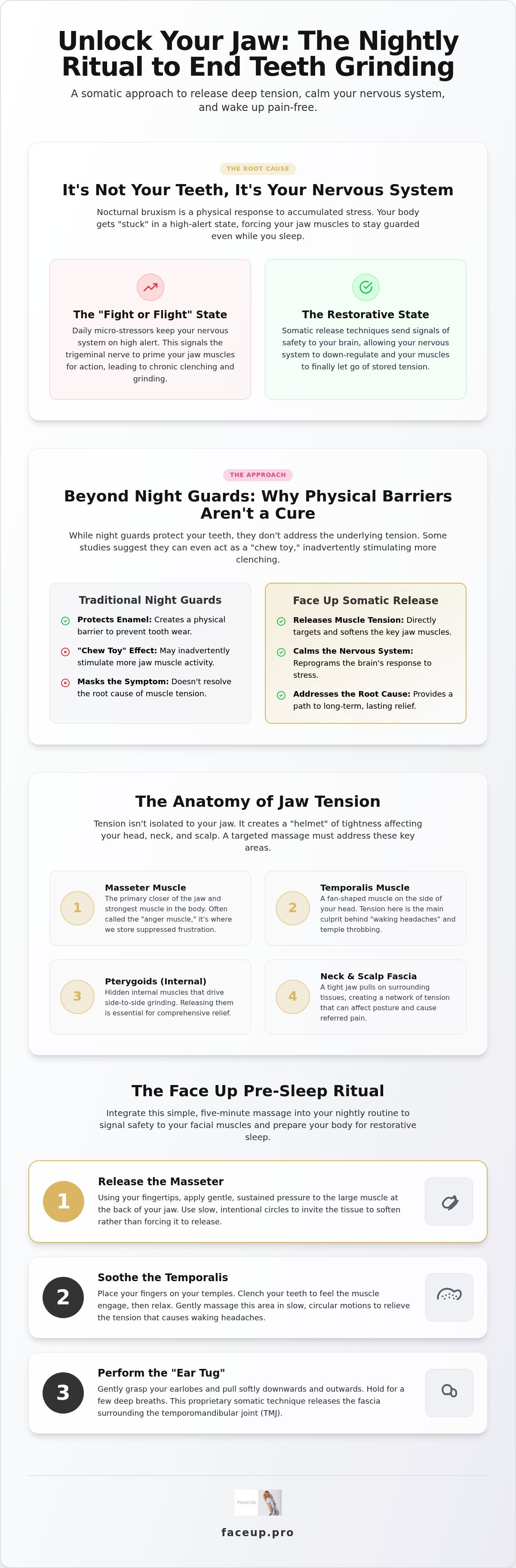
The Face Up Pre-Sleep Ritual: A Step-by-Step Massage Guide
Establishing a dedicated ritual is the bridge between a high-stress day and a restorative night's sleep. While many focus on quick fixes, this structured massage for jaw clenching at night is designed to communicate safety to your nervous system through intentional touch. By following this sequence, you move beyond simple muscle rubbing and into the realm of somatic reprogramming.
- Step 1: Preparation. Begin by thoroughly cleaning your face and hands. Apply a high-quality oil or balm to provide the necessary glide, ensuring you don't pull or irritate the delicate facial skin.
- Step 2: The Ear Tug. This somatic technique targets the fascia surrounding the TMJ. Gently grasp your earlobes and pull them slightly outward and downward, holding for several deep breaths to encourage the connective tissue to soften.
- Step 3: Intra-oral Release. Using a clean thumb, reach inside the mouth to address the pterygoid muscles. This internal work is the most effective way to deactivate the drive for side-to-side grinding.
- Step 4: The Temple Sweep. Place your fingertips on your temples and use slow, rhythmic upward strokes. This movement helps soothe the trigeminal nerve and signals the brain to exit "fight or flight" mode.
- Step 5: Integration. Conclude the ritual with three minutes of box breathing. Inhale for four counts, hold for four, exhale for four, and hold for four to "lock in" the physical relaxation you've just created.
For those who want a guided experience to ensure every movement is performed correctly, the Face Up App Subscription provides daily video rituals that walk you through these steps in real-time.
Technical Guidance for Intra-oral Massage
Safety and hygiene are paramount when working inside the mouth. Always use a clean thumb or a nitrile glove to reach the internal jaw muscles. Once you've located the pterygoids, apply the "hook and breathe" technique: gently hook your thumb into the area of highest tension and hold it while taking three slow, expansive breaths. The goal is to find the "sweet spot" where the pressure is firm but doesn't cause you to recoil or hold your breath. If the sensation is too intense, reduce the pressure; somatic release relies on the body's willingness to let go, not force.
Optimising Your Sleep Environment
Your physical environment plays a significant role in how your jaw behaves once you fall asleep. Ensure your pillow height keeps your neck in a neutral position, as a head tilted too far forward or back can put undue strain on the TMJ. During the day and as you drift off, practice keeping your tongue gently resting on the roof of the mouth, just behind the front teeth. To maintain a neutral jaw posture throughout the night, follow the rule of keeping your lips together and your teeth apart.
Integrating Jaw Release into Your Lifestyle
Consistency is the cornerstone of somatic healing. While it's tempting to seek a long, occasional session to "fix" the problem, your nervous system responds far better to frequent, gentle reminders of safety. Dedicating just five minutes to a massage for jaw clenching at night every evening is significantly more effective than a sixty-minute treatment once a month. This regular cadence prevents tension from reaching a critical threshold, ensuring your muscles don't enter the night in a state of high alert. By making this a non-negotiable part of your wind-down routine, you create a reliable "gateway" to restorative sleep.
To help you maintain this vital consistency, the Face Up App Subscription offers a structured environment for your daily practice. It serves as a digital mentor, providing guided rituals that take the guesswork out of your evening routine and keep you accountable. For those navigating chronic TMJ issues that require a more comprehensive approach, our Jaw Release Course provides an intensive deep dive into the mechanics of tension. If you find that self-directed work isn't enough, you can seek out a professional Somatic Bodywork Session with a certified expert from our practitioner directory to address deeper structural imbalances.
Daily Habit Stacking
The tension you feel at midnight often begins at midday. Integrating "micro-releases" into your workday is essential for preventing the cumulative buildup that leads to nocturnal clenching. Be mindful of "tech-neck" and poor posture; a forward-leaning head position puts immense strain on the jaw structures and the trigeminal nerve. Viewing your jaw care as a form of "emotional hygiene" allows you to process micro-stressors in real-time rather than storing them in your masseters. Simple checks throughout the day to ensure your teeth are apart can change your baseline tension levels significantly.
The Path to a Tension-Free Face
Embracing a somatic approach offers benefits that extend far beyond the absence of pain. By mastering the massage for jaw clenching at night, you invite better sleep quality, a reduction in chronic headaches, and a more relaxed, defined jawline. This journey is about more than just physical relief; it's about reclaiming the connection between your mind and your body. When you signal safety to your nervous system, your entire face reflects that internal calm, appearing more youthful and vibrant. To begin your comprehensive transformation and master these techniques, Join the Jaw Release Course today and discover the lasting power of the Face Up Method™.
Reclaim Your Morning with Somatic Rituals
Breaking the cycle of nocturnal tension requires more than just a physical barrier between your teeth. By shifting from passive protection to the active, neurological reset of the Face Up Method™, you address the root cause of your discomfort. You now understand that your jaw is a storage site for daily stress and that true relief comes from signaling safety to your nervous system before you sleep. This transition from "body armoring" to active release is the key to preserving both your dental health and your facial structure.
Founder Olga Newman has spent years refining this expert approach to somatic bodywork; it's a methodology now utilized by certified practitioners globally. Incorporating a targeted massage for jaw clenching at night into your evening routine isn't just about muscle relaxation; it's a holistic, non-invasive commitment to your long-term wellness. When you prioritize this neurological de-escalation, you're choosing a path of professional self-care that yields visible, lasting results.
You don't have to navigate this journey alone. To make these practices a seamless and accountable part of your lifestyle, Download the Face Up App for Daily Jaw Rituals. Waking up refreshed and pain-free is a standard you can absolutely achieve. Your path to a calm, tension-free morning starts with your first ritual tonight.
Frequently Asked Questions
How long should I massage my jaw before bed?
A massage for jaw clenching at night should ideally last between five and ten minutes. Consistency is far more valuable than intensity; a short, focused ritual performed every evening is more effective than a long session done once a week. This duration allows enough time to move through the Face Up Method™ sequence without causing irritation to the skin or underlying muscles.
Can massage for jaw clenching help with my morning headaches?
Yes, targeted release work can significantly reduce the frequency and intensity of morning headaches. These "waking headaches" are often caused by tension in the temporalis muscle, which fans across the side of the head. By deactivating this muscle through somatic massage before sleep, you prevent the buildup of pressure that leads to throbbing temples or a "heavy" head upon waking.
Is it safe to massage my jaw from the inside of my mouth?
Intra-oral massage is safe and highly effective when performed with clean hands or a nitrile glove. It's the only way to directly access the lateral and medial pterygoid muscles, which are the primary drivers of side-to-side grinding. This technique is a core component of the Face Up Method™ and is essential for achieving deep, structural relief from chronic tension.
Why do I still clench even when I use a night guard?
Night guards are designed to protect your enamel, but they don't address the neurological drive to clench. In fact, some people experience the "chew toy" effect, where the presence of the guard actually stimulates the jaw to bite down harder. Integrating a massage for jaw clenching at night helps reprogram the muscle-brain connection, addressing the somatic cause rather than just the dental symptoms.
How quickly will I see results from a somatic jaw ritual?
You'll likely feel a sense of immediate physical ease after your first session, but neurological reprogramming takes time. Most individuals report a significant reduction in morning soreness and tension after 21 to 30 days of consistent nightly practice. Lasting change occurs as your nervous system learns that it no longer needs to maintain a defensive posture during sleep.
Can jaw clenching at night cause my face to look wider?
Chronic clenching can lead to masseter hypertrophy, where the jaw muscles grow larger from constant, involuntary exercise during the night. This often results in a wider, more square-shaped lower face. By using somatic techniques to release this tension, you can naturally slim the appearance of the jawline as the muscles return to a more relaxed and neutral state.
What is the best oil to use for a jaw release massage?
The best choice is a high-quality, non-comedogenic oil that provides sufficient glide without clogging your pores. Jojoba oil, squalane, or a lightweight facial balm are excellent options. Using an oil ensures that you can perform the Face Up Method™ techniques smoothly, preventing any unnecessary pulling or friction on the delicate skin of the face, jawline, and neck.


