

What if the persistent clicking in your jaw isn't just a mechanical glitch, but a physical echo of your nervous system's response to stress? You likely know the frustration of waking up with a sore jaw or managing chronic tension headaches that feel as though they're woven into your very skin. It's exhausting to feel like stress is physically stuck in your face, manifesting as popping sounds every time you eat or speak. Establishing a daily face massage routine for tmj is often the first step toward reclaiming your comfort, yet many traditional methods only scratch the surface of the problem.
We believe that true relief comes from a somatic dialogue with your body rather than a simple mechanical rub. In this guide, you'll discover how the professional Face Up™ approach releases deep muscular and emotional tension to provide lasting jaw relief. We'll walk you through specialized techniques designed to ease the physical weight of chronic pain, moving you toward a state of calm efficiency and facial ease. You're about to learn how to transform a basic habit into a sophisticated ritual for your professional and personal well-being.
Key Takeaways
- Understand why the jaw acts as the primary container for emotional stress and how somatic release addresses the root cause of tension.
- Identify the specific roles of the masseter and temporalis muscles in chronic headaches to target your relief more effectively.
- Discover how the proprietary Face Up Method™ serves as a high-standard alternative to invasive procedures while naturally sculpting the face.
- Master a structured daily face massage routine for tmj that integrates fascia warming and nervous system regulation for sustainable relief.
- Explore the path toward professional advancement with Face Up Method Certification or establish a consistent daily practice through the Face Up App.
Understanding TMJ Tension: Why Your Jaw Holds Emotional Stress
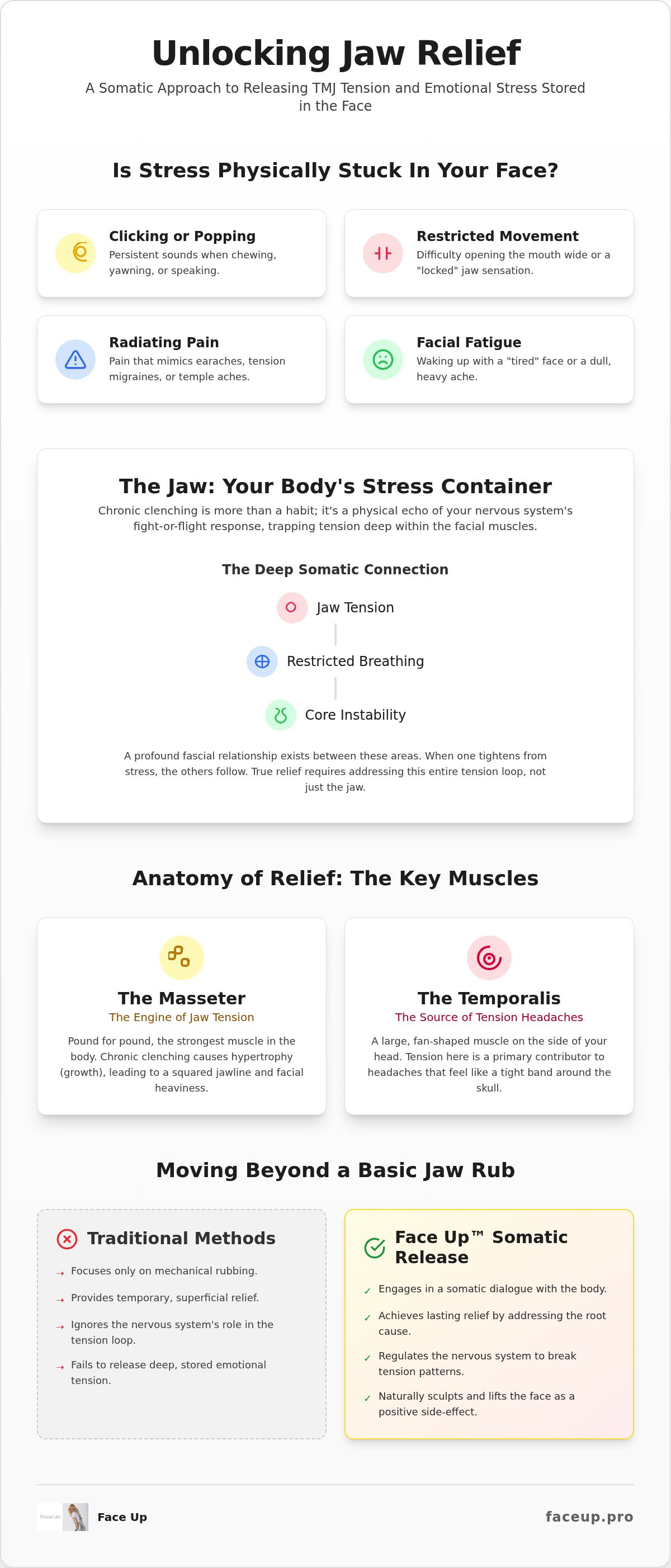
The temporomandibular joint is one of the most complex structures in the human body, acting as the pivot point for speech, nourishment, and expression. When this delicate system falls out of balance, it results in Temporomandibular joint dysfunction. You might recognize this through a variety of disruptive symptoms that impact your professional and personal life:
- Persistent clicking or popping sounds when chewing or speaking.
- Restricted range of motion when opening the mouth wide.
- Radiating pain that mimics an earache or a tension migraine.
- Waking up with a "tired" face or a dull ache in the temples.
While many clinical perspectives treat this as a purely mechanical joint failure, it's often the result of somatic storage. The jaw is the body's primary container for emotional stress. It's where we physically hold back what we cannot say or "grit our teeth" through demanding obligations. This chronic clenching isn't just a habit; it's a physical manifestation of your body's attempt to manage the weight of your environment.
Managing these daily obligations often requires a reliable support network; for instance, parents looking to reduce their mental load can discover Lucy Bird Early Learning LLC for comprehensive childcare and preschool services that allow for more focus on personal well-being.
The masseter muscle is remarkably powerful, yet it's also deeply connected to our survival instincts. During a fight or flight response, the brain signals the jaw to clench to protect the throat and stabilize the skull. In our fast paced world, this reflex rarely gets the chance to fully reset. Over time, chronic tension pulls on the fascia, which can lead to visible changes in facial symmetry and even affect your overall posture. Adopting a daily face massage routine for tmj is a proactive way to communicate safety to your nervous system and release these deep seated habits.
The Somatic Connection: More Than Just a Hinge
The jaw acts as a sophisticated gateway for both emotional expression and suppression. There is a profound fascial relationship between the jaw, the diaphragm, and the pelvic floor; when one area tightens, the others usually follow. This is why a simple "jaw rub" often fails to provide lasting relief. Without somatic awareness, you aren't addressing the nervous system's role in the tension loop. True release requires a professional, holistic approach that acknowledges these deep biological connections and moves beyond mere mechanical manipulation—this is where the MindSHIFT coaching offered by Cindy Legare can help you address the subconscious patterns that contribute to physical tension.
Identifying Your Tension Patterns
To find sustainable relief, you must first recognize your specific patterns of holding. Try a simple self assessment: place your fingers just in front of your ears and open your mouth slowly. Do you feel a "jump" or hear a click? Now, gently press into the fleshy part of your cheek. If you find spots that feel like hard grains of sand, those are trigger points where the muscle has stayed contracted. It's vital to distinguish between muscular fatigue, which feels like a dull, heavy ache, and joint inflammation, which is often sharp. Identifying these nuances is the foundation of an effective daily face massage routine for tmj.
The Anatomy of Relief: Key Muscles Targeted in a TMJ Massage Routine
To master a daily face massage routine for tmj, you must first understand the landscape of the muscles you are addressing. While the nervous system triggers the tension, the muscles are the physical archives where that stress is stored. Effective relief isn't about general rubbing; it requires a precise, anatomical approach to the structures that govern your jaw's movement and stability. By identifying these key players, you can move from superficial touch to deep, restorative release.
The Masseter: The Engine of Jaw Tension
The masseter is the primary architect of jaw pain. Pound for pound, it's the strongest muscle in the human body, capable of exerting immense pressure on your molars. You can easily locate it by placing your fingers on the back of your jaw and clenching your teeth; the firm bulge you feel is the masseter. Chronic clenching causes this muscle to undergo hypertrophy, which often leads to a wider, more squared jawline and a constant sense of facial heaviness. Because this muscle is exceptionally dense, effective TMJ massage techniques must penetrate beyond the skin to address the deep fibers where knots reside. Sinking into these layers with slow, intentional pressure is the only way to signal the muscle to let go of its protective grip.
Secondary Muscles: The Supporting Cast
While the masseter does the heavy lifting, several other muscles contribute to the "locked" feeling associated with TMJ dysfunction. The temporalis is a fan shaped muscle that covers your temples. If you experience pressure behind your eyes or headaches that wrap around your skull, the temporalis is likely overactive. Releasing it requires working upward into the scalp, following the muscle's broad attachment points.
Equally important are the pterygoids, which sit behind the jawbone. These are the muscles responsible for lateral movement and grinding. Because they're located deep within the facial structure, they are often the "missing link" in traditional massage. Accessing them sometimes requires buccal massage, or working from the inside of the mouth, to reach the root of the tension. Finally, we must look at the neck and scalp. The Sternocleidomastoid (SCM) and suboccipital muscles at the base of the skull often tighten in response to jaw pain, creating a cycle of poor posture and restricted movement. To truly break this cycle, your routine must address the jaw as part of this larger, interconnected system. If you're looking for a structured way to navigate these complex muscle groups, the Face Up App provides guided rituals that ensure every movement is anatomically precise.
Your oral posture also plays a significant role in muscle activity. If your tongue isn't resting on the roof of your mouth, your jaw muscles never truly find a state of repose. Integrating these anatomical insights into your daily face massage routine for tmj ensures that you are treating the cause, not just the symptom.
Why Somatic Facial Sculpting Surpasses Basic Jaw Rubs
While a quick rub of the cheeks might provide temporary relief, it rarely addresses why the tension exists in the first place. Most online tutorials offer "hacks" that treat the jaw like a mechanical hinge that just needs oiling. The Face Up Method™ shifts the focus toward fascial unwinding. This technique uses slow, intentional movements rather than aggressive rubbing. By working with the fascia, we allow the tissue to reorganize and lengthen, which creates a more sustainable shift in your comfort levels.
This approach aligns with medical recommendations, as even the Mayo Clinic advocates for gentle stretching and massage for TMJ to manage symptoms at home. However, somatic sculpting adds a layer of nervous system regulation. When you integrate breathwork into your daily face massage routine for tmj, you signal to your brain that it's safe to let go of the protective clenching habit. This down-regulation is the difference between a fleeting moment of ease and a lasting neuromuscular change.
Holistic Rejuvenation vs. Clinical Treatment
One of the most significant advantages of this somatic approach is the aesthetic benefit. Chronic jaw tension often leads to masseter hypertrophy, which can make the lower face appear wider or more heavy. By releasing these deep muscular contractions, you naturally slim and lift the face without the need for invasive masseter Botox. This process also stimulates lymphatic drainage, effectively clearing away morning puffiness and restoring a refreshed, healthy glow. It's about building a respectful relationship with your face through somatic touch, viewing your body as a partner in your professional readiness rather than a burden to be managed.
The Face Up Advantage
True relief isn't found in isolation. A comprehensive daily face massage routine for tmj must integrate the neck, chest, and face to be truly effective. Tension in the jaw is rarely an isolated event; it's often tethered to tightness in the décolleté or restricted breathing patterns. Our specialized tmj massage therapy focuses on these interconnected zones to ensure a complete release. For those looking to deepen their at-home results, using a dedicated tmj massage tool can help reach those difficult pterygoid muscles and provide consistent, professional-grade pressure. By moving beyond simple symptom management, you create the conditions for a face that feels as vibrant as it looks.
Your 5-Step Daily Face Massage Routine for TMJ Release
Establishing a consistent ritual is the most effective way to reprogram your nervous system and break the cycle of chronic clenching. This isn't just a list of exercises; it's a somatic practice designed to bring your awareness back to the present moment. Before beginning your daily face massage routine for tmj, find a quiet space where you won't be interrupted. Take three deep, diaphragmatic breaths to signal to your body that it's safe to relax. Cleanse your hands and face, and ensure you have a comfortable seat with your feet flat on the floor.
- Step 1: Warming the Fascia. Start by placing your palms on your décolleté. Gently sweep your hands upward along the sides of your neck toward the base of your ears. This opens the lymphatic pathways and prepares the tissue for deeper work.
- Step 2: The Masseter Melt. Place your knuckles or the pads of your fingers on the thickest part of your jaw muscle. Instead of rubbing, simply lean the weight of your head into your hands. Wait for the tissue to "melt" and accept the pressure.
- Step 3: The Temporal Lift. Use your fingertips to apply firm, upward circles on your temples. Imagine you are lifting the skin toward the top of your head to relieve the pressure behind your eyes.
- Step 4: Intraoral Awareness. With a clean thumb inside your cheek and your index finger on the outside, gently compress the masseter muscle. This buccal approach allows you to reach the deeper pterygoid muscles that are often inaccessible from the outside.
- Step 5: Integration. End the ritual by resting your hands over your face, feeling the warmth and the new space you've created in your jaw.
Mastering the 'Melt' Technique
The secret to a successful daily face massage routine for tmj lies in the "sink-in" method. Sliding your fingers over the skin often causes friction and superficial irritation. Instead, apply static pressure and wait for the muscle fibers to yield. Keep your mouth slightly open, with your tongue resting on the roof of your mouth and your teeth apart. This position prevents the muscles from counter-contracting against your touch. For a more immersive experience with visual guidance, you can access the Face Up App to follow along with our professional practitioners.
Safety and Contraindications
While somatic massage is generally safe, you should avoid these techniques if you have acute inflammation, an active skin infection, or have had dental work within the last 48 hours. You might feel a "productive" soreness, which feels like a satisfying release of a deep knot. However, if you experience sharp, radiating pain or increased joint clicking, reduce your pressure immediately. For the best results, perform this ritual once daily, preferably in the evening to release the day's accumulated stress before sleep.
Elevating Your Practice: From Daily Rituals to Professional Certification
While a consistent daily face massage routine for tmj provides the foundation for relief, many find that chronic tension requires a more sophisticated intervention. Moving beyond the basics allows you to address the deeper layers of somatic storage that a five-minute ritual might only graze. The Face Up ecosystem is built to support this progression, offering a structured path from self-care to professional mastery. By engaging with these higher-level resources, you move from managing symptoms to mastering the underlying dialogue between your nervous system and your muscles.
The Jaw Release Course: A Deep Dive
For those ready to commit to a permanent shift, the Jaw Release Course offers a comprehensive digital workshop. This curriculum is specifically designed for chronic clenchers who feel that stress is physically locked within their skeletal structure. It bridges the gap between simple home routines and professional-grade therapy by teaching the nuances of fascial unwinding and nervous system down-regulation. Participants can expect a transformative journey over 21 days, moving through phases of awareness, release, and stabilization. This course provides the professional authority needed to navigate your own anatomy with confidence, resulting in a face that feels lighter and a jaw that moves with calm efficiency.
Becoming a Face Up Practitioner
The landscape of professional wellness is shifting toward non-invasive, somatic-based solutions. If you are a therapist or aesthetician, obtaining a facial sculpting certification is a powerful way to expand your clinic’s offerings. The Face Up Method™ is rooted in the science of somatic bodywork, providing a reliable framework that practitioners worldwide are adopting to achieve superior results. This certification doesn't just teach a technique; it invites you into a proprietary ecosystem of global standards and professional advancement. Certified providers are featured in our Practitioner Directory Listing, making it easy for clients to find high-standard care in their own jurisdiction.
For those who prefer a guided experience, the Face Up App Subscription serves as a rhythmic gateway to daily relief. It ensures your daily face massage routine for tmj is performed with the correct pressure and flow, preventing the common mistakes of aggressive rubbing. If you find that your tension requires hands-on intervention, booking a Somatic Bodywork Session with a certified professional can provide the deep release necessary to reset your system. We invite you to join this specialized community, where integrity and proactive management lead to a life free from the burden of jaw pain.
Empowering Your Journey Toward Lasting Facial Freedom
Reclaiming your comfort begins with the realization that your jaw isn't just a joint; it's a reflection of your internal state. We've examined how the masseter and temporalis muscles act as archives for stress and how a somatic approach facilitates a deeper release than traditional methods. By integrating a daily face massage routine for tmj into your life, you're choosing a path of proactive management rather than reactive symptom control. This holistic perspective, championed by somatic expert Olga Newman, ensures that your results are both physically restorative and aesthetically rejuvenating.
The proprietary Face Up Method™ stands as a reliable, non-invasive alternative to clinical procedures, offering a sophisticated ecosystem for both individuals and professionals. It's time to move beyond the burden of chronic clenching and embrace a state of calm efficiency. Release your jaw tension today with the Face Up Jaw Release Course and step into a specialized community dedicated to global standards of wellness. You deserve a face that feels as open and expressive as you are. We're here to guide you toward that lasting relief.
Frequently Asked Questions
Can face massage really help with severe TMJ pain?
Yes, somatic face massage is highly effective for severe pain because it addresses both the muscular and nervous system components of the disorder. While it isn't a cure for structural joint damage, it significantly reduces the protective clenching that exacerbates pain. By practicing a daily face massage routine for tmj, you can lower the intensity of flare ups and improve your overall quality of life. Consistent application helps retrain your muscles to find a state of repose.
How often should I massage my jaw for TMJ relief?
You should aim to perform your jaw massage ritual once every day to achieve the most sustainable results. Consistency is more important than duration; a focused five minute session is more beneficial than an occasional hour long treatment. This frequency allows you to prevent tension from accumulating into chronic pain. If you're experiencing an acute flare up, you might find relief by performing shorter, gentler sessions twice daily until the intensity subsides.
What is the best time of day to perform a TMJ massage ritual?
The evening is generally the most effective time to perform your ritual because it allows you to release the day's accumulated stress before sleep. Many people clench their teeth subconsciously during the night, so relaxing the masseter and temporalis muscles before bed can improve sleep quality and reduce morning soreness. However, if you wake up with significant stiffness, a brief morning session can help clear the lymphatic system and restore mobility for the day ahead.
Is it safe to do intraoral (buccal) massage on myself?
Yes, performing intraoral massage on yourself is safe and often necessary to reach the deep pterygoid muscles. Always ensure your hands are thoroughly cleaned before beginning. Use a light, "sink in" pressure rather than a pulling motion on the delicate internal tissues. If you feel any sharp pain or have active mouth sores, you should skip this step. This technique is a cornerstone of a professional daily face massage routine for tmj because it addresses tension from the inside out.
Can jaw massage help with tension headaches and migraines?
Jaw massage is an excellent tool for alleviating tension headaches and migraines because these conditions are often linked to temporalis muscle tightness. When the jaw is locked, the tension radiates upward into the temples and the base of the skull. By releasing the masseter and temporalis, you reduce the mechanical pull on the cranial fascia. Many people find that regular jaw release significantly decreases the frequency and severity of their chronic headaches.
Will massaging my jaw change the shape of my face?
Massaging your jaw can lead to visible changes in your face shape by reducing masseter hypertrophy. When you stop chronic clenching, the masseter muscle loses its excessive bulk, which often results in a slimmer, more contoured lower face. Additionally, the somatic techniques used in the Face Up Method™ promote lymphatic drainage. This clearing of stagnant fluid reduces morning puffiness and restores a more defined, lifted appearance to your jawline and cheekbones.
What should I do if my jaw clicks or pops during massage?
If your jaw clicks or pops, you should immediately reduce your pressure and ensure your mouth is only slightly open. Clicking often indicates that the joint disc is slightly out of place, and aggressive rubbing can increase inflammation. Focus on the soft tissues around the joint rather than the joint itself. If the clicking is accompanied by sharp pain or if your jaw "locks" in place, it's vital to stop the massage and seek a professional assessment.
When should I see a professional instead of doing self-massage?
You should seek professional help if your pain is sharp, radiating into your neck, or if you experience a sudden loss of jaw mobility. While self care is powerful, some complex cases require the expertise of a certified Face Up practitioner to address deep seated somatic patterns. If your symptoms don't improve after several weeks of consistent daily practice, a professional Somatic Bodywork Session can provide the deeper intervention needed to reset your system.


