

What if the very exercises you are doing to lift your face are actually etching deeper lines into your skin? It’s a common concern for those navigating the choice between facial sculpting vs face yoga. You likely want a defined jawline and a youthful glow, yet the repetitive movements of traditional face yoga can feel counterproductive or even painful if you struggle with chronic jaw tension.
It is easy to feel confused by the conflicting advice to 'tone' muscles when your face actually feels like it needs to 'release.' This article helps you discover the critical differences between repetitive facial exercises and somatic sculpting so you can choose the most effective path for your unique face. We will look at how manual tissue remodeling and the Face Up Method™ target deep muscular tension to reduce puffiness and restore a natural, relaxed radiance without ever reaching for a needle.
Key Takeaways
- Understand the fundamental differences between facial sculpting vs face yoga to determine if your face requires muscle toning or deep tension release.
- Learn why performing repetitive exercises on already tense muscles can inadvertently deepen wrinkles instead of smoothing them.
- Discover how to perform a simple 'Tension Test' to identify if your facial structures are hypertonic or simply in need of manual remodeling.
- Explore the professional evolution of natural rejuvenation through the Face Up Method™, which integrates somatic bodywork for long-term facial longevity.
- Compare the timelines for visible results, ranging from the gradual hypertrophy of exercises to the immediate depuffing effects of manual sculpting.
Understanding Natural Rejuvenation: What is Facial Sculpting and Face Yoga?
The beauty industry in 2026 is undergoing a profound transformation. We're seeing a decisive shift toward holistic aesthetics, where the goal isn't just a temporary fix but long-term facial longevity. This movement prioritizes the health of the skin and underlying structures over invasive alterations. As more individuals seek ways to age gracefully, the debate of facial sculpting vs face yoga has moved to the forefront of the conversation. Both methods promise rejuvenation, yet they operate on fundamentally different principles of anatomy and physiology.
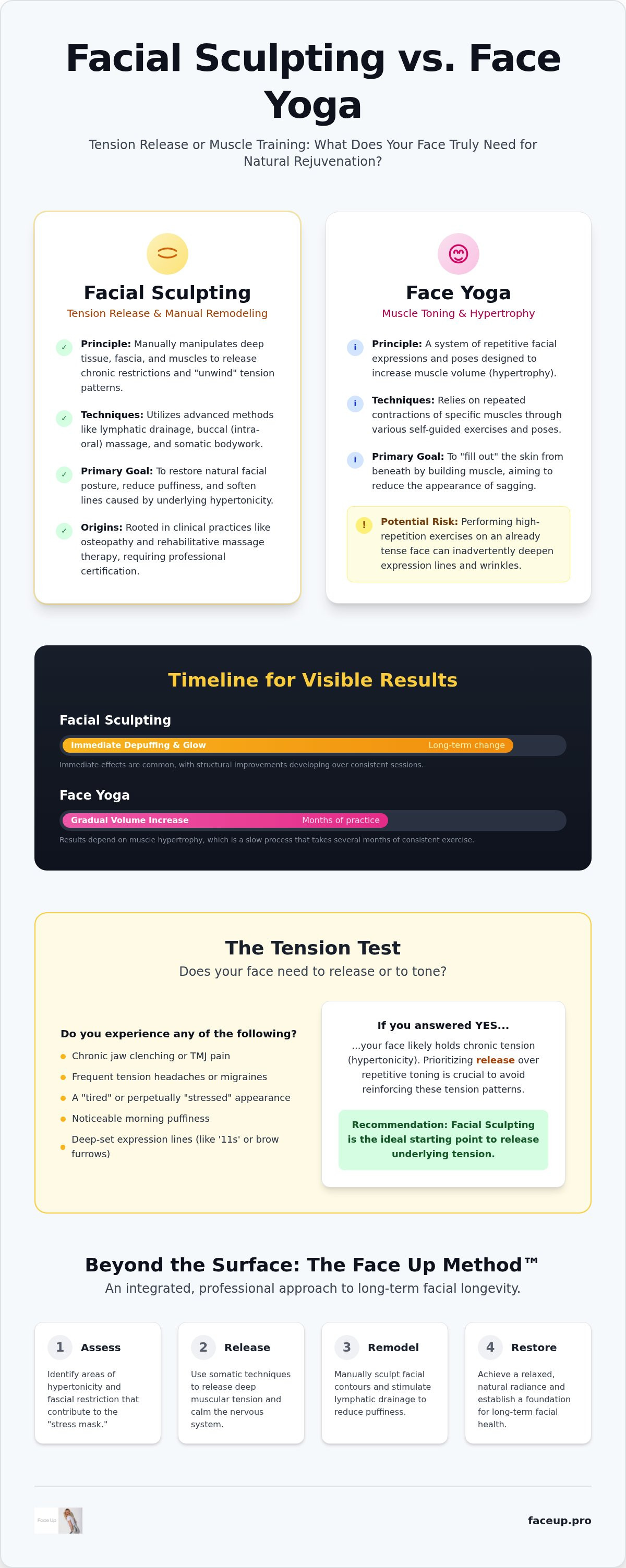
Face yoga is essentially a system of facial toning that relies on repetitive expressions and poses. The objective is hypertrophy; by repeatedly contracting specific muscles, you aim to increase their volume to "fill out" the skin from beneath. In contrast, facial sculpting is a manual manipulation of the tissue. It incorporates advanced techniques such as lymphatic drainage and buccal (intra-oral) massage to remodel the face from the inside out. While face yoga asks you to work your muscles harder, sculpting focuses on releasing the restrictions and tension that cause aging in the first place.
The Origins of Facial Exercise vs. Manual Therapy
Traditional face yoga emerged as an adaptation of ancient yoga practices, translating body poses into movements for the 57 muscles of the face and neck. It’s often marketed as a "natural facelift" you can perform yourself at home. However, facial sculpting has a more clinical lineage, rooted in osteopathy and rehabilitative massage therapy. Because sculpting involves deep tissue work and precise manual pressure, professional facial sculpting certification has become a vital requirement for practitioners. This formal training ensures that the delicate structures of the face are handled with anatomical expertise rather than guesswork.
Common Goals: Why We Seek Natural Alternatives
Most people start exploring these methods because they want to address specific signs of aging without the "frozen" appearance associated with neurotoxins. The desire for a "snatched," contoured jawline is a primary driver, but the goals often go deeper. Common objectives include:
- Softening the depth of nasolabial folds and marionette lines.
- Lifting sagging tissue along the cheeks and jowls naturally.
- Reducing chronic puffiness through improved lymphatic flow.
- Restoring a relaxed, vibrant glow to the skin.
The Science of Somatics: Why Tension Release Trumps Muscle Training
The common mistake in the facial sculpting vs face yoga debate is the assumption that facial muscles behave exactly like the muscles in your body. When you go to the gym, the goal is often hypertrophy, or building muscle mass. However, your facial muscles are unique because they are attached directly to the skin. While some scientific studies suggest that targeted exercises might increase cheek volume over several months, they often overlook the impact of hypertonicity. This is a state where muscles remain stuck in a semi-contracted position due to chronic stress or habit.
If your muscles are already hypertonic, adding repetitive "yoga" movements can actually be counterproductive. Think of a piece of paper being folded in the same spot thousands of times; eventually, the crease becomes permanent. When you perform high-repetition exercises on a face that already carries tension, you risk deepening expression lines rather than smoothing them. True rejuvenation requires remodeling the tissue through release, not just bulking it up through effort. If you're ready to experience this release firsthand, exploring a professional sculpting session can provide the clarity your skin needs.
The Role of the Nervous System in Facial Ageing
Your face is a primary landing site for the nervous system's 'fight or flight' response. Daily micro-stressors manifest as a perpetually clenched jaw, a furrowed brow, or tightened lips. This isn't just a mood; it’s a physical state that restricts blood flow and lymphatic drainage, leading to a duller complexion and accelerated sagging. Somatic release techniques are essential because they address the root cause of this "stress mask." By integrating tmj massage therapy, practitioners can help reset the nervous system, allowing the facial features to soften and lift naturally as the underlying tension dissolves.
Buccal Massage: The Deep Tissue Difference
One of the most effective tools in the facial sculpting arsenal is buccal massage. This intra-oral technique allows a practitioner to access the muscles from both the inside and outside of the mouth. This dual-sided approach reaches the deep masseter and lateral pterygoid muscles, areas that traditional face yoga simply cannot touch. Manual sculpting breaks down internal adhesions and "knots" in the muscle fibers that restrict movement and pull the face downward. By releasing these deep-seated contractions, you achieve an immediate, visible lift in the lower face and a significant reduction in jaw-related puffiness.
Facial Sculpting vs. Face Yoga: A Direct Comparison
Choosing between facial sculpting vs face yoga requires an understanding of how each method interacts with your specific anatomy. While they share the goal of natural rejuvenation, their mechanisms are polar opposites. Face yoga relies on active, repetitive muscle contractions to build volume. It's a form of resistance training for the 57 muscles in your face and neck. Facial sculpting, however, is a practitioner-led or ritualistic manual therapy. It prioritizes the passive release of the fascia and the drainage of stagnant lymphatic fluid to reveal the underlying bone structure.
The timeline for results also differs significantly. Because face yoga aims for muscle hypertrophy, it demands a high level of consistency. You'll likely need to practice for 20 minutes daily for several months before noticing structural changes. Facial sculpting offers a more immediate gratification. By manually moving fluid and releasing the tight "knots" in the masseter muscles, a single session can produce a visible lift and a reduction in puffiness. This makes sculpting a preferred choice for those seeking a "snatched" look for an upcoming event, while yoga is a long-term commitment to building muscle mass.
Which Method is Better for Your Face Shape?
Your unique facial structure should dictate your chosen method. Individuals with "gaunt" or thin faces often have less subcutaneous fat. They should approach aggressive face yoga with caution; overworking these muscles can sometimes lead to a more hollowed appearance if not balanced with restorative techniques. Conversely, those with "heavy" or puffy faces prone to fluid retention will find immense value in sculpting. The manual manipulation effectively clears the pathways for lymphatic drainage, sharpening the jawline and cheekbones. If you're looking to bridge the gap between professional treatments and home care, using a tmj massage tool can help you maintain that sculpted look by addressing jaw tension daily.
The Longevity Factor: What Happens After 5 Years?
When we look at the five-year horizon, the sustainability of each method becomes clear. Building muscle mass through face yoga can provide a supportive internal "scaffold" for the skin as we age. However, without the release provided by sculpting, this extra muscle can sometimes contribute to a "hardened" or perpetually tense facial expression. Regular sculpting prevents the soft tissues from adhering to the bone, ensuring the face remains mobile and radiant. Many professionals now advocate for a balanced routine: use face yoga for structural "fitness" and facial sculpting for "recovery" and fluid management. This dual approach ensures you aren't just building a stronger face, but a more relaxed and youthful one.
Identifying Which Method Your Face Actually Needs
Deciding between facial sculpting vs face yoga shouldn't be a matter of guesswork. Your face provides clear physical cues that indicate whether your muscles are over-contracted, a state known as hypertonicity, or simply lack volume. Most modern professionals live in a state of high stress; this often means the face is already over-worked by unconscious tension. In these cases, adding more exercise through face yoga can be like trying to run a marathon on a cramped leg. You must first address the state of the tissue before you can effectively change its shape.
You likely need facial sculpting if you wake up with morning puffiness, experience jaw clicking, or notice heavy jowls. These are classic signs of stagnant lymph and hypertonic muscles pulling the features downward. If you notice a loss of cheek volume or a flat appearance in the mid-face without significant tension, face yoga can help build the necessary muscle mass. But the most effective path usually starts with release. Once the stress mask is removed through manual sculpting, any subsequent toning becomes far more visible and sustainable. If you're ready to start your journey, you can find a certified practitioner in our directory to receive a professional assessment of your facial needs.
The Jawline Check: A Quick Self-Assessment
You can perform a simple check right now to determine your immediate needs. Place your fingers on your jaw, just in front of your ears, and clench your teeth firmly. If you feel hard, rope-like knots or experience tenderness, your masseters are hypertonic. Next, gently press the area just above your collarbone. If it feels boggy or stays slightly indented for a second, you have lymphatic stagnation. A truly defined jawline requires clearing this fluid and releasing these knots before you ever attempt a strengthening pose. Exercise alone cannot fix a jawline that is being obscured by fluid and tension.
Creating Your Personal Ritual
Integration is the secret to seeing lasting results. You don't need hours; you need a consistent rhythm that respects your body's natural cycles. Try incorporating five minutes of manual sculpting into your evening skincare routine using a high-quality facial oil. This signals to your nervous system that it's time to downregulate and release the day's stress. Conversely, use a few targeted face yoga poses in the morning to wake up the muscles and provide a natural lift for the day ahead. This balanced approach ensures you aren't just building a stronger face, but a more relaxed and youthful one.
Beyond the Surface: The Face Up™ Professional Approach
The Face Up Method™ represents a professional evolution in the facial sculpting vs face yoga landscape. It isn't just about moving muscles; it’s a proprietary fusion of somatic bodywork and manual tissue remodeling. While face yoga focuses on active movement, this method prioritizes the passive release of deep-seated emotional and physical tension. This approach ensures that rejuvenation isn't forced but invited through the intelligent manipulation of the fascia and musculature. It moves the focus from simple repetition to a more sophisticated understanding of how the face reflects our internal state.
Professional certification is a cornerstone of this ecosystem, especially for those performing buccal massage. This technique involves working inside the oral cavity to release the masseter muscles from both sides. It requires precise anatomical knowledge that goes beyond what a casual DIY video can provide. By choosing a certified professional from our Practitioner Directory Listing, you're ensuring that your treatment is governed by high standards of safety and efficacy. This level of care is vital for anyone looking to address chronic jaw tension or structural sagging without invasive surgery. It’s about more than just a temporary lift; it’s about maintaining the long-term integrity of the facial structures.
The Somatic Difference in Professional Training
Face Up practitioners are trained to look beyond the surface. They understand that facial ageing is often a physical reflection of the nervous system's state. What sets a Face Up professional apart is their ability to facilitate holistic regulation, moving the body from a state of 'fight or flight' into one of 'rest and restore.' This global community of practitioners is dedicated to natural rejuvenation that respects the body's biological limits while achieving profound aesthetic results. By choosing a Somatic Bodywork Session, you're investing in a treatment that calms the mind as much as it contours the face.
Next Steps: Starting Your Journey
You don't have to navigate this path alone. For those who want to integrate these principles into their daily life, the Face Up App Subscription offers guided somatic rituals designed for the modern professional. These daily sessions help you release the stress that accumulates during the workday, preventing it from settling into permanent lines. If your primary struggle is a tight jaw or teeth grinding, the Jaw Release Course provides the specific tools needed for lasting relief. You can also explore our global directory to find a specialist near you or learn how to join our community through the Face Up Method Certification.
Discover the Face Up Method™ and find your nearest practitioner here.
Your Path to Holistic Facial Longevity
Choosing between facial sculpting vs face yoga isn't just a beauty decision; it's a commitment to your long-term well-being. We've explored how building muscle mass through yoga requires a foundation of relaxed tissue to be truly effective. Without releasing the deep-seated tension and lymphatic stagnation identified in our 'Tension Test,' even the most diligent exercise routine can fall short of its potential. True rejuvenation happens when we stop fighting our anatomy and start working with it.
The Face Up Method™, founded by somatic expert Olga Newman, provides this essential bridge. It targets deep muscular and emotional tension through a proprietary approach that has already built a global network of certified practitioners. Whether you're seeking a personal transformation or a professional advancement, the path forward is clear. You don't have to settle for temporary fixes when you can achieve lasting, natural results.
Ready to elevate your practice? Master the art of natural rejuvenation with Face Up Method™ Certification and join a community dedicated to authentic, non-invasive results. Your journey toward a more radiant and relaxed version of yourself begins today. Explore more at faceup.pro and take the first step toward a snatched, tension-free glow.
Frequently Asked Questions
Can face yoga cause more wrinkles if done incorrectly?
Yes, performing repetitive exercises on a face that already holds significant tension can deepen expression lines. When you fold the skin repeatedly over hypertonic muscles, you risk creating permanent creases rather than lifting the features. This is why the facial sculpting vs face yoga debate often favors sculpting for those with high stress levels; you must release the tension before you can safely tone the muscle.
How often should I perform facial sculpting vs face yoga?
Consistency matters more than intensity for both methods. Face yoga usually requires a daily commitment of 15 to 20 minutes to see structural changes in muscle volume over several months. In contrast, a professional facial sculpting vs face yoga approach suggests that manual sculpting is best performed two to three times per week to manage fluid and maintain a relaxed muscular state without overworking the tissue.
Is facial sculpting painful, especially the buccal massage part?
Facial sculpting should feel like a productive deep-tissue release rather than a painful ordeal. During buccal massage, you might feel a sensation of intense pressure as the practitioner works on the masseter muscles from inside the mouth. It’s similar to the feeling of a tight shoulder being massaged; it’s a deep release of stored physical and emotional tension that leads to immediate relaxation once the session ends.
Can I do facial sculpting at home, or do I need a professional?
You can certainly integrate basic sculpting techniques into your daily ritual using the Face Up app. However, professional treatments provide a level of depth and safety that’s difficult to achieve alone. A certified practitioner has the anatomical training to perform intra-oral work safely, ensuring that you’re remodeling the tissue without causing bruising or unnecessary strain on the delicate facial nerves.
What is the best age to start a natural facial rejuvenation routine?
There isn't a single perfect age, but starting in your mid-20s is ideal for preventative care and lymphatic health. In your 30s and 40s, the routine shifts toward maintaining collagen production and addressing the first signs of sagging. Even if you start later in life, these methods are highly effective at restoring radiance and softening the deep-seated tension that contributes to an aged appearance.
Does facial sculpting help with TMJ and teeth grinding?
It’s one of the most effective non-invasive ways to manage jaw-related issues. By manually releasing the masseter and pterygoid muscles, facial sculpting directly addresses the root cause of TMJ and nocturnal grinding. Many clients report a significant reduction in headaches and jaw clicking after just a few sessions of targeted somatic work, as the muscles finally learn to let go of their chronic contraction.
How long does it take to see results from the Face Up Method?
You’ll likely notice a reduction in puffiness and a brighter complexion after your very first session. The lifted effect on the jawline and cheekbones becomes more apparent within four to six weeks of regular practice. Long-term structural changes, such as a more defined facial contour and reduced tension lines, happen as the fascia is remodeled and the nervous system learns to stay in a more relaxed state.
Can I combine facial sculpting with Botox or fillers?
You can combine these approaches, but you must follow strict timing protocols. It’s essential to wait at least two to four weeks after receiving injections before performing any deep manual sculpting. This waiting period ensures that the neurotoxins or fillers have fully settled and won't be displaced by the massage. Once settled, sculpting can actually improve the health of the surrounding tissue, potentially extending the life of your results.


