

What if your facial structure isn't actually changing with age, but is simply being pulled down by the weight of stored stress? You've likely noticed your jawline losing its definition or felt the persistent ache of TMJ tension after a long day. It's common to feel a sense of disconnection from your reflection when puffiness and nasolabial folds begin to settle in. When you search for face sculpting massage before and after results, you're looking for more than just a temporary glow; you're seeking a way to reclaim your natural architecture.
We believe that true facial rejuvenation happens when we address the deep-seated muscular and nervous system tension that limits your radiance. In this guide, you'll discover the science-backed reality of how somatic release creates transformations that go deeper than the skin. We'll explore how the Face Up Method™ utilizes specialized techniques to lift cheekbones and define the jawline without the need for fillers. You'll gain a clear understanding of how to integrate these sustainable practices into your life for lasting, non-invasive results.
Key Takeaways
- Understand the somatic connection between the nervous system and facial fascia to address the root causes of chronic tension.
- Discover why manual therapy serves as a functional alternative to injectables, favoring fluid movement over muscle paralysis.
- Evaluate the visible results of a face sculpting massage before and after journey, focusing on the definition of the jawline and cheekbones.
- Learn a sustainable home ritual that emphasizes daily consistency to maintain your results between professional sessions.
- Explore the professional standards of the Face Up Method™ and how these proprietary techniques create a deeper, more lasting rejuvenation.
Understanding the Anatomy of a Face Sculpting Transformation
Face sculpting massage is far more than a relaxing ritual; it's a sophisticated manual therapy designed to recalibrate the structural integrity of your face. While massage has long been a standard part of skincare treatments, this specific modality moves beyond the epidermis to engage with fascia, deep muscle tissue, and the lymphatic system. It operates on the principle that the face is a living architecture, where every layer influences the final "drape" of the skin.
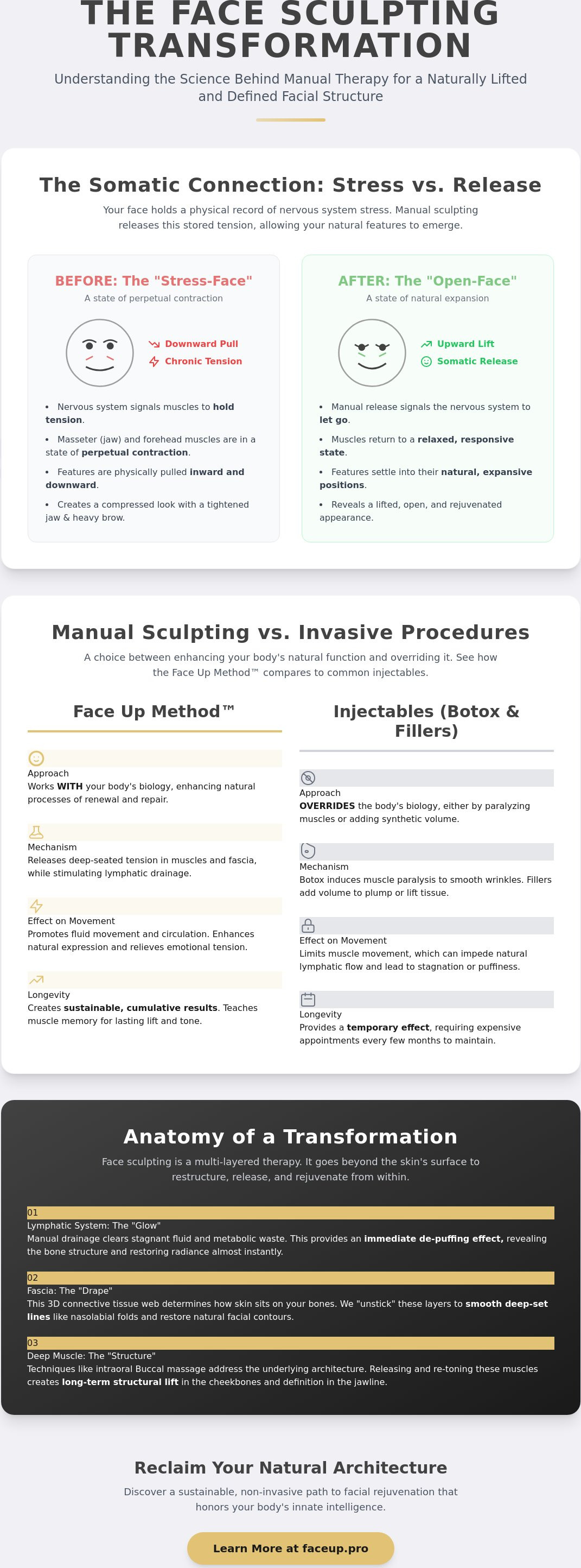
The "before" state in a face sculpting massage before and after comparison often tells a story of the nervous system's response to chronic stress. This is what we call the Somatic Connection. When you're under pressure, your nervous system signals the masseter and forehead muscles to hold tension in a state of perpetual contraction. This isn't just an internal feeling; it physically pulls the features inward and downward. It creates a compressed "stress-face" characterized by a tightened jaw and heavy brow. The "after" photos show an "open-face" because the manual release signals the nervous system to let go, allowing the features to settle into their natural, expansive positions.
Results are tiered based on which anatomical layer is being addressed. Fluid-based changes happen almost instantly as stagnant lymph is moved, reducing puffiness and revealing the bone structure beneath. However, long-term structural lifting comes from re-toning the muscles and releasing the connective tissue. This dual approach ensures that the initial glow is supported by a firmer foundation over time.
The Role of Fascia in Facial Rejuvenation
Fascia is the three-dimensional connective tissue web that determines how your skin drapes over your bone structure. When this tissue becomes stagnant or "stuck" due to lack of movement or dehydration, it creates a visible heaviness and deepens nasolabial folds. Manual manipulation serves to unstick these intricate layers, allowing the skin to sit smoothly and restoring the natural contours of the face.
Lymphatic Drainage vs. Muscle Sculpting
It's vital to distinguish between surface-level glow and structural change. Lymphatic drainage offers an immediate de-puffing effect by clearing metabolic waste from the tissues, which is why you look refreshed right after a session. In contrast, deep tissue techniques, such as intraoral Buccal massage, address the underlying muscle architecture itself. While you'll see a surface-level "glow" immediately, structural changes to the jawline and cheekbones typically require consistent work over several weeks to effectively remodel the muscle memory.
Comparing Results: Manual Sculpting vs. Invasive Procedures
Choosing between manual therapy and clinical injectables often comes down to a choice between structural health and immediate camouflage. While Botox and dermal fillers remain popular for their speed, they don't address the underlying health of the facial tissue. In a face sculpting massage before and after comparison, the results you see aren't just about fewer wrinkles. They represent improved circulation and muscle vitality. Manual sculpting acts as a functional alternative that works with your body's biology rather than overriding it.
Research suggests that specific manual techniques are clinically proven to improve skin elasticity and contour by stimulating the production of collagen and elastin naturally. Unlike fillers, which can sometimes lead to a "heavy" appearance over time as they migrate or stretch the skin, manual therapy keeps the tissue resilient. It prepares the face for better aging by ensuring the lymphatic system remains active and the muscles stay responsive. This makes it an ideal strategy for those who value longevity over a quick fix.
Why Somatic Release Beats "The Frozen Look"
Botox works by inducing muscle paralysis, which effectively smooths the skin but also limits the natural pump that drives lymphatic flow. When muscles don't move, fluid can stagnate, leading to a subtle lack of radiance or even localized puffiness. The Face Up Method™ takes the opposite approach. It prioritizes fluid movement and somatic release, acknowledging that your face needs to move to stay healthy. Maintaining your full range of expression while reducing the deep-seated tension in your jaw and brow offers emotional relief that a frozen look simply cannot provide.
The Cost and Maintenance Comparison
Clinical procedures often trap patients in a cycle of expensive appointments every few months to maintain a temporary effect. Manual sculpting, however, is a long-term investment in your tissue's structural health. While professional sessions provide deep, transformative work, the real power lies in the cumulative effect of daily practice. By utilizing the Face Up App Subscription for just five minutes a day, you reinforce the muscle memory established during professional treatments. This creates a sustainable rejuvenation strategy that actually improves the quality of your skin and muscle tone over time. If you're ready to start your journey toward a more lifted, expressive reflection, you can explore our professional facial sculpting ecosystem to find the right path for your needs.
Real-World Examples: What Face Sculpting Looks Like for Different Concerns
Visualizing the shift in face sculpting massage before and after comparisons requires looking beyond simple skin texture. It's an analysis of how the face carries its history and stress. When we release the "stress mask," which is that habitual tightening of the forehead, eyes, and mouth, the entire energy of the face shifts from guarded to open. This transformation isn't just about vanity; it's about restoring the face to its natural, relaxed state. Realistic expectations are vital for a successful journey. In the first week, you'll likely see a significant decrease in morning puffiness and a more "rested" tone. By the one-month mark, muscle memory begins to shift, revealing more prominent cheekbones. At six months, structural transformation occurs as the fascia is remodeled, allowing the skin to drape more elegantly over the bone structure.
The "Jawline Reveal": Addressing TMJ and Masseter Tension
Chronic clenching doesn't just cause discomfort; it physically widens the lower face by overworking the masseter muscles. This makes the jawline appear heavier and less defined. By integrating specialized tmj massage therapy, we can address this bulkiness at the source. The visual "after" of a jaw release is a slimmer, more defined contour and an elongated neck line that looks more graceful. During a somatic session, you might identify "emotional jaw tension," which often feels like a stubborn knot that releases only when you consciously let go of stored frustration. Reclaiming this area of the face often provides the most dramatic shift in face sculpting massage before and after results for those dealing with high stress.
Lifting the Mid-Face: Cheekbone Definition and Nasolabial Folds
The mid-face is where gravity often shows its first signs. Manual lifting techniques work to reposition the malar fat pads naturally, which tends to lift the entire cheek area. As the muscles are lengthened and the fascia is smoothed, the depth of nasolabial folds often decreases. This creates a smoother transition from the nose to the mouth. For the eyes, periorbital lymphatic work clears the fluid that causes bags and puffiness. Even "hollow" eyes often look more rested and vibrant because the surrounding tissue is no longer compressed and dehydrated, allowing for better light reflection and a natural glow.
How to Maximize Your Face Sculpting Massage Results at Home
Achieving a dramatic face sculpting massage before and after transformation requires more than just an occasional professional appointment. It's about the daily rituals you maintain in your own space. Consistency is the primary driver of success; five minutes of daily engagement is far more effective than a single sixty-minute session once a week. This regular stimulation keeps the fascia pliable and prevents the re-accumulation of fluid that leads to morning puffiness. By making these moves a habit, you reinforce the structural changes initiated during professional treatments.
To truly unlock your facial architecture, you must look below the jawline. Posture and neck release are the secret ingredients to lasting facial results. If your neck is tight and your shoulders are hunched, the lymphatic "pipes" are effectively kinked, preventing the drainage you need for a defined look. Opening these pathways ensures that the work you do on your face actually has somewhere to go. Without addressing the neck, facial sculpting is often just moving fluid around a closed system.
The Face Up Ritual: More Than Just a Massage
- Step 1: Nervous system regulation. Begin with deep breathwork to prime your muscles for release. Moving your body out of a "fight or flight" state allows the facial muscles to soften, making the massage more effective.
- Step 2: Neck and décolleté opening. Clear the primary drainage channels first. This "clears the pipes," ensuring that fluid from the face can be effectively moved away.
- Step 3: Targeted sculpting moves. Focus on the specific trouble zones you want to address. Choosing the right tmj massage tool can significantly enhance this part of your ritual, providing the necessary leverage for deep somatic relief that fingers alone sometimes can't reach.
Common Mistakes That Stall Your Progress
Incorrect pressure is a frequent hurdle. Using too much pressure can cause bruising or skin irritation, while too little fails to engage the fascia and muscle layers. You want a firm, "melting" touch that feels productive but never painful. Another common error is ignoring the "internal" work. Professional practitioners often use Buccal techniques to release the muscles from the inside out. While you should be cautious at home, incorporating gentle jaw release exercises can bridge the gap between home care and professional results. Finally, don't fail to hydrate. Water is essential for flushing the metabolic waste released during your session. Without it, those "before and after" toxins simply settle back into the tissue, dulling your glow.
If you're ready to master these techniques with guided precision and professional-grade routines, you can access our full library of tutorials through the Face Up App Subscription.
Elevating Your Results: The Face Up Method™ and Professional Mastery
Transitioning from a casual consumer of beauty trends to a master of your own facial health requires a deeper understanding of anatomical relationships. While home practice is the foundation of consistency, the most profound face sculpting massage before and after transformations often involve the intervention of a skilled professional. The Face Up Method™ isn't a generic routine; it's a proprietary blend of osteopathic, somatic, and sculptural techniques designed to address the face as a whole system. By integrating these diverse modalities, we move beyond simple skin manipulation to achieve structural shifts that are both visible and sustainable.
Why Seek a Certified Face Up Practitioner?
It's vital to distinguish between a traditional "facial" and a professional sculpting treatment. While a standard facial focuses primarily on the skin's surface, a certified practitioner utilizes intensive intra-oral (Buccal) work to release the deep muscles of the lower face from the inside out. These professionals don't just follow a script; they assess the unique somatic map of your face to identify and release specific emotional blocks held in the tissue. You can find a qualified local provider through our practitioner directory to experience this level of precision and somatic bodywork firsthand.
The Path to Professional Excellence
For beauty professionals, obtaining a facial sculpting certification represents a significant career advancement. This training facilitates a psychological shift from being a traditional aesthetician to becoming a somatic facial therapist. By adding these specialized techniques to your menu, you can double your impact by addressing both the physical and emotional layers of aging. We invite you to explore the 2026 certification intake to join a global community dedicated to high-standard, non-invasive rejuvenation. Mastery is a journey that begins with understanding the face sculpting massage before and after potential in every client.
Reclaiming Your Natural Architecture
If you're ready to transition from a student of beauty to a leader in facial health, the journey is waiting for you. Founded by somatic bodywork specialist Olga Newman, our proprietary approach is supported by a global community of certified practitioners dedicated to high-standard rejuvenation. You can master the art of somatic transformation with the Face Up Method™ Certification and begin providing these life-changing results to others. Your path to professional excellence and personal radiance starts here. Embrace the power of your own hands and the science of somatic release to create a reflection that feels as good as it looks.
Frequently Asked Questions
How long do face sculpting massage results last?
Immediate results from lymphatic drainage typically last 48 to 72 hours as your body naturally reaccumulates fluid. However, structural changes to muscle tone and fascia can persist for several weeks when supported by regular maintenance. The longevity of your transformation depends on your daily habits and the frequency of professional treatments. Consistent home rituals help extend the "lifted" appearance between your deep sculpting sessions.
Is face sculpting massage permanent?
Face sculpting massage is not a permanent surgical fix because your facial muscles and fascia are living, responsive tissues that react to daily stress and gravity. While you won't see a permanent change from a single session, consistent practice creates a cumulative effect that remodels your facial architecture over time. You should view it as a sustainable rejuvenation strategy rather than a one-time event with a fixed expiration date.
Can face sculpting massage help with TMJ and jaw pain?
Yes, this modality is specifically designed to address the root causes of TMJ and jaw discomfort by releasing stored somatic tension in the masseter muscles. By manually softening these deep tissues, you can reduce the physical bulkiness caused by chronic clenching. Many clients report significant relief from tension headaches and jaw clicking after integrating targeted jaw release techniques into their routine through our Jaw Release Course.
How often should I do facial massage to see a difference?
You should engage in a short home ritual for about five minutes every day to maintain a consistent face sculpting massage before and after progression. Professional treatments are generally recommended once or twice a month to address deeper structural concerns that home tools can't reach. This balance ensures that your lymphatic system stays active while your muscles receive the deep work necessary for visible lifting and definition.
Does facial massage work for sagging skin in your 50s?
Facial massage is highly effective for mature skin because it addresses the underlying muscle foundation that supports the skin's drape. In your 50s, the focus shifts toward improving circulation and unsticking stagnant fascia to restore natural volume and lift. While it won't replace a surgical facelift, it significantly improves skin elasticity and provides a more vibrant, rested appearance by clearing metabolic waste and stimulating collagen production.
What is the difference between Gua Sha and the Face Up manual method?
Gua Sha relies on external stone tools to scrape the skin's surface, while the Face Up Method™ utilizes a proprietary blend of manual osteopathic and somatic techniques. Our approach focuses on deep tissue manipulation and intra-oral work to release muscles from the inside out. This manual precision allows for a more nuanced assessment of your facial somatic map than a generic tool can provide, leading to more targeted results.
Can I do face sculpting massage if I have Botox or fillers?
You can certainly incorporate massage into your routine, but you must wait at least two weeks after Botox and four weeks after dermal fillers to ensure the products have settled. It's important to inform your practitioner about any recent injectables before your session. Manual therapy can actually help maintain the health of the surrounding tissue, ensuring that your clinical results look more natural and expressive over time.
Why does my face look puffy the morning after a massage?
Waking up with a puffy face is often a sign that your lymphatic system is processing the metabolic waste released during the session. This temporary reaction usually subsides within a few hours as your body flushes the toxins. To minimize this effect, ensure you're hydrating properly and performing gentle neck opening moves before bed to keep your drainage pathways clear. Proper hydration is essential for a successful face sculpting massage before and after transition.


