

What if the lines on your forehead aren't just signs of aging, but a physical map of stored stress that no needle can truly erase? You likely feel that the standard cycle of injections, which can cost between $250 and $500 per area in 2026, is the only path to a smooth appearance. Many professionals are growing weary of the "frozen" look and the recurring financial burden of temporary fixes. If you're searching for effective alternatives to botox for forehead lines, you're likely looking for a solution that respects your natural expression while addressing the root cause of facial tension.
We believe that true rejuvenation happens within the muscular and fascial layers of the face. This guide explores how to achieve a lifted, serene brow by addressing somatic stress and habitual movement patterns rather than simply paralyzing them. You'll discover how the Face Up Method™ and targeted somatic bodywork release the deep seated tension that creates static wrinkles. We will walk you through the latest holistic techniques and tools, from the Face Up App to professional sculpting treatments, that empower you to reclaim a smooth forehead and a lasting sense of calm.
Key Takeaways
- Explore why the 2026 movement toward pro-ageing prioritizes expressive, natural faces over the traditional frozen aesthetic.
- Identify how chronic stress keeps your forehead muscles in a permanent grip, making somatic release one of the most effective alternatives to botox for forehead lines.
- Gain insight into the cumulative health benefits of facial sculpting compared to the temporary, recurring costs of injectable neurotoxins over a five-year period.
- Learn how the Face Up Method™ uses jaw release and deep tissue work to achieve a holistic lift that smooths the brow from the inside out.
Beyond the Needle: The Rise of Holistic Botox Alternatives in 2026
The aesthetic landscape of 2026 marks a definitive turning point in how we approach facial rejuvenation. The previous era's obsession with total muscle paralysis is yielding to a sophisticated "Pro-Ageing" movement. This shift prioritizes expressive, natural faces over the static perfection of the past. Holistic alternatives are non-invasive methods that work in harmony with the body's natural physiology. While neurotoxins offer a temporary mask by interrupting nerve signals, holistic approaches focus on rehabilitating the muscle tissue and releasing deep-seated tension. They address the actual causes of skin folding rather than just hiding the result.
Choosing alternatives to botox for forehead lines often stems from a desire to escape the cycle of constant maintenance. With industry averages for forehead treatments currently ranging from $250 to $500 per session, the financial commitment is significant. Beyond the cost, long-term reliance on injectables presents physiological risks. Extended muscle inactivity can lead to muscle atrophy, where the forehead muscles thin and weaken over time. Somatic work offers a restorative path by improving blood flow and functional movement, ensuring the face remains vibrant and supported naturally.
The Problem with the "Frozen Face" Trend
Facial paralysis does more than just smooth the skin; it disrupts the vital dance of non-verbal communication. When we lose the ability to lift a brow or furrow in concern, we lose a primary tool for social connection and empathy. There is also a psychological dimension to this stillness. Facial biofeedback is the physiological process where facial muscle activity sends signals to the brain to help regulate and process our emotional states. Being unable to express an emotion physically can actually dampen your ability to experience that emotion fully, leading to a sense of emotional blunting.
Why 2026 is the Year of Somatic Beauty
We are currently witnessing a powerful intersection of mental health and skincare. Modern research confirms that the nervous system directly influences skin elasticity and muscle tone. Understanding the science of wrinkles reveals that forehead lines are frequently the physical manifestation of a chronic "fight or flight" response. This realization has sparked a surge in demand for practitioner-led therapies like a Somatic Bodywork Session or a Face Up Sculpting Treatment. These methods don't just treat the surface. They calm the nervous system to create a lasting, natural glow that reflects internal balance rather than chemical intervention.
The Somatic Connection: Why Your Forehead Lines Aren’t Just About Age
The frontalis muscle is your primary tool for expressing surprise and concern. While many believe forehead lines are purely a sign of age, they're often a physical map of your nervous system's history. When you live in a chronic "fight or flight" state, your body keeps these muscles in a permanent, protective grip. This constant contraction transforms temporary dynamic expressions into static stress lines. These lines remain visible even when your face is at rest because the muscle has forgotten how to fully lengthen. Searching for alternatives to botox for forehead lines involves understanding this biological grip rather than just masking it.
Fascia dehydration also plays a critical role in how deep these lines appear. Fascia is the connective tissue that wraps around every facial muscle. When it becomes restricted due to stress or lack of movement, it acts like a tight shrink-wrap, pinning the skin into a wrinkled position. Conventional medicine often points toward proven non-invasive methods like topical retinoids to treat the surface. However, true rejuvenation requires addressing the deeper layers where the tension is held. Restoring fascia hydration through movement replaces the need for synthetic fillers by allowing the skin to lay flat naturally.
Storing Stress in the Upper Face
Daily digital work often leads to unconscious scowling or brow lifting. You might find yourself squinting at a screen for hours without realizing your forehead is working overtime. This repetitive action doesn't just affect the brow. There is a "posterior chain" of the face where jaw tension directly pulls on the scalp and forehead. Emotional anatomy suggests that we hold specific burdens in our facial structures. If you find yourself clenching your teeth, you're likely pulling on your forehead too. Releasing this tension through a Somatic Bodywork Session can often lead to a spontaneous smoothing of the brow as the entire facial chain finally relaxes.
Fascia: The Secret to Smooth Skin
Facial fascia should ideally glide smoothly over the underlying muscles. When it gets "stuck" due to chronic tension, it creates a rigid environment where wrinkles thrive. Manual release of this tissue can instantly soften the appearance of even deep, etched lines. By physically breaking up these adhesions, you allow blood and nutrients to reach the skin more effectively. This internal "re-patterning" teaches the muscles to stay long and relaxed. It's a sustainable way to maintain a youthful look without relying on the temporary paralysis of a needle.
Roundup: 5 Proven Non-Invasive Methods for Forehead Rejuvenation
Achieving a smooth brow without injectables requires a multi-layered strategy that addresses both the skin's surface and the underlying musculature. While medical providers often suggest lasers or microneedling, these 2026 trends focus on working with your body's natural healing capacity. Here are five effective alternatives to botox for forehead lines that prioritize long-term tissue health over temporary paralysis.
- Deep Tissue Facial Sculpting: This technique involves precise manipulation of the frontalis and procerus muscles. By releasing chronic contractions, it allows the forehead to physically flatten and relax.
- Face Taping (Kinesiology): Using specialized tape creates a biofeedback loop. It trains the brain to recognize and stop unconscious muscle furrowing, especially during sleep.
- Gua Sha and Lymphatic Drainage: Stagnant fluid can make wrinkles appear deeper. Systematic drainage reduces this puffiness, creating a smoother and more refined skin texture.
- Microcurrent Therapy: Low-level electrical currents act like a gym session for your face. They re-educate the muscles to maintain a lifted, toned position without the risk of atrophy.
- High-Performance Topical Retinoids: These remain a cornerstone for accelerating cellular turnover. They improve skin density and elasticity, helping the surface recover from expression-based folding.
Manual Therapies: Sculpting and Buccal Massage
Deep tissue work provides a natural lift that Botox simply cannot mimic. While a needle only stops a muscle from moving, manual sculpting actually changes the quality of the tissue. It restores length to the muscles and breaks up the fascial adhesions discussed in the previous section. Effective results often require targeting the scalp and neck, as tension in these areas pulls directly on the forehead. Professionals seeking to master these techniques often look to the Face Up Method™ Certification to ensure they are meeting the highest standards of somatic care.
Home Rituals: Taping and Tools
Maintaining a smooth forehead is a daily commitment. Home rituals like face taping using silk tape help inhibit the unconscious habits that etch lines into the skin. These tools provide a gentle physical reminder to keep the brow soft. Consistency is the most important factor in any manual practice. Integrating these rituals with the right equipment makes a significant difference. For example, selecting the proper TMJ massage tool allows you to release the jaw, which is the foundational step for relaxing the entire facial chain. Over time, these daily acts of self-care create results that look entirely natural and vibrant.
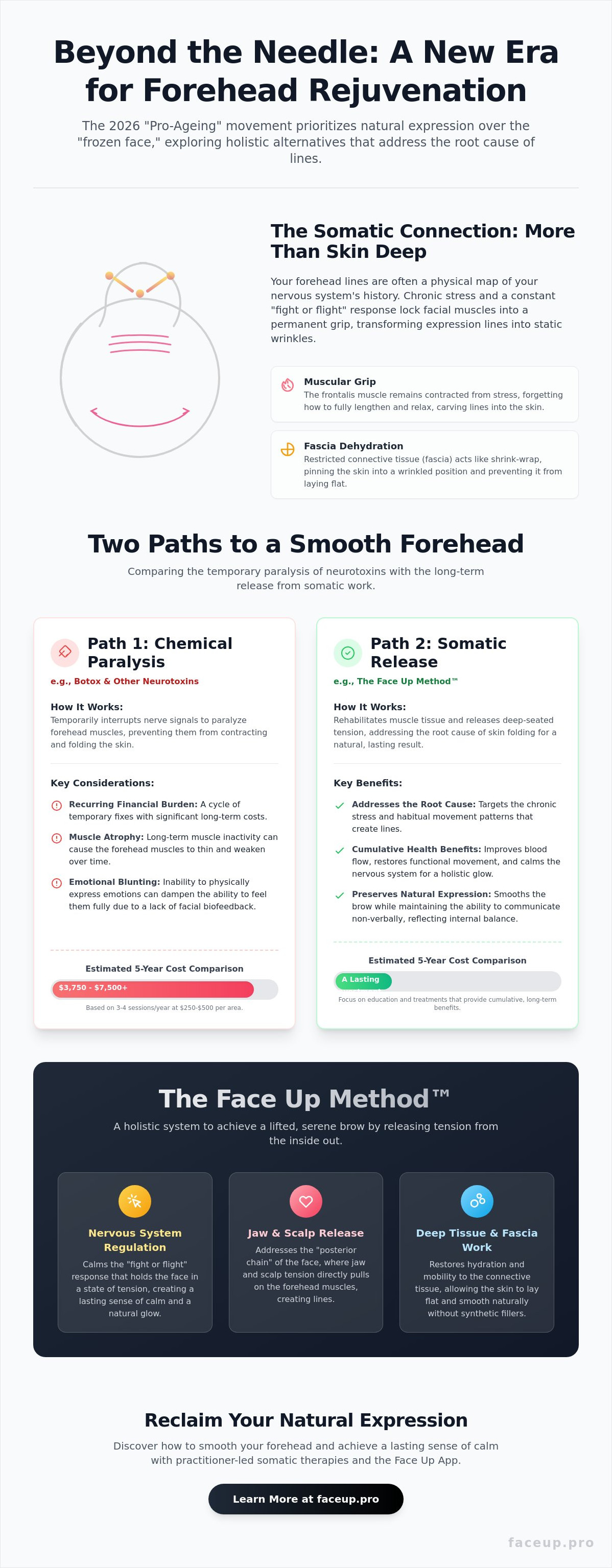
Comparing Outcomes: Somatic Release vs. Chemical Paralysis
Choosing between neurotoxins and somatic work is a choice between an instant mask and long-term tissue rehabilitation. Botox offers a temporary "reset" by interrupting nerve signals, but this convenience comes with a trade-off in facial vitality. When you look for alternatives to botox for forehead lines, you're opting for a cumulative health model. Somatic release improves the quality of the skin and muscle over time, whereas chemical paralysis merely pauses the clock while the underlying tension remains unresolved.
The financial and biological costs diverge significantly over a five-year period. A standard forehead treatment in 2026 costs between $250 and $500 per session. Maintaining this look requires three to four visits annually, which can total up to $7,500 over five years. This cycle doesn't account for the "rebound effect," where muscles may appear heavier or more wrinkled as the toxin wears off. In contrast, somatic sculpting builds structural integrity. The results are lifestyle-dependent, but they enhance your natural baseline rather than creating a dependency on an external substance.
Efficacy and Longevity
Botox typically lasts three to four months, after which the muscle returns to its previous state of tension. Sculpting treatments focus on "unlearning" the habits that caused the lines initially. By restoring blood flow and oxygen to the tissue, somatic work improves skin texture and elasticity. It addresses the "etched" stress lines that toxins often can't fully erase. While the needle provides a faster result, manual release offers a glow that comes from actual health rather than forced stillness.
Health and Safety Considerations
Safety is a growing priority for professionals in 2026. All FDA-approved neurotoxins carry a "black box" warning regarding the potential spread of toxin effects. Manual therapies avoid these risks entirely. Instead, they promote lymphatic drainage and natural detoxification. For many, TMJ massage therapy is the essential first step to a smooth forehead. Releasing the jaw tension that pulls on the upper face often does more for the brow than a dozen injections. Recovery time is another major factor. Sculpting has zero downtime, while injections require precautions against exercise and lying down for several hours.
Take control of your facial health and discover a more vibrant, natural you. Book a Somatic Bodywork Session today to experience the difference of true release.
The Face Up Method™: A New Standard in Natural Facial Sculpting
The Face Up Method™ represents a sophisticated evolution in somatic beauty. Developed by Olga Newman, this proprietary approach moves beyond surface level aesthetics to address the foundational muscular tension that causes deep brow furrows. Unlike traditional alternatives to botox for forehead lines that focus only on the upper face, this method recognizes the interconnected nature of our anatomy. By integrating intra-oral techniques and deep fascial work, we help you release the emotional stress stored within your tissues. This is not a temporary fix; it's a profound restoration of your face's natural architecture.
This methodology shifts the paradigm from transactional treatments to a sustainable lifestyle. While a single Face Up Sculpting Treatment can provide visible relief, the true transformation lies in the daily re-education of your nervous system. We invite you into a community of professionals who value transparency and integrity. By working with a certified practitioner from our directory, you gain access to a mentor who understands the complex relationship between your jaw, your brow, and your overall well-being. This global standard of care ensures that your journey toward a smoother forehead is both effective and empowering.
Professional Results at Home
The transition from clinical sessions to self-led care is facilitated by the Face Up App Subscription. This platform guides you through neuro-muscular re-education, helping you identify and dissolve the habitual patterns that lead to wrinkle formation. Central to this process is the Jaw Release Course, which targets the primary source of tension in the facial chain. Developing somatic awareness is the most critical factor in achieving permanent wrinkle reduction, as it allows you to catch and release tension before it etches into the skin.
Your Journey to a Tension-Free Face
Your path begins with a personalized somatic assessment. You'll learn to map where you hold stress, whether it's in a clenched jaw or a perpetually lifted brow. From this point of awareness, the roadmap leads you through deep tissue release toward a sculpted, smooth appearance. This process respects your natural expressions while removing the "noise" of chronic stress. It's a professional entry into a more governed and relaxed version of yourself. Discover the Face Up Method™ App and start your ritual today to reclaim the serenity of your natural expression.
Embrace a Future of Expressive Vitality
The transition toward somatic rejuvenation represents a profound shift in how we define facial care in 2026. You've discovered that true beauty doesn't require the temporary stillness of a needle. By understanding the link between nervous system regulation and muscular tension, you can effectively utilize alternatives to botox for forehead lines to restore your natural architecture. This approach moves beyond masking symptoms; it rehabilitates the tissue and releases the deep-seated stress that creates permanent etching.
Your journey toward a tension-free face is supported by a global infrastructure of expertise. Whether you engage with our global directory of certified practitioners or integrate daily guided rituals through the Face Up App, you're entering a community dedicated to professional standards and lasting results. Our specialized Somatic Jaw Release course provides the foundational work necessary to smooth the brow by addressing the full facial chain. It's time to choose a path that honors your expression and your long-term health. Join the Face Up Method™ Community and Reclaim Your Natural Beauty and step into a new standard of holistic self-care.
Frequently Asked Questions
Do natural alternatives to Botox actually work for deep forehead wrinkles?
Yes, but they work by addressing the root cause of the line rather than paralyzing the muscle. Deep wrinkles are often the result of chronic muscle shortening and fascial adhesions. By using manual techniques to lengthen the muscle and hydrate the fascia, the depth of the line can be significantly reduced. Consistency is key for achieving long term structural changes that look natural.
How long does it take to see results from facial sculpting?
You can often observe a temporary softening of lines immediately after a single session. Lasting structural changes typically require four to six weeks of consistent practice. This timeframe allows the nervous system to unlearn old tension habits and the connective tissue to remodel. Daily rituals through digital tools like the Face Up App help maintain these gains between professional treatments.
Can I do facial exercises if I already have Botox in my forehead?
You should wait until the initial injection has settled, usually about two weeks, before beginning any manual work. Engaging in somatic release while you have neurotoxins can actually help prevent the muscle atrophy often associated with long term use. It ensures that blood flow remains active in the area. It's best to consult your provider to ensure the toxin has fully bonded to the nerve receptors.
What is the best topical alternative to Botox for forehead lines?
High performance retinoids and peptides that target the neuro-muscular junction are considered the most effective topical solutions. While no cream can paralyze a muscle like an injection, ingredients like Argireline are often used for their ability to subtly relax surface tension. These products work best when paired with manual therapies that improve the skin's ability to absorb and utilize active ingredients effectively. For those looking to source these formulations, Puur Skincare Canada offers a curated selection of natural and Korean skincare products that align with a holistic beauty philosophy.
Is face taping safe to do every night?
Yes, face taping with specialized kinesiology or silk tape is safe for nightly use as long as your skin doesn't show signs of irritation. The tape acts as a physical barrier that prevents unconscious furrowing during sleep. It also provides a gentle lift to the lymphatic system. Always perform a patch test first to ensure you don't have a sensitivity to the specific adhesive used on the tape.
How does releasing my jaw help my forehead lines?
Your facial muscles are connected through a continuous chain of fascia that runs from the jaw up to the scalp and forehead. When you clench your jaw, you create a downward pull that forces the forehead muscles to compensate by lifting. Releasing the masseter muscles through a specialized Jaw Release Course often results in an immediate relaxation of the brow. Addressing the jaw is essential for any holistic approach to alternatives to botox for forehead lines.
What is the difference between Gua Sha and professional facial sculpting?
Gua Sha is primarily a tool based technique focused on lymphatic drainage and surface circulation. Professional facial sculpting involves deep, manual manipulation of the muscles and intra-oral work. Sculpting targets the specific attachments of the muscles to release deep seated somatic stress. While Gua Sha is excellent for daily maintenance, professional sculpting provides a more intensive structural lift by reaching the deeper tissue layers.
Is somatic facial therapy painful?
Somatic therapy should never be painful, though you may experience intense sensations in areas of high tension. The goal is to stay within a range where your nervous system feels safe enough to let go. If a practitioner works too deeply or too quickly, the body will naturally guard itself, which defeats the purpose of the release. Effective alternatives to botox for forehead lines prioritize a state of calm efficiency over aggressive pressure.


