

Why do the same physical tension patterns return to your table week after week, regardless of your technical skill? With the global somatic therapy market projected to reach $4.01 billion in 2026, it's clear that clients are seeking more than just surface-level physical relief. If you feel unequipped to navigate emotional purges or find yourself exhausted by repetitive manual work, you're not alone. Investing in professional emotional release bodywork training allows you to stop chasing symptoms and start addressing the stored trauma that keeps your clients in a cycle of chronic pain.
You understand that true healing requires a bottom-up approach, yet finding the right path forward can feel overwhelming amidst shifting industry standards. This guide provides a clear roadmap for your professional advancement in 2026. We will explore how to master high-value skills like the Face Up Method Certification, which focuses on the face and jaw as critical sites for somatic release. You'll discover how to navigate new regulations, such as the updated NCBTMB board exam, while building a premium, specialized practice that delivers the visible results your clients deserve.
Key Takeaways
- Shift your practice from repetitive physical work to a holistic somatic discipline that resolves the emotional roots of chronic tension.
- Discover why the jaw and facial muscles are biological mirrors for emotional states and how releasing these areas unlocks profound physical results.
- Evaluate the most effective emotional release bodywork training programs for 2026 by prioritizing scientific depth, practical application, and global professional standards.
- Learn how to establish a premium wellness practice by integrating holding container protocols and specialized somatic sculpting treatments.
- Explore the Face Up Method™ as a proprietary ecosystem for practitioners seeking to master the intersection of buccal massage and deep emotional release.
The Evolution of Emotional Release Bodywork Training
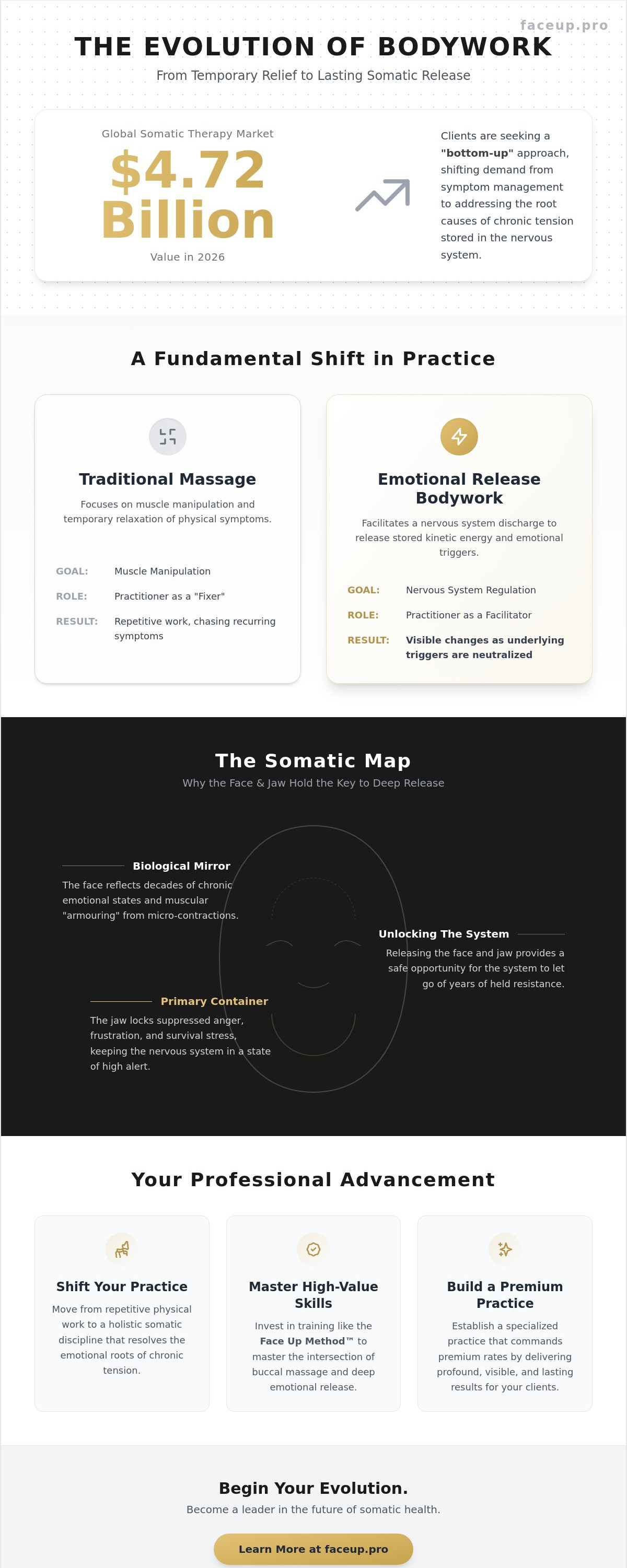
The landscape of manual therapy is undergoing a significant transformation. As we move through 2026, practitioners are recognizing that physical tension is rarely just a physical issue. It's often the body's way of archiving unprocessed stress. This realization has turned emotional release bodywork training into a vital path for those who want to provide lasting relief rather than temporary comfort. The global somatic therapy market is estimated to be valued at $4.72 billion this year. This growth reflects a massive shift toward "bottom-up" healing. Clients are no longer satisfied with masking symptoms. They want to address the root causes of their chronic patterns.
The Professional Demand for Somatic Skills
The wellness industry has pivoted toward nervous system regulation as the foundation of health. This shift requires a new breed of practitioner who can bridge the gap between traditional manual work and the emotional nuances of the human experience. By understanding the history of body psychotherapy, we see how modern somatic skills have evolved from niche theories into mainstream clinical practices. Today, being "somatic-informed" is a critical credential for any professional working with the human form. It allows you to offer holistic rejuvenation that addresses the nervous system directly. This provides a sustainable, natural alternative for clients who might otherwise seek invasive procedures like Botox or dermal fillers.
Emotional Release vs. Traditional Massage
Traditional massage often focuses on muscle relaxation, but emotional release bodywork training teaches you to facilitate a full nervous system discharge. This is crucial when dealing with "body armouring," a term used to describe chronic muscular patterns that resist standard massage techniques because they are held by the subconscious mind. To address these patterns, many practitioners integrate the subconscious reprogramming expertise of Salarah K Starre to facilitate deeper mental shifts. Practitioners are moving away from purely physical work to specialized facilitation.
- The Goal: Moving from muscle manipulation to facilitating a release of stored kinetic energy.
- The Role: You act as a facilitator rather than a "fixer," creating a safe container for the body to process what it has held.
- The Result: Visible physical changes that occur because the underlying emotional trigger has been neutralized.
- The Shift: Moving away from repetitive, purely physical work toward high-value, specialized sessions that command premium rates.
Instead of simply rubbing a tight shoulder, you're helping the client's system recognize it no longer needs to hold that protective stance. This evolution represents a move toward high-standard, specialized care. It positions you as an expert in a field that values integrity and proactive management of the mind-body connection. By mastering these skills, you enter a proprietary ecosystem of practitioners who are leading the future of somatic health.
Understanding the Somatic Map: Why the Face and Jaw Hold the Key
The human face is the most expressive part of our anatomy, yet it's frequently the most overlooked in traditional therapeutic settings. In the context of emotional release bodywork training, the face serves as a biological mirror. It reflects decades of chronic emotional states through micro-contractions and habitual expressions that eventually set into the musculature. When we talk about facial "ageing," we're often observing the cumulative effect of long-term emotional tension rather than simple chronological time. Deep furrows, a heavy brow, or a sagging jawline are frequently the visible markers of the muscular "armouring" we explored in the previous section.
The jaw acts as a primary container for suppressed anger, frustration, and survival stress. Whenever we "grit our teeth" to endure a difficult situation, the masseter and temporalis muscles lock that energy into the tissue. This physical bracing creates a feedback loop that keeps the nervous system in a state of high alert. Because of this, tmj massage therapy serves as the ultimate entry point for practitioners. By addressing the jaw, you aren't just relaxing a muscle; you're providing the system with a safe opportunity to let go of years of held resistance.
The Neuroscience of Facial Tension
The face is densely populated with nerves that connect directly to our emotional processing centers. A randomized controlled study highlights how somatic interventions effectively regulate the nervous system by targeting these specific pathways. The Vagus nerve connection ensures that intentional facial touch can instantly signal safety to the brain, shifting a client from "fight or flight" into a state of social engagement. The masseter muscle is particularly sensitive to this shift, as it's one of the first muscles to contract during a stress response. The Somatic Face is a repository for micro-expressions that the conscious mind has long forgotten but the body still remembers.
Beyond Traditional Facial Massage
Standard facials often focus on the skin's surface, but they fail to address deep-seated muscular trauma held within the fascia. Professional emotional release bodywork training moves beyond the superficial to target the underlying architecture of the face. Buccal, or intra-oral, techniques are particularly effective here. By accessing the muscles from the inside of the mouth, you can reach attachments that are impossible to manipulate through the skin alone. This often triggers profound emotional breakthroughs as the deep layers of the jaw finally soften. Furthermore, releasing tension in the neck and throat is essential to unlock emotional flow to the rest of the body, preventing the "bottleneck" effect where stress remains trapped in the head and shoulders. If you're interested in how these techniques can be applied, a somatic bodywork session offers a direct experience of this transformative power.
Evaluating Training Programmes: What Makes a Certification Worthwhile?
Selecting the right path for your professional advancement is a significant decision that requires more than a surface-level review of course modules. As the demand for somatic expertise grows, the market has become saturated with various offerings. To ensure you're investing in a high-standard education, you must look for the "Big Three" criteria: scientific grounding, practical depth, and robust business support. A worthwhile emotional release bodywork training program shouldn't just teach you how to touch; it should provide a comprehensive understanding of why certain techniques trigger specific physiological responses. This includes a deep dive into Somatic Psychotherapy for Trauma, which offers the clinical foundation necessary to handle the emotional "purges" that often occur during deep tissue work.
Curriculum Depth vs. Duration
There is a vast difference between a 10-week introductory process and a 6-month masterclass. A professional-grade program requires time for the information to integrate. Look for certifications that include supervised clinical practice and formal assessments. This ensures that when you begin offering these services to the public, you're doing so with the backing of verified quality. The balance between theory and hands-on skills should be roughly equal; knowing the "how" is useless without the "why" provided by modern neuroscience.
Accreditation and Professional Standing
Gaining a facial sculpting certification provides you with a distinct advantage in a competitive market. It moves you beyond the "kitchen sink" approach of general wellness and into a specialized niche that commands higher rates. This level of accreditation is essential for securing professional insurance and gaining recognition from global health bodies. Additionally, look for programs that offer a practitioner directory listing. This isn't just a badge of honor; it's a proactive tool that builds your local authority and connects you with a global community of high-standard facilitators. By aligning yourself with a reputable ecosystem, you transition from a generalist to a recognized expert in emotional release bodywork training.
Integrating Emotional Release into Your Professional Practice
Completing your emotional release bodywork training marks the beginning of a new professional chapter. It requires a fundamental shift in how you position your value within the wellness market. Most practitioners are stuck in a "time-for-money" trap, offering general relaxation at a fixed hourly rate. By specializing in somatic release, you move into a result-based pricing model. This transition allows you to evolve from offering a standard massage to providing a premium somatic sculpting session. This isn't just a price increase; it's a reflection of the specialized expertise and the intensive "holding container" you provide for your clients' transformation.
When a client arrives expecting a "nice facial," your role as a facilitator is to bridge the gap between their aesthetic goals and their somatic needs. You can explain that while their skin will look rejuvenated, the primary objective is to release the underlying muscular patterns that hold stress and tension. To support this deep manual work, using the correct tmj massage tool is essential. It allows you to target specific trigger points in the jaw with precision, enhancing the manual release without causing unnecessary strain to your own hands or the client's delicate facial tissues.
Revenue Diversification for Therapists
Building a sustainable practice in 2026 involves more than just one-off appointments. You can create high-ticket "Transformation Packages," such as a six-session somatic series, that guide clients through a progressive release of chronic tension. To increase client retention, integrate digital support into your service model. Offering at-home rituals through the Face Up App Subscription ensures your clients stay connected to their somatic journey between sessions. This approach builds a proprietary ecosystem around your practice, positioning you as a long-term partner in their health rather than a temporary service provider.
Client Management and Safety Protocols
Safety and professional integrity are the pillars of a successful somatic practice. You must be skilled at recognising the signs of an emotional abreaction, or release, during a session. These signs often include changes in breathing patterns, subtle muscle tremors, or sudden shifts in body temperature. Facilitating these moments requires a calm, steady presence. It's equally important to establish clear boundaries; if a client's emotional needs exceed the scope of bodywork, you must refer them to a qualified psychotherapist. The ethical responsibility of a somatic practitioner is to facilitate the body’s innate wisdom while strictly acknowledging the limits of manual intervention.
If you are ready to elevate your professional standing and master these advanced techniques, the Face Up Method Certification provides the comprehensive training and community support you need to thrive.
The Face Up Method™: A New Standard in Somatic Facial Therapy
While general emotional release bodywork training often focuses on broad somatic principles, the Face Up Method™ provides a specialized architecture for practitioners who recognize the face as the primary site of emotional storage. This method is not merely about relaxation; it's a sophisticated system that bridges the gap between aesthetic rejuvenation and deep emotional health. By focusing on the "Somatic Face," the curriculum developed by Olga Newman allows you to deliver visible lifting and sculpting results that are rooted in the release of chronic mental and emotional tension. This dual-purpose approach ensures that your clients don't just feel better internally; they see the transformation in the mirror.
The Face Up Method™ stands apart by integrating three distinct pillars of manual therapy. It combines advanced facial sculpting techniques with precise buccal (intra-oral) massage and somatic bodywork. This trifecta addresses the muscular "armouring" we explored in previous sections at its deepest level. By accessing the muscles of the jaw and mouth from both the internal and external surfaces, you can facilitate breakthroughs that traditional massage simply cannot reach. This unique skill set positions you within a proprietary ecosystem of professionals who are redefining the standards of natural rejuvenation in 2026.
The Proprietary Sculpting Approach
The core of the curriculum is the "Face Up" sequence. This specific protocol is designed to lift the facial features by systematically releasing the mind's habitual bracing patterns. Intra-oral work plays a central role here, as it allows for the direct manipulation of the masseter and pterygoid muscles. These are the areas where survival stress and suppressed anger are most commonly archived. As a Face Up practitioner, you become a sought-after expert because you offer a sustainable alternative to invasive procedures. You are teaching the body to release the tension that causes sagging and deep lines, rather than simply filling the skin.
Joining the Global Face Up Community
The journey toward becoming a certified facilitator is structured to ensure global readiness and professional integrity. It begins with foundational courses, such as the Jaw Release Course, and progresses toward full Master status. Throughout this journey, you are supported by a community of global-minded professionals who value order and reliability. Membership in this ecosystem provides several key benefits:
- Practitioner Directory Listing: Gain visibility and local authority through a verified directory of high-standard experts.
- Face Up App Subscription: Access digital tools that allow you to provide your clients with at-home rituals, ensuring their somatic progress continues between sessions.
- Ongoing Mentorship: Benefit from a professional mentor who helps you navigate complex client cases and business management.
If you are ready to move beyond transactional services and enter a specialized professional landscape, the path is clear. You have the opportunity to master a high-value skill set that delivers profound healing and visible results. Apply for the Face Up Method™ Certification and transform your practice into a premier destination for somatic facial therapy.
Elevate Your Practice to Global Somatic Standards
The transition toward root-cause facilitation is no longer just a trend. It is the new benchmark for professional excellence in 2026. By understanding how the face and jaw archive life's stressors, you can provide the deep results that standard massage often misses. Choosing a high-standard emotional release bodywork training allows you to move beyond repetitive physical labor and into a specialized, high-value career path. You'll gain the confidence to handle complex emotional purges while delivering visible, sculptural results that speak for themselves.
You have the opportunity to join a proprietary ecosystem that values integrity and global readiness. As a Red Dot Design Award Nominee with a proprietary somatic sculpting curriculum, we offer the tools you need to thrive. From appearing in our Global Directory of Certified Practitioners to mastering intra-oral techniques, your journey toward professional mastery is supported at every step. This isn't just about a certificate; it's about belonging to a community of high-standard facilitators who are redefining the wellness landscape.
It's time to transition from a generalist to a recognized leader in somatic health. Apply for the Face Up Method™ Professional Certification and begin facilitating the deep, visible transformations your clients are searching for. Your practice deserves this evolution.
Frequently Asked Questions
What exactly is emotional release bodywork training?
This specialized education focuses on the intersection of manual therapy and nervous system regulation. It teaches practitioners how to identify and release stored emotional stress that has manifested as chronic physical tension. Unlike standard relaxation massage, emotional release bodywork training equips you with the skills to facilitate a safe discharge of kinetic energy held within the fascia and musculature. This "bottom-up" approach addresses the root cause of somatic patterns rather than just the symptoms.
Can I learn somatic bodywork online, or do I need in-person workshops?
You can master the theoretical foundations, neuroscience, and specific protocols through a high-quality digital curriculum. However, achieving professional competency in 2026 usually requires a hybrid model that combines online modules with supervised clinical practice. This ensures you understand the complex biological triggers before applying hands-on techniques. The hybrid approach offers the flexibility of global accessibility while maintaining the high standards necessary for professional certification and insurance compliance.
Do I need a background in massage or nursing to take this training?
While a background in anatomy or manual therapy is helpful, these programs are often open to a wide range of wellness professionals, including yoga instructors and aesthetic therapists. Some advanced modules, such as those involving intra-oral techniques, may have specific prerequisites depending on your local jurisdiction. It's best to check the entry requirements for each specific certification level to ensure you meet the necessary standards for professional practice in your region.
How does emotional release bodywork differ from trauma-informed therapy?
Emotional release bodywork training focuses on the physical manifestation of stress through a manual approach, while trauma-informed therapy often prioritizes cognitive or "top-down" processing. Bodywork practitioners work directly with the tissue and the autonomic nervous system to facilitate a physical release of held energy. It acts as a powerful complementary discipline to psychotherapy, focusing on the body's innate ability to process and discharge stress through intentional touch and movement.
What kind of results can clients expect from a somatic facial session?
Clients often experience a profound sense of mental clarity and emotional lightness alongside visible physical lifting and sculpting. By releasing the chronic contractions associated with "body armouring," the face appears more open and naturally rejuvenated. These results are typically more sustainable than superficial treatments because they address the underlying muscular habits that cause sagging and deep lines. Many clients also report improved sleep and reduced jaw tension following a session.
Is emotional release bodywork scientifically proven?
Modern research into polyvagal theory and the Vagus nerve provides a robust scientific foundation for these interventions. Clinical studies have demonstrated that targeted somatic work can effectively regulate the nervous system and lower cortisol levels. This scientific grounding ensures that practitioners are operating within a verified framework of physiological health. By using these evidence-based techniques, you can offer your clients a reliable path toward both emotional balance and physical relief.
How much can a certified somatic bodywork practitioner earn?
Earnings vary significantly based on your location and level of specialization, but certified facilitators generally command much higher rates than general therapists. By specializing in high-value niches like somatic facial sculpting, you move away from a standard hourly rate toward a result-based pricing model. This allows you to build a premium practice that reflects your specialized expertise and the deep, transformative results you provide for your clients.
What is the best way to start learning the Face Up Method™?
The most effective entry point is enrolling in the foundational Jaw Release Course to master the basics of facial tension release. After completing this initial step, you can progress toward the full Face Up Method Certification. This structured journey allows you to integrate new skills into your practice at a measured pace. You'll also gain access to the global practitioner directory and the Face Up App Subscription to support your clients' at-home rituals.


