

What if the persistent tightness in your face isn't just a physical habit, but a somatic survival response stored deep within your nervous system? If you wake up with a sore jaw or find yourself clenching during every focused task—such as operating the best longarm quilting machines for professional use—you're part of the 29.5% of the global population currently navigating these disorders. While many people reach for mouthguards or temporary injections, these solutions often ignore the emotional roots of the tension. Integrating DIY jaw release exercises into your routine allows you to go beyond the surface, addressing both the masseter muscle and the nervous system to create a lasting sense of ease.
You deserve to move through your day without the weight of tension headaches or a restricted range of motion. This guide provides a pathway to discover how somatic bodywork can transform your relationship with stress and even improve your facial aesthetics. We will preview a daily ritual designed for immediate physical relief and offer a deeper understanding of why your body holds onto clenching. From specific movements to nervous system regulation, you'll find the professional tools needed to unlock a more relaxed and confident version of yourself in 2026.
Key Takeaways
- Identify the hidden link between your nervous system's survival response and chronic jaw clenching to address the root cause of your discomfort.
- Distinguish between clinical physical therapy and somatic rituals to ensure your efforts provide relief rather than accidentally increasing muscle tension.
- Master five effective DIY jaw release exercises designed to reset your Vagus nerve and release deep-seated emotional stress stored in the face.
- Learn how to establish a sustainable daily ritual for facial relaxation that supports long-term structural health and improved aesthetics.
Why Your Jaw Tension Isn't Just a Physical Issue
The jaw often acts as the body's primary stress container. When the nervous system detects a threat, the masseter muscle is one of the first to engage. This is a vestige of our evolutionary fight-or-flight response, designed to protect the skull and prepare the body for conflict. However, in our modern environment, this protective mechanism frequently malfunctions, leading to chronic Temporomandibular joint dysfunction (TMD). If you only treat the jaw as a mechanical hinge, you miss the underlying neurological command that keeps the muscle tight.
Traditional mechanical stretching frequently fails because it ignores the brain's role in muscle tone. If your nervous system still feels unsafe due to high cortisol or unresolved stress, it will immediately re-tighten the muscles you've just stretched. At Face Up, we view these tensions as emotional holding patterns that have become physically calcified. Effective DIY jaw release exercises must therefore do more than pull on tissue; they must communicate safety to the brain to allow for a genuine, lasting release.
The Somatic Connection: Emotions and the Masseter
Suppressed emotions like anger, frustration, or persistent anxiety physically manifest in the jawline. You might notice you're emotional clenching during a difficult email or a tense conversation, which is distinct from functional jaw use like chewing. Somatic therapy also highlights a fascinating anatomical link between the pelvic floor and the jaw. These two areas often mirror each other's tension; when one is tight, the other follows. Identifying these patterns is the first step in moving from temporary fixes to permanent relief through DIY jaw release exercises.
How Chronic Tension Affects Your Facial Aesthetics
Beyond the physical discomfort, chronic tension significantly impacts your facial appearance. Persistent clenching leads to masseter hypertrophy, where the muscle grows larger and creates a wider, more squared jawline. This can eventually lead to issues with facial symmetry and contribute to the appearance of the jowl area as the muscles pull on the surrounding skin. This is why a professional sculptural face lifting protocol always begins with tension release. By addressing the root cause of clenching, you aren't just seeking pain relief; you're actively preserving the natural contours and harmony of your face.
The Nervous System Connection: Beyond Simple Stretching
To understand why your jaw feels permanently clenched, you must look beyond the muscles to the underlying nervous system. Your brain often 'locks' the jaw as a defensive maneuver to protect the cervical spine during periods of high stress. This isn't a mechanical failure; it's a sophisticated survival strategy. While Johns Hopkins Medicine classifies TMD into categories like myofascial pain and internal joint derangement, the neurological driver is often the missing piece of the puzzle. Integrating DIY jaw release exercises into your routine helps address this, as a tight jaw creates a constant feedback loop that signals the brain to stay in high-alert mode. This cycle makes it nearly impossible to achieve relaxation through sheer willpower or traditional physical therapy alone.
The Role of the Vagus Nerve in Jaw Release
The Vagus nerve plays a pivotal role in regulating facial muscle tone. As the primary component of the parasympathetic nervous system, it influences everything from your heart rate to the tension in your face. Because the nerves controlling the jaw, eyes, and inner ear are geographically and functionally linked, you can use specific 'hacks' to signal the body to let go. For example, moving your eyes in a slow, rhythmic pattern can stimulate the Vagus nerve and begin to soften the masseter muscles. A ventral vagal state represents a physiological condition of safety where the nervous system allows the body to rest, digest, and disengage its defensive shielding.
Why 'Forceful' Exercises Can Backfire
Forceful stretching often does more harm than good in the context of chronic clenching. When you aggressively pull on a muscle that the brain is trying to protect, you trigger the 'stretch reflex.' This is an automatic response where the muscle contracts even harder to prevent a perceived tear. In somatic work, we prioritize safety and gentle invitations over mechanical force. Effective DIY jaw release exercises focus on subtle shifts that convince the nervous system to drop its guard. If you're ready to move beyond basic stretches, exploring a holistic somatic approach can help you break the cycle of chronic tension and restore natural mobility. Transitioning from clinical physical therapy to somatic invitations allows the muscle to release because it finally feels safe to do so.
Clinical Exercises vs. Somatic Rituals: Which Is Better?
While clinical physical therapy offers structured movements like the 'Goldfish' method, somatic rituals focus on the internal experience of the muscle. Standard DIY jaw release exercises often prioritize resistance, yet research from the NIDCR suggests that TMD is frequently linked to other systemic conditions like fibromyalgia and irritable bowel syndrome. This connection indicates that a purely mechanical approach may fall short for those whose tension is driven by a sensitized nervous system. For many, strength isn't the problem; over-activity is. If you're already clenching, adding resistance exercises can accidentally signal the brain to tighten the jaw even further.
Somatic rituals differ because they prioritize sensory awareness and nervous system safety over repetitive repetitions. By shifting from a "workout" mindset to a "ritual" mindset, you encourage the brain to release its protective grip. This transition is essential for those who find that their tension returns minutes after a standard stretch. Integrating these practices into a sustainable daily routine ensures that you aren't just managing symptoms, but actively changing your baseline level of facial tension.
When to Use Clinical Jaw Movements
Clinical movements like chin tucks or resisted opening are valuable for joint alignment and tracking. These are most effective if your pain is 'joint-centric,' often characterized by clicking or popping without significant muscle soreness. However, for chronic, stress-based clenchers, these movements can sometimes trigger the stretch reflex mentioned earlier. It's helpful to identify whether your discomfort stems from the joint itself or from the surrounding musculature before committing to a rigid exercise protocol. If your jaw locks during times of high anxiety, a mechanical approach may be too aggressive for your current state.
The Somatic Advantage: Lasting Change
The somatic approach moves beyond external massage to include intra-oral, or buccal, work. This allows you to access the masseter and pterygoid muscles from the inside, providing a level of release that external pressure cannot match. Using a specialized tmj massage tool can further deepen this experience, helping you create a new neural blueprint for relaxation. These rituals don't just provide temporary relief; they retrain the brain to keep the jaw in a softened state, which naturally enhances facial aesthetics and symmetry. By integrating these DIY jaw release exercises into a daily ritual, you establish a sustainable path toward a tension-free life that standard physical therapy often misses.
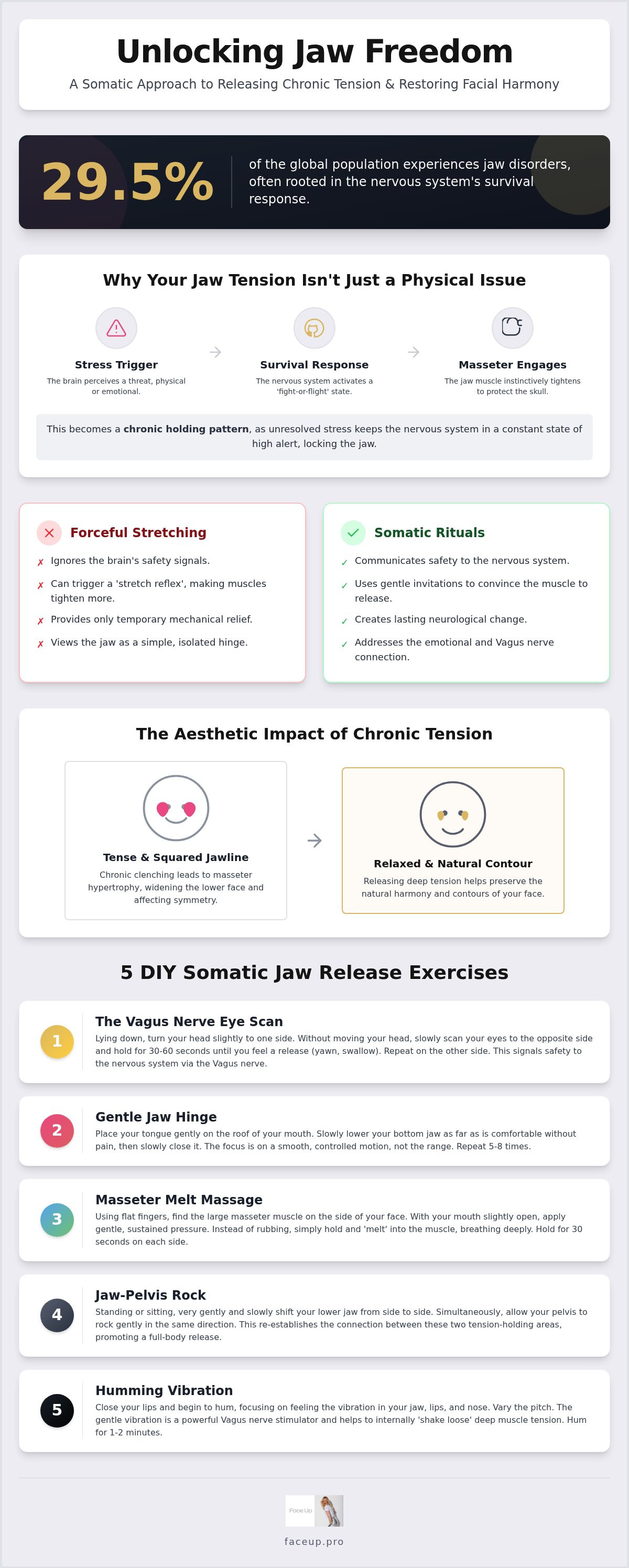
5 DIY Somatic Jaw Release Exercises for 2026
The effectiveness of DIY jaw release exercises depends heavily on your physiological state before you begin. Creating a "safety-first" environment is the foundation of somatic practice. This means finding a quiet space where you can focus entirely on internal sensations without external distractions. By signaling to your brain that you are safe, you bypass the protective guarding that usually keeps the jaw locked. This ritual moves beyond simple mechanical movement to create a dialogue with your nervous system.
Step 1 & 2: Preparing the Nervous System and the Soft Palate
Begin by using specific breathwork techniques to signal the Vagus nerve. Inhale deeply through your nose for a count of four, then exhale through pursed lips for a count of eight. During this process, ensure your tongue is properly positioned to encourage total relaxation. Rest the tip of your tongue gently against the tissue ridge just behind your upper front teeth while allowing the back of the tongue to drop away from the roof of the mouth. This simple shift immediately reduces tension in the floor of the oral cavity. Follow this with the "Yawn-Sigh" method; mimic the start of a deep yawn to lift the soft palate, then let out a long, audible sigh to drop the jaw into a neutral hanging position.
Step 3, 4 & 5: Deep Muscular Release and Integration
Moving into deep muscular release requires a gentle, respectful touch. For the external masseter release, apply the Face Up sculpting touch by placing your fingertips on the cheekbones and slowly gliding them down toward the jawline with light, steady pressure. To take the release further, you can perform a self-buccal release by placing a clean thumb inside the cheek and your index finger on the outside. Gently pinch and roll the masseter muscle to break up fascial adhesions from both sides. Don't forget to address the temples; circular massage in the temporal region is essential to stop jaw-related headaches before they start.
Finish your ritual with the "Face Up" sweep, a light stroking motion from the center of the face out toward the ears and down the neck. This encourages lymphatic drainage and leaves the nervous system in a state of calm efficiency. To maintain these results and explore more advanced techniques, you can access our professional somatic resources to build a sustainable daily practice. Finally, use the "Gentle Hum" to integrate the changes. Hum a low, steady tone to create a vibration that travels through the facial fascia, providing a final, soothing reset for the entire facial structure. These DIY jaw release exercises are most effective when performed consistently, turning a physical necessity into a restorative daily ritual.
Taking Your Jaw Release Further: The Face Up Journey
While DIY jaw release exercises offer an excellent starting point for daily relief, chronic tension often requires a more structured, layered approach. Moving from isolated movements to a comprehensive system allows you to address the deep-seated emotional and physical layers of clenching that have built up over years. The Face Up ecosystem is designed to guide you through this progression, offering professional tools that bridge the gap between simple self-care and transformative, long-term results. By committing to a more formal education through our Jaw Release Course, you gain the knowledge to manage your nervous system with clinical precision.
For many, the goal of tension release is as much about appearance as it is about comfort. Chronic clenching leads to a squared jawline and a heavy lower face, prompting many to consider invasive measures. However, tmj massage therapy serves as the ultimate natural alternative to Botox. While injections temporarily paralyze the muscle, somatic bodywork restores its natural function and length. This process addresses the root cause of masseter hypertrophy rather than just masking the symptoms, ensuring your results are both functional and aesthetically pleasing. While DIY jaw release exercises provide the foundation, professional somatic sessions offer the deep buccal work necessary for a complete facial reset.
The Power of Guided Rituals with the Face Up App
Consistency is the primary driver of somatic change. Dedicating just 10 minutes a day to guided rituals within the Face Up App can fundamentally reshape your jawline and significantly reduce daily pain. The app provides an accessible gateway to exclusive somatic bodywork content, allowing you to maintain your practice wherever you are in the world. By tracking your progress, you'll see the shift from a habitual clencher to a relaxed, harmonious face. These daily rituals ensure that tension doesn't have the chance to accumulate, preserving your comfort and your facial symmetry through a steady, invitational rhythm.
Professional Certification: Helping Others Release Tension
The demand for natural, somatic-based solutions is growing as more people seek high-standard alternatives to traditional treatments. Wellness and beauty professionals are increasingly moving toward somatic training to provide their clients with more sustainable and ethical results. Our facial sculpting certification program provides the expertise needed to master the proprietary Face Up Method™ and join a global community of practitioners. Upon completion, you can join our global directory, connecting you with an international market of professionals who value integrity, reliability, and proactive management of their physical health.
Embrace a Future of Lasting Facial Ease
Achieving a tension-free life requires moving beyond the surface and addressing the deep neurological roots of jaw clenching. You've learned that your jaw acts as a primary stress container for the nervous system; mechanical stretching often fails if the brain doesn't feel safe. By integrating DIY jaw release exercises into a mindful daily ritual, you begin to communicate safety to your body. This allows for a genuine and lasting release of both physical pain and the emotional stress that frequently manifests in the face.
While self-management is a powerful first step, true transformation often comes from expert-led somatic training. Olga Newman's proprietary method offers non-invasive, holistic results that prioritize both physical comfort and facial beauty. Whether you are seeking immediate relief through the Face Up App's daily rituals or looking for a deeper professional education, our ecosystem provides the support you need. Unlock your tension-free life with our comprehensive Jaw Release Course and experience the difference of a high-standard somatic approach. You have the tools to reshape your relationship with stress; now is the time to let your face reflect that inner calm.
Frequently Asked Questions
How often should I do these DIY jaw release exercises?
Aim for a daily practice of approximately 10 minutes to achieve the best results. Consistency allows your nervous system to build a new blueprint for relaxation rather than reverting to old clenching habits. Many users find that performing DIY jaw release exercises before bed improves sleep quality. Morning sessions are equally beneficial for releasing any tension that accumulated overnight while you were sleeping.
Can jaw release exercises actually change my face shape?
Yes, these exercises can significantly refine your facial contours by reducing masseter hypertrophy. When you consistently release the tension in your jaw muscles, the overdeveloped masseter begins to soften and slim down. This process restores your natural face shape and improves symmetry. Beyond pain relief, a relaxed jaw supports a more harmonious and youthful aesthetic by preventing the heavy look associated with chronic clenching.
Is it normal for my jaw to click during these exercises?
Occasional clicking is common and usually harmless if it isn't accompanied by sharp pain. This sound often occurs as the joint moves through its range of motion or as the disc realigns. However, you should always prioritize a safety-first approach. If the clicking becomes painful or is accompanied by locking, you should move more slowly and consult a professional from our practitioner directory to ensure your alignment is correct.
How long does it take to see results from somatic jaw release?
You will likely experience immediate physical relief after a single session, though lasting neurological change takes more time. Most individuals notice a significant reduction in chronic tension and headaches within two to four weeks of consistent daily practice. True somatic transformation relies on neuroplasticity, which requires repetitive, gentle input to convince the brain that it's safe to permanently drop its defensive guarding of the jaw area.
Can I do these exercises if I have dental implants or braces?
You can safely perform most somatic movements even if you have dental work like implants or braces. Because somatic work focuses on gentle internal awareness and external muscle release, it doesn't typically interfere with hardware. However, you should avoid any intense intra-oral pressure directly on the hardware itself. It's always a professional standard to check with your orthodontist or dentist before starting a new routine involving the oral cavity; to explore how professional care can support your alignment journey, you can learn more about modern dental solutions.
What is the difference between a jaw massage and a somatic ritual?
A standard massage is a mechanical manipulation of tissue, while a somatic ritual is a communication with your nervous system. Massage often focuses on breaking up knots with force, which can sometimes trigger a protective stretch reflex. In contrast, a somatic ritual uses sensory cues and Vagus nerve stimulation to invite the muscle to let go. This holistic approach ensures the release is deeper and more sustainable than external-only massage.
Are these exercises a replacement for a night guard?
Somatic exercises address the root cause of clenching, while a night guard primarily protects your teeth from the physical impact of grinding. While a guard is a valuable tool for preventing dental wear, it doesn't stop the neurological drive to clench. Integrating DIY jaw release exercises into your routine can eventually reduce your reliance on a guard by retraining your nervous system to stay in a relaxed state throughout the night.
Should I feel pain while performing these jaw releases?
You should never feel pain during these exercises; somatic work is based on the principle of safety. If you experience discomfort, it's a signal that your nervous system is entering a defensive state, which will cause the muscles to tighten further. The goal is to stay within a comfortable range of motion. Effective release happens when the body feels supported and secure, allowing the masseter to soften naturally without force.


