

A vagus nerve facial massage may feel relaxing, even though facial touch does not directly reach the vagus nerve. That distinction matters: the nerve’s main pathway lies deep in the neck, beyond the reach of a facial massage. Gentle touch can still offer a chance to slow down and notice tension in your face or jaw. It’s sensible to be cautious when wellness claims promise more than the evidence can show.
This guide separates a calming self-care practice from medical treatment. You’ll learn what facial touch may support, what it can’t establish about vagus nerve activity, and how to try a gentle massage with comfortable pressure. The aim is relaxation and body awareness, not to treat a condition or “reset” your nervous system.
We’ll cover a simple sequence, which sensations to notice, and when to stop. We’ll also explain when persistent pain or other symptoms deserve professional attention. This approach reflects Face Up™’s somatic perspective: meet facial tension with curiosity, move gently, and let your comfort guide the practice.
Key Takeaways
- Understand what “vagus nerve facial massage” means and why gentle facial touch isn’t the same as directly stimulating the nerve.
- Learn how comfortable breathing and mindful touch can accompany a relaxation ritual without proving a specific nervous-system effect.
- Separate possible short-term feelings of calm or reduced tension from claims that massage treats health conditions.
- Follow a simple self-massage sequence, adjusting the touch to your comfort and stopping if it feels unpleasant.
- Explore Face Up™’s somatic approach to facial self-practice as a way to build body awareness and self-connection.
What Does “Vagus Nerve Facial Massage” Actually Mean?
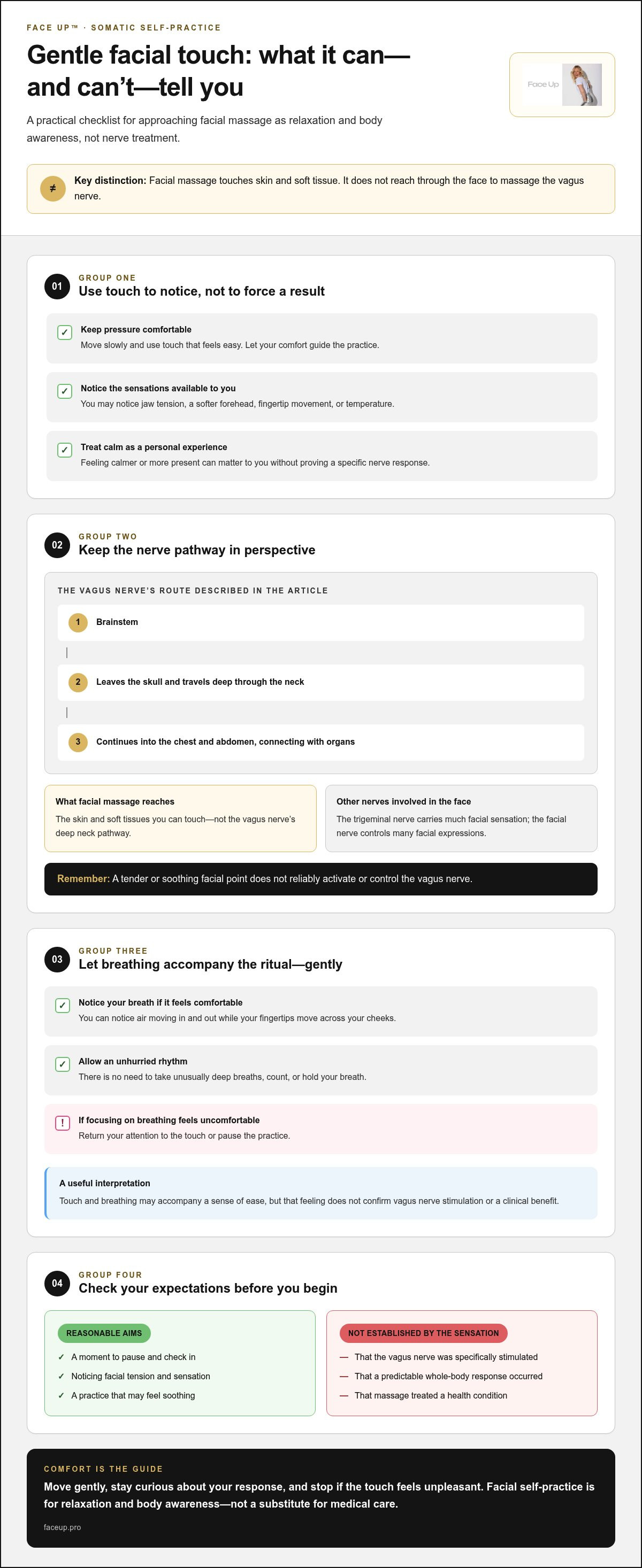
If your jaw feels clenched or your face holds tension, a gentle touch-based ritual can be a manageable way to pause and check in with yourself. The phrase vagus nerve facial massage is often used for this kind of practice, but it can suggest more than the technique delivers. Facial massage works with the skin and soft tissues you can touch. It doesn’t reach through the face to massage the vagus nerve.
The vagus nerve is part of the autonomic nervous system, which helps regulate functions such as heart rate and digestion without requiring conscious control. It carries signals between the brainstem and parts of the body, including organs in the chest and abdomen. For an overview of its route and role, see Vagus Nerve: Anatomy and Function.
A useful definition: “Vagus nerve facial massage” describes gentle facial touch used as a relaxation practice, not a proven medical intervention that directly stimulates or treats the vagus nerve.
Where the vagus nerve travels, and why facial massage is not nerve massage
The vagus nerve begins in the brainstem, leaves the skull, and travels down the neck into the chest and abdomen, where it connects with organs. Its main pathway sits deep in the neck, not just beneath the facial skin. Rubbing your cheeks, temples, or jaw therefore doesn’t mean you’re physically massaging the nerve itself.
Face sensation and movement involve other nerves and tissues. The trigeminal nerve carries much of the face’s sensory information, while the facial nerve controls many facial expressions. Muscles, skin, and connective tissues also shape what you feel during touch. A facial point may feel tender or soothing, but pressing it can’t reliably activate or control the vagus nerve.
Why facial touch may feel calming
Gentle touch gives you a chance to shift attention from a busy day to sensations in your face. You might notice your jaw resting, your forehead softening, or the temperature and movement of your fingertips. If the pressure feels comfortable and you feel safe, that focused attention and sensory input may feel soothing. Experiences vary, and the practice doesn’t need to feel dramatic to be worthwhile.
Keep the interpretation modest. Feeling calmer, more present, or less aware of facial tension is a real personal experience, but it doesn’t prove that the vagus nerve was specifically stimulated or that a particular physiological change occurred. The feeling alone can’t identify the mechanism behind it.
For a somatic approach, treat facial touch as an invitation to notice rather than a way to force a result. Move slowly, use pressure that feels easy, and stay curious about your response. Comfort and self-awareness can be meaningful goals without presenting facial massage as nerve therapy or a substitute for medical care.
How Facial Relaxation, Breathing, and the Nervous System Relate
A facial massage ritual can bring together touch, attention, and breathing. These experiences may support a sense of ease, but it helps to separate that personal feeling from claims about exactly what the nervous system is doing. The sympathetic and parasympathetic branches of the autonomic nervous system are often described in simple terms, yet they work as parts of a responsive system, not as a switch that flips from stress to calm.
The sympathetic branch helps the body respond to demands, while parasympathetic activity supports functions associated with rest and everyday maintenance. The vagus nerve carries a major portion of parasympathetic signals, but it isn’t the only influence on autonomic activity. A particular facial stroke can’t be assumed to trigger a predictable whole-body response.
What the “rest and digest” response does, and doesn’t mean
“Rest and digest” is shorthand for some processes associated with parasympathetic activity, such as supporting digestion when the body isn’t focused on immediate demands. It doesn’t mean the body enters one uniform state or that sympathetic activity stops. Responses shift with context, and people may react differently to the same touch or setting.
If your face feels softer during a massage, notice that as your experience. It isn’t, by itself, evidence that a specific nerve pathway has been activated or that your whole nervous system has changed state. Keep expectations practical: facial touch may feel calming, but the sensation can’t confirm a clinical effect.
Why breathwork may accompany a gentle facial ritual
Breathing can give your attention a comfortable place to rest while you touch your face. You might notice the air moving in and out, or allow your breath to find its own unhurried rhythm as your fingertips move across your cheeks. There’s no need to take unusually deep breaths, count, or hold your breath. If focusing on breathing feels uncomfortable, return your attention to the touch or pause.
This kind of easy noticing may help some people feel more present. It’s a companion to the ritual, not proof of vagus nerve stimulation and not a treatment in itself. You don’t need to achieve a particular breathing pattern or emotional state for the practice to count as a moment of self-attention.
Evidence-aware distinction: “A calming experience during facial massage is meaningful as a personal sensation, but it does not confirm a specific nerve response or a clinical benefit.”
Face Up™ takes a somatic approach that connects facial awareness with body awareness and self-connection. Explore guided facial self-practice as a wellness ritual, rather than a way to control vagal activity.
Vagus Nerve Facial Massage: Plausible vs. Unproven Claims
Facial massage can be a gentle way to explore comfort and tension. The key is not to mistake a relaxing moment for proof that a particular nerve has been activated or a health condition has changed. Research about the vagus nerve, or about clinical vagus nerve stimulation, doesn’t automatically establish what ordinary facial self-massage does. The method, intensity, and purpose are different.
Use this distinction to keep expectations grounded:
What a gentle facial practice may reasonably offer
During a comfortable practice, you may notice that your jaw feels less clenched, your face feels more at ease, or your attention has settled on the sensations of touch. These are possible immediate experiences, not guaranteed results. They may change from one session to another, and they don’t measure vagal activity or predict a lasting effect.
Observe your response without turning it into a test. Notice whether the touch feels pleasant, neutral, or uncomfortable, then adjust or stop accordingly. A soothing sensation is valuable as a sensation; it isn’t a diagnostic sign that your nervous system is regulated or that a particular health issue is improving.
Health claims that need stronger evidence
Be cautious of claims that facial massage treats anxiety, depression, inflammation, digestive disease, pain, or trauma. Clinical vagus nerve stimulation uses targeted medical devices under healthcare guidance. That is not equivalent to moving your fingers over facial skin, and evidence about one approach can’t prove what another does. A pleasant response during massage also doesn’t demonstrate targeted nerve stimulation.
Facial self-massage may sit alongside ordinary wellbeing practices, but it shouldn’t replace assessment or care for persistent symptoms. If pain, digestive problems, anxiety, or another concern continues or affects daily life, speak with a qualified healthcare professional. Keep the practice focused on gentle touch and self-awareness, rather than using it to diagnose or treat something that may need medical attention.
How to Try a Gentle Vagus Nerve Facial Massage at Home
Use the following sequence as an optional moment of relaxation and facial awareness, not as a way to stimulate or treat the vagus nerve. There’s no target sensation to produce. Choose a comfortable seated or reclined position, wash your hands, and briefly notice how your brow, cheeks, and jaw feel before you begin.
A simple, pressure-light facial sequence
Keep your hands relaxed and your touch light. The movements should feel comfortable on the skin, never sharp or forceful. Move slowly enough to notice the contact, and pause whenever you want.
- Settle in. Let your shoulders rest. Take a few easy, unforced breaths and notice your face without trying to change it. If focusing on your breath feels uncomfortable, let it happen in the background.
- Soften the forehead. Place your fingertips gently above the brows and glide outward toward the temples. Keep clear of the eyes, and don’t press hard or drag the skin.
- Move across the cheeks. Rest your fingertips beside the nose, then make a light, slow sweep outward across each cheek. Use a touch that feels pleasant or neutral, not one that pushes deeply into the tissue.
- Check in around the jaw. With your fingertips, make small, gentle circles over the broad muscles at the sides of the jaw. Keep your teeth unclenched if that feels easy, and avoid forcing your mouth open or pressing into a tender spot.
- Pause and notice. Let your hands rest, or finish there. Notice whether your face feels different, the same, or ready for a break. Any of those responses is okay.
This routine doesn’t rely on a special nerve point or a particular number of repetitions. It’s a way to bring gentle attention to the forehead, cheeks, and jaw. The name “vagus nerve facial massage” shouldn’t be taken as evidence that these movements directly reach or activate the nerve.
How to adapt the practice to your comfort
Your comfort sets the pace. Use lighter contact, keep your hands still, skip an area, or stop altogether. You don’t have to massage the jaw if it feels sensitive, and you can leave out any movement that doesn’t suit you. If touch brings pain, dizziness, or emotional distress, stop rather than trying to push through it.
If jaw tension is a particular concern, explore this TMJ massage therapy guide for more focused context. Persistent or worsening pain deserves professional attention; self-massage isn’t a substitute for assessment or care.
For a guided way to explore facial awareness and gentle self-practice, explore Face Up™’s somatic approach. Treat it as a complementary wellness practice, with your comfort guiding each step.
Explore Facial Self-Practice Through Face Up™’s Somatic Approach
With the evidence and limits in mind, approach facial self-practice as a way to pay attention to your experience, not as a technique for controlling the vagus nerve. Face Up™ brings a somatic perspective to facial wellness, connecting awareness of facial tension with body awareness and self-connection. The focus is on noticing what you feel and responding with care, rather than chasing a promised result.
A somatic perspective beyond facial appearance
Somatic practice means turning attention toward sensations in the body. During facial self-practice, that might mean noticing a clenched jaw, a furrowed brow, or how your shoulders feel as you touch your face. You can observe without needing to change anything. Face Up™’s approach places facial wellness in this wider context of self-connection, without treating a sensation as proof of a specific nerve effect.
This shifts the emphasis from viewing facial massage only as a beauty routine or a route to a particular physical change. Your experience may vary from one practice to another. There’s no need to interpret a quiet moment, a strong emotion, or a change in tension as a guaranteed outcome. Keeping the practice exploratory leaves room for your comfort and boundaries.
Choose a self-practice or guided way to continue
If you’d like more structure, Face Up Club and Face Up™ self-practice sessions offer ways to explore guided rituals. For a jaw-focused learning experience, Jaw Release by Face Up™ is a workshop. These options support facial awareness and somatic practice; they are not treatments for vagus nerve function or medical conditions.
You can also explore somatic bodywork as a separate way to engage with the relationship between facial tension and body awareness. Whatever format you choose, keep the same principles from this guide: move at a manageable pace, notice your response, and stop if the practice becomes uncomfortable. The value lies in attending to your experience, not in achieving a prescribed sensation.
If jaw tension is your main area of interest, the TMJ massage tool guide explores a related topic from a somatic perspective. It’s distinct from this gentle facial routine, so use it as additional context rather than assuming a tool is necessary for self-practice.
The phrase vagus nerve facial massage can make a relaxation ritual sound like targeted nerve therapy. Face Up™’s approach keeps the distinction clear: facial self-practice may support awareness and self-connection, but it doesn’t establish vagus nerve stimulation or promise clinical effects. If this perspective feels right for you, explore Face Up™ and its facial self-practice and bodywork options.
Make Space for a Gentle, Personal Practice
Let your next step be simple: choose a quiet moment to notice how your face feels, then respond with the gentlest comfortable touch. A vagus nerve facial massage doesn’t need to produce a particular sensation or outcome to be meaningful. Treat it as an opportunity to build awareness, not another task to get right.
Face Up™ offers self-practice sessions and bodywork grounded in a somatic approach to facial wellness and self-connection. The brand has been featured in Vogue, Elle, The Daily Telegraph, Marie Claire, SPA+CLINIC, Professional Beauty, and Mamamia. These features offer context for the brand, while your comfort and needs remain the best guide to whether a practice feels right for you.
Explore Face Up™ self-practice and bodywork to find a guided approach that suits you. Keep it gentle, stay curious, and let each practice meet you where you are.
Frequently Asked Questions
Can facial massage directly stimulate the vagus nerve?
Gentle facial massage can’t be assumed to directly stimulate the vagus nerve. Facial sensation involves several nerves, while the vagus nerve follows a complex route through the body. You might feel calmer during a vagus nerve facial massage, but that sensation doesn’t establish targeted nerve activation. If you’re considering nerve stimulation to address a health concern, discuss evidence-based options with a qualified clinician rather than relying on facial massage.
How long should a gentle facial massage last?
There’s no established facial-massage duration that guarantees a nervous-system effect. For a first attempt, keep the practice brief and pause to check how your skin, jaw, and overall comfort feel. You can stop at any point, even if you’ve only touched one area. There’s no need to finish a timed routine or extend the massage to seek a stronger response. Comfort matters more than duration.
Is facial massage a treatment for anxiety or trauma?
No. Facial massage shouldn’t be presented as treatment for anxiety or trauma, or as a substitute for mental-health care. Some people may find gentle touch or body awareness calming; others may feel uneasy or prefer not to be touched. If distress is ongoing or affecting daily life, seek support from a qualified health professional. Choose only practices that feel emotionally safe, and stop if your response changes.
What happens if facial massage makes me feel uncomfortable or emotional?
Stop the massage, remove your hands, and give yourself permission to pause. Instead of trying to explain the reaction, orient to something steady in the present, such as naming objects in the room or feeling your feet on the floor. You don’t need to push through discomfort or interpret it as proof of stored trauma or nerve activation. If distress continues, consider support from a qualified professional.
Can I massage my ears to activate the vagus nerve?
Parts of the outer ear have sensory nerve connections, but ordinary ear massage can’t be assumed to reliably activate the vagus nerve or create a health benefit. Avoid firm pressure and don’t put fingers or objects into the ear canal. Ear massage is not equivalent to medical vagus nerve stimulation. If you’re considering a medical intervention involving the vagus nerve, discuss its suitability and risks with a qualified clinician.
Should I use facial massage instead of medical care for ongoing symptoms?
No. A soothing self-care ritual shouldn’t replace assessment or treatment for persistent pain, dizziness, digestive symptoms, anxiety, or other health concerns. Arrange professional guidance if symptoms continue, worsen, or interfere with daily activities. Facial massage can be an optional wellness practice if it feels comfortable, but it can’t diagnose a problem or guarantee nervous-system regulation. Don’t delay care because a massage seems temporarily soothing.


