

What if the first step toward a less guarded jaw isn’t making it move farther, but noticing how it moves now? If chewing, talking, or opening your mouth feels effortful, somatic exercises for tmj pain may sound appealing. It’s understandable to wonder whether movement could aggravate discomfort. Somatic practice starts with attention to sensation and small, comfortable movements, not pushing through pain or forcing a release.
Jaw discomfort can have different contributing factors. Stress may affect tension for some people, but it doesn’t explain every case, and trauma shouldn’t be assumed to be stored in the jaw. This guide explains somatic practice in this context and offers a cautious way to notice and move your jaw without treating the exercises as a cure. You’ll also learn when to pause and seek qualified advice, so you can approach self-practice with care rather than pressure.
Key Takeaways
- Learn the difference between the TMJ, the jaw joint, and TMD, the broader term for jaw-related disorders.
- Use somatic exercises for tmj pain to explore jaw movement and sensation gently, without forcing relaxation or range of motion.
- Set realistic expectations: awareness practice may support mindful movement, but it can’t guarantee relief or cure TMD.
- Try an optional sequence of settling, noticing your resting jaw, exploring a small comfortable movement, and pausing to reflect.
- Explore Jaw Release by Face Up™, a workshop, as a guided way to engage with jaw awareness and self-practice.
What Are Somatic Exercises for TMJ Pain?
Somatic exercises for tmj pain are gentle movements paired with attention to what you feel as you move. Instead of trying to stretch your jaw as far as possible, notice details such as effort, ease, and whether your teeth are touching. The key distinction is simple: somatic jaw practice is self-directed movement guided by sensation, not forceful stretching or an attempt to make the jaw release.
Here, TMJ means the temporomandibular joint, the joint on each side of the head that connects the lower jaw to the skull. TMD, or temporomandibular disorders, is the broader term for conditions involving the joint and related structures. Jaw discomfort can be unsettling, but those terms alone don’t explain its cause. The overview of temporomandibular joint dysfunction describes a range of symptoms and possible contributing factors, rather than one explanation that applies to everyone.
Somatic practice isn’t a way to diagnose TMD, and it shouldn’t be presented as a cure. Its modest aim is to help you notice how your jaw moves and how much effort you use. For example, opening slowly may feel different from opening quickly, or you might notice that you’ve been holding your teeth together while concentrating. These observations can help you describe your experience, but they don’t prove a particular problem or explain its cause.
How Is Somatic Jaw Practice Different from Jaw Massage?
In somatic practice, you guide your own small movements and notice the sensations they create. Jaw massage, by contrast, involves hands-on contact with soft tissue, whether self-applied or provided by a practitioner. One approach emphasizes awareness through movement, while the other focuses on touch. They aren’t interchangeable, and neither should be forced through pain. For massage-focused information, see the TMJ massage therapy guide.
What Might Jaw Tension Feel Like?
People may describe tension as tightness, effort when opening, or difficulty letting the jaw rest comfortably. Others notice tenderness, clicking, or movement that feels limited. These sensations can have different explanations, and a click by itself doesn’t establish a diagnosis. Notice what you experience without deciding that stress, emotions, or trauma must be the cause. If discomfort is persistent, worsening, or interfering with daily activities, seek qualified advice rather than relying on self-practice alone.
How Somatic Awareness Relates to Jaw Movement and Tension
The jaw is involved in familiar actions such as speaking, chewing, and yawning. Its movement depends on the temporomandibular joints and the muscles that move the lower jaw. Everyday habits can also affect how much effort you notice: you may hold your teeth together while concentrating, brace your jaw during a demanding task, or move quickly without noticing the effort involved.
Somatic awareness brings attention to those details. Rather than assuming a particular muscle is “too tight” or trying to make your jaw relax, observe what happens as you breathe, speak, or make a small movement. Does your jaw move easily, or do you notice extra effort? Are your teeth touching when you’re not eating? These are observations, not diagnoses, and they don’t explain why discomfort is present.
Jaw pain can have multiple causes, so understanding what’s behind yours may require an individual assessment. Stress or clenching may be relevant for some people, but neither is a universal explanation for TMJ symptoms. Paying attention to patterns can help you describe your experience more clearly; it can’t establish the cause or replace advice from a qualified health professional.
What Role Can the Nervous System Play in Jaw Awareness?
Attention gives you a chance to notice sensations and movement patterns as they happen. For example, you might become aware that your jaw feels more effortful during a tense conversation, or that your breathing changes when you’re concentrating. Stress can influence how someone experiences tension, but that relationship varies. Awareness exercises don’t reset, heal, or retrain the nervous system; they invite careful observation without assuming one explanation fits everyone.
Why Gentle Movement Matters More Than Forcing a Stretch
A small, comfortable movement lets you explore how your jaw feels without making maximum range the goal. You might notice the beginning of an opening movement, then stop well before you feel compelled to stretch farther. This isn’t a flexibility test. Pushing through pain, increasing range to meet a target, or repeating a movement that worsens symptoms isn’t necessary for useful awareness.
The joint and its surrounding muscles work together, but discomfort doesn’t reveal exactly which structure is involved. Keep your attention on what you can observe: how easy the movement feels, whether effort changes, and whether your breathing feels held or comfortable. If movement feels uncomfortable, return to rest or stop. Persistent, worsening, or function-limiting symptoms deserve individual guidance rather than a more forceful stretch.
If you’d like structure while exploring facial awareness, Face Up self-practice offers a way to continue at a comfortable pace. It can complement your own observations, but it can’t determine the cause of pain or promise a particular result.
Can Somatic Exercises Help TMJ Pain? Benefits, Limits, and Misconceptions
Somatic exercises may help you notice how your jaw moves and when you’re using extra effort, but somatic exercises for tmj pain can’t guarantee pain relief. A practice that feels manageable for one person may not suit someone else, and noticing a pattern doesn’t prove what’s causing discomfort. Treat these exercises as optional self-awareness, not a test of whether your jaw is healthy or a substitute for assessment.
That distinction matters because strong claims can make a simple practice sound like a complete treatment. Gentle movement doesn’t establish that it will cure a temporomandibular disorder, permanently ease pain, stop teeth grinding, or resolve trauma. If you’re comparing hands-on approaches with self-practice tools, the TMJ massage tool guide covers tools as a separate topic. Using one isn’t the same as somatic movement.
What Somatic Exercises May Support, and What They Cannot Promise
A realistic aim is to notice whether you’re clenching, how much effort a movement takes, or whether a particular motion feels comfortable. You might observe that your jaw feels different after a pause, or that you tend to hold it firmly during a task. Those details can help you describe your experience, but they don’t identify the source of pain or show that a specific exercise is treating it.
Self-practice can’t assess every possible cause of jaw symptoms. It also can’t guarantee that grinding will stop or that relief will last. Suitability and experience vary, so avoid judging a practice by a promised timeline or pushing through discomfort to reach an expected result. If you have a diagnosis or care plan, use exercises only in a way that fits the guidance you’ve received.
When Should You Pause and Seek Professional Advice?
Stop the movement if it increases pain, discomfort, or distress. You don’t need to finish a sequence or repeat an exercise to prove you’ve tried hard enough. Persistent or worsening symptoms, or difficulty with everyday function, are reasons to seek assessment from a qualified healthcare professional. A clinician can consider your individual symptoms and advise whether self-practice is appropriate.
Some changes call for timely guidance rather than experimentation. Seek clinical advice if jaw symptoms begin suddenly, follow an injury, or make eating difficult. This isn’t a reason to assume the worst; it’s a practical way to avoid relying on exercises when you need an individual assessment. If you’re unsure whether a movement is suitable, pause until you can get advice.
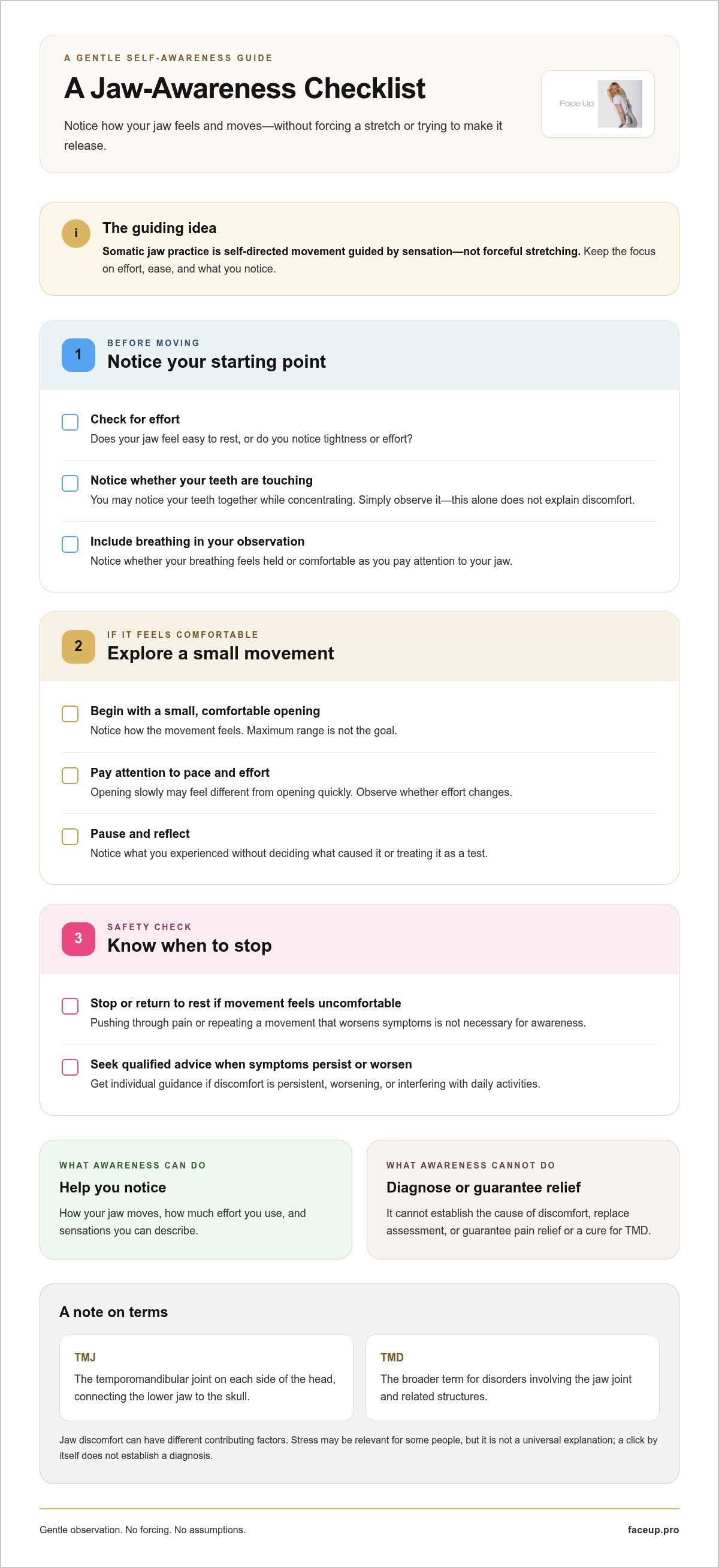
A Gentle Somatic Practice for Noticing Jaw Tension
This optional check-in is for noticing, not treating, jaw pain. It isn’t a prescribed exercise or a substitute for assessment. Choose a seated or supported position where your head and body feel at ease. You can skip any step, keep your jaw still, or stop altogether. There’s no target range to reach and no particular result you need to feel.
Move only if it feels comfortable. If you notice increasing pain, new discomfort, or distress, stop rather than trying to work through it. If symptoms persist or interfere with daily activities, seek qualified healthcare advice instead of relying on self-practice.
How to Begin with a Resting-Jaw Check-In
Start by noticing, without correcting, how your jaw rests. Sense whether your teeth are touching, how much effort you notice around your face, and whether your breathing feels easy or held. If it feels comfortable, allow a little space between your teeth. There’s no need to interpret a sensation or decide what caused it. Simply register what’s present.
How to Explore Small, Comfortable Jaw Movement
If you’d like to continue, explore a small opening or gentle side-to-side movement, only within a comfortable range. Move slowly enough to notice effort and ease; don’t stretch toward your maximum or aim to make one side match the other. Keeping your jaw still is also a valid choice. Pause if anything feels uncomfortable, and skip movement if you’re unsure it’s suitable for you.
Use this sequence as a flexible guide, not a routine you must complete:
- Settle. Sit or rest in a supported position. Let your shoulders and head be comfortable, without trying to correct your posture.
- Notice. Check in with your resting jaw, facial effort, and breath. Let these sensations be as they are.
- Explore. If comfortable, make one small jaw movement. Stay within an easy range, or skip this step.
- Pause. Let the jaw be still again. Notice whether your breathing or facial effort feels different, the same, or hard to tell.
- Reflect. Compare neutrally with how you felt at the start. Any change, or no change, is simply information, not a measure of success.
There’s no need to repeat the movement or practise for a set length of time. The point is to notice, not to make the jaw relax or produce relief. If sensations become more uncomfortable, stop and let the jaw rest. You can also end the check-in at any point, even before trying movement.
If you’d like a guided way to explore facial awareness at your own pace, explore self-practice with Face Up Club. This is an invitation to engage with awareness, not a promise of pain relief.
Explore Guided Jaw Self-Practice with Face Up™
After trying a gentle check-in on your own, you may want a guided way to explore jaw-focused awareness. That’s an optional next step, not a requirement for practising or a promise of relief. The right approach depends on what feels useful and comfortable to you. Jaw Release by Face Up™ is a workshop for exploring jaw-focused practice; it isn’t a diagnosis or a substitute for clinical care.
How Jaw Release by Face Up™ Fits into Self-Practice
A workshop can offer a point of focus for exploring practice, while self-practice lets you decide whether and how to engage with it in your own routine. Jaw Release by Face Up™ is a workshop, not a treatment claim. Keep that distinction in mind if you’re managing pain: educational practice can support exploration, but it doesn’t determine the cause of symptoms or replace individual healthcare advice.
There’s no need to move from a solo check-in to a guided option unless it suits you. You might simply continue noticing your jaw in everyday moments, such as checking whether you’re holding it firmly while reading or working. Or you may prefer a structured way to explore facial awareness. Let your interest, comfort, and current needs guide that choice, rather than a promise that one approach will work for everyone.
Choosing a Practice Path That Feels Right
Face Up™ offers different ways to engage with facial wellness. Each has a different focus, so consider what you’re looking for without treating any one path as necessary or right for every person.
- Self-practice: Face Up Club offers a way to explore practice independently.
- Bodywork: Face Up™ bodywork sessions are a separate, practitioner-led option, distinct from self-directed movement.
- Professional training: Face Up™ Training is a professional learning option for practitioners interested in the method.
These options aren’t interchangeable, and none should be understood as a guaranteed answer to jaw pain. If symptoms are persistent, worsening, or affecting daily activities, keep qualified healthcare guidance in the picture as you consider self-practice or bodywork. You can also choose not to add anything further; a gentle, self-directed check-in may be enough for your current interest.
If a workshop feels like a suitable next step for exploring jaw-focused awareness, Explore Jaw Release by Face Up™. Take your time choosing. Your practice can remain simple, and you’re free to pause or choose a different path whenever that feels right.
Let Your Next Step Be Gentle and Personal
Your next step doesn’t need to be a bigger movement or a stricter routine. You might simply take a moment during the day to notice whether your jaw feels at ease, then carry on without trying to change it. That small pause can keep somatic exercises for tmj pain grounded in curiosity rather than pressure to achieve a particular result.
Let your experience guide what comes next. If you’d like more structure for exploring jaw awareness, consider a guided approach that respects your pace and comfort. If now isn’t the right time, it’s fine to leave the practice there. There’s no need to make self-care another task to get right.
Explore Jaw Release by Face Up™ as an optional way to continue your exploration. Choose the path that feels appropriate for you, and give yourself permission to move gently, pause, or change course.
Frequently Asked Questions
Can somatic exercises help with TMJ pain?
They may help you notice jaw effort and movement habits, though each person’s response can differ. Somatic exercises for tmj pain aren’t a proven cure or a way to diagnose what’s causing discomfort. For example, noticing that your jaw feels strained while speaking can be useful information, but it doesn’t explain why. Stop if symptoms worsen, and seek qualified assessment for persistent, concerning, or disruptive pain.
What is the best somatic exercise for jaw tension?
There isn’t one exercise that’s best for everyone. A gentle starting point is to notice your jaw at rest, then, only if comfortable, explore a small movement such as beginning to open your mouth. Keep the movement easy rather than trying to stretch farther. You can skip movement entirely. Don’t push through pain, and seek individual guidance if symptoms persist or limit daily activities.
Can I do jaw exercises if my TMJ hurts?
Whether exercises are suitable depends on your symptoms and their cause. If you choose to explore movement, keep it gentle and comfortable, and stop if pain, discomfort, or distress increases. Don’t try to exercise through pain or force your jaw to move farther. Persistent, worsening, injury-related, or function-limiting symptoms warrant assessment by an appropriately qualified healthcare professional before you rely on a generic exercise routine.
How often should I do somatic exercises for TMJ pain?
There’s no one schedule that suits everyone, so treat practice as an optional check-in rather than a routine you must complete. Notice whether your jaw feels comfortable during and after a brief exploration; don’t chase repetitions or assume more practice means better results. If symptoms increase, stop. For persistent concerns, ask a qualified healthcare professional for individual guidance instead of following a generic schedule or expecting a set timeline.
Are somatic exercises the same as TMJ massage?
No. Somatic exercise centres on your attention to sensation and gentle self-directed movement, while massage involves hands-on techniques. They’re different approaches, not interchangeable methods, and neither guarantees a particular result. If you’re looking for information specifically about massage approaches and tools, the TMJ massage therapy guide discusses that topic separately. Stop any approach that aggravates discomfort.
When should I see a healthcare professional about jaw pain?
Seek qualified assessment if jaw pain persists, worsens, affects eating or daily activities, follows an injury, or concerns you. Sudden or significant changes call for timely clinical advice. An online exercise article can’t identify the cause of your symptoms, so don’t use it as a substitute for individual evaluation. Pause any practice that makes discomfort worse, and share what movements or activities affect your jaw with the clinician.


