

The most advanced-looking certificate may be the wrong fit for your practice. A certification for facial rejuvenation can refer to device-based aesthetics, clinical procedures, hands-on facial work, or somatic approaches, and each prepares practitioners for a different kind of client experience.
It makes sense to look for training that builds confidence and supports real client work, not just a credential to display. The key is to match the method and scope of a course with your existing skills, the clients you serve, and the work you want to offer. Local professional requirements also matter, particularly for clinical or device-based procedures.
This guide compares the main approaches to facial rejuvenation training and explains what to consider when assessing course content, practical application, and fit with your professional goals. You’ll also learn how Face Up™ Training offers a somatic, hands-on path that connects facial sculpting with tension release, wellbeing, and self-connection. Whether you’re drawn to clinical aesthetics or a more holistic style of facial work, you can use these distinctions to choose a learning path that feels relevant to your practice.
Key Takeaways
- A certification records completion of a particular training pathway; it isn’t automatically a universal licence to perform every facial procedure.
- Compare clinical, device-led, and manual or somatic methods by their curriculum, intended practitioners, and service context.
- Use a practical checklist to assess whether a certification for facial rejuvenation matches your skills and the services you plan to provide.
- Before practising, consider your scope, understand the method, build appropriate practice, and communicate clearly with clients.
- Explore how Face Up™ Training connects hands-on facial sculpting with bodywork, tension awareness, and self-connection.
What Does Certification for Facial Rejuvenation Actually Mean?
A certificate usually records that a learner completed a defined course or training pathway. It may describe the subject studied, but it doesn’t automatically function as a professional licence, guarantee recognition by an employer or insurer, or grant permission to perform every treatment. The meaning depends on the course provider, curriculum, assessment, and the professional context in which the training is used.
Course titles can sound similar while pointing to very different work. One program may focus on general facial-care knowledge, another on clinical procedures or equipment, and another on manual techniques. Facial rejuvenation is a cosmetic treatment or series of treatments aimed at restoring a youthful appearance to the face. That broad description includes varied approaches, so the label alone tells you little about what a particular course teaches or who it prepares to serve.
A useful definition: certification for facial rejuvenation is evidence of completing a specific course of study, with its value and relevance shaped by the training content, assessment, and recognition in the learner’s professional setting.
Why facial rejuvenation certificates are not all equivalent
General facial-care education may cover foundational knowledge and routine care, while specialist rejuvenation training focuses on particular methods and service contexts. Clinical courses may teach procedures that require medical knowledge; device-based courses centre on operating or applying equipment; hands-on approaches use manual techniques and may frame facial work through relaxation, tension awareness, or wellbeing. These are differences in scope, not a ranking of quality.
A certificate’s title cannot establish professional eligibility. A course called “advanced” or “professional” doesn’t, by itself, show that its methods fit your existing qualifications or local rules. Completion confirms what the course provider says was completed; it doesn’t replace relevant registration, legal scope, or other requirements that may apply to your role and location.
What to understand before enrolling
Read beyond the headline and look for clear information about the intended learner and the skills the training aims to develop. A course designed for healthcare professionals may assume prior clinical knowledge, while hands-on or somatic training may centre on a different service model. The distinction matters: the right choice should support the work you are trained and permitted to do.
- Audience: Identify who the course is designed for and any prior experience it expects.
- Methods: Check which approaches are taught, and whether they match the services you intend to provide.
- Learning and assessment: Review the stated curriculum, practical learning opportunities, and how completion is assessed.
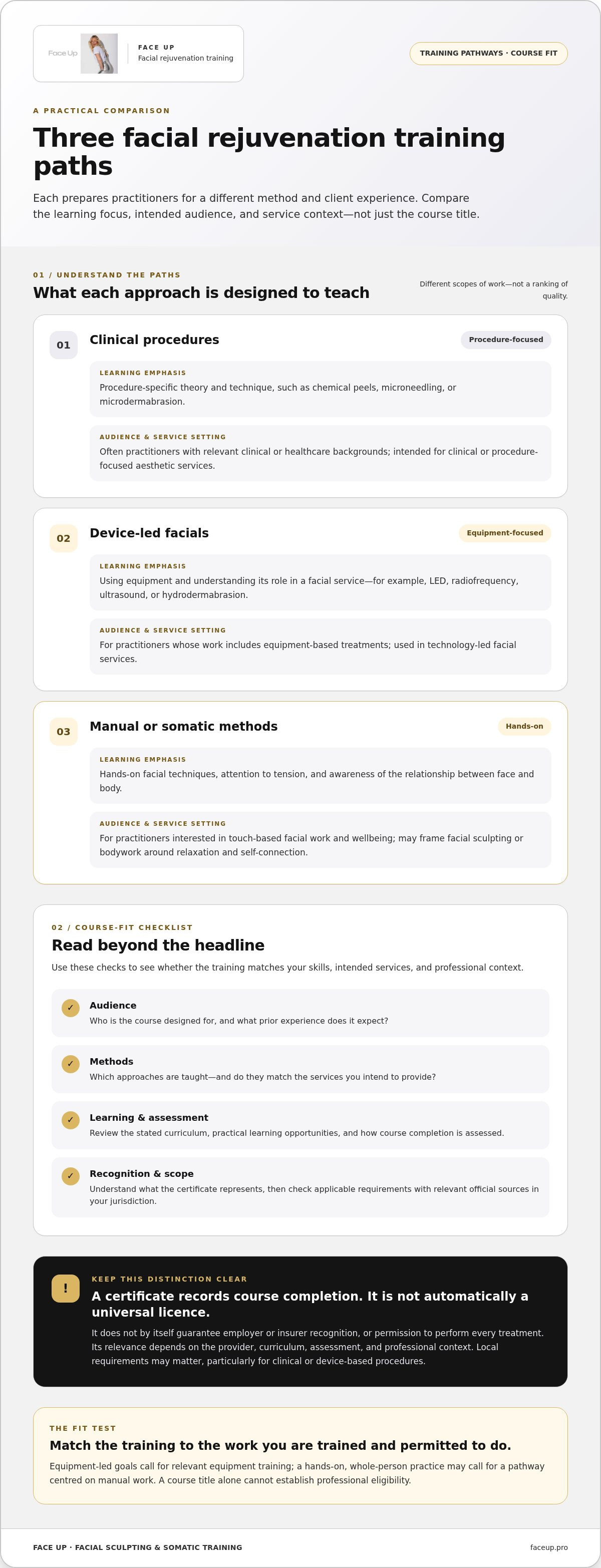
- Recognition and scope: Understand what the certificate represents, then check applicable requirements with relevant official sources in your jurisdiction.
Make the comparison concrete. If your goal is to offer equipment-led treatments, training in manual facial work may not cover the skills you need. If you’re drawn to a hands-on, whole-person approach, a clinical course may not reflect your intended practice. Match the learning pathway to both your professional context and the client experience you want to create.
How Facial Rejuvenation Training Methods Differ
Training pathways differ because they prepare practitioners for different methods and service settings. Clinical procedures, equipment-led facials, and hands-on somatic work shouldn’t be treated as interchangeable. A course may teach a specific technique without covering the skills or context required for another. This comparison can help you identify which learning approach best matches the client experience you intend to offer.
| Training approach | Learning emphasis | Typical audience | Service context |
|---|---|---|---|
| Clinical procedures | Procedure-specific theory and technique, such as chemical peels, microneedling, or microdermabrasion | Often practitioners with relevant clinical or healthcare backgrounds | Clinical or procedure-focused aesthetic services |
| Device-led facials | Using equipment and understanding its role in a facial service, such as LED, radiofrequency, ultrasound, or hydrodermabrasion | Practitioners whose work includes equipment-based treatments | Technology-led facial services |
| Manual or somatic methods | Hands-on facial techniques, attention to tension, and awareness of the relationship between face and body | Practitioners interested in touch-based facial work and wellbeing | Facial sculpting or bodywork framed around relaxation and self-connection |
Clinical and device-led facial aesthetics
Clinical training may focus on procedures such as peels, microneedling, and microdermabrasion. Device-led education, by contrast, centres on applying technologies such as LED, radiofrequency, or ultrasound in facial services. These pathways have distinct learning needs, and neither should be confused with hands-on facial sculpting. Non-invasive describes an approach, not automatic permission to practise it or proof that it is medical treatment.
Regulatory context can also depend on what’s being used and where. The FDA’s overview of the Modernization of Cosmetics Regulation Act (MoCRA) explains requirements related to cosmetics. It should not be read as a complete guide to rules for procedures or equipment; those may involve other requirements.
Hands-on sculpting and somatic facial work
Manual and somatic approaches place the practitioner’s hands, touch, and observation at the centre of the session. A practitioner may attend to facial tension and body awareness, while framing the work around wellbeing rather than presenting it as a clinical procedure. Face Up™ Training offers professional training in a holistic, somatic approach to facial sculpting and bodywork. Its focus includes facial tension and self-connection, without promising a particular cosmetic or therapeutic result.
For a closer look at this method, explore the facial sculpting certification guide. The Face Up™ approach to facial sculpting may be relevant if your professional goals centre on hands-on work rather than clinical or device-led treatments.
Method shapes professional context: the techniques a course teaches influence the audience it serves and the kind of client experience it prepares practitioners to provide.
How to Compare Facial Rejuvenation Certification Options
A useful comparison starts with the work you want to do, not the boldest promise on a course page. A certification for facial rejuvenation is relevant when its method, intended learners, and learning outcomes align with your professional direction. Use the checklist below to compare courses on substance rather than presentation.
Match the training method to your professional direction
First, picture a typical client session in your practice. Would you be working with skin-focused procedures, operating aesthetic devices, or using hands-on facial techniques as part of bodywork? Each direction calls for different learning and a distinct client experience. The best fit is the pathway that develops skills you can apply within your professional role, not simply the one with the broadest-sounding title.
Consider how the training would sit alongside your existing work. A practitioner whose services centre on equipment may want education closely tied to that technology. Someone whose practice is based on touch and whole-person wellbeing may look for a manual or somatic approach. Think about the clients you serve, the nature of the sessions you want to offer, and how facial work complements your current professional identity.
- Method: Does the course focus on clinical procedures, devices, manual techniques, or a clearly described combination?
- Audience: Is it designed for practitioners with your background and experience?
- Practice fit: Can you connect the course’s stated learning outcomes to the services you intend to provide?
Assess curriculum and learning experience
Look for specific learning objectives rather than relying on promotional phrases such as “advanced” or “complete.” A clear curriculum should help you understand what topics and techniques are covered, how learning is developed, and what successful completion involves. For practical work, find out what the course itself says about practice and assessment. Don’t assume that a certificate title tells you how competence is evaluated.
Course format is another point of comparison, but only use details the provider actually states. Online, in-person, and blended learning describe delivery, not necessarily the depth or relevance of the content. Consider whether the stated format gives you a suitable way to engage with the methods you want to learn. A useful question is: after completing this training, what specific client-facing work will I be better prepared to discuss or provide within my professional scope?
- Curriculum: Are the methods and topics explained clearly enough to judge their relevance?
- Practice and assessment: Does the provider describe how applied learning is supported and how progress is assessed?
- Professional context: Does the course distinguish its educational certificate from any separate requirements relevant to your work?
Finally, separate evidence from marketing. A polished certificate, confident claims, or an appealing course name can’t replace a clear account of the learning. Compare what’s taught with what you hope to offer, then choose accordingly. If a hands-on, whole-person approach fits your direction, Face Up™ Training offers a somatic pathway centred on facial sculpting and bodywork.
What to Consider Before Practising After Certification
Completing a course is one step in professional development, not an automatic green light to offer every technique it covers. Before adding a service, connect your training to your professional scope, local requirements, practical readiness, and the way you explain the work to clients. This matters across facial aesthetics, including for practitioners whose training focuses on non-clinical, hands-on methods.
Use this sequence as a practical pause before you begin:
- Review your scope. Check relevant official requirements for your location and profession, including any rules that apply to the specific technique or service. A certificate doesn’t replace local registration or permission where these are required.
- Understand the method. Be clear about what the technique involves, what it is intended to offer, and where its boundaries lie. Don’t present wellness-oriented facial work as diagnosis or medical treatment.
- Practise appropriately. Revisit the course objectives and apply the method only within your training and professional scope. If an aspect of the work is outside that scope, don’t assume course completion makes it appropriate to offer.
- Communicate clearly. Explain the nature of the service, what a session involves, and what clients can reasonably expect. Avoid promising a particular cosmetic, therapeutic, or health outcome.
Check professional scope and client communication
Requirements can vary by location, profession, and type of procedure. Use the relevant regulator, licensing authority, or professional body as your source for current guidance rather than relying on a course title or informal advice. Keep the distinction clear in your own language: a facial service centred on touch, relaxation, or body awareness is not the same as assessing a condition or providing medical care.
Before a session, describe your approach in plain terms. For jaw-focused work, for example, explain whether the service involves gentle hands-on techniques and how it fits within your practice. The TMJ massage therapy guide offers related context on jaw tension, while clear boundaries help clients understand what your service does and does not set out to do.
Build confidence through reflective practice
Professional readiness develops through thoughtful application, not the certificate alone. Before offering a service, revisit the learning objectives and consider whether you can describe the method consistently, explain its limits, and keep the client experience aligned with your training. After sessions, reflect on what went as intended and where you may need to deepen your understanding. Continued learning can help you keep your practice considered as your work evolves.
If your professional direction is hands-on facial sculpting with a somatic focus, explore Face Up™ professional training as a way to learn more about the Face Up™ approach.
Explore a Somatic Pathway with Face Up™ Training
Clinical procedures, device-led facials, and hands-on facial work serve different professional interests. For practitioners drawn to a holistic approach, Face Up™ Training offers professional learning within the Face Up™ somatic facial-sculpting approach. Its perspective connects facial work with bodywork, attention to facial tension, and self-connection, placing wellbeing alongside the experience of facial sculpting.
This is a distinct pathway, not a substitute for clinical qualifications or training in procedures and equipment. The right choice depends on the work you intend to offer, the clients you hope to serve, and how facial practice fits your professional identity. Choose what’s right for you by looking for a method that aligns with those aims and stays within your professional scope.
How the Face Up™ approach fits this comparison
Face Up™ frames facial sculpting through a hands-on, somatic lens. Rather than presenting facial work as medical treatment, its holistic approach draws attention to facial tension and the relationship between facial work, body awareness, and self-connection. This offers a different emphasis from training centred on clinical procedures or devices, without suggesting that one approach replaces another.
That distinction can help you picture the kind of client experience you want to create. If you’re interested in facial wellness and touch-based work, consider whether a somatic method complements your existing practice. If your goals involve clinical procedures, this pathway shouldn’t be treated as a substitute for the relevant clinical education or professional requirements.
Take the next step in your professional learning
Face Up™ was founded by Olga Newman, and its professional training sits within a wider ecosystem that includes bodywork sessions, self-practice sessions, and live events. These offerings provide different ways to engage with the brand’s approach, while the training is specifically positioned for professional learning. No single pathway needs to suit every practitioner.
As you consider a certification for facial rejuvenation, return to the practical questions that guide a sound choice: Does the method match your direction? Does it fit the service you intend to provide? Can you explain its purpose and boundaries clearly to clients? Those answers can help you choose a path with intention rather than relying on a certificate title alone.
If the Face Up™ approach feels aligned with your professional interests, take a calm next step: explore Face Up™ Training and discover more of the Face Up™ world.
Shape a Learning Path That Grows With Your Practice
Your next step can be guided by the kind of professional experience you want to create. Rather than treating another credential as the destination, consider how continued learning can deepen your confidence, sharpen your approach, and support thoughtful client relationships over time. The right certification for facial rejuvenation is one that belongs within a wider commitment to practice with clarity and care.
For practitioners interested in facial work that makes room for wellbeing and self-connection, Face Up™ offers a perspective to explore. The brand has been featured in Vogue, Elle, The Daily Telegraph, and Marie Claire. Its professional training sits alongside bodywork and self-practice options, creating a broader context for engaging with the Face Up™ approach.
Take time to consider whether this direction reflects the work you want to bring into your practice. If it does, explore Face Up™ Training and discover a considered next step in your professional learning. Your path can be both purposeful and personal.
Frequently Asked Questions
What is certification for facial rejuvenation?
Certification for facial rejuvenation is a course credential showing that a learner completed a particular training programme. The title can cover varied subjects, such as conventional facials, device-led aesthetics, or hands-on sculpting. Before relying on one, look at what skills it covers and who it was designed for. For example, a certificate in facial massage doesn’t by itself demonstrate training in operating aesthetic equipment.
Is facial rejuvenation certification the same as an aesthetics licence?
No, a course certificate and permission to practise are different things. A certificate records course completion, while professional permissions depend on your qualifications, location, and intended service. Requirements may vary by procedure, too. Before adding a service to your menu, identify the exact technique you plan to provide and consult the official regulator or professional body relevant to your role and location.
Can I offer facial treatments after completing an online certification?
Not solely on the basis of completing an online course. Whether you can offer a particular treatment depends on the technique, your existing qualifications, the course’s scope, and the requirements where you practise. For example, completing online lessons about a method doesn’t necessarily demonstrate practical competence with it. Review the learning outcomes and applicable local requirements, then describe your services accurately rather than implying broader training than you’ve completed.
How do somatic facial training and clinical aesthetics training differ?
Somatic facial training centres on hands-on work and awareness of facial tension and body experience, while clinical aesthetics training may focus on procedures, equipment, or clinical protocols. Consider a practitioner choosing between a touch-based session and an equipment-led facial: the skills and client experience differ. Compare the techniques taught and the course’s intended context, rather than assuming similar words in course titles mean equivalent preparation.
What should a facial rejuvenation certification course include?
Look for a course description that names its learning objectives, intended practitioner audience, curriculum, and assessment approach. The relevant content depends on the method: a device-focused course and a hands-on sculpting programme should not be expected to teach identical skills. Also consider whether the stated format supports your learning needs. If you plan to work with clients, check how the course prepares learners for the specific service you intend to offer.
Does a facial sculpting certificate qualify me to perform medical aesthetic procedures?
No, don’t assume a facial sculpting certificate prepares you for medical aesthetic procedures. Hands-on or somatic facial work is distinct from training for medical procedures, such as injections. For instance, learning a manual sculpting method doesn’t establish that you’re qualified or permitted to perform an unrelated procedure. Your professional credentials and the requirements applying to that procedure and location determine eligibility, so represent your training and services precisely.
Is Face Up™ Training focused on facial rejuvenation?
Face Up™ Training is professional training within Face Up™’s somatic approach to facial sculpting and bodywork. Its perspective brings attention to facial tension, wellbeing, and self-connection. This may interest practitioners whose work is oriented toward hands-on facial wellness, rather than clinical procedures or device-led aesthetics. To assess whether it suits your direction, consider the kind of client experience you want to offer and how this approach fits your professional practice.


