

What if the $87 wireless jaw massager sitting on your nightstand is actually preventing you from finding the permanent relief you crave? It is a common frustration to wake up with a dull headache or hit a wall of face fatigue by 2 PM, only to find that standard massages offer nothing but a fleeting pause in the pain. You aren't alone in this cycle. With up to 35 million people in the United States currently reporting symptoms of jaw disorders, the search for a solution that lasts has never been more urgent.
Welcome to the World of Face Up™, where we believe that a massager treats the muscle, but somatic jaw tension release treats the nervous system pattern that creates the tension. In this guide, you'll discover how to move beyond temporary fixes and achieve a defined, tension-free jawline using the Face Up™ method. We'll show you how to identify the emotional roots of your clenching and establish a daily ritual that actually works. You'll learn how to join the 90% of patients who respond to conservative, non-invasive care as we explore the latest research from the 2026 TMD IMPACT Initiative.
Key Takeaways
- Identify the difference between simple muscle tightness and the chronic neuromuscular patterns that cause your jaw to stay locked.
- Discover why mechanical vibration from consumer tools often fails to provide the same lasting results as intentional somatic jaw tension release.
- Learn how to recognize "micro-clenches" throughout your workday to stop face fatigue before it begins.
- Gain an introduction to the Face Up™ buccal technique for softening tension from the inside out.
- Explore how to integrate these rituals into your life through the World of Face Up™ app and professional practitioner network.
Understanding Somatic Jaw Tension: Why Your Muscles Stay Tight
Most people treat a tight jaw as a mechanical failure, like a rusty hinge that needs oiling. They reach for a massager or try to stretch the muscle into submission. This rarely works because jaw tension isn't just "tight muscles." It is a chronic neuromuscular pattern. Your brain has essentially forgotten how to let these muscles go. This state is known as Sensory Motor Amnesia (SMA). In the masseter and temporalis muscles, SMA occurs when the brain maintains a constant level of contraction, even while you sleep. You don't feel it happening because it has become your "new normal."
To truly understand why your jaw remains tight despite your best efforts, it helps to ask: What is Somatics? At its core, somatic work focuses on the body as perceived from within. Your jaw is the primary site for the "fight or flight" response. When you face stress, your nervous system prepares you to bite or defend. Over time, this survival mechanism gets stuck in the "on" position. Somatic release is the process of re-educating the brain to let go of the jaw.
The Nervous System and the Masseter Loop
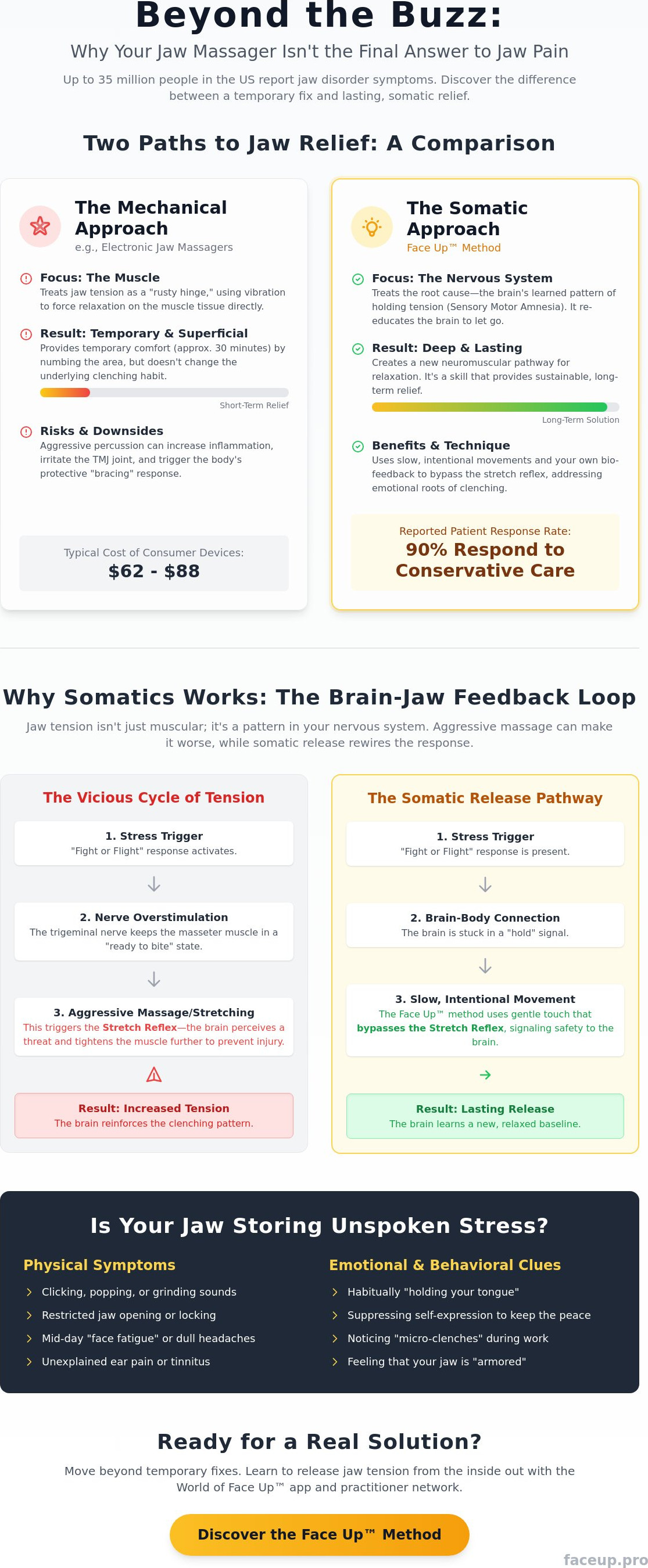
The trigeminal nerve is the architect of your jaw tension. It is the largest cranial nerve, governing both the physical act of chewing and your emotional stress response. When this nerve is overstimulated, it creates a feedback loop that keeps the masseter muscle locked. If you try to aggressively stretch a tight jaw, you often trigger the stretch reflex. Your brain perceives the sudden pull as a threat of injury and signals the muscle to snap back even tighter. The Face Up™ Method avoids this trap. By using slow, intentional movements, we bypass the stretch reflex and speak directly to the nervous system. This allows for a somatic jaw tension release that feels safe to the brain, leading to a depth of relaxation that mechanical tools cannot achieve.
Signs You Are Storing Emotional Trauma in Your Jaw
Your jaw often acts as a vault for unspoken words and suppressed feelings. Physical symptoms like clicking, popping, or a restricted opening are clear indicators of Temporomandibular Joint (TMJ) issues. However, the emotional symptoms are just as telling. Do you find yourself "holding your tongue" during difficult conversations? Do you suppress self-expression to maintain peace? This emotional "bracing" manifests as physical armor. You can explore this further in our guide on The Connection Between Facial Tension and Emotions. Recognizing that your clenching is a protective habit is the first step toward a permanent somatic jaw tension release. Once you address the emotional root, the physical muscle finally has permission to soften.
The 'Jaw Massager' Debate: Can a Tool Solve a Somatic Problem?
By May 2026, the wellness market has seen a significant surge in specialized electronic facial tools. You can now purchase a wireless jaw massager for around $62.99, or a heat-enabled relief device for approximately $87.64. These gadgets promise a quick fix for the "face fatigue" that sets in by mid-afternoon. While these tools offer a modern appeal, they often fail to address the core issue. A massager provides mechanical vibration, which can numb the area and provide about 30 minutes of temporary comfort. However, it doesn't change the clenching habit because it doesn't communicate with the nervous system.
The risk of relying on cheap, high-intensity tools is real. Over-stimulating an already sensitive area can lead to increased inflammation. If you are struggling with TMJ disorders, aggressive percussion can irritate the joint capsule further. True somatic jaw tension release requires a level of nuance that a vibrating motor simply cannot replicate. You need a solution that addresses the brain's role in muscle contraction, not just a device that shakes the muscle tissue.
Electronic Jaw Massagers vs. Manual Somatic Work
Percussive therapy is popular for large muscle groups like the quads, but the face is a map of intricate nerves and delicate bones. Electronic massagers deliver a uniform, repetitive force that can trigger the body's protective bracing response. Manual somatic work, however, utilizes "bio-feedback." This is the real-time sensory information you receive when your own hands touch your face. In the World of Face Up™, we maintain that the hand is the most sophisticated healing tool available. It allows for the subtle adjustments in pressure and speed that are necessary to convince the brain to release its grip. This intentional touch is the foundation of lasting somatic jaw tension release.
When to Use a Jaw Massager (and When to Avoid One)
Tools have a specific, limited role in a facial wellness routine. They are often effective for lymphatic drainage or improving surface circulation when used gently. However, you should avoid them for deep muscular release if you experience sharp pain or joint clicking. If a tool makes your jaw feel "tired" or "sore" the next morning, it is likely doing more harm than good. For a detailed breakdown of which instruments might actually support your progress, consult our guide on Choosing the Best TMJ Massage Tool. If you're ready to stop relying on batteries and start trusting your own body, our Jaw Release Course offers the professional guidance you need to master the Face Up™ Method.
Comparing Solutions: Mechanical Tools vs. Somatic Face Up™ Rituals
Choosing between a mechanical tool and a somatic ritual is a choice between symptom management and root-cause resolution. A jaw massager works through external force, often providing a temporary numbing effect that masks discomfort. While this might feel pleasant for a few moments, it doesn't address why the tension exists. True rejuvenation requires active participation from your nervous system. Without this internal shift, the muscles simply return to their habitual clench the moment the vibration stops.
A cost-benefit analysis reveals a clear distinction in value. You can find a wireless jaw massager for $62.99 or a heated version for $87.64. These are one-time purchases for a device that will eventually wear out or be forgotten in a drawer. In contrast, investing in a Somatic Bodywork Session or our Jaw Release Course provides you with a lifetime of somatic knowledge. This is an asset that never depreciates. When you learn the Face Up™ Method, you're gaining the ability to regulate your own physiological response to stress, which is far more powerful than any battery-operated tool.
The World of Face Up™ approach is comprehensive. We combine internal buccal massage with broader somatic bodywork to address the entire tension chain. We don't just look at the jaw; we look at how the neck, shoulders, and even the breath contribute to the masseter's grip. This holistic perspective ensures that your somatic jaw tension release is deep and enduring.
The Problem with Passive Relief
Passive relief occurs when you have something done to you. Whether it's a vibrating tool or a standard massage, your brain remains a spectator. This is why many people feel "face fatigue" again just hours after a treatment. Active relief requires you to learn how to move and sense your muscles from the inside. Face Up™ rituals bridge the gap between professional treatment and self-mastery. By using the Face Up™ app, you can maintain a tension-free state through daily micro-movements that keep your nervous system informed and relaxed. This shifts the 75% to 90% success rate of conservative care into a permanent lifestyle change.
The Somatic Advantage: Beyond the Surface
How to Release Jaw Tension Naturally: A Somatic Framework
Achieving a lasting somatic jaw tension release requires a structured approach that moves beyond occasional stretching. It's about building a new relationship between your brain and your masseter muscles. Our framework consists of four essential stages designed to transition you from chronic bracing to effortless ease. Awareness is the first pillar. Without identifying the subtle micro-clench that occurs during a difficult email or a long drive, any physical release will only be temporary. Once you recognize these patterns, you can begin the process of softening the tissue using the Face Up™ buccal technique.
- Step 1: Awareness. Identify the "micro-clench" throughout your workday.
- Step 2: Softening. Use the Face Up™ buccal technique for internal release of the masseter.
- Step 3: Integration. Connect the jaw release to the neck and shoulders to address the entire stress chain.
- Step 4: Ritualization. Use the Face Up™ app for 5-minute daily resets to maintain your progress.
This process ensures that you aren't just treating a symptom but are instead re-patterning your nervous system's response to daily pressure. By May 2026, thousands of professionals have adopted these rituals to replace the "face fatigue" of the past with a sense of calm efficiency.
The Buccal Secret: Releasing from the Inside Out
Buccal massage is the gold standard for somatic jaw tension release because it allows direct access to the masseter muscle from inside the mouth. Traditional external massage often hits a wall of superficial fascia, but by placing a gloved finger inside the cheek, you can gently palpate the muscle fibers where they attach to the jawbone. This provides the bio-feedback your brain needs to recognize and release deep-seated contraction. For a detailed walkthrough of this professional technique, see our article on Massage for TMJ: The Somatic Guide.
Daily Somatic Rituals for Professionals
If you spend hours on Zoom, your jaw is likely a primary storage site for your cognitive load. Many professionals are told to keep their tongue to the roof of the mouth as a rest position. However, this is often a myth that creates more tension if you're forcing the posture. In the World of Face Up™, we focus on a neutral, floating tongue that allows the floor of the mouth to soften. You can try a 60-second somatic scan right now. Close your eyes and notice the space between your upper and lower molars. Don't try to change it; just observe. Gently inhale and imagine the air softening the hinge of your jaw. As you exhale, let your tongue rest heavy and wide. To build this into a permanent habit, explore our Face Up™ App Subscription for guided daily rituals that fit into any professional schedule.
Welcome to the World of Face Up™: Your Path to Lasting Relief
Welcome to the World of Face Up™, a specialized ecosystem where professional authority meets welcoming accessibility. Founded by Olga Newman, the Face Up™ Method was born from a vision to move beyond the transactional nature of modern beauty. Olga recognized that true rejuvenation is impossible if the face remains a mask of chronic stress. By integrating clinical bodywork with aesthetic mastery, she created a courageous approach to facial wellness that values integrity and proactive management. This global movement is designed for those who seek a permanent somatic jaw tension release rather than a fleeting escape from pain.
We have built our brand on three distinct pillars to support you at every stage of your journey. For daily maintenance, our Face Up™ App Subscription provides the tools for consistent self-care. If you require hands-on expertise, our Practitioner Directory Listing connects you with a global network of verified experts. For those who wish to lead others, our Face Up™ Method Certification offers a path to professional mastery. This comprehensive model ensures that whether you're a client or a professional, you have a reliable partner in your pursuit of a tension-free life. It is about global readiness and professional advancement. It is about results.
The Face Up™ Method Certification
The Face Up™ Method Certification is currently transforming the holistic beauty industry in 2026. Practitioners are moving away from surface-level treatments to address the deeper neuromuscular patterns we've discussed. Adding somatic jaw tension release to a service menu allows a professional to offer much more than a standard facial. While a traditional treatment might focus on skin glow, a Face Up™ Sculpting Treatment targets the masseter and temporalis muscles to reshape the face from the inside out. This specialized knowledge positions you as a Professional Guide in a crowded market. You can explore the curriculum and join our next international cohort through our Facial Sculpting Certification program.
Start Your Journey Today
Finding relief shouldn't be a fragmented or frustrating experience. You can begin your transformation right now by exploring the Jaw Release Course, a targeted digital workshop designed for immediate impact. If you prefer a personalized approach, our directory makes it simple to find a certified Face Up™ practitioner in your city. We don't just offer sessions; we offer a gateway to a new way of living. By joining the World of Face Up™, you're entering a community dedicated to honest, courageous beauty and lasting physical freedom. Don't settle for temporary fixes when permanent relaxation is within your reach. Your path to a defined, tension-free jawline starts here.
Reclaiming Your Natural Ease
Our ecosystem supports this journey through the trademarked Face Up™ Method and our Red Dot standard professional certification. Whether you are looking to book a session through our global directory of certified practitioners or want to master these rituals yourself, we are here to guide you. The power to unlearn years of clenching is already within you; you simply need the right framework to unlock it. Explore the World of Face Up™ and Start Your Jaw Release Journey today. Let's move forward into a future where your face reflects your inner calm rather than your daily stress.
Frequently Asked Questions
Does a jaw massager actually help with TMJ pain?
A jaw massager provides temporary symptomatic relief by numbing the area with mechanical vibration, but it does not address the underlying neuromuscular cause of TMJ pain. While it may offer comfort for about 30 minutes, research from the National Institute of Dental and Craniofacial Research suggests that 75% to 90% of patients respond better to conservative care that involves active stress management and physical therapy. These tools manage the sensation of pain without changing the habit of clenching.
How often should I perform somatic jaw release exercises?
You should integrate somatic rituals into your daily routine, focusing on short, frequent resets rather than long, occasional sessions. A 5 minute daily practice using the Face Up™ app is significantly more effective for re-patterning the nervous system than a single hour long session once a week. Consistency is the key to overcoming Sensory Motor Amnesia and teaching your brain to maintain a relaxed state throughout the workday.
Can somatic therapy change my face shape?
Yes, consistent somatic therapy can alter your facial aesthetics by reducing the bulk of chronically overactive masseter muscles. When you achieve a permanent somatic jaw tension release, the muscles soften and flatten, which often results in a more defined and slender jawline. This natural rejuvenation occurs because you are no longer "working out" your jaw muscles through constant, unconscious clenching during the day or night.
What is the difference between a jaw massager and the Face Up™ method?
The primary difference lies in the role of your nervous system. A jaw massager is a passive tool that applies external force to the muscle; the Face Up™ method is an active somatic system that requires your brain's participation. While a tool treats the muscle as an object to be shaken, our method uses intentional touch and movement to re-educate the brain's control over those muscles, leading to lasting relaxation rather than a fleeting pause in tension.
Is buccal massage safe to do on yourself at home?
Buccal massage is safe for home practice provided you follow professional guidance and maintain proper hygiene. It involves gentle, internal palpation of the masseter muscle from inside the cheek. Our Jaw Release Course provides the specific protocols needed to perform this safely, ensuring you don't over-stimulate the area or irritate the joint. It is a powerful way to provide the bio-feedback your brain needs to let go of deep-seated tension.
How long does it take to see results from somatic jaw release?
Most individuals report an immediate reduction in "face fatigue" after their first session, though permanent habit change typically requires 21 to 30 days of consistent practice. Data from the 2026 TMD IMPACT Initiative indicates that earlier access to conservative, somatic-based care is associated with much better functional recovery. The more frequently you remind your nervous system how to relax, the faster the results will become your new baseline.
Can I use a jaw massager if I have dental implants or braces?
You should consult your dental professional before using a percussive jaw massager if you have braces, bridges, or recent dental implants. High-frequency vibration can be uncomfortable or potentially disruptive to orthodontic hardware. In these cases, somatic jaw tension release through gentle manual techniques is often a safer and more effective alternative, as it does not rely on aggressive mechanical force to achieve results.
Why does my jaw tension return even after a professional massage?
Tension returns because a standard massage is often a passive experience that fails to address the brain's "Sensory Motor Amnesia." If your nervous system still believes it needs to protect you by bracing the jaw, it will signal the muscles to tighten again as soon as the massage ends. Lasting relief requires active somatic techniques that involve the brain in the process of letting go, ensuring the muscle doesn't simply default to its old, tight patterns.


