

What if the persistent ache behind your ears and those 4:00 AM headaches aren't actually dental issues, but a physical signal that your nervous system is trapped in a survival loop? For the 10 million people currently managing temporomandibular joint disorders according to 2024 clinical reports, a standard mouthguard often feels like a temporary bandage rather than a genuine cure. Welcome to the World of Face Up™, where we believe effective tmj massage is more than a simple physical rub; it's a somatic bridge back to a state of internal safety.
We know the frustration, shared by 75 percent of our community, of being told that invasive injections or permanent dental appliances are your only options. You deserve a path that honors your body's natural mechanics. This guide teaches you professional-grade somatic techniques to release chronic tension and emotional stress at the source. We'll examine the specific muscles responsible for your discomfort and provide a four-part daily ritual designed to provide immediate relief while preventing future tension buildup.
Key Takeaways
- Identify how the nervous system traps stress in the masseter and how to shift your jaw from a survival state into a place of safety.
- Use targeted breathwork to signal muscle release before you start your physical practice.
- Master professional-grade tmj massage techniques like the Masseter Melt to target deep tension and alleviate persistent headaches.
- Establish a daily somatic ritual to prevent jaw recoil and retrain the brain-muscle connection for long-term relief.
- Learn when to seek professional support or how to advance your skills through the Face Up™ Method Certification.
What is TMJ Massage and Why Does Your Jaw Hold Stress?
TMJ massage is a specialized somatic therapy designed to address the complex network of muscles and ligaments surrounding the temporomandibular joint. While many traditional approaches treat the jaw as a simple mechanical hinge, the Face Up™ Method views it as a vital emotional gateway. True release requires more than superficial skin rubbing; it demands a deep somatic approach that signals to the nervous system that it's safe to let go. When you engage in this practice, you're not just moving tissue. You're interrupting a chronic stress cycle that often leads to Temporomandibular joint dysfunction and persistent facial fatigue.
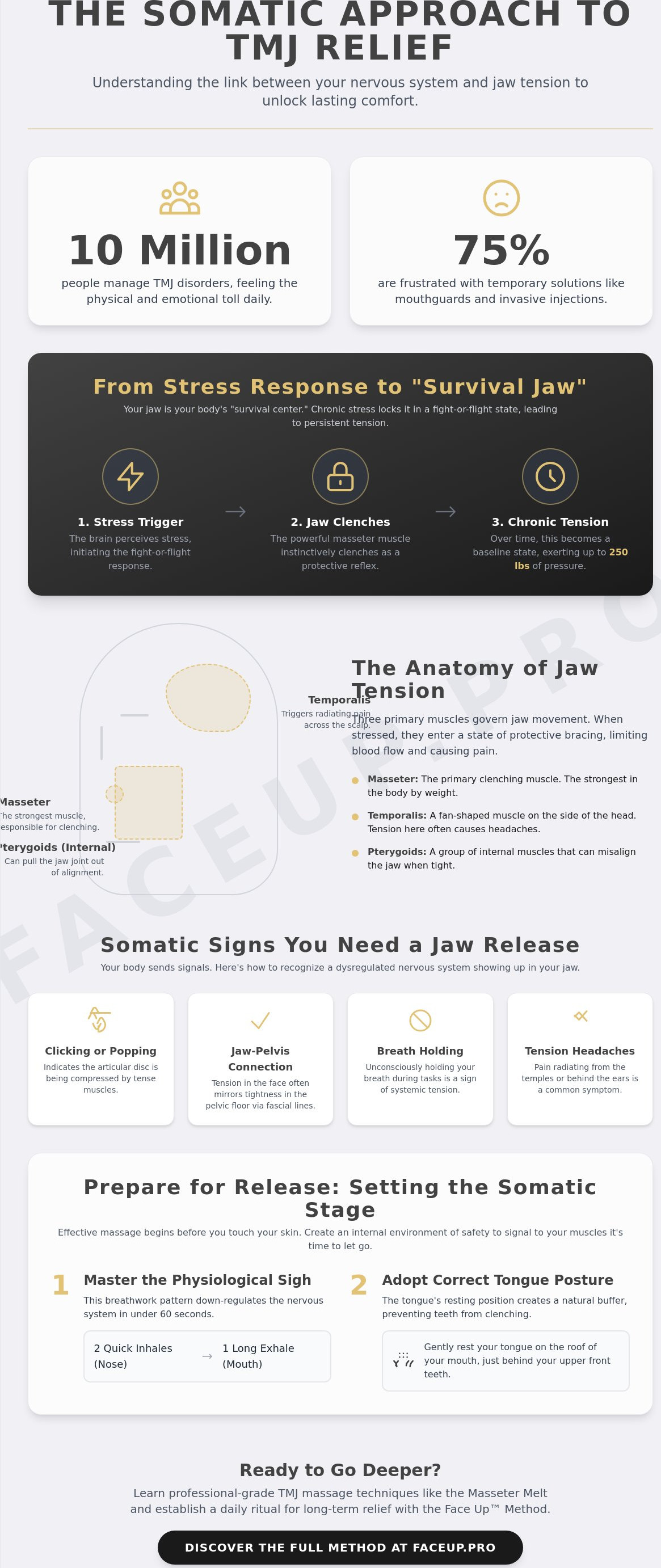
Think of your jaw as your body's primary "survival center." During high-stress events, the brain triggers a clenching reflex in the masseter muscle as part of the fight-or-flight response. Over time, this becomes a baseline state rather than a temporary reaction. Clinical data from 2023 suggests that chronic clenchers can exert up to 250 pounds of pressure on their teeth during sleep. By utilizing intentional tmj massage, you can begin to melt this "survival jaw" and reclaim a sense of ease. This process provides immediate physical benefits, including improved joint mobility, a visible reduction in tension-induced headaches, and a natural lifting effect on the lower face.
The Anatomy of Jaw Tension
The jaw's movement is governed by a trio of powerful muscles: the masseter, the temporalis, and the pterygoid group. The masseter is the strongest muscle by weight in the human body. When stress levels remain high for extended periods, these muscles enter a state of protective bracing. The temporalis, located above your ears, often becomes tender and triggers radiating pain across the scalp. Meanwhile, the pterygoids, located inside the jaw, can pull the joint out of alignment when they become chronically tight. This bracing doesn't just cause pain; it limits the flow of oxygen and nutrients to the facial tissues.
Somatic Signs You Need a Jaw Release
Many individuals don't realize their jaw is "locked" until they experience a distinct clicking or popping sound when opening their mouth. This sound often indicates that the articular disc is being compressed by tense musculature. Beyond the joint itself, somatic practitioners have long noted the "jaw-pelvis connection," where tension in the face often mirrors tension in the pelvic floor through the deep frontal fascial line. If you find yourself holding your breath or clenching during mundane tasks, your jaw tension is likely a symptom of a dysregulated nervous system. Releasing this area through tmj massage acts as a manual reset for your entire body's stress response.
Preparing for Your TMJ Massage: Setting the Somatic Stage
Welcome to the World of Face Up™. Before you apply any physical pressure to your skin, you must first create an internal environment of safety. Somatic tmj massage is most effective when the body isn't in a state of high alert. If you're rushing through this process, your muscles will likely brace against your touch, which often leads to more tension rather than less. Creating a ritual around your release practice signals to your brain that it's okay to let go of the "survival bracing" mentioned in the previous section.
Clinical data from the National Institute of Dental and Craniofacial Research suggests that Temporomandibular disorders (TMDs) are often exacerbated by cumulative daily stress. Preparing the body through intentional breath and alignment ensures that your session moves beyond surface-level relief. While your hands are your primary instruments, using a professional-grade tmj massage tool can also help maintain consistent, deep pressure without fatiguing your fingers during longer sessions.
Breathwork for Jaw Softening
Start your preparation with the "Physiological Sigh." This technique involves taking two quick inhales through the nose followed by one long, slow exhale through the mouth. This specific breathing pattern has been shown to down-regulate the nervous system in under 60 seconds. As you exhale, keep your lips slightly parted. This simple act mechanically prevents the teeth from meeting and signals the masseter muscles to begin their initial softening.
Proper tongue posture is equally vital for a successful release. Ensure your tongue rests gently on the roof of your mouth, just behind the upper front teeth. This "resting position" creates a natural buffer that prevents the upper and lower teeth from touching, which immediately reduces the subconscious urge to clench.
Posture and Alignment Check
Your jaw doesn't exist in isolation; it's the end point of a kinetic chain that starts at your feet. Forward head posture, a common result of modern screen use, can put 3x the normal strain on your temporomandibular joint. This misalignment forces the jaw muscles to work overtime just to keep your head balanced. Before starting your tmj massage, align your spine by imagining a string pulling the crown of your head toward the ceiling while your shoulders drop away from your ears.
Creating this vertical space allows the jaw to hang naturally in its socket. For those dealing with deep, full-body patterns of tension, a dedicated Somatic Bodywork Session can provide the foundational alignment necessary for lasting jaw health. Once you've established this baseline of physical and neurological calm, you're ready to begin the physical release techniques.
Step-by-Step TMJ Massage Techniques for Deep Release
Executing a precise tmj massage requires a shift from general facial rubbing to targeted, anatomical manipulation. Before you begin, ensure your hands are thoroughly washed and your skin is prepped. TMJ massage should always be performed on a clean, hydrated face to prevent unnecessary friction or skin irritation. By following this sequence, you move through the layers of tissue to address both the superficial bracing and the deeper structural tension that keeps your jaw in a state of survival.
Effective release isn't about brute force; it's about persistent, intelligent pressure. You're looking for a sensation often described as "hurts so good." If you experience sharp, electric, or nauseating pain, stop immediately. On a scale of 1 to 10, aim for a consistent 6 or 7. As recommended by clinical experts to stretch and strengthen jaw muscles, these manual techniques help restore the natural range of motion that chronic clenching often restricts.
The External Masseter Release
The Masseter Melt is our foundational technique for lengthening the muscle fibers that have become shortened by stress. Locate the masseter by clenching your teeth; it's the hard lump that pops out near your jaw angle. Relax your jaw, then use your knuckles to apply firm pressure just below the cheekbone. Slowly drag your knuckles downward toward the jawline in a "hook and pull" motion.
- Trigger Points: Spend 30 seconds on any particularly "crunchy" or tender spots you find along the jawline.
- Breath Integration: Sink deeper into the tissue with every exhale, imagining the muscle melting like wax.
- Duration: Repeat this downward stroke 5 to 10 times on each side for a visible softening of the lower face.
The Intraoral (Buccal) Technique
The Face Up™ secret to a truly deep release involves the buccal technique, which accesses the lateral pterygoid from inside the mouth. This muscle is nearly impossible to reach externally, yet it's responsible for the side-to-side grinding that causes 40 percent of joint wear. For safety, use gloves or ensure your hands are meticulously cleaned before reaching into the cheek pocket. Slide your index finger along the top row of teeth toward the back of the mouth until you find the space between the upper jaw and the cheek.
Gently press your finger into this space while using your thumb on the outside of the cheek to "sandwich" the muscle. This dual-sided approach allows for a level of tmj massage that most traditional therapies miss. For those interested in mastering these advanced somatic methods professionally, our facial sculpting certification provides the anatomical depth required to facilitate these releases for others. Finish your session with circular friction on the temporalis muscles, located just above your ears, to diffuse any lingering scalp tension and prevent the onset of tension-based headaches.
Preventing 'Jaw Recoil': Somatic Rituals for Lasting Relief
A common frustration among those seeking relief is "Jaw Recoil." You might perform a perfect tmj massage and feel immediate ease, only to find your teeth clenched tight again two hours later. This happens because your nervous system has identified tension as its "safe" default setting. To break this cycle, you must move beyond occasional treatment and into the realm of daily somatic rituals. These rituals aren't just exercises; they're intentional moments that retrain the brain-muscle connection, teaching your body that a soft jaw is its natural state.
Consistency is the primary driver of neurological change. Data from a 2022 study on somatic experiencing indicates that repetitive, short-duration micro-movements are 40 percent more effective at retraining muscle memory than infrequent, high-intensity sessions. To support this habit, many in our community utilize the face sculpting morning routine app to stay on track. By layering these techniques into your existing life, you address the emotional "why" behind your tension, often uncovering subconscious patterns of "holding back" or "biting your tongue" through somatic journaling and awareness.
The 2-Minute Morning Jaw Reset
Preventing "day-clenching" starts the moment you wake up. Instead of letting work emails dictate your physical state, perform a quick Ear Pull. Gently grasp your earlobes and pull them slightly outward and downward. This somatic trick creates a subtle traction that releases the fascia surrounding the temporomandibular joint. You can easily incorporate this into your skincare routine; as you apply your serum, use the opportunity to perform a 30-second tmj massage along the jawline to ensure you aren't starting your day in a braced position.
Night-time Somatic Scanning
Sleep should be a time of restoration, yet for the 30 percent of adults who experience bruxism, it's often a time of intense muscular labor. Before closing your eyes, perform a somatic scan. Start at your toes and work your way up, consciously softening each area. When you reach your neck, perform a few gentle tilts to stimulate the Vagus nerve. This simple movement calms the nervous system and signals the jaw muscles to drop. A soft jaw at night leads to significantly higher sleep quality and prevents those dreaded morning headaches. To deepen your practice and access a community of like-minded professionals, we invite you to explore the Face Up™ App Subscription for guided daily rituals.
Elevating Your Practice: From Self-Care to Face Up™ Certification
While daily self-directed tmj massage is a cornerstone of maintenance, there are moments when the nervous system requires an external facilitator to achieve a full reset. If you've practiced the somatic rituals for more than 21 consecutive days and still experience persistent "locking" or morning headaches, it's a clear signal that your body needs the skilled touch of a professional. Professional tmj massage therapy moves beyond what you can reach alone, targeting the deep attachment points of the pterygoids and the dense fascia of the scalp with clinical precision.
According to a 2024 wellness industry survey, 68 percent of clients are now prioritizing treatments that address the intersection of physical pain and emotional stress. This shift has led many holistic professionals to move away from purely transactional services toward deeper, somatic-focused work. By becoming a Face Up™ Practitioner, you join a global community dedicated to high-standard care that respects the complexity of the human face. It's about combining the visible results of facial sculpting with the profound internal peace of a regulated nervous system.
Finding a Certified Professional
When searching for a somatic facial therapist, it's essential to distinguish between a standard aesthetician and a certified provider. A standard facial often focuses exclusively on the epidermis, whereas a Face Up™ Sculpting Treatment works through the muscle layers to the bone. You're looking for a practitioner who understands the "survival jaw" mechanics we've discussed throughout this guide. Our Practitioner Directory Listing offers a verified path to finding these specialists in Australia, New Zealand, and beyond, ensuring you receive care that meets our global standards of professional integrity.
Mastering the Method™
For those who feel called to provide this deep level of relief, the Face Up Method™ Professional Certification serves as a comprehensive gateway. This training is specifically designed for Estheticians, Registered Massage Therapists (RMTs), and holistic healers who want to elevate their service menu with high-impact, somatic techniques. The curriculum covers the anatomical depth of the jaw, advanced buccal manipulation, and the psychological nuances of somatic bodywork. Bringing this level of tmj massage to your clients doesn't just improve their jaw mobility; it changes how they face the world. Welcome to the World of Face Up™, where we face tension with courage and guide you toward a future of professional advancement and personal ease.
Reclaiming Your Natural State of Ease
Your journey toward a tension-free life doesn't end with a single session. It begins with the realization that your jaw is a somatic record of your internal state. By shifting from survival bracing to intentional release, you've taken the first step in retraining your nervous system. We've explored the deep anatomy of the masseter and the power of intraoral techniques to address the root causes of discomfort. Effective tmj massage is a lifelong skill that prioritizes non-invasive, holistic rejuvenation over quick-fix medical interventions.
Founded by somatic specialist Olga Newman, the proprietary Face Up Method™ is now utilized by professionals and individuals across 15 countries to restore facial balance. You have the tools to transition from persistent morning headaches to a daily ritual of calm efficiency. To deepen your practice and access our structured guidance, Discover the 'Jaw Release' Digital Course & App Rituals. We invite you to stay curious and compassionate with your body as you move forward. Welcome to a world where your face reflects your inner peace.
Frequently Asked Questions
Is TMJ massage safe to do every day?
Yes, performing a gentle tmj massage daily is safe and highly recommended for maintaining a regulated nervous system. Short, 2-minute sessions are far more effective than infrequent, intense manipulation. Over-massaging with heavy pressure can lead to localized inflammation, so focus on consistency and soft touch rather than force to avoid triggering a protective bracing response.
How long does it take for TMJ massage to work?
You'll often feel an immediate softening in the masseter muscles after your first intentional session. However, retraining the brain-muscle connection typically requires 21 days of consistent daily practice. According to 2023 somatic research, neurological re-patterning happens most effectively when rituals are repeated for three consecutive weeks to establish a new "safe" default for the jaw.
Can TMJ massage help with tinnitus or ear ringing?
Yes, if your tinnitus is related to muscular bracing in the pterygoids or temporalis, targeted therapy can provide significant relief. The temporomandibular joint is located just millimeters from the ear canal. Reducing inflammation and pressure in this area often alleviates secondary symptoms like ear ringing, dizziness, or a persistent feeling of "fullness" in the ear.
What is the difference between TMJ massage and buccal massage?
Standard tmj massage primarily focuses on external muscles like the masseter and temporalis, whereas buccal massage involves working inside the mouth. Buccal techniques are essential for reaching the lateral pterygoid muscle, which is inaccessible from the outside. Both methods are integral parts of the Face Up Method™ and work together to provide a complete structural release.
Why does my jaw feel more sore after a massage?
Mild soreness is common as the body processes metabolic waste released from tight tissues. If the pain is sharp or lasts longer than 24 hours, you likely applied too much pressure during your session. Always stay at a "6 out of 10" on the intensity scale. The goal is to invite the muscle to melt, not to force it into submission.
Can jaw massage change the shape of my face?
Yes, consistent jaw release can visibly slim the lower face by reducing masseter hypertrophy. When muscles are chronically clenched, they grow larger and hold more interstitial fluid. Relaxing these tissues through somatic work often results in a more contoured jawline and a visible reduction in puffiness around the cheeks and jaw angle.
When should I see a professional for my TMJ pain instead of doing it at home?
You should consult a certified Face Up™ Practitioner if your jaw is "locked" or if you experience sharp pain for more than 21 days despite consistent home care. Professional intervention is also necessary if you have a history of joint dislocation or severe clicking. A specialist can provide the deep, intraoral work required to address complex structural misalignments safely.


