

When looking for natural ways to boost collagen in face, it helps to separate habits that support skin health from claims that promise to rebuild collagen. Sun protection, balanced nutrition and a simple skincare routine are practical places to start. Supplements, active ingredients and facial massage each have different roles, and none should be treated as a guaranteed shortcut to firmer skin.
Collagen helps give skin structure and firmness, but everyday habits cannot promise instant results or stop visible ageing. Consistent basics can support overall skin health without making your routine complicated.
This guide explains collagen’s role in facial skin and offers practical steps for supporting it, along with points to consider before trying supplements or active skincare. It also explains where facial practices fit: Face Up™’s somatic approach focuses on facial tension and self-connection, not collagen production. The aim is a routine you can sustain, with realistic expectations.
Key Takeaways
- Understand how collagen supports facial skin’s structure and why firmness can change over time.
- Prioritise practical natural ways to boost collagen in face, including sun protection, balanced nutrition and avoiding smoking.
- Learn how gentle cleansing, moisturising and suitable active skincare can fit into a sustainable routine.
- Build habits gradually rather than adding several products or supplements at once.
- See how Face Up™ self-practice can support tension awareness and self-connection, without presenting it as a collagen treatment.
What collagen does for facial skin, and what natural methods can realistically change
Collagen is a structural protein that helps form the supportive framework of skin. In the face, much of this framework sits in the dermis, the layer beneath the surface. Its fibres help skin withstand everyday movement and contribute to firmness. For a broader overview of collagen’s structure and functions throughout the body, see Collagen.
In brief: Supporting collagen means caring for skin and limiting avoidable stressors. Rebuilding collagen means restoring the skin’s collagen structure, a result that should not be promised for an everyday natural routine.
How collagen contributes to skin firmness and elasticity
Collagen is one part of a larger system. Elastin helps skin stretch and spring back, while hyaluronic acid attracts and holds water, contributing to hydration and a plumper appearance. These components have different roles. Improving hydration or how skin feels does not necessarily mean collagen has been rebuilt.
Facial skin also changes for reasons beyond collagen. Sun exposure, age, genetics, smoking, health, sleep, facial movement and hydration can all affect its appearance. Fine lines or changes in firmness are not a simple measure of collagen levels. Dryness, for example, can make lines look more noticeable without showing what is happening in deeper layers.
What a natural approach can, and cannot, promise
Natural ways to boost collagen in face are best understood as habits that may support skin health, not as a guaranteed way to restore lost collagen. Protecting skin from ultraviolet exposure, eating a balanced diet and avoiding smoking are sensible parts of skin care. Their value is steady support, not an assured change to facial structure.
Be cautious of claims that one food, massage technique or supplement will erase wrinkles, lift skin or reverse ageing. A varied diet provides nutrients the body uses for normal functions, but no single food promises a visible facial result. Similarly, feeling hydrated or relaxed after a practice does not establish that collagen has increased.
- Support: A habit contributes to general skin health or reduces an avoidable source of stress.
- Rebuilding: A claim that collagen itself has been restored requires evidence for that specific outcome.
These distinctions make conflicting advice easier to assess. Ask what result a claim refers to: hydration, comfort, appearance or collagen structure. Those outcomes are not interchangeable. Individual skin and health circumstances also vary, so the same routine may not produce the same visible changes for everyone. Focus on consistent care rather than trying to control every sign of ageing.
How collagen forms in skin and why production changes
Skin is active tissue, not a fixed scaffold. Cells in its deeper layer make and organise collagen as part of normal renewal and repair. The process depends on the body’s broader biology, including amino acids from protein and nutrients involved in collagen formation. Eating one “collagen-boosting” food or applying one ingredient does not simply switch production on. The overview from Cedars-Sinai on collagen and skin health also discusses how ageing and sun exposure relate to skin collagen.
The body’s collagen-making process in simple terms
Think of collagen formation as a workshop, not a button. The body uses building materials and cellular instructions to make collagen, then organises it into supportive fibres. A balanced diet helps provide nutrients for normal body functions, but the process is regulated and influenced by more than any single meal, supplement or skincare product. A sensible routine can support skin health without guaranteeing that facial collagen will be restored.
Everyday and personal factors that may influence skin
Some influences are more changeable than others. Ultraviolet exposure can damage skin structures, including collagen, over time. Smoking is another avoidable stressor associated with poorer skin health. Reducing these exposures is a practical part of caring for skin, though it cannot erase past exposure or ensure a particular appearance.
Other factors are not fully within your control. Collagen production and skin repair change with age, while genetics and hormonal variation can affect how skin changes and how those changes appear. Two people with similar habits may notice different patterns in firmness, texture or lines. Visible changes can reflect several influences at once, rather than one measurable change in collagen.
Collagen changes reflect the combined influence of biology, personal history and daily exposures, so no single cause explains every face.
For a useful reality check, separate actions into two groups:
- Habits you can influence: Protect skin from excessive sun exposure and avoid smoking. These steps support skin health but do not promise to rebuild collagen.
- Factors you can’t simply change: Age, inherited traits and hormonal shifts shape individual patterns, so routines and visible results will differ.
This distinction can help you choose natural ways to boost collagen in face without blaming yourself for normal variation or chasing claims that promise control over every sign of ageing. Aim for consistent, manageable care rather than a quick fix. Face Up™ somatic self-practice can complement these habits by giving you a way to explore facial tension and self-connection, not by acting as a collagen-production treatment. Learn more about Face Up™ self-practice.
Which natural ways to support facial collagen are worth prioritising?
Start with habits that protect skin and support general health, rather than a long list of “collagen-boosting” products. Sun protection and avoiding smoking are practical priorities. Balanced nutrition and a simple skincare routine can complement them. These habits support skin health, but they do not guarantee a visible change in collagen or facial firmness.
Everyday habits that support overall skin health
Regular sun protection helps limit ultraviolet exposure, which can damage skin over time. Choose a sunscreen you can use consistently, follow its directions, and add shade or protective clothing when appropriate. Nutrition matters too. Aim for varied meals that provide enough protein and a range of nutrients instead of relying on a restrictive plan or a single “beauty” food. Vitamin C is needed for normal collagen formation, but eating citrus or another vitamin C-rich food will not, by itself, reverse wrinkles. Avoiding smoking is another worthwhile step for general and skin health.
Skincare ingredients, supplements, and evidence limits
Topical skincare works at the skin’s surface, and its effects vary by ingredient, formulation and strength. Retinoids may support changes in skin appearance, while vitamin C products are used for different skincare purposes. Neither makes every product interchangeable or guarantees collagen rebuilding. Introduce active ingredients thoughtfully because some can irritate skin. Supplements and home-use devices also vary in evidence and suitability. Some research on collagen supplements reports potential skin benefits, but that does not establish a guaranteed outcome for every person or product. Discuss supplements with a clinician if you have health concerns, take medication, or are considering them during pregnancy or breastfeeding.
| Habit | Potential role | Evidence caveat | Practical starting point |
|---|---|---|---|
| Sun protection | Limits avoidable UV exposure | Doesn’t undo past exposure or stop all skin changes | Use sunscreen consistently and add shade or clothing |
| Balanced nutrition | Supplies protein and nutrients used in normal body functions | No single food is proven to erase wrinkles | Build varied meals rather than pursuing a restrictive diet |
| Smoking avoidance | Supports general and skin health | Doesn’t guarantee a particular facial result | Seek appropriate support if stopping feels difficult |
| Topical skincare | Can address specific skin-care goals | Effects depend on ingredient, formulation and tolerance | Keep the routine simple and introduce actives cautiously |
| Supplements or devices | May be considered for specific goals | Evidence and suitability vary; claims can exceed evidence | Discuss personal health concerns with a clinician |
These natural ways to boost collagen in face work best as steady skin-health habits, not a promise of restored collagen. Facial massage is a separate practice that may be explored for facial tension, but it should not be confused with skin-protection measures. For more on that distinction, see this guide to TMJ massage therapy.
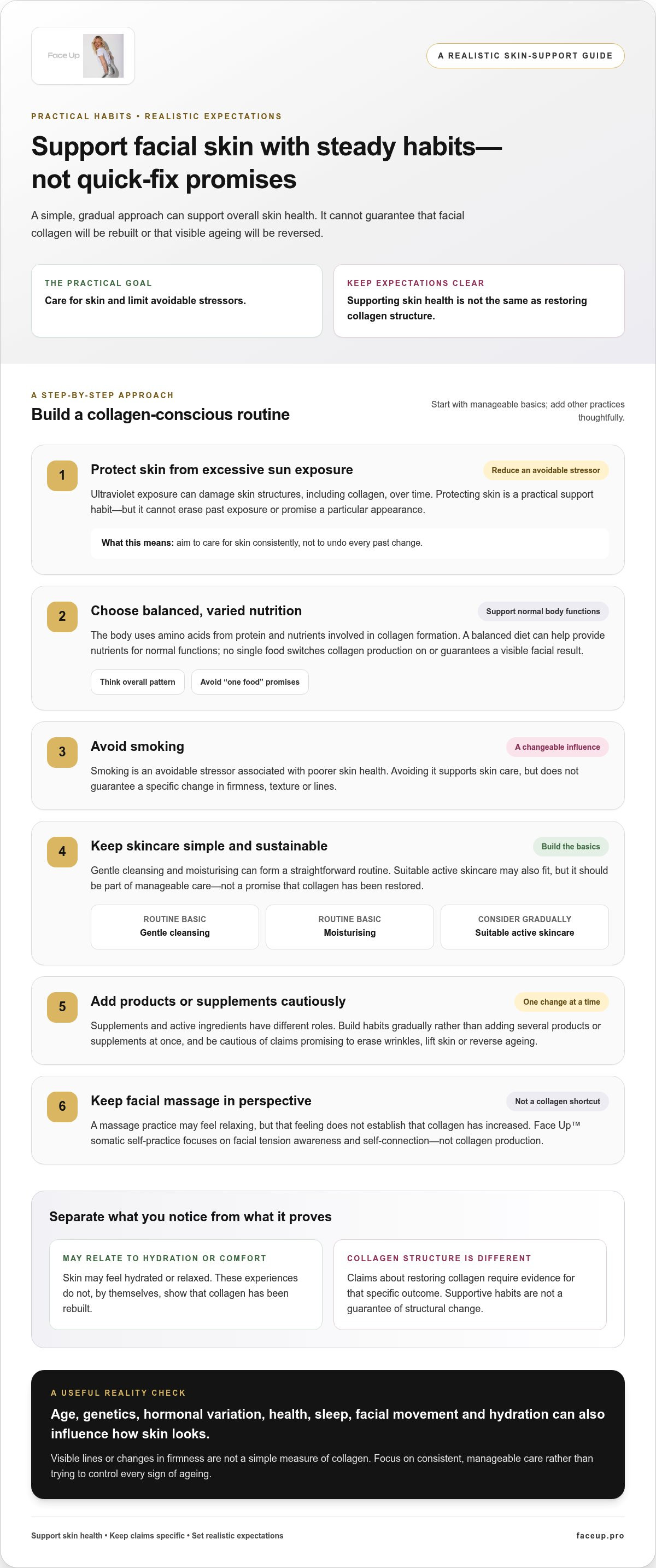
How to build a realistic daily routine for collagen-supportive skin habits
A useful routine is one you can repeat without making skincare feel like a project. Begin with the basics, then decide whether an active ingredient fits your needs. The goal is to protect and care for your skin consistently, not to assemble the longest routine or assume every new product will improve collagen.
A simple morning and evening framework
In the morning, use skincare that suits your skin and finish with sunscreen according to its directions. In the evening, gently cleanse to remove sunscreen, makeup and daily residue, then moisturise. If you choose an active ingredient, such as a retinoid or vitamin C product, introduce it gradually and follow its label directions. Avoid starting several new products at once, so you can better identify what suits your skin.
- Morning: Apply suitable skincare, then sunscreen. Add shade or protective clothing when useful.
- Evening: Cleanse gently and moisturise. Avoid scrubbing or using water hot enough to leave skin uncomfortable.
- Optional active: Add one product at a time, follow its instructions, and pause if irritation develops.
A gradual-start checklist: Keep the basics steady, choose products for your skin, introduce one active at a time and pay attention to comfort. This is a skin-health routine, not proof that collagen has been rebuilt.
How to assess progress without unrealistic expectations
Use practical measures to see how your routine is working: consider whether you follow it consistently, whether your skin feels comfortable and whether you notice changes in dryness, texture or appearance. A brief note or occasional photo in similar lighting may help you compare observations, but neither can measure collagen directly.
Skin can respond differently to the same product or habit. Changes in appearance may have several causes, so do not assume one new step created a particular result. If a product causes persistent irritation, stop using it. Seek medical advice for reactions that continue, worsen or concern you. A clinician can help assess symptoms and discuss options suited to your health and skin.
Choose natural ways to boost collagen in face as supportive habits, not as a promise of a specific outcome. If you would like to add a separate wellbeing practice, Face Up™ self-practice focuses on facial tension and self-connection. It can complement skincare, but it is not an established collagen-production treatment. Explore Face Up™ self-practice as a distinct part of facial wellness.
Where Face Up™ facial self-practice fits into a collagen-conscious routine
A collagen-conscious routine can include more than skincare, as long as each practice has a clear purpose. Face Up™ takes a somatic approach to facial wellness, with a focus on facial tension, bodywork and self-connection. These aims are distinct from changing skin structure. Facial self-practice is not established as a collagen-production treatment and should not replace habits such as sun protection or gentle skincare.
Collagen support and facial tension are different goals
Collagen is part of the skin’s structural support. Facial tension, by contrast, relates to how the muscles and surrounding tissues feel and function. You might explore facial practices for awareness, relaxation or a stronger sense of connection with your face. Those experiences do not show that collagen has increased or that skin has been lifted.
Keeping these goals separate makes it easier to value facial wellness without treating it as a shortcut to a particular appearance. If jaw or facial tension is what you want to explore, the guide to choosing a TMJ massage tool discusses tension-focused practices. That is a different aim from supporting skin through daily care.
Choose a Face Up™ self-practice or bodywork option
Face Up™ offers self-practice sessions and bodywork sessions as distinct ways to engage with its approach. Self-practice lets you take part in facial wellness independently, while a bodywork session centres on somatic facial work. Neither should be understood as a proven method for stimulating collagen, and neither promises a skin-lifting outcome.
Face Up Club and Jaw Release by Face Up™ are also ways to explore this approach. Choose based on what you are looking for, whether that is personal self-practice, attention to jaw tension or a broader interest in somatic facial wellness. Decide on your goal first, then keep collagen support grounded in skin-health habits rather than expecting facial work to rebuild skin structure.
There is room for both perspectives in a thoughtful routine. You might protect your skin and follow a simple skincare sequence while also making space for a practice that helps you notice facial tension or feel more connected to yourself. Treat these as complementary aims, not interchangeable treatments. A massage or self-practice may feel meaningful, but that alone does not establish an effect on collagen.
If facial wellness is something you would like to explore, take a gentle next step: explore Face Up™ and choose an option that suits your interests. Keep your skin-health routine alongside it, with realistic expectations for what each practice can do.
Choose a next step that feels sustainable
Make your next step small enough to maintain. Choose one skincare habit to make more consistent, or decide whether you would also like a practice focused on facial tension and self-connection. The natural ways to boost collagen in face are best approached as ongoing skin-health support, not a promise to change your face on demand.
Facial wellness can have value in its own right, without being framed as collagen treatment. Face Up™ offers self-practice and bodywork options, and its work has been featured in Vogue, Elle, The Daily Telegraph, Marie Claire, SPA+CLINIC, Professional Beauty, and Mamamia. Explore Face Up™ and choose what feels right for you.
You do not need a perfect routine to begin. A thoughtful, steady choice is a meaningful place to start.
Frequently Asked Questions
Can natural methods restore lost collagen in the face?
Natural methods can support skin health, but they cannot reliably promise to restore collagen that has already been lost. Protecting your skin from excess sun exposure and maintaining balanced nutrition are useful habits, not guaranteed ways to rebuild its structure. For everyday routines, “collagen support” is more accurate than “collagen restoration.” If a change in your skin worries you, a medical professional can help assess it.
Which foods help the body make collagen?
No single food makes the body produce more facial collagen on demand. A varied diet can provide protein, which supplies amino acids, and vitamin C, which the body needs for collagen formation. A meal with beans or fish, vegetables and fruit, for example, can provide useful nutrients without making any one ingredient a wrinkle remedy. If you have dietary restrictions, focus on suitable alternatives rather than a narrow “collagen diet.”
Does facial massage increase collagen production?
Facial massage is not established as a way to increase collagen production. Some people use gentle touch to unwind or become more aware of tension, but that experience is not evidence of a change in skin structure. Keep pressure comfortable and avoid forceful rubbing, especially over irritated or sensitive skin. Think of massage as a facial wellness practice if it feels pleasant, not as a substitute for skin-health habits.
How long do natural collagen-supporting habits take to show results?
There is no reliable, fixed timeline for visible results from everyday collagen-supporting habits. Skin appearance can vary with the season, hydration, sleep, hormones and other changes, so an improvement cannot always be attributed to one new step. Rather than checking daily for a transformation, notice whether a routine feels comfortable and manageable. Consistency can support skin care over time, but it does not guarantee a particular change.
Can sunscreen rebuild collagen in the face?
Sunscreen does not rebuild collagen. Its role is to help protect skin from ultraviolet exposure that can contribute to damage. Dermatologists and The Skin Cancer Foundation recommend at least SPF 30 for daily use, according to the guidance summarised in this article. Apply it as directed on the label and make it a regular part of sun protection. This can help limit future exposure, but it cannot reverse past changes.
Does facial yoga boost collagen?
Facial yoga has not been established as a collagen-boosting treatment. Facial movements may give you a structured way to notice how you hold tension, but that is different from showing that skin collagen has increased. If you enjoy facial exercises, approach them as a personal wellness practice and stop if they cause discomfort. For natural ways to boost collagen in face, keep expectations focused on general skin support, not a guaranteed lifting or firming effect.


