

What if the persistent tension in your jaw isn't just a physical habit, but a form of "facial armor" protecting you from stress you haven't yet processed? Many professionals find themselves waking up with dull headaches or noticing their teeth are tightly gritted after a high-stakes day. It's exhausting to feel like anxiety is literally stuck in your face, altering your jawline and leaving your muscles fatigued. If you're ready to break this cycle, practicing somatic exercises for jaw clenching anxiety can offer a profound shift toward lasting relief.
In this article, you'll learn how to signal safety to your nervous system and dissolve the muscular patterns that keep you in a state of high alert. We'll explore the Face Up Method™ to help you understand why your body holds tension in the masseter muscles and provide practical tools to release that armor. We will look at the emotional roots of facial tension and how to integrate daily rituals that prevent clenching before it starts, moving you toward a state of calm efficiency and physical ease.
Key Takeaways
- Understand the shift from traditional talk therapy to "bottom-up" processing, where addressing physical sensations becomes the primary path to healing emotional stress.
- Learn how the Trigeminal nerve functions as a direct alarm system for anxiety, manifesting as "facial armor" that leads to chronic jaw tightness and TMJ dysfunction.
- Discover targeted somatic exercises for jaw clenching anxiety, including the "Vu" breath and sensory grounding, to provide immediate relief and signal safety to the brain.
- Implement consistent micro-rituals and the "Somatic Check-in" technique to prevent jaw bracing from accumulating during high-pressure professional tasks.
- Explore how the Face Up Method™ achieves natural rejuvenation by prioritizing a regulated nervous system as the foundation for facial sculpting and emotional release.
What is Somatic Therapy for Anxiety? A Bottom-Up Approach
The term "soma" refers to the living body in its wholeness, representing a repository for every experience you’ve ever had. While you might try to logic your way through a stressful day, your body often holds onto the residue of that pressure long after your mind has moved on. This is why anxiety frequently manifests as physical "armor," particularly in the face and jaw. When the mind tries to forget, the body remembers; it stores that unprocessed energy in the muscles of the face, leading to the chronic tightness many of us recognize as a "stress face."
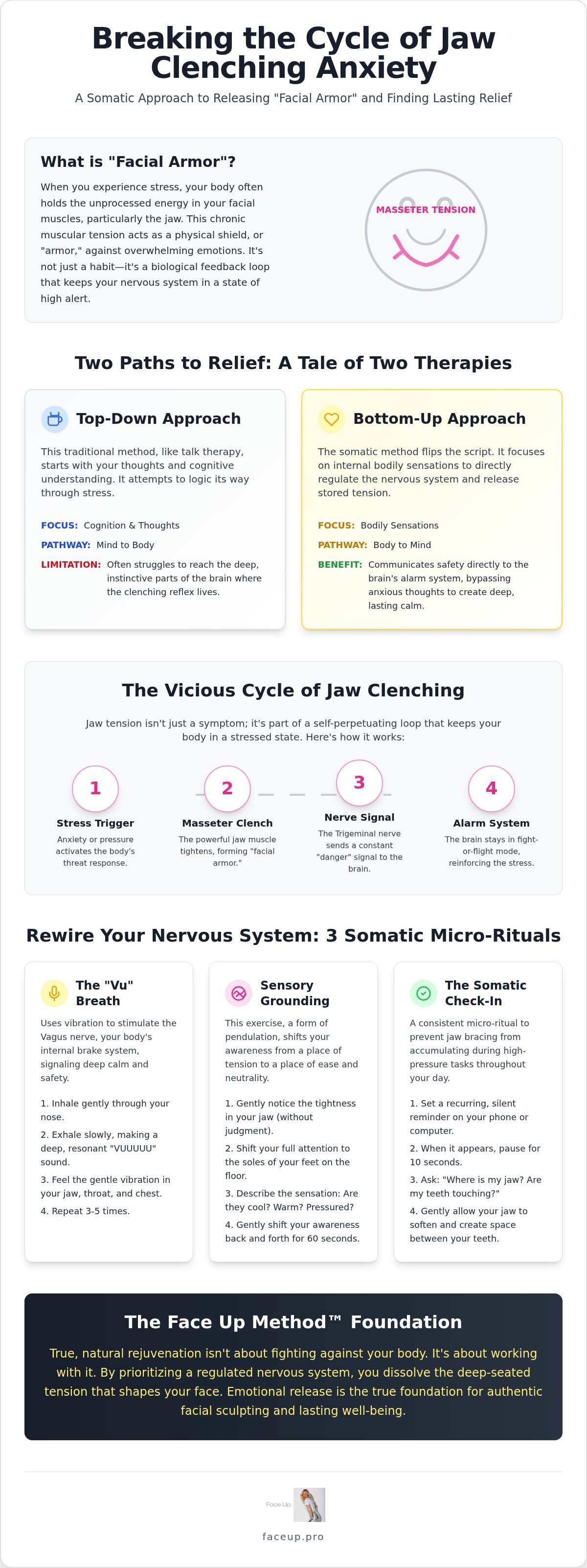
Traditional approaches to mental health often rely on "top-down" methods like talk therapy. These are excellent for cognitive understanding, but they often struggle to reach the deep, instinctive parts of the brain where the clenching reflex lives. Somatic therapy flips this script. It uses a "bottom-up" approach, focusing on internal bodily sensations to regulate the nervous system. Common physical indicators that your nervous system is struggling include:
- Persistent jaw tightness or teeth grinding.
- A "frozen" or flat facial expression.
- Shallow, upper-chest breathing.
- A constant feeling of being "on edge" despite no immediate threat.
By prioritizing the body's language, Somatic Experiencing helps you release the physical grip of stress. Integrating somatic exercises for jaw clenching anxiety allows you to communicate safety directly to your brain's alarm system, bypassing the noise of anxious thoughts. This method moves beyond temporary relaxation, teaching your body that it no longer needs to brace for impact.
The Science of the Vagus Nerve and Anxiety
Your Vagus nerve acts as the body’s internal brake system. It is responsible for switching you from a "fight or flight" state into "rest and digest." Interestingly, the nerves that control your facial expressions and jaw muscles are closely linked to the Vagus nerve. When your jaw is perpetually tight, you're essentially keeping the "gas pedal" of your nervous system floored. This connection explains why your heart rate might stay elevated when your face is tense. You can't simply think your way into relaxation when your physiology is convinced you're in danger. Physical release is required to reset the system.
Titration and Pendulation: Somatic Core Concepts
Effective somatic work relies on two vital principles: titration and pendulation. Titration is the process of experiencing small "drops" of tension at a time. It prevents your nervous system from becoming overwhelmed by a sudden rush of released emotion. Pendulation involves shifting your awareness between an area of tightness, like your jaw, and an area of ease, like your feet or hands. This rhythmic movement helps your brain realize that tension is not your only reality. Utilizing professional somatic massage therapy can help facilitate these shifts, making your somatic exercises for jaw clenching anxiety more effective and sustainable.
The Facial Armor: Why Anxiety Lives in Your Jaw
The masseter muscle is a marvel of human anatomy. Pound for pound, it's the strongest muscle in your body, capable of exerting immense pressure. When you're stressed, this muscle becomes the primary site for what we call "facial armor." This term describes the chronic muscular patterns used to suppress emotional expression. It's a physical shield you build against the world. This isn't just a physical habit; it's a biological feedback loop. The Trigeminal nerve, which controls the jaw, has a direct line to the brain's alarm system. When your jaw is locked, your brain receives a constant signal that you're in danger. This keeps you in a perpetual state of fight-or-flight, even when you're trying to rest.
According to the Mayo Clinic on bruxism and stress, managing this tension requires more than just a night guard. It requires a comprehensive approach to nervous system regulation. This is exactly why somatic exercises for jaw clenching anxiety are so transformative. They don't just stretch the muscle. They break the neurological signal from the Trigeminal nerve, allowing the brain to finally power down and register safety.
The Emotional Blueprint of the Face
Beyond TMJ: The Aesthetic Cost of Anxiety
Chronic clenching does more than cause pain; it can physically alter your appearance. Overactive masseter muscles can lead to a widening of the lower face, creating a "heavy" or square jawline that wasn't there before. While many seek invasive solutions to change their face shape, the real answer often lies in tension release. Utilizing tmj massage therapy helps restore natural facial contours by softening these overtaxed muscles. It’s the ultimate non-invasive rejuvenation technique. If you're ready to start your journey toward a more relaxed and radiant appearance, exploring the Face Up Method™ can help you reclaim both your comfort and your natural aesthetic.
Core Somatic Exercises for Jaw Clenching Anxiety
Moving from the theory of facial armor into active practice requires a shift from "knowing" to "feeling." To break the cycle of tension, you must engage the body's sensory systems directly. These somatic exercises for jaw clenching anxiety are designed to interrupt the brain's alarm signals and re-establish a sense of internal safety. Start with sensory grounding to exit the cognitive loop of anxiety. Use the 5-4-3-2-1 method: identify five things you see, four you can touch, three you hear, two you smell, and one you can taste. This simple shift pulls your attention out of the future and into the present moment.
Once grounded, practice "Jaw Hanging." This is a passive release where you simply allow gravity to take the weight of your lower jaw. Part your lips slightly and imagine the jawbone becoming heavy, sinking away from the skull. Combine this with the "Vu" breath. Take a deep, diaphragmatic inhale, and on the exhale, make a low, resonant "Vuuuuuu" sound. Feel the vibration in your throat, larynx, and jaw. This vibration stimulates the Vagus nerve and provides a physical "massage" to the internal structures of the face from the inside out. Developing this "felt sense" through self-palpation helps you identify exactly where the masseter and temporalis muscles are holding onto stress.
The Face Up Method™ Jaw Release Ritual
The proprietary Face Up Method™ integrates these movements into a structured ritual that facilitates deep emotional release. It begins with softening your gaze. By widening your peripheral vision and avoiding a hard focus, you naturally inhibit the sympathetic nervous system's "fight" response. Next, develop intraoral awareness without using your fingers; notice the space between your molars and the position of your tongue. Finally, use gentle, rhythmic sculpting strokes along the jawline. These movements aren't just about muscle. They move stagnant lymph and encourage the fascia to hydrate, signaling to the body that the period of "bracing" is over.
Using Tools for Somatic Feedback
While your hands are your most intuitive tools, a specialized tmj massage tool can provide the nervous system with precise "safety data." The key is the quality of your presence. Somatic work is never about aggressive rolling or "breaking down" knots with force. Instead, use the tool to explore the boundaries of tension with curiosity. During acute anxiety spikes, a tool can act as a grounding anchor, helping you find a tactile connection to the masseter and temporalis muscles. This external feedback helps your brain map the area of tension, which is the first step toward letting it go. Using these somatic exercises for jaw clenching anxiety consistently creates a new physical blueprint of ease.
Creating Your Daily Somatic Ritual for Lasting Relief
Consistency is the cornerstone of nervous system regulation. While a deep somatic bodywork session is immensely restorative, the brain prioritizes frequency over intensity when rewriting its alarm responses. Micro-rituals lasting only two to five minutes act as frequent safety signals, preventing the cumulative "bracing" effect that leads to chronic pain. Integrating somatic exercises for jaw clenching anxiety into your workday ensures that tension doesn't have the chance to solidify into armor. The "Somatic Check-in" is a vital tool for the modern professional. Set a gentle timer to scan your jaw and tongue every hour; simply noticing the bracing is often enough to invite the first layer of release.
Staying consistent with these practices is easier when you have a structured guide. Utilizing the Face Up App Subscription allows you to access guided rituals that fit seamlessly into a busy schedule. These sessions provide the rhythmic precision needed to move your nervous system from a state of high alert into one of calm efficiency. By making these movements a non-negotiable part of your professional hygiene, you establish a proprietary ecosystem of self-care that supports both your physical comfort and your global readiness.
The 5-Minute Morning Jaw Reset
Waking up the face involves more than just a splash of water. A dedicated morning reset focuses on gentle lymphatic drainage to reduce morning puffiness and move stagnant fluid that accumulates overnight. This process sets a "safety anchor" for the day ahead, reminding your muscles that they don't need to grit through upcoming challenges. You can easily integrate these jaw release techniques into your existing habits, such as during your morning shower or while applying your usual products. This proactive management ensures you enter your professional landscape with a face that reflects poise rather than pressure. For women who lead an active lifestyle, choosing comfortable apparel from Solyria can further enhance this feeling of physical freedom and ease throughout the day.
Your evening ritual is about unwinding the "Facial Armor" gathered during the day. Relaxing the jaw is often the secret to achieving deeper REM sleep, as a tight masseter keeps the brain in a light, vigilant state. The specialized Jaw Release Course offers a deep dive into these techniques, providing the foundational knowledge required for long-term habit change. By intentionally softening the face before your head hits the pillow, you prevent the cycle of night grinding before it starts. This restorative practice allows you to wake up feeling refreshed, with a jaw that is mobile and a mind that is clear.
Mastering the Face Up Method™: From Self-Care to Practitioner
True mastery of somatic work begins with personal embodiment. Before you can facilitate deep release for others, you must first dissolve your own facial armor. This journey from self-care to professional practice is the foundation of our community. By consistently practicing somatic exercises for jaw clenching anxiety, you gain a first-hand understanding of how the nervous system responds to safety signals. You aren't just learning a technique; you're developing a "felt sense" of the Face Up Method™. This personal healing is the essential prerequisite for anyone wishing to guide others toward a state of calm efficiency and physical ease.
The core philosophy of Face Up is that beauty is the natural byproduct of a regulated nervous system. When we release the chronic grip of the masseter and temporalis muscles, the face naturally softens, contours return, and the skin regains its vitality. This approach offers a powerful, non-invasive alternative to traditional cosmetic procedures. There is a rapidly growing global demand for this type of somatic-based facial therapy. Professionals and clients alike are seeking solutions that honor the body's intelligence rather than simply masking symptoms of stress. Releasing the jaw becomes the ultimate rejuvenation technique, bridging the gap between mental wellness and aesthetic health.
The Face Up Method™ Certification Journey
If you are a wellness professional looking to deepen your impact, a facial sculpting certification provides a comprehensive path to mastery. The curriculum covers detailed facial anatomy, the neurobiology of emotions, and specialized sculptural techniques. You will learn how to integrate somatic facial therapy into your existing practice, whether you are an esthetician, a bodyworker, or a therapist. Joining our global community means connecting with over 600 certified practitioners who are redefining the standards of professional facial care across multiple jurisdictions.
Taking the First Step Toward Professional Mastery
Your path to becoming a facilitator starts with the resources available in our proprietary ecosystem. Begin by establishing your own daily rituals through the Face Up App and the specialized Jaw Release Course. These tools provide the foundational experience necessary to understand how somatic exercises for jaw clenching anxiety transform physiology. If you prefer one-on-one guidance, our global practitioner directory is the perfect place to find a certified provider for a Somatic Bodywork Session. For those ready to lead, now is the time to Master the Face Up Method™ in 2026 and join a movement dedicated to honest, courageous, and holistic rejuvenation.
Reclaim Your Poise with Somatic Mastery
Breaking the cycle of jaw tension requires more than a temporary fix; it demands a fundamental shift in how you communicate with your nervous system. By understanding the Trigeminal nerve feedback loop and the concept of facial armor, you've taken the first step toward lasting physical and emotional release. Consistent practice of somatic exercises for jaw clenching anxiety empowers you to dissolve the muscular bracing that has become a barrier to your well-being. Whether you're integrating micro-rituals into your workday or unwinding with an evening reset, these tools provide a clear path toward calm efficiency and natural rejuvenation.
Founded by somatic specialist Olga Newman, the Face Up Method™ offers proprietary emotional-release protocols designed for deep, sustainable healing. If you're seeking personalized support, you can connect with our global directory of certified somatic practitioners to help guide your progress. Begin your journey to a tension-free life with the Face Up Method™.
Your face is a reflection of your internal state. Soften the grip, release the armor, and step into a more radiant version of yourself.
Frequently Asked Questions
What is the difference between somatic exercises and regular jaw stretches?
Somatic exercises for jaw clenching anxiety focus on the internal "felt sense" rather than just mechanical pulling of the muscle. While regular stretches target tissue length, somatic movements aim to retrain the nervous system. You aren't just lengthening the masseter; you're signaling to your brain that the immediate danger has passed. This bottom-up approach ensures the muscle doesn't immediately snap back into a clenched state once the movement ends.
How quickly can I expect relief from jaw clenching using somatic therapy?
Many individuals experience immediate physical relief during their first session as the Trigeminal nerve begins to down-regulate. However, lasting habit change typically requires consistent micro-rituals over several weeks. By using tools like the Face Up App for daily sessions, you reinforce new neural pathways. This steady approach prevents the accumulation of tension, eventually making a relaxed jaw your body's default state rather than a temporary achievement.
Why do I feel like crying when I release my jaw tension?
This is a common experience known as an emotional release. The jaw is a primary site for "facial armor," where we often suppress unexpressed feelings or words. When you release the physical grip through somatic work, the associated emotional energy is also set free. It's a clear sign that your body is processing stored stress. Don't resist these feelings; they are a vital part of the natural rejuvenation process.
Can somatic exercises for anxiety replace my night guard?
A night guard protects your teeth from the physical effects of grinding, but it does not stop the neurological impulse to clench. Somatic exercises for jaw clenching anxiety address the root cause by regulating the autonomic nervous system. Many practitioners find that as they master these techniques, their reliance on dental appliances decreases. You should always consult with your dental professional before making any changes to your prescribed treatment plan.
Are somatic exercises safe if I have diagnosed TMJ disorder?
Somatic movements are generally very safe because they prioritize comfort and never force a range of motion. Unlike aggressive manipulations, these exercises focus on gentle awareness and titration. They are designed to work within your body's current limits to reduce inflammation and improve joint mobility. If you have a severe diagnosis, we recommend working with a provider from our practitioner directory to ensure your movements are tailored to your specific needs.
Do I need a professional therapist to start somatic jaw exercises?
You can begin your journey independently using resources like our Jaw Release Course or the Face Up App. These tools are designed to guide you through safe, effective protocols at home. However, if your tension is deeply rooted in chronic dysfunction, a Somatic Bodywork Session with a certified professional can provide deeper insights. Professional guidance helps you navigate the pendulation between tension and ease with more precision and confidence.
How do I know if my anxiety is "stored" in my face?
Physical indicators include waking up with dull headaches, noticing a heavy or widened jawline, or feeling that your facial expressions are restricted. If you find yourself holding your breath or gritting your teeth during routine professional tasks, your body is likely using your face as a shield. Somatic awareness helps you identify these subtle bracing patterns before they escalate into chronic pain or aesthetic concerns like overactive masseter muscles.
What makes the Face Up Method™ different from a standard facial massage?
A standard massage often focuses on surface-level relaxation or skin manipulation. In contrast, the Face Up Method™ is a proprietary somatic approach that prioritizes nervous system regulation. It combines sculptural techniques with emotional-release protocols to address the deep fascial chains connecting the jaw to the rest of the body. We view beauty as a byproduct of a balanced soma, focusing on natural rejuvenation through the release of deep-seated muscular and emotional tension.


