

What if the chronic tension your clients carry isn't a muscular failure, but an emotional story waiting for a safe way to be told? You've likely felt the frustration of watching the same rigid patterns return week after week, or perhaps you're feeling the physical toll of practitioner burnout from relying on deep tissue labor alone. It's common to feel unqualified when a client has an unexpected emotional release on the table, yet these moments are often where the real healing begins.
We understand that you're looking for a way to differentiate your practice through deeper, science-backed results. This guide explores how somatic bodywork training bridges the gap between physical touch and emotional release to fundamentally transform your professional practice. You'll discover how to blend intuition with nervous system regulation to achieve better client retention and lasting change. It's about moving beyond the surface to address the root causes of physical restriction.
We will walk through the 2026 landscape of professional certification, including the proprietary Face Up Method™ and the latest global standards. From the rising demand for trauma-informed care to the shift in professional recognition for bodyworkers, this is your roadmap to becoming a leader in the somatic field.
Key Takeaways
- Learn how somatic bodywork training shifts the professional focus from "fixing" physical tension to facilitating nervous system regulation and emotional release.
- Discover the biological link between the Vagus Nerve and facial expressions to understand why the jaw serves as the body's primary container for emotional stress.
- Identify the essential criteria for choosing a certification program, including why hands-on, in-person practice is a non-negotiable requirement for somatic mastery.
- Gain practical steps for integrating somatic techniques into your practice through nervous system assessments and the use of "invitational" language during sessions.
- Explore the professional journey of the Face Up Method™ Certification, a proprietary approach that blends facial sculpting with deep somatic healing.
What is Somatic Bodywork Training in 2026?
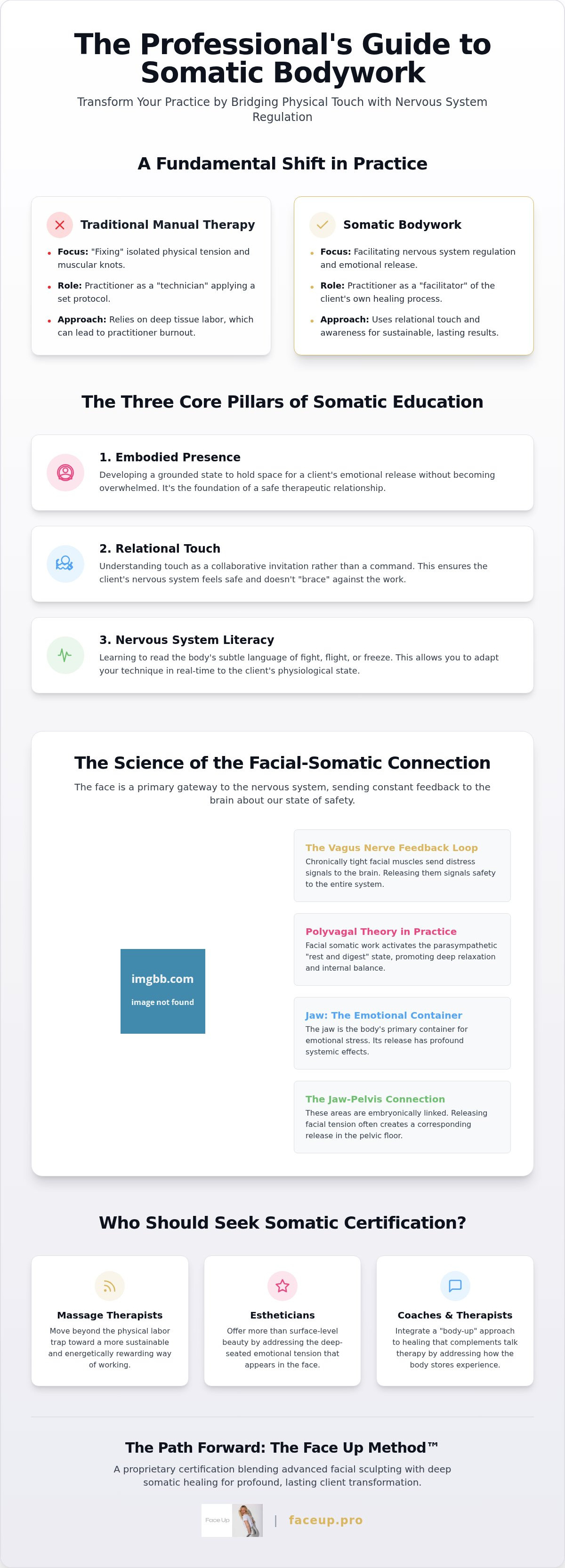
Professional certification in 2026 isn't just about learning new massage strokes. It's a deep dive into the science of nervous system regulation. Somatic bodywork training teaches you to facilitate a state of safety through touch, movement, and awareness. Unlike traditional manual therapy, which often focuses on "fixing" a specific physical ailment, this approach emphasizes "listening" to the body's subtle signals. It's a shift from being a technician to becoming a facilitator of a client's own healing process.
By 2026, the global demand for trauma-informed care has surged as more individuals seek non-drug interventions for stress and anxiety. Professionals now recognize that physical tension is often a somatic manifestation of stored stress. A foundational understanding of Somatic Bodywork allows practitioners to work with interoception, the sense of the internal state of the body. This education helps clients transform their relationship with their own physical and emotional sensations, leading to results that last far longer than a standard massage session.
The Core Pillars of Somatic Education
To master this modality, practitioners must focus on three essential areas of development:
- Embodied presence: You learn to develop the "practitioner's seat," a grounded state that allows you to hold space for a client's emotional release without becoming overwhelmed yourself.
- Relational touch: It's about understanding the boundary between clinical pressure and somatic safety. Touch becomes a collaborative invitation rather than a command, ensuring the client's nervous system doesn't "brace" against the work.
- Nervous system literacy: You'll learn to read the body's language of fight, flight, or freeze. This allows you to adjust your technique in real-time based on the client's physiological feedback rather than following a rigid protocol.
Who Should Seek Somatic Certification?
This path is ideal for professionals who feel they've reached a ceiling in their current practice. Massage therapists often seek somatic bodywork training to escape the physical labor trap, moving toward a more sustainable and energetically rewarding way of working. Estheticians find it invaluable for offering more than surface-level beauty treatments, as it allows them to address the deep-seated emotional tension that shows up in the face and jaw. Additionally, coaches and mental health professionals use these certifications to provide a body-up approach to healing, complementing traditional talk therapy by addressing how the body stores experience.
The Science of the Facial-Somatic Connection
The face is not just an aesthetic surface; it's a primary gateway for the nervous system. Through the lens of somatic bodywork training, we understand that facial expressions are direct signals to the brain regarding our state of safety. The Vagus Nerve, specifically the ventral branch, coordinates with the cranial nerves that control facial muscles. When these muscles are chronically tight, they send a feedback loop of distress to the brain. Releasing this tension doesn't just soften the look of the face; it signals the entire system to move into a state of rest.
By 2026, the "Face Up" perspective has become a vital part of the somatic conversation. It suggests that by releasing the physical "mask" we wear to protect ourselves, we reveal the true self underneath. This regulation of the nervous system leads to visible rejuvenation. When the body moves out of a chronic stress state, blood flow improves and facial muscles regain their natural tone, creating a "glow" that originates from internal balance rather than topical application.
Polyvagal Theory in Bodywork
Polyvagal Theory highlights the Social Engagement System, which involves cranial nerves VII (facial) and IX (glossopharyngeal). These nerves help us communicate and perceive safety through vocal tone and facial movement. When we engage in facial somatic work, we trigger the parasympathetic nervous system, allowing the body to enter a "rest and digest" state. It's also essential to note the connection between a tight jaw and a dysregulated pelvic floor. Because these areas are embryonically linked, releasing tension in the face often facilitates a corresponding release in the lower body.
Emotional Anatomy of the Face
Different areas of the face serve as specialized containers for specific emotions. The Frontalis and Corrugator muscles, located in the forehead and between the brows, are where we often store cognitive load and persistent worry. Meanwhile, the Masseter is the epicenter of suppressed anger or the habit of "biting one's tongue." The somatic mask is the physical manifestation of long-term emotional suppression.
By addressing these holding patterns, practitioners facilitate more than just relaxation. While programs like Somatic Experiencing Professional Training provide a broad foundation for trauma work, focusing specifically on the face allows for a unique intersection of emotional health and natural rejuvenation. If you're ready to explore how this science can elevate your professional practice, consider learning the Face Up Method™ to bridge the gap between aesthetics and deep somatic healing.
Evaluating Somatic Bodywork Programs: What to Look For
Selecting the right somatic bodywork training is a critical step in evolving your professional identity. In 2026, the distinction between a surface-level course and a deep certification lies in how the program balances theoretical science with embodied practice. You should prioritize programs that hold professional weight and offer a clear path to global recognition. It's not just about the hours spent in a classroom; it's about the quality of the mentorship and the validity of the methodology in a clinical or therapeutic setting.
While hybrid models offer flexibility for the modern professional, hands-on touch practice remains a non-negotiable element of somatic education. The nuances of nervous system regulation cannot be fully mastered through a screen. They require the live feedback of a client's physiological responses and the guidance of an experienced facilitator to refine your touch. Additionally, look for programs that emphasize practitioner self-work. It's a foundational truth in this field that you can only take a client as far as you have gone yourself. Your own nervous system must be the grounded anchor for the session, providing a safe container for the client's experience.
Curriculum Essentials for 2026
A modern curriculum should move beyond traditional musculoskeletal anatomy to focus heavily on the nervous system. You'll need to understand the complex pathways of the vagus nerve and how to manage emotional abreactions safely through trauma-informed protocols. This ensures that when a client experiences a sudden release, you remain a confident facilitator rather than an overwhelmed observer. Finally, look for business integration modules. Learning to market somatic services to a modern audience is essential for building a sustainable practice that doesn't rely solely on grueling physical labor; many practitioners find that using management software like StudioBookings helps streamline the administrative side of their business. A program that provides digital support and ongoing education helps you maintain your own practice and standards after graduation.
Many professionals find that standard facial courses near me often fail to address the root cause of aging or chronic tension. They focus on topical treatments rather than the deep emotional holding patterns in the jaw and face. The Face Up Method™ offers a distinct advantage by combining advanced buccal massage with somatic emotional release techniques. This dual approach addresses both the aesthetic desire for rejuvenation and the biological need for nervous system regulation.
Beyond the technical skill, the value of a certification often lies in the community it provides. Face Up practitioners gain access to a global directory and digital support, including proprietary protocols via the Face Up App. This ensures your practice continues to evolve long after your initial training is complete. By joining a specialized professional landscape, you position yourself as a reliable, high-standard partner in your client's wellness journey.
How to Integrate Somatic Techniques into Your Practice
Integrating these techniques into an established practice requires more than just a certificate. It demands a recalibration of your clinical approach. Through somatic bodywork training, you learn that the session begins long before you touch the client. It starts with the way you frame the space and the language you choose to use. You're moving from a model of "doing to" a client toward "being with" them in their process of regulation.
The Somatic Intake Process
The traditional intake often focuses on pathology, asking "Where is the pain?" In a somatic context, we shift the inquiry to "Where do you feel this in your body right now?" This invites the client into a state of interoception. As a practitioner, you're observing micro-expressions and postural holding patterns that reveal the client's current nervous system state. Establishing a clear container of safety and explicit consent is vital. It ensures the client's body doesn't perceive the subsequent work as a threat, which is especially important when addressing sensitive areas like the face and jaw.
Once on the table, the work moves through a logical progression of regulation. You might start by incorporating breathwork, using "invitational" language to guide the client's awareness. Phrases like "Notice if you can allow your breath to soften" empower the client to remain in control. The session then transitions from surface sculpting to deep intra-oral (buccal) somatic release. This is where the physical labor of traditional massage is replaced by the precision of somatic facilitation, reaching the deep layers of the masseter where emotional stories are often stored.
Using Tools in Somatic Bodywork
In 2026, the use of specialized instruments has evolved to support the practitioner's hands rather than replace them. Knowing when to use a tmj massage tool can significantly assist you in navigating dense tissue without causing unnecessary strain. Within the framework of somatic bodywork training, you learn that a tool should never replace your presence; it should extend your ability to listen to the tissue's response. Part of your role is teaching clients self-regulation techniques they can use at home, ensuring the somatic opening achieved in the studio isn't lost once they return to daily stress.
Sustainable change is further supported by "home rituals" provided via digital platforms like the Face Up App. This allows clients to maintain their nervous system regulation between visits, deepening their results and increasing their commitment to your practice. If you're ready to master these advanced protocols and offer a unique modality that differentiates your practice, explore our Somatic Bodywork Session options to experience the method firsthand.
The Path Forward: Face Up Method™ Certification
The Face Up Method™ Certification represents the final stage of your professional evolution within our proprietary ecosystem. This program is not merely a course; it's an invitation into a specialized community of practitioners dedicated to high-standard, results-driven care. By choosing this somatic bodywork training, you align your practice with a methodology that has been recognized for its excellence, including receiving the prestigious Red Dot Design Award. You'll move beyond the limitations of traditional massage to master a unique blend of facial sculpting and deep nervous system regulation.
Olga Newman’s philosophy serves as the foundation for this journey, rooted in the belief that the face is the mirror of the nervous system. As you progress from student to certified practitioner, you'll learn to facilitate natural rejuvenation by releasing the emotional stories held within the tissues. This path ensures you're not just providing a service, but acting as a professional mentor for your clients' long-term well-being.
Mastering Facial Sculpting and Somatic Release
The training focuses heavily on the Face Up signature protocols for jaw and neck release. While the somatic element addresses the internal state, the "Sculpting" component is equally vital. We understand that visible physical results are essential for client buy-in and retention. By mastering buccal massage and deep tissue sculpting, you provide the immediate aesthetic gratification clients desire while simultaneously addressing the root causes of their tension. This dual approach differentiates your practice in a crowded market, positioning you as an expert in both beauty and holistic healing.
To sustain these results, practitioners receive exclusive access to the Face Up App. This digital tool provides daily rituals and proprietary protocols that you can share with your clients. This ensures the somatic opening achieved during your sessions is reinforced at home. Once certified, you'll join our global practitioner directory, making it easier to attract clients specifically seeking specialized tmj massage therapy and emotional release work.
Enrollment and Professional Advancement
We are currently accepting applications for the 2026 cohort. The certification process includes a deep immersion experience at our Auckland studio, which serves as our global center of excellence. Here, you'll receive 1-on-1 mentorship and hands-on training to refine your touch and presence. This in-person training is a non-negotiable step in ensuring you can hold space for complex emotional releases with confidence and integrity. It's time to transform your career by mastering the profound connection between the face and the body. Join a movement that values professional advancement, global standards, and the courageous pursuit of true healing.
Elevate Your Professional Practice in 2026
The landscape of bodywork is shifting from purely mechanical labor toward deep, trauma-informed facilitation. By embracing somatic bodywork training, you move beyond temporary fixes and address the root causes of chronic tension stored in the face and jaw. You've seen how nervous system literacy and relational touch can transform client results, creating lasting rejuvenation that surface-level treatments simply cannot match. It's about becoming a facilitator who leads with both science and intuition to reveal the true self beneath the somatic mask.
Now is the time to join a global community of certified practitioners using our Red Dot Award-winning methodology. You'll gain access to proprietary app-based ritual libraries that support your clients' journeys long after they leave your table. This is your opportunity to build a sustainable, high-impact career that values your own well-being as much as your clients'. If you're ready to bridge the gap between physical touch and emotional release, we're here to guide your evolution.
Apply for the Face Up Method™ Certification today and step into the future of holistic healing.
Frequently Asked Questions
What is the difference between somatic bodywork and regular massage?
Somatic bodywork focuses on nervous system regulation and emotional release, whereas regular massage typically targets muscular tension for relaxation. In somatic bodywork training, you learn to facilitate a client's awareness of internal sensations, known as interoception. This approach views physical restriction as a story the body is telling rather than a mechanical failure to be fixed. It moves from "doing to" a client toward "being with" them in a collaborative healing process.
How long does it take to become a certified somatic practitioner?
The time commitment varies based on the depth of the program. Comprehensive certifications like Somatic Experiencing® can take three years of hybrid study. Specialized programs like the Face Up Method™ Certification are designed as intensive immersions, including a 5-day certification program followed by practical assessments. You should choose a path that aligns with your professional background and the level of specialization you wish to achieve for your practice in 2026.
Do I need a prior medical or massage license to take somatic bodywork training?
Requirements depend on the specific training and your local regulations. Many programs are open to coaches, estheticians, and mental health professionals. However, some advanced certifications may require a foundational license in massage therapy. For example, in California, therapists must be at least 18 years old and complete 500 hours of curriculum. Always check the specific prerequisites of your chosen program and your local licensing board's current rules to ensure professional standing. If you are preparing for medical school entrance exams as part of your licensing journey, you can explore Course Enrollment and Subscription Fees at Blueprint Prep to find the right study support.
Yes, somatic facial therapy is highly effective for chronic jaw pain because it targets both physical masseter tension and underlying emotional stress. By focusing on the jaw as a "stress container," practitioners help clients release long-held holding patterns that contribute to TMJ. This method uses intra-oral techniques and nervous system regulation to provide lasting relief that traditional surface-level massage often misses. It's a holistic alternative to invasive procedures or temporary fixes.
Is somatic bodywork training available online or is it strictly in-person?
Most high-standard programs in 2026 utilize a hybrid model. While tele-somatic sessions saw a 45% surge in 2024, hands-on touch practice remains non-negotiable for true mastery. Somatic bodywork training requires the live feedback of a facilitator to refine your presence and relational touch. For example, Face Up Method training combines a digital curriculum with an in-person immersion at our Auckland studio to ensure practitioners can safely manage emotional releases.
What kind of salary or session rates can a somatic bodywork specialist expect in 2026?
Specialists in this field often command higher rates than traditional massage therapists because they offer a high-impact modality. The Global Somatic Therapy Market is estimated to be valued at USD 4.72 billion in 2026, reflecting a rising demand for non-pharmacological treatments. While we don't quote specific pricing, industry professionals who integrate somatic techniques often see improved client retention and the ability to position their practice in the premium wellness market. This leads to a more sustainable career.
How does the Face Up Method™ differ from other somatic training programs?
The Face Up Method™ is unique because it specifically bridges the gap between high-end facial sculpting and deep somatic release. While many programs focus broadly on the body or purely on aesthetics, our proprietary method uses the face and jaw as the primary gateway to nervous system regulation. It combines buccal massage with trauma-informed protocols, allowing practitioners to offer natural rejuvenation alongside emotional healing. This dual-focus approach is a career-evolving certification for therapists.
What are the prerequisites for the Face Up Method Certification?
We welcome a diverse range of professionals, including massage therapists, estheticians, and wellness coaches. Applicants should have a foundational interest in the mind-body connection and a desire to move beyond surface-level treatments. While prior experience in bodywork or skincare is beneficial, our curriculum provides the specialized anatomy and somatic protocols needed to master the method. The primary requirement is a commitment to the practitioner self-work necessary to hold a safe container for clients.


