

What if a polished course certificate tells you less about client readiness than the practical assessment behind it? That’s a real concern when comparing facial sculpting certification online: a completion document and a professional certification pathway aren’t necessarily the same. Studying remotely can also raise a practical question: how will you build and demonstrate hands-on skills?
A credible pathway connects structured learning with practical evaluation. This guide explains how to compare curriculum, instructor feedback, and skills assessment, and how private certification differs from a state-issued license. You’ll also find ways to prepare for training and consider how new techniques fit within your existing professional credentials.
Face Up Method Certification brings together a curriculum, practical assessments, and professional accreditation within a proprietary approach combining facial sculpting and somatic bodywork. Use the framework below to compare learning pathways and decide whether this approach fits your professional development goals.
Key Takeaways
- Use a curriculum checklist to see whether training covers foundations, technique, client communication, and professional scope.
- Compare facial sculpting certification online pathways by teaching support, opportunities to practise, assessment, and the credential awarded.
- Prepare for training by clarifying your goals, reviewing relevant foundations, and planning how to practise and reflect.
- Understand how the Face Up Method combines facial sculpting with somatic bodywork as part of a distinct professional development pathway.
What Does Facial Sculpting Certification Online Mean for Practitioners?
In a practitioner setting, facial sculpting means hands-on work with a client’s face, sometimes considered alongside broader somatic bodywork. It isn’t the same as digitally sculpting a face or model on a computer. Learning a hands-on method involves more than watching a demonstration: practitioners need to understand the approach, develop practical skills, and work within the boundaries of their professional role.
Structured education can help practitioners build a foundation before adding a new service to their practice. It can bring technique, relevant anatomy, communication, and assessment into a coherent learning pathway. The phrase facial sculpting certification online describes a digitally delivered course, but the word “certification” alone doesn’t tell you what learners study or how their practical skills are evaluated.
How facial sculpting differs from digital sculpting
Searches for “facial sculpting” can bring up digital sculpting resources, where artists use software to shape a three-dimensional model. That is a different discipline from hands-on facial and somatic bodywork in a practitioner-client setting. Software tutorials can teach digital tools and modelling workflows, but they don’t teach client-facing facial techniques.
For practitioners, a useful learning foundation includes familiarity with facial structures and movement. A reference on facial muscles anatomy and function can provide general background, but it isn’t a substitute for practical education and assessment. Recognising the difference helps you find training intended for practitioners rather than digital artists.
What a practitioner certification is intended to demonstrate
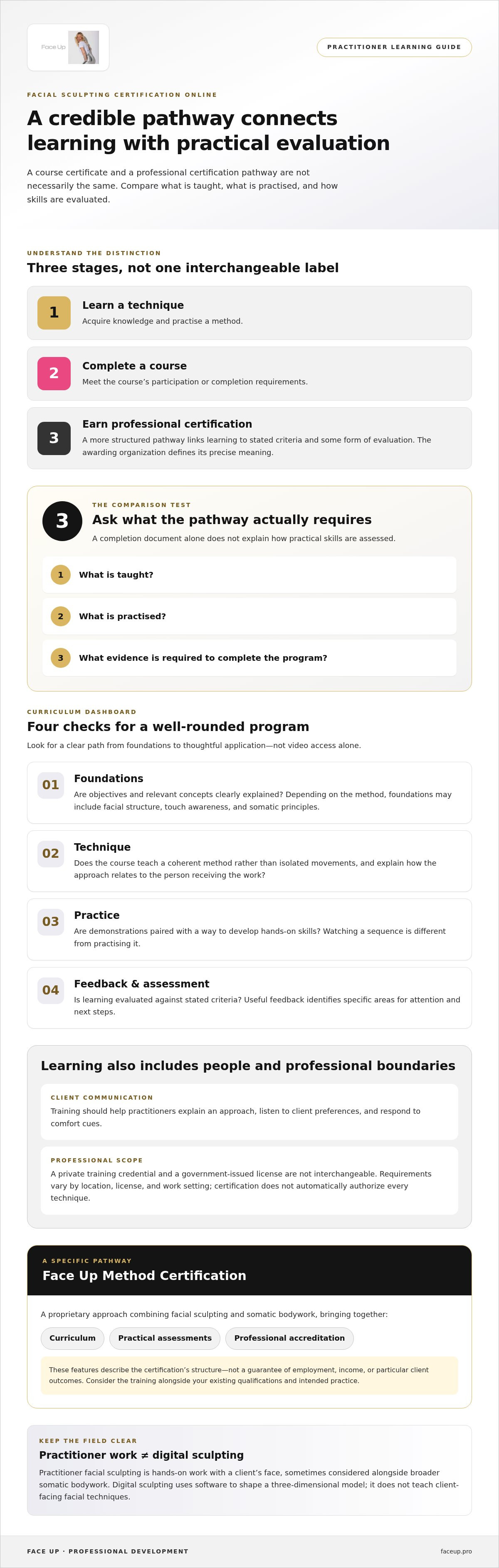
Three related terms are often used as if they mean the same thing, but they describe different stages. Learning a technique means acquiring knowledge and practising a method. Completing a course means meeting its participation or completion requirements. Professional certification generally signals a more structured pathway, where learning is linked to stated criteria and some form of evaluation. The precise meaning depends on the organization awarding the credential.
A curriculum organizes the subject matter; skills practice gives learners a chance to develop technique; assessment evaluates whether they have met defined learning standards. A participation record may simply document attendance or completion, while a credential involving evaluated learning indicates that assessment is part of the pathway. When comparing programs, look for clear answers to three questions: what is taught, what is practised, and what evidence is required to complete the program?
Face Up Method Certification includes a curriculum, practical assessments, and professional accreditation. It is based on Face Up’s proprietary approach combining facial sculpting and somatic bodywork. These features describe the certification’s structure, not a guarantee of employment, income, or particular client outcomes.
A private training credential and a license issued by a government authority are not interchangeable. Requirements can differ by location, license, and work setting, so certification does not automatically authorize every practitioner to offer every technique. Assess training in the context of your existing qualifications and intended practice.
What Should an Online Facial Sculpting Certification Teach?
A useful curriculum shows how learners move from understanding a method to applying it thoughtfully. For a facial sculpting certification online, video access alone doesn’t show whether the learning is structured or practical. Look for clear objectives, ways to practise, feedback, and an assessment process that explains what learners are expected to demonstrate.
A well-rounded curriculum connects relevant foundations, hands-on skill development, feedback, and professional scope. This helps learners understand not only what a technique involves, but how to approach it responsibly.
Curriculum foundations for facial and somatic work
Start with the learning sequence. Objectives should explain what learners are expected to understand and do, with concepts introduced before they’re applied in practice. Depending on the method, foundations may include facial structure, touch awareness, and somatic principles. The aim isn’t to collect terminology; it’s to understand how the method relates to the person receiving the work.
Client communication belongs in the curriculum, too. Training should help practitioners explain an approach, listen to a client’s preferences, and respond to comfort cues. Resources from the American Academy of Dermatology can offer broader skin-health context, while the course should explain its own method and intended professional scope.
Practical learning, feedback, and assessment
Demonstrations make a sequence easier to observe, while guided practice helps learners work through it rather than simply watch. Feedback can identify where a learner’s understanding or application needs attention. A practical assessment can then show how well they apply the learning against stated criteria. It’s most useful when expectations are clear and feedback points to specific next steps.
Use this checklist to compare a curriculum:
- Foundations: Are learning objectives and relevant concepts clearly explained?
- Technique: Does the course teach a coherent method, not just isolated movements?
- Practice: Are demonstrations paired with a way to develop hands-on skills?
- Feedback and assessment: Is there a defined way to evaluate learning and identify gaps?
- Professional scope: Does the training distinguish its curriculum from the requirements of a practitioner’s existing credentials and work setting?
Face Up Method Certification includes a curriculum, practical assessments, and professional accreditation. Its approach combines facial sculpting and somatic bodywork, giving you concrete features to consider without assuming that every training pathway uses the same standards. For more detail about the method, read the Face Up certification guide.
When comparing options, give particular weight to how practical learning and evaluation fit together. You can also explore Face Up’s professional learning as you consider your next step.
How to Compare Online Facial Sculpting Certification Pathways
Two programs can both be delivered online and still offer very different learning experiences. Compare what sits behind the format: the curriculum, the guidance available, how practical skills are assessed, and what the credential represents. For a facial sculpting certification online, convenient access matters, but it doesn’t tell you how thoroughly skills are taught or evaluated.
Use the framework below to record what each program explains. If a detail isn’t clear, note the question and look for an answer in the program description before deciding. Don’t assume that the format or credential name tells the whole story.
Compare structure, support, and practical assessment
Self-paced study can make it easier to revisit lessons and organize learning around your schedule. Instructor-supported learning may add opportunities for questions or feedback. Neither format is automatically right for every practitioner. Consider which structure suits your goals and experience. Convenience describes how you access learning, not how thoroughly skills are taught or evaluated.
Practical assessment complements theoretical learning by showing how a learner applies concepts, not only how well they can describe them. Look for a clear connection between course objectives, practice, and assessment. For example, if a course teaches a sequence, its evaluation should explain how learners demonstrate relevant skills and receive useful feedback.
Understand the credential and its professional context
Read the credential description closely. A course may document participation or completion, while another credential may be tied to evaluated learning or professional accreditation. These terms aren’t interchangeable, and a certificate alone doesn’t establish legal permission to practise. Recognition can also depend on local requirements and the expectations of a particular employer or work setting.
Before deciding, note what successful completion means according to the program, then consider how that fits your professional context. This makes comparisons more useful than relying on delivery format or a title alone.
How to Prepare for Online Facial Sculpting Training
Preparation helps turn lessons into purposeful learning. Before starting facial sculpting certification online, consider your professional setting, the clients you hope to serve, and the experience you already bring. This context can help you connect course concepts to your goals without moving beyond your training or professional scope.
Set learning goals and establish a foundation
Begin with a clear reason for learning. You might want to deepen an existing hands-on practice or explore how facial work fits into a broader wellness approach. Review relevant foundations, including facial anatomy, touch awareness, and client communication. A simple learning journal can help you track questions, note ideas to revisit, and reflect on your progress.
- Define your goals. Write down what you want to learn and how it relates to your current or intended practice.
- Identify your professional context. Consider your qualifications, work setting, relevant experience, and the clients you have in mind.
- Review foundational knowledge. Refresh your understanding of facial structures, mindful touch, and clear communication so new concepts have a place to connect.
- Plan your practice. Set aside focused time to revisit demonstrations and practise only in ways permitted by the training and your professional scope.
- Reflect and seek feedback. Record questions, note areas that need more attention, and use available feedback to guide your next learning steps.
Build reflective practice into skills development
Practice is more useful when it’s deliberate. Follow the course’s guidance rather than improvising or extending a technique beyond what you’ve learned. After a practice session, note what felt clear, where you hesitated, and what feedback you received. These observations can help you return to a lesson with a focused question instead of repeating the same uncertainty.
Reflection also helps you recognize when to pause. If a concern falls outside the course material, your experience, or your professional scope, don’t treat guesswork as a substitute for guidance. Pause and seek direction from a qualified source appropriate to the issue before proceeding. This is a considered part of learning, not a setback.
If your preparation includes learning about jaw-related approaches, the TMJ massage therapy guide offers related context. Use it as a learning reference, not as a replacement for course instruction or guidance about your professional responsibilities.
When you’re ready to explore a structured approach combining facial sculpting and somatic bodywork, explore the Face Up Method Certification as a potential next step in your professional development.
How the Face Up Method Certification Supports Professional Development
Face Up is a holistic beauty and wellness platform founded by Olga Newman, a specialist in facial sculpting and somatic bodywork. Its proprietary Face Up Method brings these areas together as a defined approach for practitioners to explore in their professional development. Rather than treating facial sculpting as a collection of movements in isolation, the method combines hands-on facial work with somatic bodywork.
For practitioners comparing learning pathways, a certification’s structure and evaluation are important considerations. Face Up Method Certification includes a curriculum, practical assessments, and professional accreditation. These features make the pathway easier to assess, while practitioners remain responsible for understanding how the training relates to their existing qualifications and professional context.
What the Face Up Method brings to practitioner learning
The method focuses on facial and neck tension through non-invasive bodywork. Its combined perspective gives learners a way to consider facial sculpting alongside somatic principles, rather than viewing the face as a purely technique-based area of practice. This describes the method’s approach, not a promise of physical, emotional, career, or client outcomes.
A curriculum provides a learning framework, and practical assessments give learners an opportunity to demonstrate their learning against the program’s criteria. Together with professional accreditation, these elements distinguish the certification pathway from simply encountering a technique or collecting informal learning materials. They also give prospective learners specific features to weigh when deciding whether the method aligns with their interests and professional development goals.
A considered next step in your professional journey
Before choosing a pathway, connect your goal to what the program teaches and evaluates. If you want to deepen your understanding of facial work within a somatic approach, consider whether the curriculum addresses that aim and includes practical assessment. Then reflect on your background, work setting, and the professional requirements relevant to where you practise. Certification can support learning, but it shouldn’t be treated as a substitute for any separate license or permission required for your work.
Use the same framework to decide whether the Face Up Method Certification is a relevant next step. Consider its curriculum, practical assessments, and professional accreditation in light of what you want to learn and how you intend to apply that learning. A thoughtful match between your goals and a program’s learning structure is a solid basis for continuing your professional development.
Choose a Learning Pathway That Fits Your Next Step
Your next step doesn’t need to be a commitment made in haste. Before choosing a facial sculpting certification online, write down what you hope to develop and how training should support your professional direction. Use those priorities to make a considered choice based on your experience, goals, and relevant professional requirements.
If you’re drawn to an approach that brings facial sculpting together with somatic bodywork, the Face Up Method Certification offers a pathway built around curriculum, practical assessments, and professional accreditation. These features give you a clear starting point for considering how the method’s learning structure aligns with your interests.
Explore the Face Up Method Certification and consider whether it’s the right next step for you. Thoughtful professional development begins with curiosity and a commitment to keep learning.
Frequently Asked Questions
Is an online facial sculpting certification enough to practise professionally?
Not necessarily. A private training credential doesn’t automatically replace a professional license or establish permission to perform every technique. Whether you can offer a service depends on your existing qualifications and the rules that apply where and how you practise. For example, a practitioner working in a clinic may also need to meet workplace requirements. Treat certification as evidence of specific training, then assess your professional scope separately.
Can you learn hands-on facial sculpting techniques online?
Online training can introduce techniques through explanation and visual demonstration, and learners may practise skills according to the course’s instructions. Watching a technique, however, isn’t the same as receiving feedback on how you apply it. Consider how the learning pathway supports practical skill development and helps you identify questions. Practise within your training and professional scope, rather than improvising beyond either.
How long does facial sculpting certification take online?
There isn’t one standard duration for every facial sculpting certification online. Study time can depend on the program’s curriculum, the pace you choose, and whether practical learning or assessment is part of completion. Look for a stated course structure and information about expected study or practice commitments. If the schedule is flexible, plan time to revisit challenging material rather than judging readiness only by how quickly you finish the lessons.
Does facial sculpting certification include practical assessment?
Some programs include practical assessment, while others may document participation or completion without evaluating applied skills. Read the program description to see whether assessment is required and what successful completion represents. Face Up Method Certification includes practical assessments. That detail helps explain the pathway’s structure, though assessment formats and criteria can differ between programs.
What is the difference between facial sculpting certification and a course certificate?
The wording alone may not reveal the difference. A course certificate can record attendance or completion; a certification may involve a defined program and assessment requirements. Look at the criteria behind the document: does it state what learning was evaluated, or only that you completed the course? Keep the record with your other professional documents, and describe your training accurately when presenting it to employers or clients.
Can massage therapists add facial sculpting to their existing practice?
Potentially, if the training fits their professional scope and the rules in their location and work setting. A massage therapist can use prior experience as context for learning, but should distinguish familiar skills from techniques that require additional education or authorization. Before adding a facial service, consider whether it falls within your current credentials and workplace expectations. Certification supports method-specific learning, but doesn’t automatically expand legal permission to practise.


