

More pressure isn’t the secret to releasing a tight jaw. A masseter muscle massage should feel gentle and manageable, not like a test of how much discomfort you can tolerate. If you’ve struggled to find the tense spot or found conflicting advice about how firmly or how long to press, you’re not alone.
The masseter sits along the side of your jaw, but jaw tension can involve more than one muscle. Temporary relief doesn’t necessarily resolve the underlying cause. A careful approach starts with noticing how your jaw responds, rather than pushing through pain.
In this guide, you’ll learn how to locate the masseter, try a simple self-massage sequence, and know when to stop. You’ll also learn which symptoms call for guidance from a dentist or doctor, so you can use self-care thoughtfully without mistaking it for a diagnosis or complete treatment.
Key Takeaways
- Locate the masseter along the side of your jaw and understand its role in chewing and clenching.
- Try a gentle masseter muscle massage with light contact, slow movements, and attention to how your jaw feels.
- Massage may offer temporary comfort, but it can’t diagnose or treat every cause of jaw symptoms.
- Know which pain or new symptoms mean it’s time to stop self-massage and seek clinical guidance.
- Build a comfortable jaw-release ritual around awareness and consistency, not harder pressure or dramatic results.
What Is the Masseter Muscle, and Why Can It Feel Tight?
The masseter is one of the main muscles that helps you chew. You can feel it on each side of your face, extending from the cheek area toward the lower jaw. It’s easy to mistake for the jaw joint, but the two are different structures. The masseter is a chewing muscle along the side of the jaw; the jaw joint is where the lower jaw connects to the skull.
The muscle works whenever you bite down or chew. It also firms when you clench your teeth, which can make it feel tired or tender. Repeated clenching, chewing, or holding tension in the face may contribute to tightness, but that sensation alone can’t explain what’s causing it. The masseter muscle has a specific role and location, but jaw discomfort can involve other muscles or structures too.
Where Is the Masseter Muscle Located?
Place your fingertips on the fleshy area of your cheek, just in front of the back teeth and above the angle of your jaw. Briefly bring your teeth together with a light clench, just enough to feel the muscle firm beneath your fingers. Then relax your jaw. Keep your teeth comfortably apart as you explore the area. There’s no need to keep clenching or press deeply.
This check can help you distinguish the broad, firm muscle from nearby soft tissue. The masseter runs toward the bony corner of the lower jaw, so its edges may feel clearer near the cheek and jaw angle. This orientation helps you focus a masseter muscle massage on the muscle, rather than pressing directly on bone or searching for a single “knot.”
How Is the Masseter Different From the Jaw Joint?
The temporomandibular joint, often shortened to TMJ, sits just in front of the ear, where the lower jaw meets the skull. You can notice its movement by placing a finger lightly in that area as you open and close your mouth. The masseter runs along the side of the jaw; the joint is the moving connection near the ear.
These structures work together, so sensations can overlap. Tenderness in the cheek-side muscle doesn’t identify a joint problem on its own. Likewise, clicking, restricted movement, or discomfort near the ear doesn’t automatically mean the masseter is responsible. Avoid treating a muscle sensation as a diagnosis. For a wider explanation of the area and hands-on approaches, read this TMJ massage therapy guide.
Jaw discomfort can have several contributors, including muscle tension, joint irritation, or habits such as clenching. Locating the muscle can help you understand what you’re touching, but it can’t determine the cause of symptoms. If discomfort persists or affects how you eat or open your mouth, seek clinical guidance rather than relying on massage alone.
How to Massage the Masseter Muscle Gently at Home
A useful self-massage doesn’t depend on finding a painful spot or pressing until the muscle gives way. Make light contact, notice how your jaw responds, and stop if the sensation becomes uncomfortable. Try this only when your jaw feels settled enough for gentle touch. Keep your movements slow, your teeth apart, and your attention on whether the pressure remains manageable.
A Simple Masseter Self-Massage Sequence
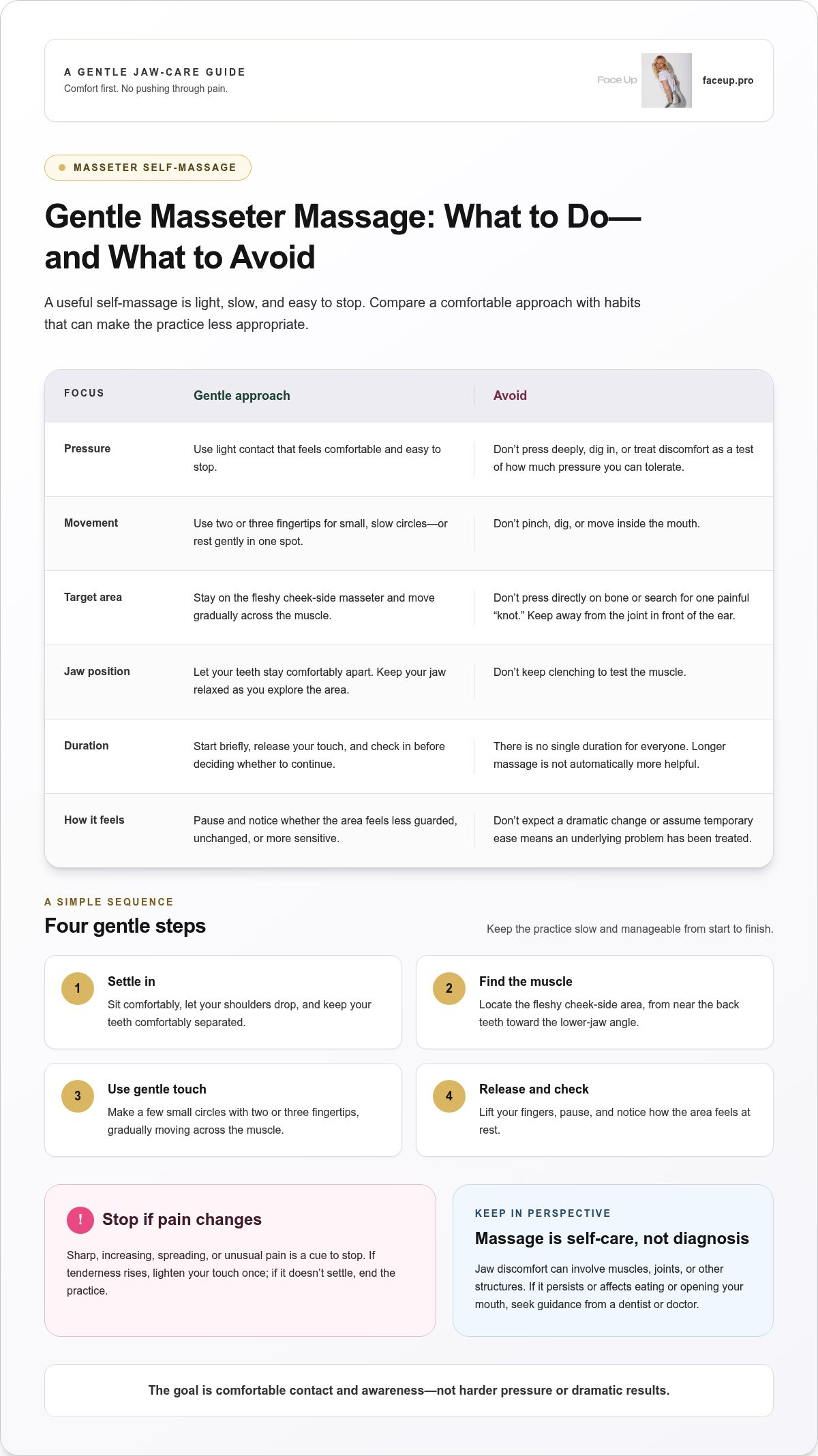
Sit comfortably and let your shoulders drop. Allow your lips to rest together or slightly apart, with your teeth comfortably separated. Find the fleshy cheek-side muscle you located earlier, then use two or three fingertips to make small, slow circles. Move gradually across the muscle, staying on the cheek-side area rather than pressing near the joint in front of your ear.
- Begin with light contact on one side of the jaw.
- Make a few small circles, or rest your fingertips gently in one spot.
- Shift gradually across the muscle without digging, pinching, or moving inside the mouth.
- Release your touch, pause, and notice how the area feels at rest.
How Much Pressure and How Long Should You Use?
Choose pressure that feels comfortable and easy to stop. You’re not trying to break up a knot or reproduce tenderness. Start briefly, then lift your fingers and check in before deciding whether to continue. There’s no single duration that suits everyone, and a longer massage isn’t automatically more helpful. Self-massage should stay comfortable and should not intensify your pain.
Notice how the area feels during and after the massage. A mild sense of contact or movement may be expected, but sharp, increasing, spreading, or unusual pain is a cue to stop. If tenderness rises, lighten your touch once. If it doesn’t settle, end the practice. Don’t keep testing the area by clenching your teeth. Let your jaw rest with your teeth apart instead.
Compare how the area feels before and after without expecting a dramatic change. Does the cheek feel less guarded, unchanged, or more sensitive? That observation can help you decide whether gentle contact feels appropriate another time. It can’t identify the cause of jaw discomfort, and temporary ease doesn’t prove an underlying problem has been treated.
If you prefer a guided routine, the Face Up app subscription includes guided facial exercises and somatic practices. Use them to add structure to your jaw-release practice while keeping the same focus on comfort and awareness. Explore guided facial exercises and somatic practices.
What Masseter Massage May Help With, and What It Cannot Promise
A gentle masseter muscle massage may leave some people feeling more comfortable or more aware of tension in the cheek-side jaw. Responses vary: you might notice a small, temporary shift, no change, or increased sensitivity. Massage is a self-care option, not a reliable way to identify the cause of jaw symptoms or treat every condition affecting the jaw.
Why Gentle Massage Can Feel Soothing
Slow, comfortable touch gives you a chance to pause and notice whether you’re holding tension in your jaw. Some people find that gentle contact feels calming or helps them let the muscle soften while their teeth remain apart. These experiences are personal, not guaranteed. Feeling more at ease doesn’t prove that tissue has changed or that a specific problem has been corrected.
Judge the response by comfort, not by how much pressure you can tolerate. If the area feels less guarded afterward, that may be a useful short-term observation. If it feels the same, there’s no need to press harder or keep searching for a tender spot. Painful pressure isn’t a measure of effectiveness.
Why Results Differ From Person to Person
Jaw symptoms can have different contributors. Muscles, jaw joints, teeth, clenching habits, and other factors may all be relevant, and more than one may be involved. A brief change after massage can’t distinguish among these possibilities. It also can’t confirm a TMJ disorder, establish why you clench, or show whether your bite needs attention.
Massage shouldn’t be presented as a way to correct bite alignment, stop bruxism, or resolve persistent jaw conditions. If symptoms continue, interfere with eating or opening your mouth, or concern you, seek assessment from a dentist or doctor. Temporary relief can be welcome, but it isn’t a substitute for understanding ongoing or troubling symptoms.
Tools are optional. Your fingertips are enough for gentle external contact, and a tool isn’t necessary to make the practice worthwhile. If you use one, choose comfort over intensity and avoid pressing forcefully into the jaw. A TMJ massage tool guide can provide broader context on tools and a somatic approach.
After self-massage, notice what changed without treating the result as a diagnosis. Did the area feel more comfortable, unchanged, or more sensitive? Let that response guide whether you pause or continue gentle self-care another time. If discomfort increases or symptoms persist, stop relying on massage alone and seek clinical guidance.
Masseter Massage Safety: When to Stop and Get Help
Keep this practice gentle and external. These steps are for touching the cheek-side masseter with your fingertips, not for working inside the mouth, forcing the jaw to move, or manipulating the joint. A masseter muscle massage should feel controlled and easy to stop. Massage should never worsen symptoms or delay an assessment you need.
Pay attention to changes during and after the massage. Mild awareness of touch is different from pain that escalates, spreads, or feels unusual. If you’re uncertain whether a sensation is safe to work through, pause instead of testing it with more pressure.
Signs to Stop a Self-Massage Session
Stop right away if pressure brings on sharp pain, increasing tenderness, dizziness, numbness, or another unusual symptom. Don’t try to work through restricted jaw movement, swelling, a recent injury, or a sudden change in how your jaw feels. Leave the area alone and consider appropriate clinical advice.
- Release your fingers if pain grows, spreads, or feels different from the tension you expected.
- Don’t press directly into the joint in front of the ear or use a tool that makes pressure difficult to control.
- Stop rather than repeating the movement if symptoms linger or feel worse after you let go.
More force isn’t a safer or more effective response to discomfort. Don’t try a different angle, a harder tool, or a longer session to push past a warning sign.
When Jaw Symptoms Need Clinical Assessment
Arrange an assessment with an appropriate healthcare professional if jaw pain persists, keeps returning, or interferes with eating, speaking, or opening your mouth. A dentist or doctor can assess concerns that self-massage can’t explain. Massage may be a comfort measure, but it can’t determine the cause or replace individual clinical guidance.
Seek prompt care for sudden severe symptoms or a significant injury. If a new symptom appears, stop self-massage and get advice instead of assuming it comes from a tight muscle. You don’t need to diagnose the problem yourself before asking for help.
Self-care has a clear role: gentle awareness, not a test of pain tolerance or a substitute for assessment. If your jaw responds comfortably, take that as one observation. If it doesn’t, stopping is a sensible next step.
For a guided approach to gentle jaw-release self-practice, explore the Face Up Jaw Release Course.
Build a Gentle Jaw-Release Ritual With Face Up
A helpful jaw-release ritual doesn’t need to be long or intense. Pause, check how your jaw is resting, use brief and comfortable contact if it feels appropriate, then notice how you feel afterward. The purpose is to build awareness, not force a change. If massage increases discomfort or symptoms concern you, stop and follow the safety guidance above.
Make Jaw Awareness Part of Everyday Practice
At a quiet moment, notice whether your teeth are touching. If they are, let your jaw return to a comfortable resting position, with the teeth apart. There’s no need to stretch, hold your mouth open, or make a strained movement. A gentle check-in can be enough.
You can pair this awareness with a brief masseter muscle massage, using the light external touch described earlier, then pause and observe your response. A few simple notes can help you notice patterns without treating them as a diagnosis:
- What was happening when you noticed your jaw tension?
- Did the area feel more comfortable, unchanged, or more sensitive afterward?
- Did any activity seem to coincide with a change in how your jaw felt?
Keep your notes practical and neutral. They’re observations to help you reflect, not a medical record or proof of what’s causing discomfort. Comfort matters more than doing the ritual every day or adding extra pressure. If the practice doesn’t feel right, leave it out.
Explore Guided Jaw-Release Practice
The Face Up app subscription offers guided facial exercises and somatic self-practice rituals. The Jaw Release Course is a focused digital learning option. Both provide a framework for exploring facial and jaw awareness at your own pace, without promising a particular result or replacing clinical assessment when symptoms need attention.
Choose a routine that feels manageable: settle your jaw, practice gentle contact only if comfortable, and check in afterward. Consistency means returning to a calm, low-pressure practice, not increasing intensity or chasing dramatic changes. If jaw symptoms persist, recur, or affect everyday activities, seek clinical guidance instead of relying on self-massage alone.
Explore Face Up jaw-release practices for guided self-practice.
Let Gentle Practice Shape Your Next Step
Let jaw practice be an invitation to notice, not another task to perfect. A brief masseter muscle massage can fit into a calm moment, but you don’t need to measure success by how much tension disappears. Pay attention to what feels comfortable and let your routine change with your needs.
Face Up offers an app with guided facial exercises and somatic practices, as well as the Jaw Release Course. Founded by Olga Newman, a specialist in somatic bodywork and facial sculpting, Face Up brings awareness to facial and body tension. These resources support self-practice, but they don’t replace clinical assessment when symptoms call for it.
Explore Face Up jaw-release practices and choose a gentle next step that feels right for you. Small, comfortable moments of awareness are a worthwhile place to begin.
Frequently Asked Questions
How do you massage the masseter muscle at home?
Use your fingertips for a gentle, external masseter muscle massage while your jaw is relaxed. Start near the middle of the cheek-side muscle, then make small, unhurried circles across the fleshy area. Keep your teeth apart and your hand pressure easy to release. Try a few circles on one side, pause, and compare how it feels with the other side before continuing.
How long should you massage your masseter muscle?
There isn’t a universal time that suits everyone, so begin with a brief check-in rather than aiming for a set number of minutes. Massage lightly, pause, and see whether the area feels comfortable before deciding to continue. A longer session isn’t necessarily better. If soreness builds, tenderness lingers, or discomfort increases, stop instead of adding time to force a result.
Can masseter massage help with jaw tension?
It may feel soothing for some people when tension seems concentrated in the cheek-side jaw muscle, but responses differ and relief may be temporary. You might notice that the area feels less guarded after gentle touch, while someone else notices no change. That sensation can guide your self-care, but it doesn’t confirm what caused the tension or rule out other contributors.
Is it normal for the masseter to feel sore when massaged?
The muscle may feel tender to touch, but soreness isn’t a goal or a sign that the massage is working. Keep contact light enough that you can relax your face and breathe normally. If a spot feels sore, ease off rather than pressing repeatedly to test it. Stop if tenderness increases, becomes sharp, or remains after you release your fingers, and seek advice if it concerns you.
Can masseter massage reduce jaw clenching or teeth grinding?
Massage may help you notice when you’re holding tension, but it can’t be relied on to stop clenching or teeth grinding. An everyday cue is to check whether your teeth are touching while reading or working, then let your jaw rest comfortably if they are. If grinding or clenching is ongoing, painful, or affecting your teeth or sleep, discuss it with a dentist or doctor.
What happens if masseter massage makes jaw pain worse?
Stop the massage and don’t try to overcome the pain by pressing harder, changing tools, or repeating the movement. Give the area a chance to settle and notice whether symptoms ease or persist. Seek clinical advice if pain continues, returns, spreads, or affects normal activities. Sudden severe symptoms or a significant injury warrant prompt care rather than further self-massage.
Should you massage the masseter near the jaw joint?
You can touch the fleshy muscle along the side of the jaw, but avoid pressing directly on the joint just in front of the ear. The muscle and joint are close, so use a light touch and stay on the cheek-side tissue rather than probing for a tender point at the joint. If you’re unsure where your fingers are or the area is painful, skip that spot and ask a healthcare professional for guidance.


