

What if relaxing a tense jaw starts with doing less, not stretching harder? If you’re searching for how to relax your jaw instantly, you may feel tempted to massage, stretch, or repeatedly test how far your jaw moves. But forcing movement can add effort when your jaw is already making it harder to talk, eat, concentrate, or rest.
A gentle reset gives you a calmer place to start. This guide walks you through a brief sequence to notice tension and ease unnecessary effort without pushing through discomfort. You’ll also learn what to avoid when your jaw feels tight and when symptoms call for professional assessment. A quick self-care step isn’t a substitute for that assessment if symptoms keep returning or feel severe.
Start with simple cues for easing effort, then consider what to use cautiously and when to seek professional guidance. The aim isn’t to force your jaw into a new position or promise an instant cure. It’s to respond with care and recognize when you may need more support.
Key Takeaways
- Learn how to relax your jaw instantly with a brief sequence that encourages ease rather than forcing movement.
- Use a simple check-in to notice when your teeth are touching and let your jaw rest if comfortable.
- Understand why forceful stretching or hard pressure may not be the right response to tension.
- Notice patterns in recurring tightness and recognize when persistent or severe symptoms deserve professional attention.
- Explore Face Up’s Jaw Release Course or app for guided self-practice, with somatic awareness as a complement to everyday care.
How to Relax Your Jaw Instantly: What to Do First
A tense jaw can make ordinary moments harder: talking through a meeting, chewing lunch, focusing on a screen, or settling down to sleep. The sensation is real, but it doesn’t point to one cause. Clenching, habits, stress, and other factors may play a role, so start a quick reset by noticing what’s happening rather than assuming why.
Think of “instant” relaxation as a short-term easing strategy, not a treatment or a promise that pain will disappear. If you’re wondering how to relax your jaw instantly, first notice how it feels. Let go of unnecessary effort if that feels comfortable. You don’t need to stretch, open wide, or move your jaw at all. Movement is optional, and comfort is the guide.
A moment of easing doesn’t explain recurring symptoms. Jaw tension, clicking, or clenching alone can’t confirm a temporomandibular disorder. The overview of Temporomandibular Joint Dysfunction (TMD) describes a broader group of concerns involving the jaw and its movement. Only a qualified professional can assess your symptoms.
What a relaxed resting jaw position feels like
Before changing anything, notice your current position. Are your teeth touching, is your tongue pressing, or are you holding your jaw still? A relaxed resting position generally means your lips can meet comfortably, your upper and lower teeth aren’t held together, and your tongue rests gently without pushing against your teeth or jaw. These are cues, not a posture to enforce. Let your jaw be where it is for a moment.
If this position feels unfamiliar, don’t try to make it perfect. Allow a little space between your teeth if that’s comfortable, and let the muscles do less. You can keep your lips parted if closing them feels strained. The aim is ease, not a fixed shape.
When to pause before trying a jaw reset
Don’t push through sharp pain, increasing discomfort, or restricted movement. Stop any attempt that makes symptoms worse; keeping still and comfortable is a reasonable first response. New, severe, or worsening symptoms deserve professional medical advice, particularly if they interfere with eating or opening your mouth. A brief self-care reset isn’t a substitute for assessment when something feels concerning.
Clicking, clenching, or tightness can be useful details to notice, but none alone establishes a diagnosis. Pay attention to when symptoms occur and whether they change, without deciding in advance that stress or one particular habit must be the cause. These observations can help you explain what’s happening if you seek professional guidance.
A Gentle 60-Second Sequence to Relax Your Jaw
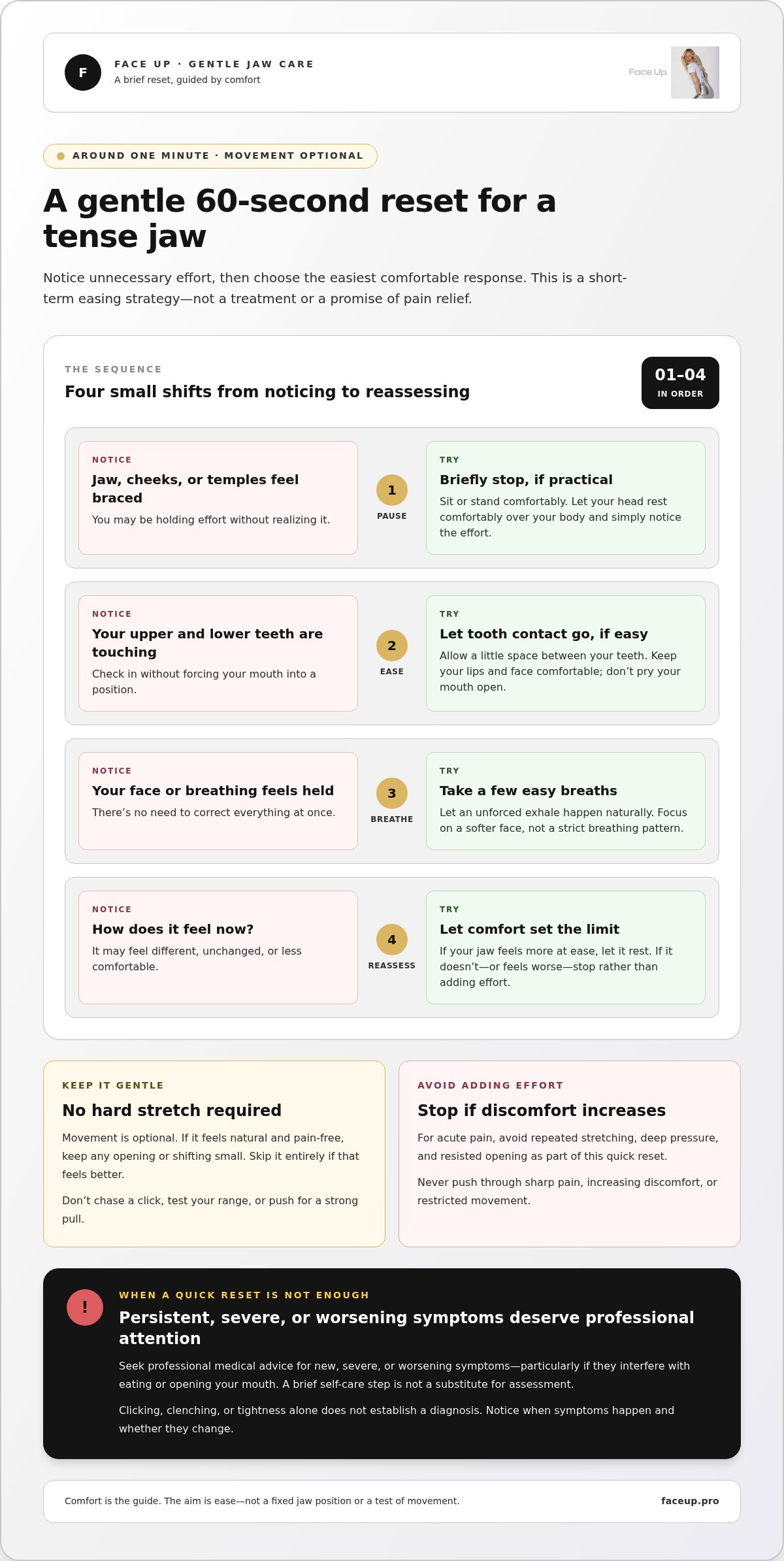
This short reset offers one simple sequence rather than a menu of exercises. It may help you notice and ease unnecessary effort, but it isn’t a treatment or a guarantee of pain relief. Take around a minute if that feels comfortable, and move at your own pace. A quick jaw reset should feel easy, never forced.
Start with breath, shoulders, and jaw awareness
Settle into a comfortable position, sitting or standing, and let your shoulders rest instead of pulling them back or holding them rigid. Allow one slow, unforced exhale. Notice whether your teeth are touching or your jaw feels braced. There’s no need to correct anything immediately. First, simply observe what your face and jaw are doing.
- Pause. Stop what you’re doing briefly, if practical. Let your head sit comfortably over your body and notice any effort around your jaw, cheeks, or temples.
- Release tooth contact. If it feels easy, let your upper and lower teeth part slightly. Keep your lips and face comfortable. Don’t pry your mouth open or hold a specific position.
- Breathe slowly. Take a few easy breaths, letting each exhale happen without pushing it out. Focus on a softer face, not on following a strict breathing pattern.
- Reassess comfort. Notice whether anything feels different, unchanged, or less comfortable. There’s no score to reach. If your jaw feels more at ease, let it rest. If not, stop rather than adding effort.
Let the jaw soften without stretching hard
Keep movement small and optional. If it feels natural and pain-free, let your jaw shift or open just a little, then return to a comfortable resting position. You can also skip movement entirely. The aim isn’t to chase a click, test your range, or create a stretch. Stay with what feels easy, and stop any step that increases discomfort.
For acute pain, avoid repeated stretching, deep pressure, and resisted opening as part of this quick reset. More effort isn’t automatically more helpful. One comfortable pause may be a better choice than repeating a motion that makes you tense or brace against discomfort.
Slow breathing may help you notice tension, but this brief sequence can’t identify or treat the cause of recurring jaw symptoms. For broader information about symptoms and care, see the Mayo Clinic on TMJ Disorders. If the reset makes your symptoms worse, stop and seek professional advice when symptoms are severe or persistent.
For guided self-practice beyond this quick reset, Face Up’s Jaw Release Course offers a focused way to explore jaw release at your own pace.
Why Gentle Jaw Relaxation Beats Forcing a Stretch
When your jaw feels tight, it can be tempting to press into the muscles or stretch until you feel a strong pull. But more pressure isn’t necessarily more helpful. A gentler approach starts by noticing effort and choosing only comfortable, easy movement, if any. That lets you respond to the sensation without turning a quick self-care moment into a test of how far your jaw can move.
Learning how to relax your jaw instantly means creating a brief opportunity for ease, not forcing a change. If your jaw feels looser afterward, that doesn’t tell you why the tension began or whether an underlying issue needs attention. Recurring symptoms can have several contributing factors, so persistent symptoms or symptoms that interfere with daily life deserve individual assessment.
What gentle release can and cannot do
Gentle awareness may help you notice when you’re bracing, holding your teeth together, or adding effort around your face. Letting go of that effort may provide temporary easing, but it can’t be relied on to resolve a joint condition, bruxism, or emotional distress. It also doesn’t replace an assessment when symptoms keep returning. For more background on hands-on approaches, explore this TMJ massage therapy guide.
Use this comparison as a practical check, not a diagnosis. Choose an approach that feels comfortable and doesn’t intensify symptoms.
| Approach | What it feels like | When to stop |
|---|---|---|
| Gentle awareness | Noticing clenching or bracing, then allowing the face to soften without demanding a particular position. | If focusing on the jaw increases distress or discomfort, shift your attention and rest. |
| Small, comfortable movement | An easy, pain-free motion that doesn’t require opening wide or reaching a stretch. | Stop if movement causes pain, feels restricted, or becomes less comfortable. |
| Forceful stretching or hard pressure | A strong pull, pressing sensation, or effort to push through tightness. | Don’t push into pain or keep applying pressure when discomfort increases. |
Signs you are pushing the jaw too far
Sharp or increasing pain, uncomfortable clicking, or a feeling that your jaw is blocked are cues to stop movement or pressure. Avoid deep pressure inside or outside your mouth if it hurts or makes you tense against the touch. Clicking by itself doesn’t prove an injury or establish a diagnosis, but discuss a new or concerning change with a health professional, especially if it comes with pain or restricted movement.
Choose less effort over more intensity. If a gentle approach feels comfortable, leave it there. If it aggravates your jaw, stop rather than stretching through it.
Build a Quick Jaw-Relaxation Habit Without Ignoring Warning Signs
A brief jaw check-in can fit into moments when you already pause, such as reading at your desk, switching screens, or noticing your teeth held together. The purpose isn’t to monitor yourself constantly or prevent every episode of tightness. It’s to notice unnecessary effort when you happen to catch it, then choose a comfortable response.
Jaw tension can have different contributing factors, so don’t assume stress is the only explanation. Instead, notice what’s happening and whether it changes. Your jaw might feel braced during a focused task, after a long conversation, or at another time. Those observations can help you recognize a pattern without turning it into a diagnosis.
Use a simple, repeatable jaw check-in
When it feels useful, pause and notice three things: whether your teeth are touching, whether you’re holding effort in your face, and whether your shoulders feel tense. Take one comfortable exhale. If it feels easy, allow your jaw to settle into a resting position, with your teeth not held together. There’s no need to stretch or make the check-in last a set amount of time.
Keep it flexible. You might pause when you catch yourself clenching at a screen, or move on if checking in feels distracting. A brief self-care moment may help you respond to tension, but it can’t guarantee prevention or explain why symptoms are happening.
Know when symptoms need professional attention
Occasional tightness that settles and doesn’t disrupt your routine is different from symptoms that persist, worsen, or interfere with speaking, eating, sleeping, or opening your mouth. Arrange a medical or dental assessment for ongoing or disruptive symptoms instead of relying on self-massage or repeated resets. Share what you’ve noticed, including when symptoms occur and how they affect daily activities.
A self-care pause can help you notice tension; it can’t replace professional assessment when symptoms persist or worsen. Seek urgent care for sudden severe symptoms or difficulty breathing or swallowing. If you’re already following clinician-directed care, don’t substitute massage or a relaxation habit for that guidance.
For structured support with ongoing self-practice, Face Up offers a Jaw Release Course and an app subscription with guided rituals. Explore guided jaw self-practice as a complement to brief check-ins, not as a diagnosis or guaranteed solution.
Continue Gentle Jaw Care with Face Up
You now have a practical way to pause, notice tension, and respond without forcing your jaw. If you’d like support beyond an occasional reset, Face Up offers guided self-practice and in-person sessions in facial sculpting and somatic bodywork. These approaches can complement personal care, but they aren’t a diagnosis or a promise to treat jaw symptoms.
There’s no single next step everyone needs. You might prefer a guided practice to explore on your own, or an in-person experience. Choose what feels appropriate, and keep seeking medical or dental advice for symptoms that persist, worsen, or disrupt daily life.
Explore guided jaw self-practice
The Jaw Release Course is a focused online offering for jaw self-practice. It may suit someone looking for more direction than a brief reset can provide, while leaving room to approach the practice gently and pay attention to comfort. It doesn’t replace professional assessment when symptoms call for it.
The Face Up App Subscription includes guided daily rituals and facial practices. It offers another way to bring guided self-practice into your routine without assuming jaw tension has one particular cause. If you’re learning how to relax your jaw instantly, a quick pause can be useful in the moment; guided practice is an optional way to explore care beyond that immediate check-in.
When hands-on somatic support may suit you
For those who prefer in-person support, Face Up offers Face Up Sculpting Treatment and Somatic Bodywork Session in its Auckland studio. These sessions combine facial sculpting and somatic bodywork for people who want a guided, hands-on experience. A session is a personal preference, not a requirement for managing jaw tension.
Somatic awareness can help you pay attention to sensations and how you respond to them, but it shouldn’t be presented as a cure or substitute for healthcare. If you have significant or ongoing symptoms, keep a qualified health professional involved in decisions about assessment and care. You can explore body-based practices alongside that guidance, rather than in place of it.
Whether you continue with self-practice or consider an in-person session, let comfort and your needs guide the choice. Explore Face Up’s approach to facial sculpting and somatic bodywork, then choose the next step that feels right for you.
Let Your Next Step Be Gentle
Jaw care doesn’t need to become another task to get right. Tension can be a cue to pause and respond with curiosity, rather than pressure yourself to make the sensation disappear. As you explore how to relax your jaw instantly, remember that a quick reset is one way to meet the moment. It doesn’t need to solve everything to be worthwhile.
Over time, you can choose the kind of support that feels most useful. Face Up brings facial sculpting and somatic bodywork together, with guided self-practice and hands-on experiences. These approaches can support exploration and awareness, but they don’t replace professional assessment when symptoms persist, worsen, or disrupt everyday life.
If you’d like to continue exploring gentle jaw care, explore Face Up’s Jaw Release Course. Take it one comfortable step at a time, and seek professional advice if symptoms persist or worsen.
Frequently Asked Questions
How can I relax my jaw instantly at home?
For a quick at-home reset, stop chewing or talking for a moment and let your face rest without testing how wide your mouth opens. If it feels soothing, place a comfortably warm, cloth-wrapped pack against your cheek; avoid temperatures that could irritate your skin. This may offer temporary comfort, but it won’t identify the reason for tension. The goal of how to relax your jaw instantly is a gentle pause, not a guaranteed fix.
Should my teeth touch when my jaw is relaxed?
At rest, your upper and lower teeth generally don’t need to stay in contact. They naturally meet for actions such as chewing and swallowing, so don’t try to keep them apart during every activity. Outside those tasks, notice whether you’re pressing them together and ease off if comfortable. Avoid repeatedly checking your bite or holding your jaw in a rigid position. A relaxed rest should feel natural, not carefully controlled.
Can breathing help relax a tight jaw?
Easy breathing can give you a moment to notice whether you’re bracing your jaw, especially during focused work or a stressful task. Try letting one exhale leave naturally, without counting or taking unusually deep breaths. This can support a calming pause, but it doesn’t guarantee that jaw muscles will relax or treat a temporomandibular disorder. If focusing on breathing feels uncomfortable, return to your normal rhythm and seek advice for ongoing symptoms.
Is it safe to massage a tight jaw yourself?
Gentle massage over the cheek muscles may feel comfortable for some people, but it shouldn’t hurt or leave you feeling worse. Use light fingertip contact on the outside of your face rather than digging into tender spots or pressing hard over the jaw joint. Don’t massage inside your mouth if you’re unsure how to do so safely. Stop if pain increases, and follow clinician-directed guidance if you’re receiving care.
Why does my jaw feel tight even when I am not eating?
Jaw muscles can feel tense outside mealtimes for several reasons, including holding your teeth together while concentrating, clenching or grinding, muscle irritation, or other jaw-related factors. Stress may contribute for some people, but it isn’t the only possible explanation. Notice whether tightness appears during particular activities or at certain times, and whether it affects function. A pattern can be useful information, but it can’t establish the cause on its own.
What should I do if my jaw locks or I cannot open my mouth normally?
Don’t force your mouth open or try to push your jaw back into place. If you can’t open or close it normally, arrange prompt medical or dental assessment, especially if this is new, persistent, or affecting eating and drinking. Sudden severe symptoms need urgent care. Difficulty breathing or swallowing is an emergency; seek emergency help rather than attempting massage or exercises.


