

What if the jaw and hips are connected through more than posture alone? The connection between hip and jaw tension may involve the dura mater, connective tissue that covers the brain and spinal cord and links the cranium with the sacrum. This offers one anatomical way to understand why tension in one area may occur alongside changes elsewhere, though it doesn’t prove that jaw tension directly causes hip pain.
If your jaw feels tight while your hips or pelvis feel restricted, it makes sense to wonder whether the symptoms are related. This article explains the proposed link, including how the dura mater may fit into the picture and how posture and muscle tension can contribute.
You’ll also learn what a clinician’s case example of longstanding jaw and hip pain illustrates, and what research findings can and can’t tell us about this relationship. The aim is a clearer, balanced view of the possible connection, not a claim that everyone’s symptoms share the same cause.
Key Takeaways
- Learn how the dura mater may help explain a relationship between jaw and pelvic tension, without assuming one symptom causes the other.
- See what a clinician’s case example suggests about changes in jaw movement alongside longstanding hip discomfort.
- Understand how posture, muscle tension, and movement patterns may contribute to symptoms across more than one area of the body.
- Explore what research findings can indicate about jaw and hip mobility, and where hands-on or self-practice support may fit.
Why would jaw pain and hip tension be linked?
Jaw and hip symptoms may coincide because muscles and connective tissues coordinate movement across the body. Their overlap can suggest a shared pattern, but it doesn’t prove one area caused the other.
Myofascial Links Between Jaw and Pelvis
Myofascial connections are relationships among muscles and fascia that help coordinate movement across body regions. The Deep Frontal Line describes a pathway linking pelvic muscles with muscles in the jaws and neck. The cranium and sacrum are also connected through the dura mater, which covers the brain and spinal cord. During embryological development around day 15, the oropharyngeal membrane develops into the mouth, while the cloacal membrane develops into openings of the urinary, reproductive, and digestive tracts. These relationships offer anatomical context, not proof of direct causation.
Hypermobility and Jaw or Pelvic Floor Dysfunction
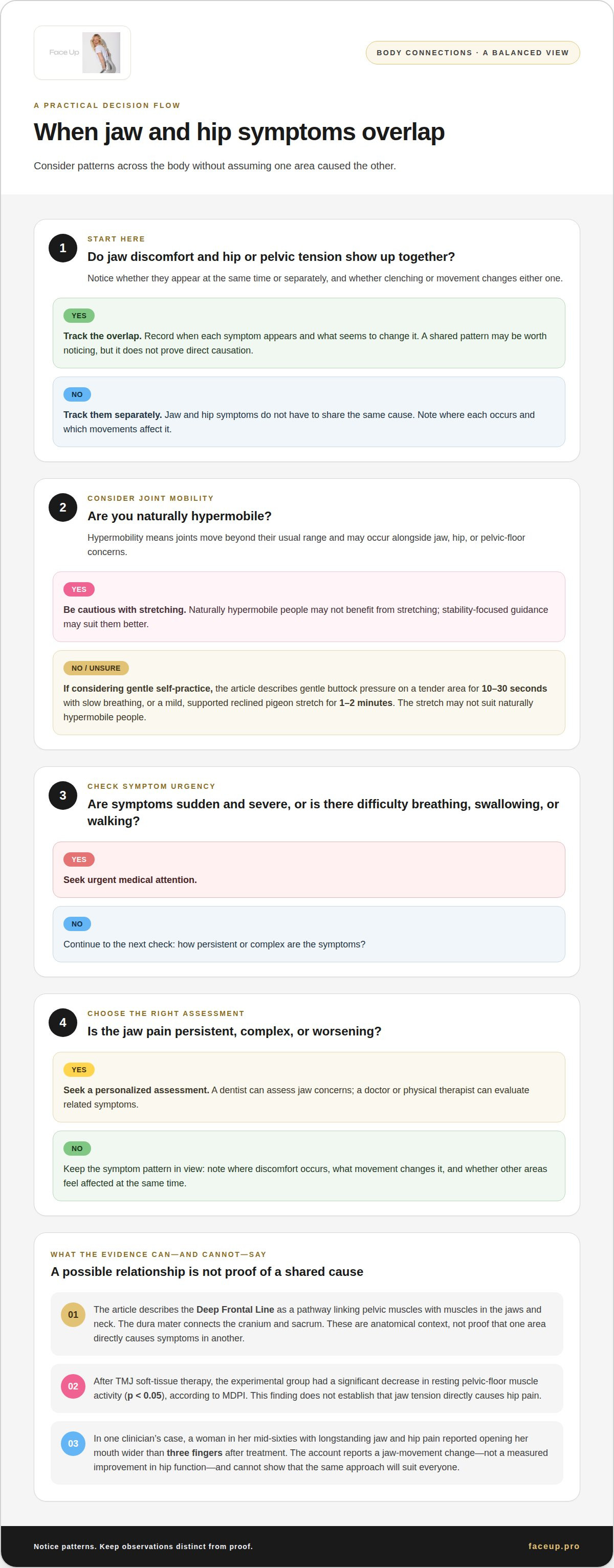
Hypermobility means joints move beyond their usual range, and it may occur alongside jaw, hip, or pelvic-floor concerns. One person with hypermobility reported TMJ, hip and piriformis, and back issues. That example shows how symptoms can overlap, but it can’t establish a single cause for everyone. To track symptoms, note whether jaw discomfort and hip tension appear together or separately, and whether clenching or movement changes either one. Naturally hypermobile people may not benefit from stretching; stability-focused guidance may suit them better.
Posture and Jaw-Hip Muscle Connections
Posture describes how the head, spine, pelvis, and limbs are positioned during standing and movement. Jaw tension may coincide with changes in posture, while compensation may contribute to hip tightness, imbalance, or low-back discomfort. Gentle buttock pressure on a tender area for 10-30 seconds, with slow breathing, is one suggested option. A mild, supported reclined pigeon stretch for 1-2 minutes is another, but stretching may not suit naturally hypermobile people.
After TMJ soft-tissue therapy, the experimental group had a significant decrease in resting pelvic-floor muscle activity (p < 0.05), according to MDPI. Persistent, complex, or worsening jaw pain calls for personalised assessment; a dentist can assess jaw concerns, while a doctor or physical therapist can evaluate related symptoms. Seek urgent medical attention for sudden severe symptoms or difficulty breathing, swallowing, or walking.
A clinician’s case example involving jaw and hip pain
A clinician described treating a woman in her mid-sixties with longstanding jaw and hip pain. Her case helps show how symptoms in separate regions can be considered together during bodywork. It does not establish that jaw tension caused her hip pain, or that the same approach will suit everyone.
After treatment, she said she could open her mouth wider than three fingers for the first time. That specific change concerned jaw movement, while her longstanding hip pain formed part of the wider clinical picture. The account doesn’t report a measured change in hip function, so the jaw-opening observation shouldn’t be treated as evidence that her hip symptoms resolved.
The case is useful for understanding what a clinician may observe: a person’s history, symptoms, and movement can provide context beyond one painful area. A reported improvement in mouth opening is a specific outcome, but it doesn’t identify which tissues or mechanisms produced that change. Nor does one case demonstrate that releasing jaw muscles reliably affects the hips.
A different person who started an online discussion described right-sided jaw and hip pain, an ankle that sometimes gave way, and walking off balance to the left. These details are not part of the clinician’s mid-sixties case. They illustrate another presentation, where symptoms in the jaw, hip, ankle, and gait appeared together and could warrant assessment as a whole.
The practical lesson is to describe each symptom clearly: where it occurs, what movement changes it, and whether other areas feel affected at the same time. The two accounts show why clinicians may consider jaw and hip symptoms together, while keeping observation distinct from proof of a shared cause. A case example can prompt useful questions, but it can’t diagnose someone else or replace an individual assessment.
What is the connection between the hips, pelvis, posture, and jaw muscles?
The relationship is often described through posture and compensation, rather than a single muscle directly joining the jaw to the hip. If jaw tension changes how someone holds their head, the neck and trunk may adjust too. The pelvis and hips help support the body during standing and walking. A shift in one area can therefore coincide with changes elsewhere, including hip tightness or low-back discomfort. This pattern doesn’t prove jaw tension caused those symptoms.
Head position also contributes to how the body senses movement. One reported figure states that 40% of proprioception comes from how the head sits on the neck. Proprioception is the body’s sense of position and movement. For example, rounded shoulders or a habit of bracing the jaw to support the head may alter posture and affect the temporomandibular joint. These details can help explain why jaw symptoms and postural changes may appear together.
Pelvic position may also influence movement through the spine. A rotated pelvis can affect spinal alignment, while ankle or pelvic alignment issues may change walking mechanics. If someone walks unevenly, the trunk and head may adapt to maintain balance. Those adjustments may coincide with jaw discomfort, but the sequence alone can’t identify the original cause. Considering walking, pelvic position, and jaw movement together gives a broader picture than focusing on one region alone.
Stress offers another possible link: people may clench their jaws while also tightening abdominal or pelvic-floor muscles and buttocks. These simultaneous responses can make the jaw, pelvis, and hips feel tense at once. Notice whether symptoms change with jaw clenching, prolonged sitting, or walking; these examples can help describe the pattern during an assessment. The useful distinction is between symptoms that repeatedly shift together and those that remain independent. Neither pattern alone confirms a diagnosis, but both give clinicians practical context.
What research supports a relationship between hip and jaw tension?
Research has explored whether jaw activity and treatment coincide with changes in hip movement. The connection between hip and jaw tension remains an area of ongoing inquiry: findings suggest possible relationships, but they don’t establish that jaw tension causes hip problems or that jaw treatment resolves hip symptoms.
A 2009 study reported that voluntarily clenching the jaw reduced hip-joint mobility in every study subject. This observation points to a possible short-term interaction between jaw activity and hip movement. It doesn’t show that everyday clenching causes lasting restriction, or establish whether the same effect occurs outside the study setting.
Another 2009 study examined treatment rather than clenching. Myofascial release of the temporomandibular joint significantly increased hip-joint range of motion. The result suggests hip movement changed after hands-on work around the jaw. It doesn’t show that the jaw caused hip symptoms, explain the mechanism, or demonstrate how long the change lasted.
A 2006 study reported a correlation between jaw angle, pelvic alignment, and lower-back curvature. Correlation means the features were associated in that study, not that one caused another. Taken together, the studies examine distinct questions: whether clenching accompanies a mobility change, whether jaw treatment precedes a range-of-motion change, and whether jaw and pelvic positioning are associated.
For anyone exploring the connection between hip and jaw tension, these findings are context rather than a personal diagnosis. An assessment can consider the affected movements, symptom locations, posture, and medical history together. No single finding establishes why an individual has pain. If you want to explore jaw-focused self-practice alongside appropriate care, consider jaw tension release practices as a learning resource.
Face Up
Face Up offers ways to explore jaw tension through education, self-practice, and facial bodywork. For structured learning, the Jaw Release Course focuses on releasing jaw tension; the Face Up App Subscription supports daily self-practice rituals. Face Up Sculpting Treatment is another option for people interested in hands-on facial work. These offerings focus on the face and jaw, rather than diagnosing the cause of hip symptoms.
If jaw discomfort is persistent, worsening, or affecting daily movement, seek appropriate clinical assessment alongside any self-practice. Face Up’s resources may complement that process by helping you build awareness of facial and neck tension. Choose a format based on whether you want to learn, practise regularly, or explore a treatment. Contact Face Up to discuss which approach suits your interests.
Choose a thoughtful next step
Understanding the connection between hip and jaw tension can help you describe your symptoms more clearly, but it can’t identify their cause on its own. If discomfort persists or affects your movement, consider appropriate clinical assessment. Alongside that care, gentle attention to your jaw may help you notice when you clench or hold tension.
For continued learning, Face Up’s Jaw Release Course and Face Up App Subscription offer ways to explore jaw-focused practice. Practitioners interested in developing this work can consider Face Up Method Certification. Each option serves a different purpose, from personal learning to professional training, so choose according to your needs.
If you’d like to discuss which Face Up option aligns with your interest, contact Face Up. Take the next step at a pace that feels right, with curiosity and care.
Frequently Asked Questions
How Is The Jaw Connected To The Pelvis?
The jaw and pelvis may be linked through coordinated muscle and connective-tissue relationships, rather than one direct muscle connection. The body adjusts across regions to support posture and movement, so tension around the jaw can occur alongside pelvic or hip tightness. These anatomical and movement relationships help explain possible overlap, but they don’t show that everyone’s jaw and pelvic symptoms share the same cause.
Can hip tension cause jaw tension or pain?
Hip tension may coincide with jaw tension, but the available information doesn’t establish that tight hips directly cause jaw pain. Shared stress responses, altered movement, or postural compensation may contribute to symptoms in more than one area. For example, notice whether jaw discomfort changes during walking or alongside hip tightness. That pattern can provide useful context, but it can’t determine the cause by itself.
Can TMJ disorders affect hip pain or muscle tension?
TMJ-related symptoms may occur alongside hip tension, and jaw activity may relate to changes in hip movement. That doesn’t mean a TMJ disorder causes someone’s hip pain. Consider whether jaw discomfort, hip symptoms, or walking changes began together, and describe how each responds to movement. This can help distinguish simultaneous symptoms from a consistent pattern that deserves assessment.
What other conditions can cause both hip and jaw tension?
Hypermobility and stress-related muscle bracing are two factors that may accompany tension in both regions. Someone with hypermobility may report jaw, hip, and back concerns, while stress can prompt jaw clenching and tightening elsewhere. These examples don’t establish a diagnosis or explain every case. Symptoms that persist, worsen, or affect movement deserve a fuller clinical assessment of the person’s overall presentation.
What treatments are commonly used for coexisting hip pain and TMJ symptoms?
Care may address the jaw and hip separately or together, depending on the symptoms and assessment. Approaches described for these concerns include dental mouthguards to help avoid clenching, physical therapy exercises that combine stretching and strengthening, and balance or gait work. Massage and bodywork may also address jaw tension and compensatory tension elsewhere. A suitable plan depends on which movements and areas are affected.


