

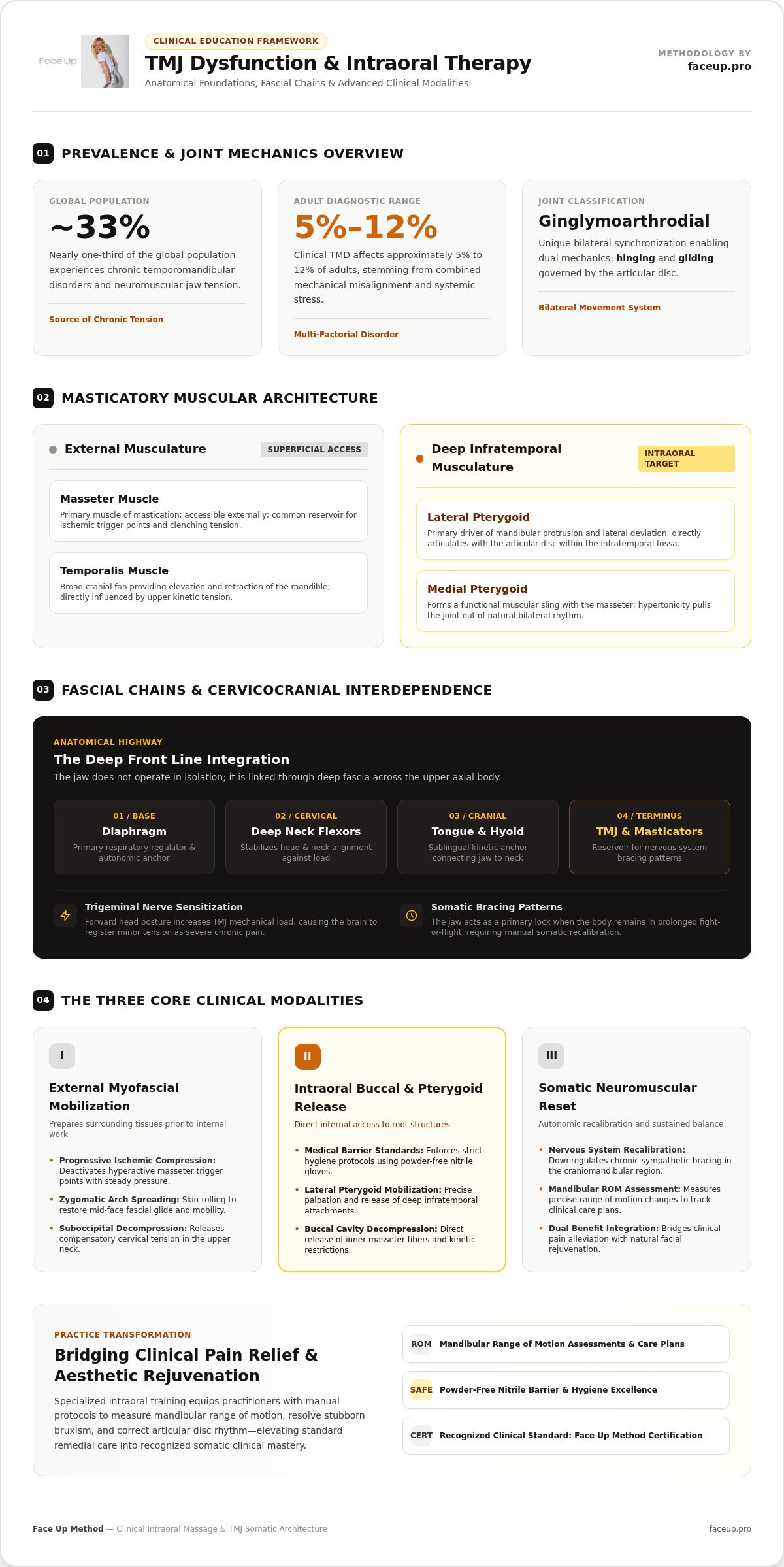
Nearly a third of the global population suffers from temporomandibular disorders, yet many practitioners feel ill-equipped to address the true source of this chronic tension. If you've ever felt a wave of hesitation when working near a client's jaw or struggled to resolve stubborn bruxism with external techniques alone, you're not alone. Specialized intraoral massage training bridges the gap between standard remedial work and clinical excellence. It transforms your practice. By moving beyond the surface, you provide the targeted, high-value somatic relief your clients desperately need.
It's natural to feel uncertain about hygiene standards or the delicate anatomy of the pterygoid muscles. You want to provide deep relief without compromising safety or overstepping your professional scope. This guide promises to help you master advanced manual protocols and somatic methods that resolve complex jaw dysfunction. We'll explore how to build confidence in your assessments, attain recognized credentials like the Face Up Method Certification, and integrate precise intraoral protocols into your existing professional practice.
Key Takeaways
- Gain a deeper understanding of TMJ dysfunction by exploring the biomechanics of the articular disc. You'll learn how it impacts mandibular movement.
- Discover how comprehensive intraoral massage training integrates external myofascial release with precise internal protocols. It's the key to addressing root muscular tension.
- Learn to evaluate professional education pathways by prioritizing curriculum depth and safety standards. Don't settle for purely transactional certification models.
- Master targeted assessment techniques, including mandibular range of motion measurements. These help you develop clinical care plans that ensure sustained neuromuscular changes.
- Position your specialized skills as a bridge between clinical pain relief and natural facial rejuvenation. It's the best way to attract high-value clients seeking non-invasive solutions.
Understanding TMJ Dysfunction: Anatomical Foundations for Practitioners
Effective clinical intervention begins with a precise understanding of the structures we intend to influence. Temporomandibular joint dysfunction (TMD) isn't a single condition but a multi-factorial disorder that affects approximately 5% to 12% of the adult population. It involves the joint itself, the masticatory muscles, and the complex neural pathways that govern them. For those pursuing professional intraoral massage training, recognizing that TMD often stems from a combination of mechanical misalignment and systemic stress is vital for successful outcomes.
The masticatory network is a powerhouse of functional movement. While the masseter and temporalis are easily accessible externally, the medial and lateral pterygoids reside deep within the infratemporal fossa. These muscles are the primary drivers of protrusion and lateral deviation. When they become hypertonic, they don't just cause local pain; they disrupt the entire kinetic chain of the skull. This muscular imbalance is frequently a somatic response. The jaw is a primary reservoir for nervous system tension, often locking in a "bracing" pattern when the body remains in a chronic state of fight-or-flight.
The Functional Anatomy of the Temporomandibular Joint
The TMJ is unique because it's classified as a ginglymoarthrodial joint, meaning it allows for both hinging and gliding movements. Its health relies on the bilateral synchronization of the left and right sides. At the heart of this movement is the articular disc, a dense fibrous structure that should glide effortlessly with the mandibular condyle. Common pathologies arise when this disc becomes displaced, often resulting in the clicking or popping sounds clients report. Advanced intraoral massage training teaches practitioners how to palpate these subtle shifts and address the muscular hypertonicity that pulls the joint out of its natural rhythm.
Fascial Chains and Cervicocranial Interdependence
We cannot treat the jaw in isolation. It's deeply integrated into the body's fascial architecture, specifically the Deep Front Line. This chain connects the jaw to the tongue, the deep neck flexors, and even the diaphragm. When a client presents with forward head posture, the mechanical load on the TMJ ligaments increases significantly. This postural strain often leads to chronic trigeminal nerve sensitization, where the brain begins to interpret even minor tension as severe pain. By addressing these cervicocranial connections through somatic facial therapy, we help recalibrate the nervous system and provide lasting relief that standard massage cannot achieve.
Core Clinical Modalities Taught in Advanced Intraoral Massage Training
Comprehensive intraoral massage training moves beyond basic relaxation by integrating three distinct pillars: external manipulation, precise intraoral access, and somatic resetting. This multi-layered approach ensures that practitioners don't just treat the surface symptoms of jaw pain but address the underlying structural and neurological causes. Somatic jaw release is the recalibration of the nervous system through manual facial work. By mastering these modalities, you provide a level of care that bridges the gap between clinical pain management and aesthetic rejuvenation.
External Myofascial Mobilization and Trigger Point Therapy
Before entering the oral cavity, we must prepare the surrounding tissues to accept deeper work. We use progressive ischemic compression to deactivate hyperactive masseter trigger points; this involves applying sustained, steady pressure until the tissue softens. Practitioners also perform skin-rolling and fascial spreading across the zygomatic arch to improve mobility in the mid-face. To complete the external protocol, we integrate suboccipital decompression. This relieves the compensatory tension that often builds in the upper neck when the jaw is chronically tight, ensuring a holistic release.
Intraoral Buccal Techniques and Pterygoid Release
Direct access to the internal musculature is the hallmark of advanced clinical work. Establishing strict hygiene standards is the first step, including medical-grade barrier protocols like using powder-free nitrile gloves. Once safety is ensured, we focus on locating and mobilizing the lateral pterygoid plate. This deep work is essential for the effective diagnosis and treatment of TMJ disorders. We also apply cross-fiber friction along the internal tendon of the temporalis to release restrictions that are unreachable from the outside, providing immediate relief for chronic clenchers.
Somatic Resetting and Nervous System Down-Regulation
The final pillar focuses on the mind-body connection to ensure results last. We incorporate diaphragmatic breathwork to shift the client's neurology into a state of parasympathetic dominance. This shift is where true neuromuscular recalibration occurs. By teaching gentle somatic pandiculation, we help clients restore proprioceptive awareness of their jaw position, preventing the return of "clamping" patterns. Professionals looking to refine these skills can explore a comprehensive somatic facial therapy course to master these proprietary nuances. If you're ready to elevate your clinical outcomes, consider joining our global practitioner network to access advanced training resources.
Evaluating Intraoral Massage Courses: Key Criteria for Professionals
Choosing the right education is a pivotal step in your career. It's not merely a transaction; it's an entry into a specialized professional community. A reputable intraoral massage training program should offer more than just basic theory. It must provide a structured pathway that ensures safety, clinical efficacy, and long-term professional support. As you evaluate your options, look for a curriculum that balances technical precision with a deep respect for the client's physiological and emotional boundaries. Safety is paramount.
Curriculum Depth and Clinical Safety Standards
The quality of visual instruction is non-negotiable when dealing with delicate internal structures. Prioritize programs that utilize high-definition anatomical footage and multi-angle demonstrations. You need to see exactly where the fingers land in relation to the lateral pterygoid and the internal tendon of the temporalis. Safety instructions must be explicit. A high-standard course will detail precautions for the carotid artery and provide clear protocols for working with trigeminal neuralgia. Clinical safety also involves understanding when not to treat. Ensure the modules cover contraindications such as:
- Acute temporomandibular joint inflammation
- Recent dental implants or major oral surgery
- Active infections or oral lesions
- Unstable orthodontic appliances
Beyond the physical, the training should address the legalities of informed consent and the specific intraoral scope of practice within your jurisdiction. This professional transparency protects both you and your clients.
Format Comparison: Online Learning vs. Hands-On Apprenticeship
The choice between digital and in-person models often depends on your current experience level and geographic location. Digital course libraries offer unparalleled scheduling flexibility. They allow you to replay complex maneuvers until the mechanics feel second nature. However, high-quality online intraoral massage training shouldn't be passive. Look for programs that require practical video assessments for certification. This ensures a mentor reviews your technique and provides necessary corrections.
Many advanced practitioners eventually seek master-level in-person immersions to refine their touch. These hybrid models combine the best of both worlds: the convenience of digital theory and the nuanced feedback of a hands-on apprenticeship. Consider the ecosystem you're joining. Post-training support, such as clinical case reviews and inclusion in a practitioner directory listing, is essential for building a high-value practice. Attaining recognized credentials like the Face Up Method Certification signals to clients that you're part of a verified, global network of experts.
Client Assessment and Developing Targeted Clinical Care Plans
A clinical care plan is only as strong as the initial assessment. While previous sections focused on the technical modalities of manual work, this phase centers on the diagnostic "why" and "where." Professional intraoral massage training teaches you to observe the subtle mechanical cues that generic massage often misses. We start by conducting a thorough intake to capture dental history, such as recent orthodontic work or tooth extractions, alongside chronic clenching habits. This qualitative data provides the necessary context for the physical measurements that follow, allowing you to build a roadmap for long-term somatic recovery.
Effective treatment isn't just about releasing tension; it's about restoring functional symmetry. By following a systematic five-step assessment process, you ensure that every manual intervention is purposeful. This structured approach builds client trust and allows you to document objective progress over time. It's the difference between a temporary "feel-good" session and a transformative clinical outcome that addresses the root of bruxism and joint dysfunction.
Objective Intake and Range of Motion Testing
We use the three-finger vertical opening test to establish a functional mobility baseline. If a client cannot comfortably stack three fingers between their incisors, it's a clear indicator of restricted range of motion (ROM). We also record visual trajectories to detect S-curve or C-curve mandibular deviation during opening and closing. These patterns reveal which side of the joint is lagging or hypermobile. During this stage, we screen for red flag symptoms, such as sudden hearing loss or an inability to close the mouth, which necessitate immediate referral to maxillofacial specialists.
Palpation Protocols and Pain Mapping
Physical palpation allows us to differentiate joint capsule tenderness from active myofascial trigger points. We palpate external masticatory muscles for hypertonicity and joint crepitus, that distinct grating sensation during movement. We then execute a bilateral intraoral assessment to identify asymmetrical tension in the deep pterygoid bellies. This process helps us map referred tension patterns that often present as temporal headaches or ear fullness. We document these discrepancies using gentle, non-reactive intraoral pressure to avoid triggering further protective guarding by the nervous system.
Prescribing Somatic Home-Care and Jaw Exercises
Lasting relief requires the client's active participation between clinical sessions. We structure a multi-session protocol paired with somatic home-care. We teach clients daily jaw decompressing habits to prevent nocturnal clenching relapse. This includes guiding appropriate selection when recommending a tmj massage tool for self-care. These tools support the foundational concepts of tmj massage therapy by maintaining tissue suppleness. To refine your assessment skills and build a high-impact practice, enroll in the Jaw Release Course today.
Integrating Intraoral Specialisation into Your Professional Practice
Integrating specialized skills into a thriving business requires more than technical proficiency. It demands a strategic shift in how you communicate your value to the market. By completing advanced intraoral massage training, you aren't just adding a technique; you're positioning yourself as a facilitator of both clinical relief and natural aesthetic refinement. This dual-purpose service appeals to a sophisticated demographic that values holistic, non-invasive interventions. It is a business asset. With the global TMJ disorders market projected to reach approximately 2.56 billion USD by 2034, the demand for verified specialists is growing rapidly.
Success in this niche relies on building a robust ecosystem around your practice. This involves establishing professional referral networks with biological dentists and sleep clinics who see the 10 million Americans affected by TMJ disorders daily. By positioning your work as a necessary adjunct to their clinical care, you secure a steady stream of high-value clients. You can also incorporate holistic sculpting rituals into your existing facial and bodywork menus to increase the lifetime value of each client relationship.
Service Positioning: Clinical Relief Meets Facial Sculpting
You must communicate how releasing masticatory tension naturally contours the lower face. Chronic clenching often leads to a widened, "heavy" jawline due to masseter hypertrophy. Your work offers a non-surgical, holistic alternative to masseter neurotoxin injections, which many clients now seek to avoid. Target high-stress demographic groups like executive professionals and tech workers who carry the weight of their deadlines in their jaws. Frame your sessions as a proprietary environment where somatic facial therapy meets high-end rejuvenation.
Structuring Multi-Session Clinical Packages
Move away from one-off appointments by designing progressive six-week protocols. These programs should target acute release in the initial weeks, followed by sessions focused on structural stability and neuromuscular recalibration. To ensure sustained results, combine your hands-on clinic visits with digital rituals via the Face Up App Subscription. This maintains client accountability between sessions. Practitioners who complete the Face Up Method Certification gain access to a dedicated Practitioner Directory Listing. This listing serves as a linguistic and professional anchor, connecting you with an international community of clients who prioritize order, reliability, and verified expertise in their wellness journey. Investing in intraoral massage training is the first step toward becoming a global-minded facilitator in this specialized field.
Elevate Your Professional Practice Through Somatic Excellence
Mastering the intricacies of the jaw is about more than physical manipulation; it's a commitment to understanding the profound connection between the nervous system and chronic muscular tension. By integrating advanced intraoral massage training into your clinical toolkit, you transition from a generalist to a specialist capable of addressing the root causes of temporomandibular dysfunction. You've learned that a structured assessment, paired with precise internal protocols, creates a proprietary environment where clients find both clinical relief and aesthetic rejuvenation.
The transition into this specialized field requires a shift in how you navigate professional requirements and client care. By attaining recognized credentials, you enter a proprietary ecosystem designed for global readiness and clinical success. Master clinical jaw release and holistic aesthetics through the Face Up Method Certification. This program features a proprietary somatic facial sculpting method founded by Olga Newman and a comprehensive curriculum integrating external and intraoral protocols. You'll also join an exclusive international practitioner directory for certified specialists. Your path toward professional mastery is clear, and the results for your clients will be truly transformative.
Frequently Asked Questions
What qualifications or licenses are required to take intraoral massage training?
Practitioners generally need a foundational license in massage therapy or a related bodywork field to pursue specialized intraoral massage training. In jurisdictions like Washington, licensed massage therapists must complete a 16-hour direct supervised course to obtain a specific intraoral endorsement. Requirements vary significantly by state and country. You should always verify your local board's regulations regarding internal cavity work before enrolling in a professional certification program to ensure compliance.
Is intraoral massage legal for licensed massage therapists and estheticians?
Legality depends on your specific license and local jurisdiction's scope of practice. Licensed massage therapists in many regions can perform intraoral work if they have documented training. For estheticians, the focus is often on buccal massage for aesthetic facial sculpting rather than clinical TMJ treatment. Oregon requires written consent and a therapeutic rationale for internal cavity massage. Always check with your state board to confirm if these protocols fall within your professional boundaries.
How does somatic TMJ therapy differ from standard deep tissue jaw massage?
Standard deep tissue jaw massage focuses primarily on the mechanical deactivation of trigger points in the masseter and temporalis. Somatic TMJ therapy, like the Face Up Method, prioritizes nervous system recalibration and the release of emotional bracing patterns. It's a holistic approach that treats the jaw as a reservoir for stress. By integrating diaphragmatic breathwork and proprioceptive awareness, somatic work ensures that the neuromuscular reset lasts longer than purely mechanical pressure.
Can intraoral massage training be completed effectively through an online course?
High-quality intraoral massage training can be exceptionally effective online when it includes high-definition, multi-angle anatomical footage. Programs like the Face Up Method Certification ensure mastery through rigorous digital assessments where practitioners submit video evidence of their technique. This format allows you to replay complex maneuvers until the mechanics are perfect. While hybrid models offer hands-on mentoring, a structured digital curriculum provides the foundational precision needed for safe clinical practice.
How quickly can practitioners integrate these techniques into their service menu?
Practitioners can typically begin integrating basic external protocols immediately after starting a specialized course. Full integration of intraoral techniques usually follows the completion of a certification and a successful practical assessment. For most professionals, this takes four to eight weeks of consistent study and practice. Once you're certified, you can leverage a Practitioner Directory Listing to immediately signal your new expertise to high-value clients seeking specialized jaw relief.
What are the primary contraindications for performing clinical intraoral massage?
Clinical intraoral massage is highly effective but must be avoided in certain scenarios to ensure client safety. Primary contraindications include acute joint inflammation, recent dental implants, and active oral infections or lesions. You should also avoid deep work if a client has unstable orthodontic appliances or has recently undergone major oral surgery. Conducting a thorough intake is essential to screen for these red flags and determine if a medical referral is necessary.
How does manual TMJ release compare to masseter Botox for long-term relief?
Manual TMJ release addresses the root cause of tension by recalibrating the nervous system and restoring muscular balance. Unlike neurotoxin injections, which temporarily paralyze the muscle and can lead to long-term bone density loss or muscle atrophy, manual therapy is entirely non-invasive. It empowers clients with somatic home-care tools to prevent future clenching. While Botox masks symptoms for a few months, specialized massage provides a sustainable, holistic path to neuromuscular health without injectables.
Will I need specialized equipment to perform intraoral massage in my clinic?
You don't need expensive machinery to perform intraoral massage, but strict hygiene protocols are mandatory. The primary requirements are medical-grade, powder-free nitrile gloves or finger cots to ensure a safe barrier. Some practitioners choose to recommend a specialized tool for client self-care between sessions to maintain results. Most of the work relies on the precision of your hands and a deep understanding of the internal anatomy, which you'll master through professional certification.


