

What if releasing emotional tension from the body isn’t about making a big feeling happen, but about noticing what’s there and responding gently? Stress can feel physical: perhaps your jaw tightens, your shoulders brace, or your breathing seems shallow. It’s understandable to wonder what those sensations mean, especially when online advice promises a dramatic release.
Stress and physical sensations can be connected, but a sensation alone doesn’t reveal its cause or amount to a diagnosis. This guide offers a grounded way to explore that connection without treating your body as something that needs to be forced into letting go. You’ll find gentle ways to notice tension, stay within your comfort, and pause or adapt a practice if it doesn’t feel right.
We’ll also look at when self-practice may be enough and when qualified health support is a better next step. For face-and-neck awareness, Face Up’s guided rituals and somatic practices offer a way to explore at your own pace. The aim isn’t to chase a release; it’s to build awareness and a sense of safety, one small step at a time.
Key Takeaways
- Physical sensations can accompany stress or emotion, but they can have many causes and don’t diagnose what’s happening.
- Explore releasing emotional tension from the body through gentle, adaptable practices rather than trying to force a dramatic emotional response.
- Compare movement, paced breathing, sensory grounding, and professional support to find an approach that feels suitable, and know when to pause.
- Try a simple sequence: orient to your surroundings, notice a sensation, choose a comfortable anchor, then check in with yourself again.
- For face-and-neck awareness, Face Up’s guided rituals offer a focused way to build repeatable self-practice at your own pace.
What Does Releasing Emotional Tension from the Body Actually Mean?
Stress can feel physical. You might notice your jaw pressing together during a difficult conversation, your breath becoming shallow before a deadline, or your body staying restless after the pressure has passed. Those sensations are real, but they can have many possible causes, including everyday circumstances and physical health factors. A feeling in the body alone can’t confirm what caused it.
In this guide, releasing emotional tension from the body means noticing bodily sensations that seem to accompany stress or emotion, then responding with care. That response might be as simple as recognizing that you’re bracing and choosing to shift position or look around the room. It’s a personal way to describe an experience, not a medical diagnosis or proof that an emotion has a specific physical location.
What people mean by emotional tension in the body
People use “emotional tension” to describe experiences such as tightness, shallow breathing, restlessness, or feeling on edge. These patterns differ from person to person and can change with the situation. Work pressure might come with a clenched jaw for one person, while another notices fidgeting or difficulty settling. Naming a sensation can help you pay attention, but it doesn’t establish its cause.
What a gentle release can, and cannot, promise
Stress involves responses across the body, though people’s experiences differ. A broad overview of these biological processes appears in Stress (biology). The word “release” is best understood as a practical metaphor for noticing a sensation and making room for a considered response. It doesn’t mean emotions are literally stored in muscles or tissues, or that one technique can identify or remove them.
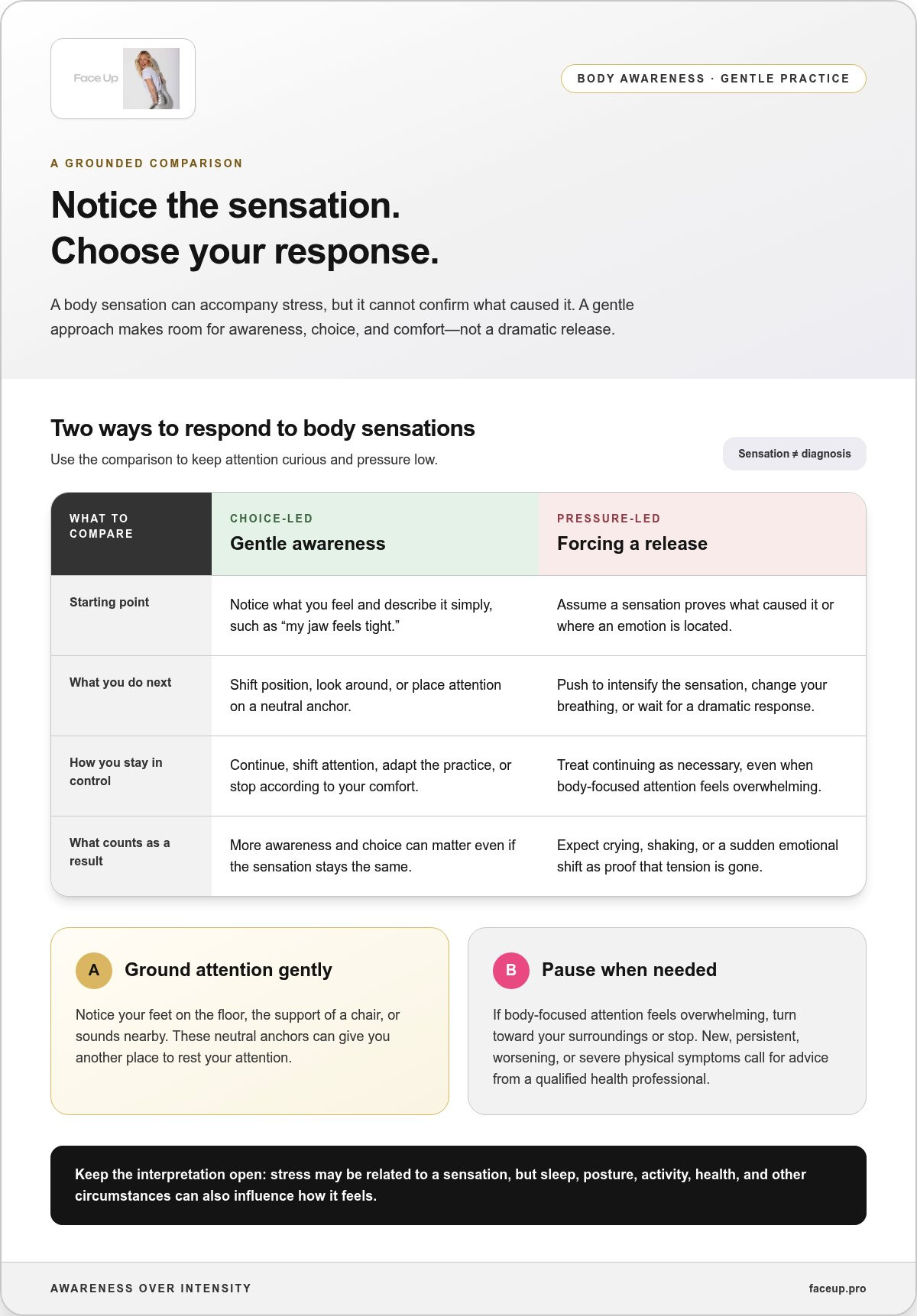
A gentle approach aims for more awareness and choice, not a particular emotional display. You might notice your feet on the floor, adjust your posture, or decide not to continue an exercise. Those small choices can be meaningful even if the sensation stays the same. Feeling steadier can be one useful outcome, but there’s no single required result.
Crying, shaking, or experiencing a sudden emotional shift isn’t necessary, and none of these responses proves that tension has been released. You don’t need to push for intensity or interpret every bodily change as a breakthrough. The practical options ahead can be tried, adapted, or stopped, with your comfort and sense of choice guiding the process.
How Stress, Body Awareness, and Emotional Tension Interact
Stress is the body’s response to demands or perceived challenges. It can shift attention toward what feels urgent and prepare the body to respond. Some people notice quicker, shallower breathing, heightened alertness, or muscles that seem ready for action; others notice little physically. The American Psychological Association’s overview of Stress effects on the body describes how stress can affect different body systems, including muscles. These patterns make a stress connection plausible, but they can’t prove that stress caused a particular symptom.
Body awareness includes interoception, the sense of the body’s internal condition. Neuroscientist A. D. Craig describes interoception as the sense of the physiological condition of the body in his review, “How do you feel? Interoception: the sense of the physiological condition of the body”. In everyday terms, it means noticing signals such as warmth, tension, a heartbeat, or a change in breathing. It can help you describe what you feel, but it can’t diagnose why you feel it.
Why stress can change what you notice in your body
Attention shapes what comes into focus. During a demanding meeting, you may suddenly notice that your jaw is clenched or your shoulders are lifted. The pressure of the moment could be related, but noticing the sensation doesn’t establish its cause. Sleep, posture, activity, health, and other circumstances can also influence how a sensation feels.
Breathing and muscle readiness may shift alongside attention, though not in the same way for everyone. If you notice yourself bracing, treat that as information rather than an instruction to fix anything. Observe where the sensation is, whether it changes as the situation changes, and what else is happening around you. A simple description such as “my jaw feels tight while I’m concentrating” is more grounded than assuming you know exactly what the sensation means.
Why body awareness is not the same as forcing a release
Observing a sensation can be enough. You might quietly name it, then place your attention on something neutral, such as the support of the chair or the sounds nearby. This leaves you with options: continue noticing, shift attention, or stop. There’s no need to intensify a sensation, change your breathing, or wait for a dramatic response. Awareness may help you make a more considered choice, but it doesn’t promise a clinical outcome.
As you explore releasing emotional tension from the body, let comfort and choice guide the practice. If body-focused attention feels overwhelming, turn toward your surroundings or pause altogether. New, persistent, worsening, or severe physical symptoms deserve appropriate advice from a qualified health professional rather than an assumption that stress explains them.
For a guided, face-and-neck-focused way to explore body awareness, Face Up’s guided rituals offer a repeatable self-practice option.
Which Ways of Releasing Emotional Tension Help, and Which Can Backfire?
There isn’t one method that suits everyone, and intensity isn’t a scorecard. Crying, shaking, or feeling a sudden shift doesn’t prove a practice has worked; a quiet moment of noticing may be enough. The World Health Organization’s overview of stress and its effects also emphasizes that people respond to stress differently. Treat self-practices as invitations, not prescriptions, and choose based on comfort and preference.
| Approach | What it involves | When it may suit | When to pause |
|---|---|---|---|
| Gentle movement | Easy walking, stretching, or slowly changing position. | If sitting still feels uncomfortable and movement feels manageable. | If movement brings pain, unsteadiness, or rising distress. |
| Paced breathing | Allowing the breath to slow or lengthen slightly, without strain. | If attention to breathing feels comfortable and steadying. | If it causes dizziness, air hunger, panic, or discomfort. Return to natural breathing. |
| Sensory grounding | Noticing a neutral detail, such as a color in the room or feet supported by the floor. | If focusing inward feels too intense or you want to reconnect with your surroundings. | If the exercise increases distress. Open your eyes and orient to the room instead. |
| Professional support | Discussing persistent concerns with an appropriately qualified health professional. | If symptoms or distress are ongoing, hard to manage, or affecting daily life. | Don’t rely on self-practice in place of appropriate health advice. |
Gentle self-practices and what each can offer
Movement offers a simple way to change position and notice how your body feels in motion. Grounding directs attention toward the immediate environment instead of asking you to examine a difficult sensation. Breathing practices are different: even gentle breath focus can feel uncomfortable for some people. You can skip it. There’s no need to use every approach or push through discomfort to make progress.
When releasing emotional tension from the body, use your ability to choose, adapt, or stop as a guide. A small, comfortable adjustment can be more appropriate than a dramatic response. If you prefer guided, repeatable rituals focused on face-and-neck awareness, Face Up’s guided practices offer one option to explore at your own pace.
When an approach feels too intense
Pause if distress rises, you feel dizzy, or you begin to feel disconnected or overwhelmed. Open your eyes, look around, name a few ordinary things you can see, and stop the exercise. You don’t need to finish a sequence. If distress continues or feels severe, seek support from an appropriately qualified professional; new or concerning physical symptoms also warrant health advice.
A Gentle, Step-by-Step Practice for Releasing Emotional Tension
This brief check-in is an invitation, not a test. You can skip any step, keep your eyes open, or stop whenever you want. There’s no need to search for a memory, change your breathing, or make a sensation disappear. The aim is simply to notice what feels manageable and choose what to do next.
A four-step body check-in
- Orient to the room. Let your gaze move around and notice a few ordinary details, such as a window, a chair, or the color of a wall. Feel free to stay seated or stand. If looking inward doesn’t feel comfortable, remain with what you can see and hear.
- Choose a neutral anchor. Notice one everyday point of contact, such as your feet resting on the floor or your back supported by a chair. You don’t need to feel relaxed. Simply observe the contact, or choose an external detail instead.
- Notice one sensation briefly. If it feels okay, name a sensation in simple terms, such as “warm,” “tight,” or “faint.” There’s no need to explain it, intensify it, or connect it to a memory. If attention turns uncomfortable, return to your anchor or stop here.
- Re-check and return. Ask yourself what feels comfortable now. You might notice the same sensation, something different, or no clear change. Then shift to an ordinary activity, such as taking a drink of water or continuing with your day. Any of these outcomes is fine.
Adapting the practice to your comfort
Make the check-in shorter if that feels better. You might only look around and notice the chair supporting you. You can leave your eyes open throughout, skip the sensation step, or end the practice without completing the sequence. If you feel overwhelmed or disconnected, stop and orient to your surroundings rather than trying harder.
If your jaw or face is where you tend to notice tension, keep the check-in light: notice whether your jaw feels at rest or engaged, without pressing, stretching, or trying to change it. For more focused context, see this TMJ massage therapy guide. A somatic guide to TMJ massage tools is a related, jaw-specific topic, not a requirement for this broader check-in.
Use this practice to explore releasing emotional tension from the body, not as a promise of relief or a substitute for appropriate health support. If guided, repeatable rituals would help you explore face-and-neck awareness at your own pace, explore Face Up’s guided practices.
Ongoing Support for Releasing Emotional Tension: A Face Up Approach
Ongoing practice doesn’t need to be intense to feel worthwhile. For some people, returning to a brief, comfortable ritual helps make body awareness part of an ordinary routine. Face Up focuses on awareness of the face and neck through somatic bodywork and facial sculpting. This offers a way to explore those areas, but it isn’t a whole-body solution or a universal treatment for emotional tension.
Where Face Up fits within a wider body-awareness practice
The face and jaw can be useful places to notice everyday patterns, such as whether you’re clenching while concentrating or holding tension in your neck. Face Up’s approach brings attention to these areas through facial sculpting and somatic bodywork. It offers one way to explore face-and-neck awareness, not a way to identify the cause of a sensation or promise a particular emotional or physical outcome.
That distinction matters. Releasing emotional tension from the body is a broad, personal process, and a face-focused ritual addresses only one area of awareness. It doesn’t replace appropriate health care, and it shouldn’t be expected to treat trauma or medical conditions. If you’re experiencing persistent or concerning symptoms, consider qualified health support alongside any self-practice.
Choosing a sustainable next step
Choose a pace that feels manageable. Rather than aiming for a dramatic shift, notice whether a practice feels comfortable enough to return to, and give yourself permission to pause or adapt it. Small, repeatable moments of attention may fit more naturally into daily life than an approach that asks you to push through discomfort. Your experience doesn’t need to match anyone else’s.
The Face Up App provides guided rituals and somatic practices for self-practice. The Jaw Release Course offers a more specific focus for people interested in guided jaw work. Both are options for exploring face-and-neck awareness, rather than comprehensive programs for every kind of bodily tension. Choose the format that feels appropriate, or decide that neither is right for you at this time.
For readers who prefer supported practice, Face Up also offers somatic bodywork sessions. These provide a practitioner-supported setting for engaging with the body, without guaranteeing a specific response or result. They’re distinct from clinical care and shouldn’t take the place of medical or mental health support when that’s needed.
A gentle next step is to choose one face-and-neck-focused practice, try it at a comfortable pace, and notice how it feels. Explore Face Up’s guided somatic practices as one option for continuing that exploration.
Choose a Gentle Next Step That Feels Right
Let your next step be small enough to feel manageable. You might pause to notice what your body is asking for, return to a familiar grounding practice, or make space for support if physical symptoms or emotional distress persist. Releasing emotional tension from the body doesn’t need to become another task to get right. A steady, respectful approach leaves room for curiosity without demanding a particular result.
If you’d like structure for exploring face-and-neck awareness, Face Up offers the Face Up App and Jaw Release Course, alongside somatic bodywork sessions and facial sculpting treatments. These are options for guided practice and body-focused support, not promises of a specific outcome or substitutes for appropriate health care.
Choose what suits your comfort and pace, and remember that stopping or seeking qualified support is also a valid choice. To explore a gentle starting point, explore Face Up’s guided somatic practices.
Frequently Asked Questions
Can emotional tension cause physical symptoms?
Stress and emotion can be associated with physical symptoms, but they aren’t the only possible explanation. You might notice a tense jaw before a presentation or a fluttery stomach during a difficult conversation. Releasing emotional tension from the body can help you observe these experiences, but it can’t confirm their cause. If a symptom is new, persistent, severe, or interferes with daily activities, seek advice from a qualified health professional.
Is it normal to feel emotional during a relaxation practice?
Emotions may come up during a quiet practice, though they don’t happen for everyone. If you feel tears, sadness, or unease, you can stop focusing inward and return attention to something ordinary, such as the light in the room or the feel of a chair. You don’t have to keep going or explain the feeling in the moment. Choose what helps you feel present and in control.
Can crying release emotional tension?
Crying can be one way emotion shows up, but it isn’t a required release or proof that an underlying issue has resolved. Some people feel different afterward; others don’t notice a clear change. If tears arise, decide whether to continue, pause, or reach out to someone supportive. You don’t need to encourage crying or interpret it as a sign that a practice has succeeded.
How long does it take to feel calmer after a body-awareness practice?
There’s no set timeline. You may feel a little more settled during a practice, notice no change, or feel more alert instead. Rather than waiting for a specific result, check whether you can comfortably return to what you were doing, such as reading a message or preparing a meal. If you don’t feel calmer, that doesn’t mean you’ve done it incorrectly. You can stop and choose another approach.
What should I do if a body scan makes me feel more anxious?
Stop the scan and shift attention outward. Open your eyes, name a few visible objects, and notice a familiar sound or the support beneath you. You can also stand or move to a place that feels more comfortable, if that’s safe for you. There’s no need to restart. If anxiety continues, becomes overwhelming, or is affecting your daily life, consider seeking support from a qualified health professional.
Can body-based practices replace therapy or medical care?
No. Gentle body-awareness practices may sit alongside appropriate care, but they don’t diagnose or treat medical conditions and aren’t a substitute for therapy or medical advice. If physical symptoms concern you, consult a qualified health professional. If emotional distress is persistent or disrupting daily life, a licensed mental health professional can help assess your needs and discuss suitable support. You can tell them which self-practices you’ve tried and how you responded.


