
The most transformative facial rejuvenation doesn't come from layers of topical serums; it happens deep within the fascia, musculature, and nervous system. If you are exploring how to become a holistic facialist, you have likely already noticed that conventional esthetics programs rarely teach these advanced somatic techniques. You want to offer meaningful, root-cause healing, but bridging the gap between basic skin science and high-demand neuromuscular sculpting can feel daunting.
You aren't alone in feeling overwhelmed by regional licensing boards, disparate training certifications, and the physical fear of practitioner hand fatigue. Modern clients actively seek natural alternatives to invasive procedures, creating unprecedented demand for specialists who understand the mind-body connection. In this guide, you'll discover the exact legal prerequisites, high-touch somatic modalities, and professional certification steps needed to build a sustainable, elevated career. We'll walk through the complete journey, from state licensing realities and postgraduate credentials to establishing an enduring practice with high-value clientele.
Key Takeaways
- Master the foundational roadmap of how to become a holistic facialist, from securing jurisdictional licensing to understanding deep cranial and muscular anatomy.
- Discover how whole-person somatic facial rejuvenation addresses root-cause tension patterns that standard topical facials overlook.
- Explore high-demand manual modalities, including fascia release and lymphatic drainage, that sculpt facial contours while preserving your physical longevity.
- Learn how to structure premium therapeutic packages and design a nervous-system-calming environment to build a loyal, high-value client base.
- Uncover how postgraduate credentials like the proprietary Face Up Method™ combine buccal work and somatic bodywork to elevate your professional authority.
What Is a Holistic Facialist and How Does the Role Differ from Traditional Esthetics?
A holistic facialist is a specialized somatic practitioner who treats structural facial tension, fascial restrictions, and nervous system imbalances to restore facial vitality from the inside out. While conventional salon treatments target surface symptoms through extractions and basic moisturizers, holistic facial therapy addresses the whole person. Facial muscle posture directly reflects internal emotional states, stress, and chronic holding patterns; over time, habitual tension alters cranial fluid dynamics and accelerates premature aging. Disillusioned with the frozen look of injectables and the barrier disruption caused by harsh chemical peels, clients increasingly seek natural alternatives that honor the body's innate architecture. Anyone learning how to become a holistic facialist must recognize that true skin longevity stems from structural alignment rather than superficial camouflage.
The Core Philosophy of Holistic Facial Therapy
Holistic therapy views the face as an interconnected extension of the muscular, fascial, and nervous systems. Instead of masking skin issues, this work stimulates deep lymphatic drainage to clear metabolic waste, mobilizes adhered facial fascia, and encourages subtle cranial balance. By intentionally down-regulating the sympathetic nervous system, practitioners melt the habitual holding patterns that drive chronic jaw clenching, midface stagnation, and tissue sagging. When structural tension dissolves, microcirculation returns, delivering an authentic vitality that topical formulations alone cannot duplicate.
Holistic Facialist vs. Conventional Esthetician: Key Differences
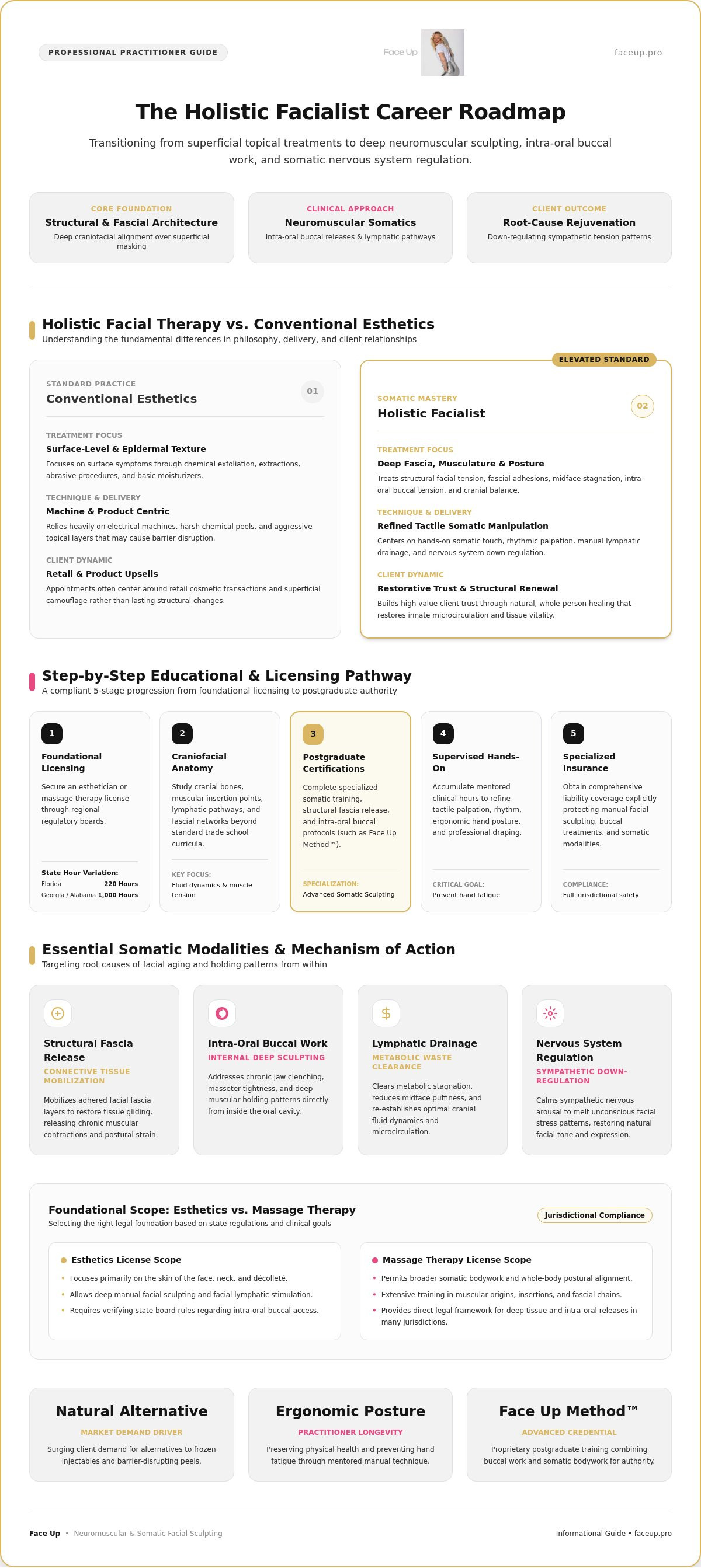
Understanding this distinction is vital when researching how to become a holistic facialist. While the traditional esthetician profession typically centers on chemical exfoliation, machine-based protocols, and retail product sales, holistic practitioners rely on hands-on somatic manipulation:
- Treatment Focus: Conventional esthetics targets epidermal texture through peels and abrasive procedures. Holistic practice focuses on deep fascial sculpting, intra-oral buccal releases, and postural correction.
- Technique Delivery: Standard facials lean heavily on electrical machines and aggressive topicals. Holistic sessions center on refined tactile sensitivity, rhythmic touch, and somatic grounding.
- Client Dynamic: Traditional appointments often prioritize product upsells. Holistic treatments build long-term trust through restorative, therapeutic bodywork that leaves clients deeply regulated and structurally renewed.
Step-by-Step Educational Pathways and Licensing Requirements
Because "holistic facialist" represents a specialized philosophy rather than a separate legal category, your career must rest on a compliant legal foundation. When determining how to become a holistic facialist, follow this structured five-step progression:
- Obtain a Foundational License: Secure an esthetician or massage therapy license through your regional regulatory board. Hour requirements vary considerably by state, from 220 hours in Florida to 1,000 hours in states like Georgia or Alabama.
- Master Deep Craniofacial Anatomy: Study the cranial bones, muscular insertion points, lymphatic pathways, and fascial networks beyond what standard trade school textbooks offer.
- Complete Advanced Postgraduate Certifications: Complete specialized training in somatic modalities, including structural fascia release and intra-oral buccal work.
- Accumulate Supervised Hands-On Hours: Refine tactile palpation, rhythm, ergonomic hand posture, and professional draping through mentored clinical practice.
- Secure Specialized Liability Insurance: Obtain comprehensive coverage that explicitly protects manual facial sculpting and somatic modalities.
Navigating Foundational Licenses: Esthetics vs. Massage Therapy
Choosing between an esthetics and a massage therapy license depends on local regulations and your intended scope of practice. Esthetics programs focus primarily on the skin of the face, neck, and décolleté, whereas massage licensing permits broader somatic bodywork. It is essential to verify local jurisdictional licensing requirements before offering advanced intra-oral treatments, as state boards define allowable manual manipulation differently. Standard beauty trade schools exist to help students pass basic sanitation exams; they rarely teach neuromuscular sculpting.
Postgraduate Certification: Moving Beyond Basic Trade School
Bridging the gap between a trade license and clinical excellence requires deliberate postgraduate education. With the career outlook for skincare specialists expanding steadily, clients seek practitioners skilled in genuine tissue change. Prioritize postgraduate programs that provide in-depth anatomical theory alongside practical hands-on assessments. Advancing through credentialed pathways like the Face Up Method Certification positions you within a global practitioner community, giving you the structured somatic training required to deliver elite, non-invasive results.
Essential Hands-On Modalities Every Holistic Facialist Must Master
True structural transformation requires mastering a cohesive toolkit of advanced tactile modalities. Anyone mapping out how to become a holistic facialist quickly realizes that superficial stroking does not create lasting tissue change. Practitioners rely on manual lymphatic drainage to clear metabolic waste, reduce fluid retention, and eliminate chronic midface puffiness. Simultaneously, targeted fascia release unglues dense, dehydrated connective tissue along the brow, jawline, and neck, freeing muscles to sit in their natural posture. For deeper tension, integrating clinical protocols like tmj massage therapy resets neuromuscular holding patterns that distort the lower facial contours.
Intra-Oral Buccal Massage and Deep Tissue Sculpting
Intra-oral buccal massage is one of the most effective non-invasive modalities available. Practiced wearing sterile nitrile gloves, this technique allows practitioners to work the lower face simultaneously from internal and external vectors. By accessing the masseter, buccinator, and pterygoid muscles directly through the oral cavity, you can release severe contractures that topical treatments cannot touch. This double-sided manipulation restores jawline symmetry, softens deep nasolabial folds, and alleviates chronic craniomandibular strain.
Somatic Bodywork and Nervous System Regulation
The face acts as a living map of the autonomic nervous system. The vagus nerve directly innervates facial micro-expressions, vascular tone, and skin radiance. When a client remains trapped in chronic sympathetic fight-or-flight, facial capillaries constrict and tissues hold rigid defense postures. Holistic therapists incorporate rhythmic diaphragmatic breathwork, grounding touch, and cervical traction to guide clients into restorative parasympathetic states. Releasing emotional stagnation trapped along the suboccipital ridge and trapezius allows facial features to visibly soften and lift.
Traditional Tools: Gua Sha, Cupping, and Manual Tools
Mechanical implements amplify tactile bodywork when applied with anatomical precision. Handheld stone, wood, or medical-grade steel tools require strict clinical disinfection standards between sessions. Rather than applying excessive scraping pressure that risks capillary bruising, skilled practitioners work at precise 15- to 45-degree angles to glide along lymphatic channels and loosen superficial fascia. Educating clients on home maintenance using the best TMJ massage tool extends treatment longevity between professional studio visits.
How to Build a Sustainable, High-Income Holistic Practice
Mastering manual sculpting is only half the journey when discovering how to become a holistic facialist; building a thriving practice requires reimagining standard salon business models. Generalist spas often trap estheticians in an exhausting cycle of back-to-back, low-margin appointments driven by product sales. Independent holistic practitioners instead replace single-session menus with high-value therapeutic packages designed around cumulative tissue remodeling. Designing a sensory-conscious studio environment with warm illumination, grounding acoustics, and tactile linens immediately signals clinical safety, establishing the deep trust required for profound somatic release. Pairing these in-studio series with seasonal ritual guidance and self-care memberships creates steady, predictable revenue while deepening client loyalty.
Practitioner Ergonomics and Hand Health Longevity
Deep facial manipulation demands significant physical exertion, making practitioner biomechanics essential for career longevity. Thumb burnout and wrist strain frequently cut careers short when therapists rely on pinching pressure. Protect your body by engaging your core and transferring weight from your pelvis and shoulders down through relaxed forearms. Daily mobility drills, wrist decompressive stretches, and somatic grounding preserve joint integrity. Cap your hands-on schedule at three or four clients daily to ensure your touch remains sensitive, precise, and energetically sustainable.
Attracting High-Value Clients Who Value Natural Aging
Discerning clients are stepping away from synthetic aesthetics and seeking specialists who honor natural facial architecture. When establishing how to become a holistic facialist with a booked client roster, position your practice around structural rejuvenation, cranial fluid dynamics, and nervous system regulation. Teach your clients that lasting lift requires cumulative myofascial realignment rather than temporary surface fixes. Documenting client improvements through consistent, unedited profile photography highlights true postural and structural changes while maintaining strict privacy standards. To position your brand alongside global leaders in manual facial rejuvenation, apply for Face Up professional certification and secure your presence on a verified international practitioner directory.
Accelerate Your Professional Career with the Face Up Method™
Standing out in a competitive beauty and wellness landscape requires far more than a basic trade school diploma; it demands a signature methodology. While generalist estheticians often rely on cyclical product trends, specialized somatic practitioners command premium authority through deep, tangible tissue transformation. The Face Up Method™ unifies structural facial sculpting, intra-oral buccal work, and somatic bodywork into a singular, cohesive clinical protocol. By releasing chronic emotional holding patterns trapped within the jaw, temporomandibular joint, and brow, practitioners deliver immediate visual lift alongside profound nervous system relief. If you are discerning how to become a holistic facialist whose practice thrives on word-of-mouth client loyalty, mastering this proprietary somatic framework is the ultimate catalyst.
The Comprehensive Face Up Method Certification Curriculum
Developed by specialist Olga Newman, this postgraduate program bridges advanced craniofacial anatomy with somatic touch therapy. As detailed in our complete breakdown of facial sculpting certification, the curriculum progresses through intensive theoretical foundations and practical hands-on execution. Students master deep myofascial release, neuro-lymphatic drainage pathways, and precision intra-oral vectors while practicing sustainable practitioner body mechanics. Rather than relying on passive attendance, candidates complete rigorous, verified video assessments to demonstrate touch pressure, anatomical precision, and draping decorum before receiving certified practitioner standing.
Joining the Global Face Up Practitioner Ecosystem
Earning your certification isn't an isolated achievement; it opens the door to an expansive international professional community. Certified practitioners secure an official placement on the global Face Up practitioner directory, connecting verified specialists directly with high-intent clients seeking non-invasive facial sculpting. To extend clinical results, practitioners empower clients with structured home rituals supported by the Face Up app. Committing to this postgraduate credential turns your exploration of how to become a holistic facialist into a sustainable, highly respected enterprise rooted in genuine somatic healing.
Elevate Your Practice with Somatic Facial Mastery
Building a fulfilling career at the intersection of beauty and somatic wellness requires moving beyond standard superficial protocols. As you map out how to become a holistic facialist, the path centers on understanding deep cranial anatomy, mastering fascial release, and preserving your own biomechanical health. When you regulate the nervous system alongside muscular architecture, you provide clients with restorative, lasting rejuvenation that synthetic treatments cannot replicate.
Transitioning from basic licensing to specialized clinical mastery demands proven postgraduate guidance. Developed by specialist Olga Newman, the proprietary Face Up Method™ combines intra-oral buccal massage, fascial release, and somatic bodywork into an empowering professional framework. Graduating unlocks access to the global certified practitioner directory, directly connecting your studio with clients seeking non-invasive structural rejuvenation. You have the passion to make a profound difference in your clients' well-being. Take the definitive step toward building a thriving, elevated practice and apply for the Face Up Method Certification today.
Frequently Asked Questions
Do I need an esthetician license to practice as a holistic facialist?
Yes, you must hold a foundational esthetician or massage therapy license in most jurisdictions to touch clients legally. "Holistic" describes a philosophical treatment approach rather than a separate state board credential. As you explore how to become a holistic facialist, check your local regulatory board guidelines carefully, especially regarding the specific scope of practice permitted for intra-oral or deep muscular manipulation.
How long does it take to become fully certified in holistic facial sculpting?
Completing your complete training pathway typically takes between three and twelve months, depending on your prior qualifications. Securing a prerequisite esthetics or bodywork license requires several months of foundational school hours. After licensing, specialized postgraduate programs like the Face Up Method™ deliver intensive theoretical and hands-on modules that you can complete over several weeks, followed by practical video case evaluations.
What is the difference between buccal massage and standard facial massage?
Buccal massage addresses facial musculature simultaneously from both inside and outside the mouth, whereas standard facial massage remains strictly external. Wearing sterile nitrile gloves, the practitioner grips muscle tissue from the interior oral cavity. This dual-sided vector allows direct access to the masseter, buccinator, and pterygoid muscles, releasing deep contractures and TMJ tension that superficial surface strokes cannot reach.
Can holistic facial techniques replace botox and dermal fillers for clients?
Holistic techniques offer a natural, functional alternative rather than an identical medical substitute for cosmetic injectables. While neurotoxins immobilize muscles to smooth surface creases temporarily, somatic facial sculpting restores neuromuscular balance, relieves chronic tension, and promotes natural lymphatic flow. Many clients choose this path to avoid frozen expressions, maintain genuine facial animation, and support long-term skin health without synthetic substances.
How do I protect my hands and wrists from fatigue while performing deep sculpting?
Protect your joints by driving pressure from your body's core rather than pinching with your fingers and thumbs. Keep your wrists straight, drop your shoulders, and transfer body weight forward into each stroke. Incorporating daily forearm stretches, wrist decompressive mobility routines, and capping your schedule at three to four daily clients preserves your hands for a long career.
Is it possible to complete holistic facial certification programs online?
Yes, high-caliber postgraduate programs deliver comprehensive somatic theory and practical methodology through digital learning platforms. When studying how to become a holistic facialist remotely, select programs that combine step-by-step video tutorials with mandatory, reviewed video assessments. This structure ensures you receive direct mentor feedback on your grip, rhythm, and draping before earning verified practitioner standing and international directory recognition.
What start-up equipment do I need to open a private holistic facial studio?
Opening a private practice requires high-quality ergonomic furniture, sensory textiles, and manual tools rather than expensive electrical machines. Essential investments include an adjustable treatment table, supportive practitioner stool, towel warmer, medical-grade nitrile gloves, and professional stone or metallic sculpting tools. Prioritize soft acoustic soundscapes and dimmable lighting to cultivate the calm environment essential for client nervous system regulation.


