

Your jaw is not just a joint; it is the body's primary vault for unspoken words and suppressed boundaries. You likely know the frustration of waking up with a sore jaw or a dull headache, feeling as though your body is bracing for a battle that never arrives. It's exhausting to feel "stuck" in a cycle of physical tension where night guards only treat the symptoms rather than the root cause. You deserve a path to relief that recognizes the complexity of your nervous system and the emotions it carries.
Achieving a lasting emotional release jaw tension often holds back requires a dialogue with the body, not just a physical stretch. In this guide, we'll explore how to unlock this "emotional vault" through somatic facial work and the Face Up Method™. You will learn why 95% of those who practice these techniques continuously for ten days notice significant progress. We'll move from understanding the mind-body connection to implementing actionable self-care rituals that offer more than just a temporary fix. It's time to transition from simply "managing" pain to facilitating a genuine, global sense of ease and professional readiness.
Key Takeaways
- Understand why the masseter muscle acts as a primary storage site for the "fight or flight" response and how this creates physical facial "armouring."
- Explore the science of neurogenic tremors to facilitate a profound emotional release jaw tension often restricts.
- Learn why traditional night guards are often incomplete solutions and how a somatic approach addresses the underlying nervous system patterns.
- Discover how the Face Up Method™ and the specialized Jaw Release Course provide a structured path toward lasting relief and mind-body connection.
The Jaw as an Emotional Vault: Why We Store Stress in the Masseter
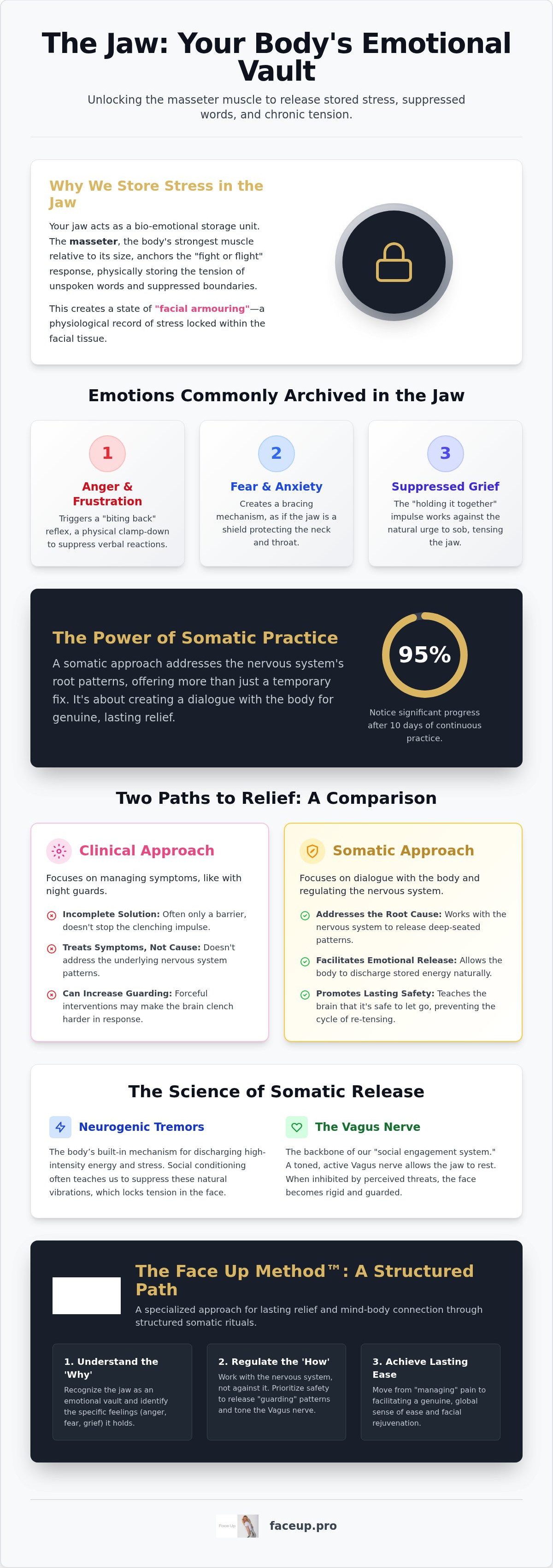
The human jaw functions as a sophisticated bio-emotional storage unit. While we often view it as a simple hinge for eating and speaking, it's actually the body's primary site for the "fight or flight" response. The masseter muscle, which covers the sides of the jaw, is the strongest muscle in the human body relative to its weight. This immense power allows it to exert pressure far beyond what is required for daily tasks. When we experience stress, this muscle acts as a physical anchor for tension, creating a state of somatic memory within the facial fascia. This phenomenon, often manifesting as Bruxism, isn't just a mechanical habit; it's a physiological record of suppressed communication. We call this the "unspoken word" theory, where every boundary not set and every truth not spoken is archived in the tissue. The jaw becomes a vault, holding the weight of things we couldn't say or didn't feel safe to express.
The Biological Link Between Jaw Tension and Survival
Your brain treats modern stress exactly like a physical threat. When the amygdala detects a stressor, it signals the brainstem to prepare for defense. This often results in a defensive clench. This reaction is mediated by the trigeminal nerve, the largest cranial nerve, which handles both the motor functions of the jaw and sensory input from the face. It's deeply connected to the brain's emotional processing centers. Because modern life involves constant "micro-stressors" like emails and deadlines rather than singular physical dangers, many of us live in a state of chronic, low-level jaw guarding. We don't just clench once; we hold that tension for hours. This persistent state of readiness prevents the nervous system from returning to a baseline of safety. It's a survival mechanism that has become stuck in the "on" position, leading to the facial "armouring" that many professionals experience today.
Emotions Commonly Stored in the Jaw
Different emotional states manifest in specific physical patterns within the facial structure. Anger and frustration often trigger a "biting back" reflex, where we physically clamp down to avoid saying something we might regret. Fear and anxiety create a bracing mechanism, as if the jaw is a shield protecting the vulnerable structures of the neck and throat. Perhaps most significantly, the jaw is a primary site for suppressed grief. The impulse to sob involves a complex contraction of the throat and jaw muscles; when we "hold it together," we force these muscles to work against a natural biological urge. Seeking a genuine emotional release jaw tension holds back requires acknowledging these specific feelings before the physical tissue can truly soften. By understanding these emotional categories, we can begin to approach the jaw with compassion rather than frustration, moving from a transactional fix to a holistic somatic dialogue.
The Somatic Science: How the Nervous System Guards Your Face
The human body possesses a built in mechanism for discharging high intensity energy known as neurogenic tremors. These involuntary vibrations are the nervous system's natural way of resetting after a period of high stress. However, social conditioning often teaches us to suppress these movements, leading to what is known as facial "armouring." This chronic tension restricts blood flow and oxygen to the tissues, effectively locking the face in a mask of stress. While traditional massage might feel pleasant, it often provides only temporary relief because it treats the muscle as a mechanical object rather than an extension of the nervous system. To achieve a true emotional release jaw work must address the somatic and nervous system aspects that keep the muscles in a state of high alert.
Central to this process is the Vagus nerve. This nerve is the backbone of our "social engagement system," connecting the brain to the muscles used for facial expression and vocalization. When the Vagus nerve is toned and active, the jaw can rest. When it's inhibited by a perceived threat, the face becomes rigid. If you're looking for a structured way to begin this work, exploring a Somatic Bodywork Session can help bridge the gap between physical touch and nervous system regulation.
Understanding Nervous System Guarding
Guarding is a protective state where the brain refuses to let a muscle relax because it doesn't feel safe. It's an internal "no." When practitioners use excessive force or deep pressure on a guarded jaw, the brain often responds by clenching even harder to protect the underlying structures. This is why somatic work prioritizes a sense of safety and slow, invitational contact. By signaling to the nervous system that the threat has passed, we allow the brain to naturally release its grip on the masseter. It's a process of negotiation with the brain, not a forced physical conquest.
Fascia: The Web That Holds Emotional History
Fascia is the connective tissue web that surrounds every muscle and organ. Under chronic stress, fascia becomes "sticky" and dense, losing its fluid quality. This "stickiness" literally glues emotional history into our physical structure. Releasing this facial fascia often triggers unexpected emotional outpourings; the physical release of the tissue allows the associated memory or feeling to finally move through the body. Beyond the emotional benefits, healthy, hydrated fascia is essential for a natural facial lift. When the fascia is supple, it provides the structural support needed for a vibrant, rejuvenated appearance. This dual benefit is why an emotional release jaw focus is so transformative for both well-being and aesthetics.
Clinical vs. Somatic: Why Night Guards Aren’t the Total Solution
When you first notice the signs of chronic clenching, the dentist's office is often the first stop. Clinical solutions like night guards provide a vital service by protecting your tooth enamel from the sheer force of the masseter. However, these tools are essentially "outside-in" interventions; they create a physical barrier without addressing the neurological impulse to clench. While they save your teeth, they don't facilitate the emotional release jaw tissues require to truly let go. For those seeking a deeper understanding of how clinical techniques intersect with hands-on work, our Ultimate Guide to TMJ Massage Therapy offers a comprehensive look at restoring balance through targeted pressure.
Somatic work, by contrast, is an "inside-out" approach. It recognizes that the jaw is not just a joint to be managed, but a gateway to the nervous system. While dental interventions are necessary for structural protection, they rarely resolve the "unspoken word" or the survival bracing we explored in previous sections. To move beyond symptom management, we must look at how the brain communicates with the face. This transition from mechanical fixes to somatic dialogue is where long term relief begins.
The Limitations of Mechanical Fixes
Mechanical fixes often ignore the "why" behind the tension. Some individuals find that night guards actually increase their urge to chew or clench during the night, as the brain treats the plastic as an object to be manipulated. Similarly, while some seek invasive injections to weaken the masseter, these can lead to muscle atrophy and a loss of facial volume over time. These methods don't re-educate the nervous system. Without changing the underlying stress response, the body simply finds new ways to express its "guarding" patterns. True freedom comes from teaching the brain that it's safe to release the bracing mechanism, rather than just temporarily paralyzing the muscle or blocking the teeth.
The Somatic Advantage
The somatic approach empowers you through interoception, which is the ability to sense the internal state of your own body. Instead of relying on a passive device, you learn to recognize the subtle "pre-clench" signals your nervous system sends. This self-awareness allows for a genuine emotional release jaw tension often masks. When you work with the body's natural intelligence, the results show up in your facial posture. A relaxed jaw naturally drops, the neck elongates, and the mid-face appears more lifted. This aesthetic rejuvenation isn't just a surface change; it's the visible evidence of a nervous system that has finally moved from a state of survival into a state of professional readiness and calm efficiency.
Somatic Rituals for Emotional Jaw Release
True rejuvenation is a practice, not a single event. At Face Up, we advocate for daily rituals that treat the body with professional integrity rather than seeking aggressive, short term fixes. These rituals create a steady environment where the emotional release jaw tension prevents can finally occur. By integrating these movements into your morning or evening routine, you move from a transactional relationship with your face to one of proactive management and global readiness. For those who prefer guided assistance, a TMJ massage tool can serve as a reliable partner in this journey, provided it is used with a somatic mindset of invitation rather than force.
Step 1: Establishing Safety and Breath
Before touching the face, you must signal to the nervous system that it's safe to let go. Start with a "sighing" breath, inhaling deeply through the nose and letting out a long, audible sigh through a relaxed mouth. This simple act stimulates the Vagus nerve, which we previously identified as the key to facial relaxation. Ground yourself by feeling the weight of your body in your chair, bringing your full awareness into the lower third of your face. The Face Up Breath is a foundational tool for release that uses a prolonged, soft exhale to signal the brain that the survival threat has passed.
Step 2: Gentle External Masseter Release
Place the pads of your fingers on the masseter muscles, located just below your cheekbones and in front of your ears. Use the "melting" method rather than a "rubbing" method. Instead of moving your fingers across the skin, apply a light, steady pressure and wait for the tissue to soften under your warmth. This invitational approach respects the brain's "guarding" response. As you explore, you may find specific trigger points that feel particularly dense. These spots often hold a significant emotional charge; stay with them patiently, allowing the breath to move through the tension without trying to "break" it.
Step 3: Intra-Oral Awareness (Buccal)
Intra-oral, or buccal, work is the most direct way to access the "emotional vault." With a clean thumb inside your mouth and fingers on the outside, gently pinch the masseter muscle. This allows you to explore the tissue from both sides, reaching the deeper pterygoid muscles that govern the jaw's lateral movement. While holding a point of tension, perform a "vowel release" by silently and slowly forming the shapes of "A-E-I-O-U" with your lips. This movement stretches the internal fascia without straining the joint. To cultivate this practice into a sustainable habit, you can find daily guided somatic rituals through the Face Up App Subscription.
Mastering the Face Up Method™ for Lasting Rejuvenation
Founded by Olga Newman, the Face Up Method™ represents a sophisticated paradigm shift in facial care. It moves away from the transactional nature of invasive procedures, opting instead for a holistic integration of somatic bodywork and facial sculpting. By addressing the deep muscular layers and the emotional narratives they hold, this proprietary approach facilitates the profound emotional release jaw tension often blocks. It's not just about softening a muscle; it's about reclaiming the vitality of your facial structure through organized, confident self-management. This method positions you as a proactive participant in your own well-being, fostering a sense of global readiness and professional integrity.
The Jaw Release Course: A Deep Dive
For those seeking a structured entry point into this ecosystem, the Jaw Release Course offers a comprehensive digital path. This program provides a series of pre-recorded tutorials and theoretical insights that guide you from "pain-focused" survival to "presence-focused" living. Verified data shows that 95% of clients who practice the Face Up Method™ continuously for 10 days notice measurable progress in their tension levels and facial ease. This transformation is both physical and emotional, as the release of stored "armouring" allows for a more authentic expression of self. The course serves as a professional mentor, guiding you through the complexities of the mind-body connection with clarity and impact.
Natural Rejuvenation Through Release
The aesthetic benefits of this work are a direct result of nervous system regulation. When the masseter and surrounding fascia are no longer in a state of chronic clenching, the jawline becomes more defined and the appearance of "jowls" is significantly reduced. There's also a critical link between jaw tension and neck posture, often exacerbated by modern "tech neck" patterns. By releasing the jaw, you allow the neck to elongate and the head to sit more naturally over the shoulders. This global alignment creates a lifted, refreshed look that reflects your internal state of calm efficiency.
For professionals looking to integrate these high-standard techniques into their own practice, the Facial Sculpting Certification provides a clear path toward professional advancement. Whether you're a practitioner or an individual seeker, the Face Up App Subscription offers daily guided rituals to maintain your results. Joining the Face Up community means stepping into a specialized environment dedicated to order, reliability, and a genuine emotional release jaw health requires for long term success.
Reclaiming Your Face and Your Peace
Transitioning from chronic tension to a state of calm efficiency requires more than just a physical fix. You've learned that the jaw functions as a biological vault for the nervous system, and that lasting change comes from an "inside-out" somatic dialogue. By moving beyond mechanical barriers like night guards and embracing daily rituals, you can finally achieve the emotional release jaw health requires for genuine rejuvenation. This holistic, non-invasive approach, founded by somatic specialist Olga Newman, is now used by certified practitioners worldwide to bridge the gap between beauty and pain relief.
It's time to stop simply managing symptoms and start facilitating your body's natural capacity for ease and professional readiness. You have the tools to unlock your own "emotional vault" and define your path forward with confidence. Start your journey to freedom with the Jaw Release Course and join a global community dedicated to high-standard self-care. Your face carries your history, but it doesn't have to carry your stress anymore.
Frequently Asked Questions
How do I know if my jaw pain is emotional or physical?
Jaw pain is rarely just one or the other; it is usually a blend of both. Physical pain often stems from the masseter clenching in response to emotional stress or "unspoken words." If your pain flares during periods of high pressure or if you wake up with a tight jaw after a stressful day, it's likely a somatic response. Tracking these patterns helps you identify the emotional root behind the physical bracing.
What is a somatic release, and what does it feel like?
A somatic release is the physical discharge of stored energy from the nervous system. It often feels like a sudden softening of the muscle, a deep sigh, or even a subtle trembling known as a neurogenic tremor. You might experience a rush of warmth or a sense of "lightness" in the face. It's the moment your brain finally signals to the jaw that it is safe to stop guarding.
Is it normal to cry during a jaw massage or facial?
Crying is a very common and healthy response during an emotional release jaw session. Because the jaw acts as a "vault" for suppressed grief and frustration, releasing the physical tension can unlock the associated emotions. Our practitioners are trained to hold space for these moments. It's a sign that your body is finally processing and letting go of energy it has held for a long time. This release is a key part of the Face Up philosophy.
How often should I perform jaw release rituals?
Consistency is more effective than intensity in somatic work. We recommend performing short, five to ten minute rituals daily to maintain nervous system regulation. This prevents the "armouring" from building up over time. Many users find that following the guided rituals in the Face Up App helps them stay consistent. Over time, these small daily shifts lead to lasting changes in both physical comfort and facial aesthetics.
Can somatic jaw work help with my teeth grinding (bruxism)?
Somatic work directly addresses the neurological impulse to grind by teaching the brain to find safety without clenching. While night guards protect the teeth, somatic practices like those in the Jaw Release Course target the root cause. By calming the trigeminal nerve and releasing the masseter, you can reduce the frequency and intensity of grinding. It's an "inside-out" solution that complements traditional dental care and offers long term relief.
What is the difference between buccal massage and regular facial massage?
Regular facial massage focuses on the skin's surface and lymphatic drainage, while buccal massage is an intra-oral technique. It involves working on the muscles from both the inside and outside of the mouth. This allows for direct access to the deeper masseter and pterygoid muscles. This specific approach is essential for a true emotional release jaw tension requires, as it reaches the layers where stress is most deeply held.
Do I need special tools for emotional jaw release?
You don't need tools to begin; your own hands are the most sophisticated instruments for somatic work. The Face Up Method™ emphasizes the "pads of the fingers" and intra-oral techniques. However, some individuals find that a specialized TMJ massage tool can help them apply steady, melting pressure more comfortably at home. The most important "tool" is actually your breath and your ability to sense your own internal state.
Can I do these exercises if I have dental implants or braces?
Yes, you can perform these exercises, but you must move with extra gentleness and awareness. Somatic work is about "invitation" rather than force, so you should never push into pain or discomfort near dental hardware. If you have braces, be mindful of the interior of your mouth during buccal work. Always consult your dental professional if you have concerns about specific structural issues or recent surgical procedures before starting a new routine.


