

What if the secret to a lifted, radiant face isn't found in a syringe or an expensive shelf of skincare products, but rather within your own ability to release stored emotional stress? Many professionals find themselves trapped in a cycle of persistent puffiness and chronic jaw tension, feeling as though their current daily facial sculpting routine simply isn't delivering the promised results. It's common to feel overwhelmed by the sheer volume of conflicting advice, yet the physical signs of stress often remain etched into our features despite our best efforts.
We understand that you're looking for more than just a temporary fix; you seek a reliable, high-standard path to natural rejuvenation. This guide introduces you to the Face Up Method™, a professional-grade somatic approach that transforms your beauty habits into a restorative ritual of self-discovery. By integrating these specialised techniques, you can achieve a more defined jawline and lifted cheekbones while easing the deep-seated tension associated with TMJ. We'll walk you through a simple, repeatable process designed to improve lymphatic drainage and reveal your natural bone structure, allowing your inner glow to finally surface through a well-governed and mindful practice.
Key Takeaways
- Understand why a somatic approach is essential for releasing deep-seated emotional tension that traditional facial exercises often fail to address.
- Learn how the nervous system and Vagus nerve directly influence your facial muscle tone and the persistence of stress-related puffiness.
- Discover the critical "Neck First" rule of the Face Up Method™ to ensure your daily facial sculpting routine effectively promotes lymphatic drainage.
- Recognise why manual sensory feedback from your own hands provides a superior framework for rejuvenation compared to most beauty tools.
- Explore how to maintain professional-grade standards and consistency in your practice by using the Face Up App for guided daily rituals.
Beyond Surface Beauty: Why Your Facial Sculpting Routine Needs a Somatic Approach
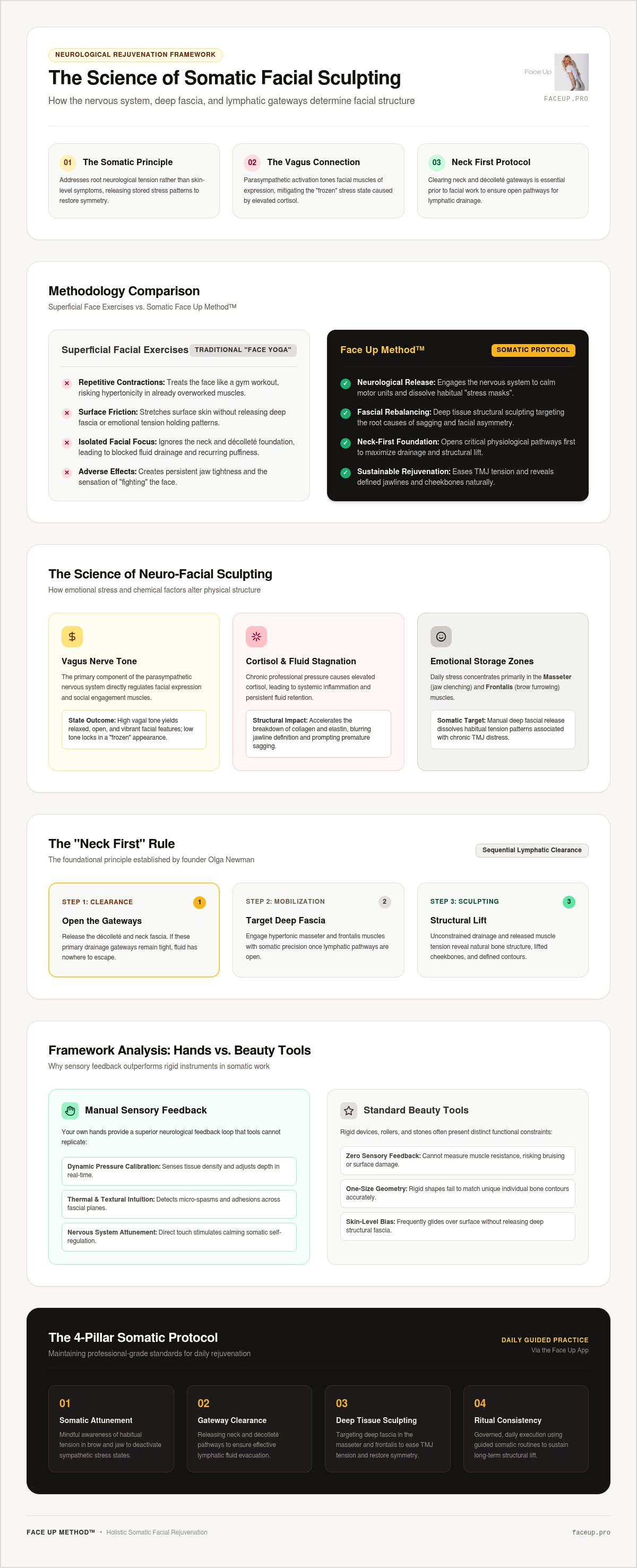
The standard approach to a daily facial sculpting routine often mirrors a typical gym workout, focusing on repetitive muscle contractions to achieve "tone." However, true rejuvenation requires a more sophisticated understanding of the body's internal landscape. Somatic facial sculpting is a specialised method of working with the nervous system to address the root causes of facial ageing and chronic tension. Somatic sculpting is the release of muscular patterns to restore natural facial symmetry. By engaging with the facial muscles through a neurological lens, we move beyond the surface to achieve a professional standard of structural balance.
The Limitation of Superficial Facial Exercises
Traditional facial exercises, often termed "face yoga," frequently fail because they ignore the complexity of deep-seated tension. When we repeat the same movements without awareness, we risk increasing the hypertonicity of muscles that are already overworked by stress. This is particularly evident in the jaw and forehead, where chronic emotional states create "stress masks" that define our resting expression. Unlike skin-level massage which only provides temporary stimulation, deep tissue sculptural work targets the fascia. It addresses the habitual patterns that lead to sagging and puffiness, offering a transparent path to lasting change. Signs your current routine may be too superficial include:
- Persistent tightness in the jaw despite daily massage or exercise.
- A lack of visible change in facial puffiness or chronic fluid retention.
- The feeling that you are "fighting" your face rather than working with it.
- Repetitive movements that leave the skin feeling stretched but the muscles still tight.
The Face Up Method™ Philosophy
The Face Up Method™ offers a holistic alternative to invasive aesthetics, prioritising the body's natural intelligence and professional integrity. Founded by Olga Newman, this philosophy establishes the neck and décolleté as the essential foundation for a lifted face. If these "gateways" are blocked by tension, any work done on the face itself will yield diminished results. By integrating somatic bodywork, we transform the daily facial sculpting routine from a transactional beauty chore into a proprietary ritual of self-regulation. This practice invites you into a unique environment of calm efficiency, where consistency leads to a more refined, authentic version of yourself. It's about global readiness; preparing the face to reflect a state of internal order and professional poise.
The Science of Sculpting: How Tension and the Nervous System Shape Your Face
To understand the efficacy of a daily facial sculpting routine, we must look beyond the mirror and into the complex world of neurobiology. Your face is a map of your nervous system's history. Every micro-expression and habitual tension pattern is a physical manifestation of your internal state. The Vagus nerve, which serves as the primary component of the parasympathetic nervous system, plays a critical role here. It regulates the muscles of facial expression and social engagement. When the Vagus nerve is toned and active, your face appears more relaxed, open, and vibrant. Conversely, chronic stress keeps the body in a sympathetic state, leading to a "frozen" or exhausted facial appearance that no amount of superficial cream can fix.
Chemical factors also dictate our structural aesthetics. Elevated cortisol levels, often the result of modern professional pressures, lead to systemic inflammation and fluid retention. This often manifests as facial puffiness and a loss of definition along the jawline. Over time, chronic cortisol exposure can even accelerate the breakdown of collagen and elastin, leading to premature sagging. By approaching facial work through a somatic lens, we address these hormonal and neurological drivers, creating a professional standard of rejuvenation from the inside out.
Facial Muscles and the Emotional Storage Effect
The facial muscles, particularly the masseter and the frontalis, are notorious for storing daily stress. We clench our jaws during difficult conversations and furrow our brows in deep concentration. This creates muscular "armouring," a state where the muscles remain partially contracted even at rest. This is further exacerbated by "tech neck," where the constant downward tilt of the head strains the platysma muscle. This strain pulls down on the lower face, contributing to drooping jowls and lymphatic stagnation. Somatic release allows us to identify these habitual patterns and consciously let them go, restoring natural symmetry and flow.
Lymphatic Drainage and the Somatic Connection
Effective lymphatic drainage is impossible if the nervous system is stuck in "fight or flight" mode. The lymphatic system lacks its own pump; it relies on deep breathing and relaxed muscle movement to transport interstitial fluid away from the tissues. When we are stressed, our tissues become constricted, trapping fluid and metabolic waste. This leads to the persistent puffiness many people struggle to resolve. Calming the nervous system is the essential first step to clearing these pathways. For those experiencing significant lower-face discomfort, The Ultimate Guide to TMJ Massage Therapy offers specialised insights into restoring balance. Integrating these principles into your daily facial sculpting routine ensures that you are working with your biology rather than against it. To deepen your understanding of these professional techniques, consider exploring our somatic bodywork sessions for a guided experience.
Hands vs. Tools: Selecting the Right Framework for Your Daily Practice
The modern marketplace is flooded with aesthetic gadgets, from vibrating wands to cold-pressed crystals. While these can be pleasant additions, a truly effective daily facial sculpting routine doesn't require a suitcase full of equipment. The Face Up Method™ positions itself as a tool-agnostic approach that prioritises tissue health and structural integrity over the novelty of a device. By focusing on the somatic connection between the practitioner and the tissue, we ensure that the practice remains grounded in physiological reality rather than marketing trends.
Manual sculpting allows for a level of precision that tools simply cannot replicate. By using your own hands, you engage in a sophisticated dialogue with your body. You can feel the subtle shifts in muscle density and identify specific areas of adhesion that require attention. One of the most powerful techniques we advocate is the buccal, or intra-oral, method. This involves working from the inside of the mouth to release the masseter and other deep muscles, providing a level of jaw release that surface-level tools often miss. It's a professional standard of care that you can master for your own personal ritual.
Why Manual Sculpting Beats Trendy Face Rollers
The primary advantage of manual work is sensory feedback. Your fingertips are highly sensitive instruments capable of detecting tension points that a rigid stone roller would simply glide over. Human touch also facilitates a natural heat transfer. This warmth helps to soften the fascia and improve the pliability of the tissue. Beyond the physiological benefits, relying on your hands simplifies your ritual. It eliminates "gadget fatigue" and ensures your practice is portable and sustainable, no matter where your professional obligations take you. You don't need a drawer full of stones to achieve a lifted, radiant look.
When to Integrate a TMJ Massage Tool
There are, however, instances where a specialised tool can enhance your practice, particularly when dealing with chronic jaw tension. Choosing a professional-grade instrument is essential to avoid the bruising or surface-level irritation common with low-quality rollers. For detailed guidance on selecting the right equipment, see our article on Choosing the Best TMJ Massage Tool. When you do use a tool, it's vital to combine it with somatic breathwork. This ensures you aren't just applying mechanical pressure. You are actively inviting the nervous system to downregulate, allowing for a deeper and more lasting release. This integrated approach ensures your tools work in harmony with your biology.
The Step-by-Step Daily Facial Sculpting Ritual for 2026
A truly restorative daily facial sculpting routine requires sufficient time to engage the nervous system and the deeper fascial layers. While some sources suggest a hurried three-minute exercise is enough, the Face Up Method™ advocates for a dedicated 10-15 minute ritual. This duration ensures the body transitions from a state of high alert into one of calm efficiency. The foundational principle of our practice is the "Neck First" rule. You cannot effectively drain or lift the face if the neck remains a bottleneck of tension. By clearing the pathways of the neck and décolleté first, you create the necessary space for the face to release and rejuvenate.
As you move through these steps, focus on the quality of your touch. We describe movements as "melting" into the tissue rather than "pulling" or "stretching" the skin. This distinction is vital for somatic success. Imagine your hands are warm and inviting, allowing the muscles to yield to your presence. Maintain a professional standard of awareness by incorporating specific somatic cues: soften the tongue away from the roof of the mouth, broaden the brow, and allow your shoulders to drop away from your ears.
Preparation: Calming the Nervous System First
Every session must begin by signalling safety to the body. Spend two minutes engaging in slow, diaphragmatic breathing. This simple act downregulates the sympathetic nervous system and prepares the fascia for manipulation. Once you feel centred, use your fingertips to gently "pump" the lymphatic termini located just above the collarbones. This opens the primary drainage points for the entire head and neck. Follow this by warming the tissue through gentle effleurage, using long, sweeping strokes from the centre of the chest out toward the shoulders and up the sides of the neck.
The Core Sculpting Sequence: From Jaw to Brow
Once the foundation is set, move to the core sequence to address structural definition and fluid stagnation. This process is designed to be a repeatable, high-standard ritual for professional-minded individuals.
- Deep Masseter Release: Place your knuckles or fingertips at the angle of the jaw. Using a "melting" pressure, slowly sink into the masseter muscle. Breathe deeply and allow the jaw to hang slightly open to facilitate a deeper release of TMJ-related tension.
- Zygomatic Lifting: Use your knuckles to glide slowly under the cheekbones, moving from the sides of the nose toward the ears. This technique encourages the lift of the zygomatic muscles and helps define the mid-face.
- Eye and Forehead Smoothing: Use the pads of your ring fingers to gently sweep from the inner corners of the eyes outward, encouraging drainage. Finish by placing your palms on your forehead and slowly "broadening" the tissue toward the temples to erase stress-induced furrowing.
To ensure you are performing these movements with the correct precision and rhythm, you can access guided sessions through our Face Up App Subscription for a professional-grade daily experience.
Elevating Your Practice: From Home Rituals to Professional Mastery
Establishing a daily facial sculpting routine is a significant first step toward reclaiming your natural features and regulating your nervous system. However, the true transformation occurs through sustained consistency and the deepening of your somatic awareness. Like any professional discipline, the Face Up Method™ relies on a steady, invitational rhythm that guides you from basic movements toward a profound state of self-governance. Maintaining this practice ensures that the results you've realised, such as a more defined jawline and reduced puffiness, become a permanent part of your physical presence rather than a fleeting improvement.
While home rituals are foundational, there are moments when the expertise of a professional is required to address deep-seated muscular armouring. Seeking out a specialist from our global practitioner directory allows you to experience a level of deep tissue work that is difficult to achieve on oneself. These practitioners are trained to identify the subtle neurological "gateways" that, when released, can dramatically alter the structural balance of the face. This transition from self-care to expert intervention creates a holistic approach to rejuvenation, positioning you within a proprietary ecosystem designed for high-standard professional results.
Consistency Made Easy with the Face Up App
To support your journey, the Face Up App Subscription serves as a daily companion, providing the structure needed to maintain a reliable practice. The app features guided videos that ensure your technique remains precise and effective, preventing the common mistakes that lead to increased tension. For those dealing with specific professional stressors, digital programmes like our specialised "Jaw Release" course offer targeted solutions that can be integrated into even the busiest schedules. Beyond the technical guidance, the app connects you to a global community of like-minded individuals, fostering a sense of belonging and shared progress that makes your ritual feel less like a chore and more like a rewarding professional obligation.
Becoming a Certified Face Up Practitioner
For individuals who find themselves passionate about the intersection of somatic bodywork and natural beauty, there is a clear path forward into professional mastery. Somatic facial therapy is rapidly emerging as the future of non-invasive aesthetics, appealing to a global market that values integrity and long-term health over quick, invasive fixes. By pursuing Facial Sculpting Certification: Master the Face Up Method™, you can transition from a dedicated student to a verified facilitator. This certification empowers you to bring these proprietary techniques to others, establishing yourself as a reliable partner in the specialised landscape of somatic rejuvenation. Whether you seek to enhance your current professional offerings or embark on a new career path, the Face Up Method™ provides a transparent and courageous framework for professional advancement.
Step Into a New Era of Somatic Beauty
True rejuvenation is far more than a surface-level pursuit. It is an invitation to reconnect with your body's internal wisdom and release the chronic tension that shapes your features. By shifting from superficial exercises to a professional-grade daily facial sculpting routine, you address the neurological root causes of puffiness and sagging. You've learned that your hands are your most powerful tools for sensory feedback and that the "Neck First" rule is the essential gateway to lasting results.
Founded by somatic specialist Olga Newman, the Face Up Method™ provides a proprietary framework for those seeking high-standard, non-invasive results. Whether you're looking to define your jawline or join our global community of certified practitioners, the path forward is one of calm efficiency and structural integrity. It's time to transform your beauty habits into a restorative ritual that honours both your physical and emotional well-being.
Start your somatic journey with the Face Up App today and discover the profound power of working in harmony with your nervous system. Your most radiant, authentic self is waiting to be revealed.
Frequently Asked Questions
How long does it take to see results from a daily facial sculpting routine?
Immediate relief from internal tension is often experienced after a single session. For structural changes such as a more defined jawline or reduced puffiness, most individuals report visible results within three to four weeks of a consistent daily facial sculpting routine. This timeframe allows the fascia to begin reshaping and ensures the nervous system receives enough repetitive signalling to maintain a new, relaxed state of muscle tone.
Can I do facial sculpting if I have had Botox or dermal fillers?
You can certainly integrate somatic work with injectables, provided you allow for the initial settling period. We generally recommend waiting at least two to four weeks after a procedure before applying deep pressure to those specific areas. Somatic sculpting can actually support the longevity of your results by improving local circulation and preventing the compensatory tension that often arises when certain muscles are immobilised by neurotoxins.
Is it better to do my sculpting routine in the morning or at night?
The ideal timing depends on your specific professional goals and lifestyle. A morning routine is highly effective for reducing overnight fluid retention and stimulating lymphatic drainage, giving the face a refreshed and "awake" appearance. Conversely, a night-time ritual is excellent for downregulating the nervous system and releasing the day's emotional storage. Many professionals find that a split approach, focusing on drainage in the morning and deep release at night, offers the most comprehensive results.
Do I need a specific oil or cream for somatic facial sculpting?
A quality oil or balm is essential to provide the necessary "slip" and prevent dragging the skin during your daily facial sculpting routine. While we don't sell physical skincare products, we suggest using a clean, non-comedogenic oil that allows your hands to glide smoothly. The focus of the Face Up Method™ is always on the depth of the tissue work and the somatic connection rather than the specific brand of lubricant used during the practice.
What is the difference between face yoga and the Face Up Method™?
Face yoga typically focuses on repetitive muscle strengthening exercises, which can sometimes inadvertently increase tension in already hypertonic areas. The Face Up Method™ is a proprietary somatic approach that prioritises the nervous system and fascial release. It moves beyond simple "gym for the face" concepts to address how emotional stress and postural habits, like "tech neck," shape our physical features over time through professional-grade techniques.
Can facial sculpting help with chronic TMJ and jaw pain?
Somatic facial sculpting is specifically designed to address chronic jaw tension and TMJ discomfort. By focusing on the masseter and pterygoid muscles through techniques like buccal massage, you can release the "armouring" that leads to pain. Our specialised Jaw Release Course provides a targeted framework for those seeking to move beyond surface aesthetics to achieve deep, functional relief from the physical manifestations of chronic stress and clenching.
How often should I perform deep buccal massage at home?
Deep intra-oral work, such as buccal massage, is best performed once or twice a week. This frequency allows the internal tissues time to recover and integrate the structural changes. For your daily maintenance, focus on external manual techniques that maintain flow and prevent new tension from accumulating. If you're working with a certified Face Up practitioner, they can provide a personalised schedule based on your specific level of muscular adhesion and tissue health.
Is facial sculpting safe for sensitive or acne-prone skin?
Somatic sculpting is safe for most skin types because it emphasises a "melting" touch rather than aggressive friction. However, you should avoid performing deep work directly over active, inflamed acne or broken skin to prevent further irritation. Instead, focus on the surrounding areas and the lymphatic termini at the collarbones. This supports the body's natural clearing processes and reduces inflammation without disturbing the affected sites, making it a gentle yet effective approach for sensitive individuals.


