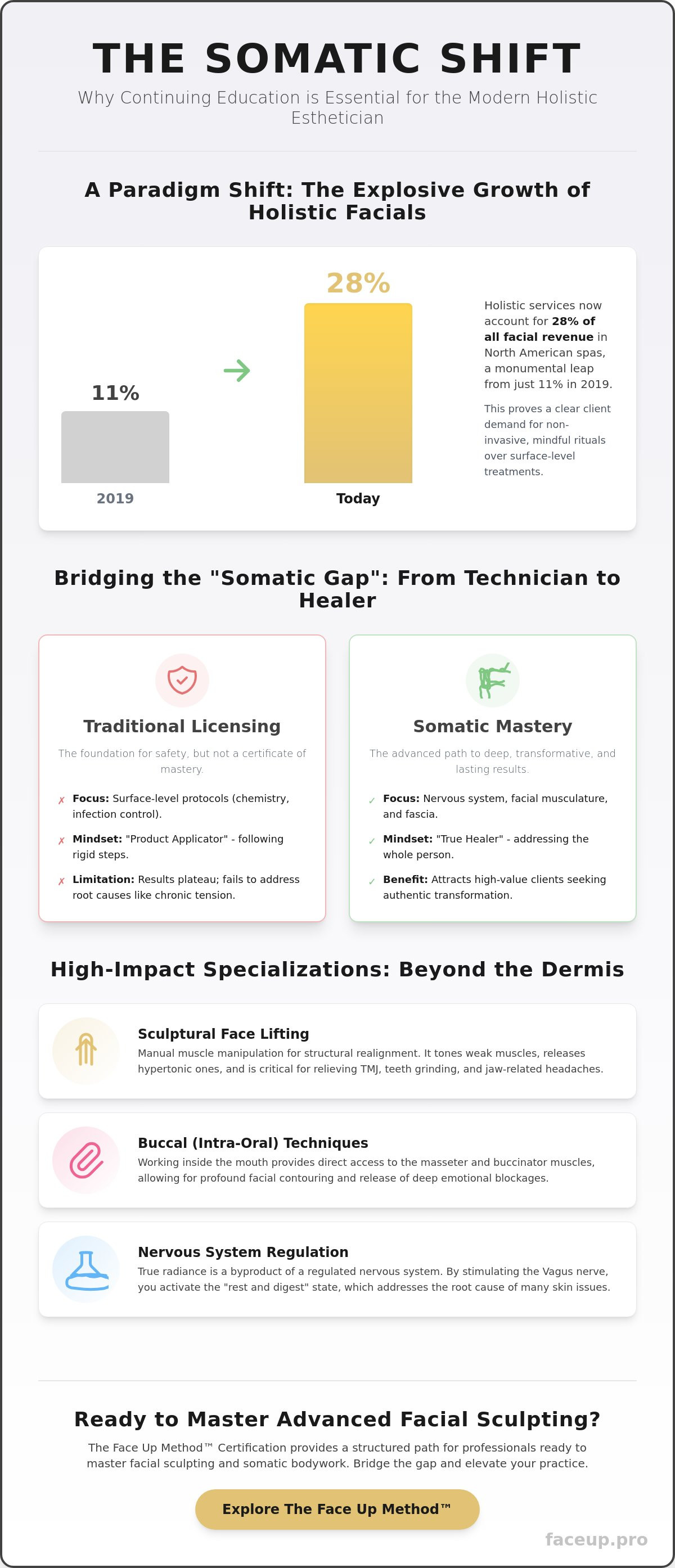
Holistic services now account for 28% of all facial revenue in North American spas, a significant leap from just 11% in 2019. This shift confirms that clients are moving away from invasive procedures in favor of mindful, sensorial rituals that prioritize the skin's natural barrier. You likely recognize the frustration of seeing results plateau or feeling the physical strain of repetitive movements. It's common to feel more like a product applicator than a true healer when your toolkit is limited to the skin's surface. Investing in targeted continuing education for holistic estheticians is the most effective way to break through these barriers and revitalize your professional path.
This guide provides a clear roadmap for mastering advanced somatic techniques that deliver deep-tissue rejuvenation without the need for harsh actives. We'll navigate the 2026 landscape, including specific state updates like Maryland's new requirement for six hours of education, to ensure your practice remains both compliant and competitive. You'll discover how to bridge the gap between topical skincare and nervous system regulation to build a unique, non-invasive brand that attracts high-value clients seeking authentic transformation.
Key Takeaways
- Understand why continuing education for holistic estheticians is the essential bridge between standard licensing and true somatic mastery in a competitive market.
- Explore how moving beyond the dermis into facial musculature and fascia can release deep-seated tension and fundamentally transform client results.
- Learn a professional framework for evaluating advanced training programs based on curriculum depth and the lineage of the methodology.
- Discover strategies to transition your current clientele toward high-value somatic treatments and develop a unique, signature treatment menu.
- Gain insight into how the Face Up Method™ Certification provides a structured path for professionals ready to master facial sculpting and somatic bodywork.
Why Basic Licensing is Just the Beginning for Holistic Estheticians
A license is a legal permit, but it isn't a certificate of mastery. In 2026, the gap between what state boards require and what high-value clients demand has never been wider. While basic schooling provides the foundation for safety, continuing education for holistic estheticians serves as the vital bridge to advanced somatic mastery. The modern market has moved past the era of "clean beauty" as a standalone selling point. Today’s consumers view skincare as a mindful ritual; they seek practitioners who can influence their internal state as much as their external glow. This is the Somatic Gap: the space where traditional school ends and deep, transformative healing begins.
The Limitations of Traditional Esthetics School
Traditional curricula are designed for safety and sanitation. Most programs spend the majority of their 600 to 1,500 hours on chemistry, infection control, and basic facial steps. This focus creates a "product applicator" mindset rather than a healing one. When you rely solely on these protocols, you often hit a wall with clients who have chronic facial tension or stubborn inflammatory issues. These "one-size-fits-all" routines fail because they ignore the unique anatomical and emotional landscape of the individual. To grow, you've got to unlearn the "scrub and mask" mentality. You need to move beyond the dermis and into the deeper layers of the face where true change happens.
The Rise of the 'Somatic Skin' Movement in 2026
The "Somatic Skin" movement represents a paradigm shift in how we treat the face. We now understand that the face acts as a map for the nervous system. Chronic stress and emotional trauma often manifest as jaw tension, brow furrows, or lymphatic stagnation. By integrating principles from Somatic psychology, practitioners can offer a holistic, body-centric approach that addresses these root causes. This shift moves the focus from topical treatments to nervous system regulation.
Consumer demand for non-invasive, needle-free rejuvenation is surging. Holistic services now account for 28% of all facial revenue in North American spas, showing a clear preference for natural longevity over quick fixes. Practitioners who master the nervous system are seeing better results and higher retention rates. They aren't just applying products; they're facilitating deep healing. This specialized knowledge allows you to stand out in a crowded market where traditional spas are still focusing on surface-level treatments.
High-Impact Specialisations: From Buccal Massage to Somatic Therapy
Beyond the dermis lies a complex network of 43 facial muscles and a delicate web of fascia. Mastering this anatomy is what separates a technician from a true specialist. High-impact continuing education for holistic estheticians focuses on this deeper architecture, moving past topical applications to address the root causes of facial aging and tension. By understanding how the face, neck, and shoulders interact as a single functional unit, you can provide results that mimic surgical interventions through purely manual means. This approach doesn't just change how a client looks; it changes how they inhabit their own skin.
Mastering Sculptural Face Lifting and Buccal Techniques
Manual muscle manipulation isn't just about relaxation. It's about structural realignment. Sculptural lifting techniques use deep, rhythmic strokes to tone weak muscles and release hypertonic ones. This is particularly effective for the jaw, where stress often manifests as chronic tightness. Mastering tmj massage therapy has become a critical skill for 2026 practitioners as more clients seek relief from teeth grinding and jaw-related headaches. Buccal massage takes this a step further by working intra-orally. This direct access to the masseter and buccinator muscles allows for profound facial contouring and the release of emotional blockages that topical treatments simply can't reach.
Integrating Nervous System Regulation into Facial Work
True skin radiance is often a byproduct of a regulated nervous system. When you stimulate the Vagus nerve through gentle touch and specific points on the face and neck, you activate the parasympathetic nervous system. This "rest and digest" state increases blood flow and optimizes lymphatic drainage, which supports the body’s natural detoxification and clarity. The benefits of somatic therapy extend far beyond the treatment room, as clients often report reduced anxiety and improved sleep after a session.
As you dive deeper into this work, you'll find that physical releases often trigger emotional ones. Holding space for a client during these moments requires a high level of professional maturity and specialized training. It’s about creating a safe container for the body to let go of what it no longer needs. If you’re ready to transition your practice into this profound territory, exploring a comprehensive Face Up Method Certification can provide the technical and energetic foundation you need to lead your clients toward holistic rejuvenation.
How to Evaluate Continuing Education: A Professional Framework
Choosing the right path for professional advancement requires more than following a social media trend. As you look to deepen your practice, you need a structured way to filter the noise. Effective continuing education for holistic estheticians should do more than add a new tool to your kit; it should fundamentally shift your understanding of human physiology. To ensure your investment yields both clinical results and professional growth, use this five-step framework to evaluate any potential training program.
- Assess curriculum depth: Does the program include a rigorous study of anatomy and physiology? You can't master somatic work without a granular understanding of the musculature and fascial planes you're manipulating.
- Verify practitioner lineage: Investigating the methodology’s origins is vital. A reputable program should have a clear lineage and a track record of proven, non-invasive results.
- Look for ongoing support: Mastery doesn't happen in a weekend. Seek out programs that offer a proprietary ecosystem, such as a Practitioner Directory Listing or community access, to support your journey post-certification.
- Evaluate the "High-Touch" balance: In a market saturated with devices, your hands are your most valuable asset. Ensure the training prioritizes manual mastery over machine-dependency.
- Calculate the potential ROI: Consider how the new modality allows you to reposition your brand. Advanced somatic techniques often command higher session rates than traditional surface-level facials.
Online vs. In-Person Training: Which Delivers Better Results?
Digital training has revolutionized global accessibility. It allows you to learn at a measured pace, revisiting complex anatomical lessons as often as needed. This is ideal for the theoretical components of somatic work. However, in-person workshops remain essential for fine-tuning manual pressure and the subtle nuances of touch. The gold standard for modern professional advancement is a hybrid model. This approach combines the convenience of an Face Up App Subscription for ongoing theory with intensive practical sessions to ensure your technique is flawless.
Certification vs. Weekend Workshops: Protecting Your Practice
There's a significant difference between attending a workshop and earning a certification. Relying on random techniques from unverified sources carries legal and professional risks. A recognized certification builds immediate trust with high-caliber clients who seek specialized expertise. It demonstrates that you've committed to a comprehensive method rather than a collection of disconnected tricks. By choosing a structured path like the Face Up Method Certification, you align your practice with a global standard of excellence, ensuring you're viewed as a professional mentor in the holistic space.
Implementing Advanced Modalities into Your Treatment Menu
Successfully integrating advanced techniques into your practice requires a strategic shift in how you present your expertise. You're no longer just providing a service; you're facilitating a transformation. When you transition a client from a surface-level facial to a deep-tissue somatic session, you're inviting them into a higher standard of self-care that prioritizes long-term structural integrity over temporary fixes. This is where your investment in continuing education for holistic estheticians becomes a tangible asset. By developing a signature protocol, you create a proprietary experience that differentiates your brand from traditional spas that rely on standard, product-heavy routines.
Marketing these new skills involves showing, not just telling. Use "before and after" documentation to highlight the visible lifting and tension release that somatic work achieves. Focus on the ethics of natural rejuvenation. Unlike medical esthetics, which often uses temporary paralyzing agents or fillers to mask aging, your work restores the face's natural vitality and movement. This positioning attracts a high-value clientele who values sustainability and health-conscious beauty. It’s about building a brand that feels like a professional partnership rather than a transactional service.
Pricing Your Advanced Holistic Services for Profit
Pricing is a reflection of the specialized results you deliver. You should move away from hourly rates and toward value-based pricing. A somatic session provides total-body benefits, including nervous system regulation and improved lymphatic flow, which justifies a premium rate. To maximize client results and your own revenue, package your treatments into a series. Cumulative work is essential for structural improvement. Selling a series of six or ten treatments ensures the client sees the full benefits of your continuing education for holistic estheticians while providing your business with steady, predictable growth. For those scaling their operations in Australia, utilizing a platform like Workforce Access can help manage the staffing needs that come with a busier treatment schedule.
Educating Clients on the Value of Somatic Rejuvenation
Clients often need help understanding why you're focusing on their jaw or scalp during a facial. Explain the "why" behind every movement. For example, show them how releasing the masseter muscle can soften the entire lower face and reduce chronic stress. You can enhance their home-care results by recommending a specific tmj massage tool to maintain the progress made during their sessions. This positions you as a professional mentor who provides long-term solutions rather than just a relaxing hour. By framing your work as a sustainable alternative to injections, you empower your clients to choose health-focused longevity.
Ready to elevate your practice and master these high-impact techniques? Join a community of elite practitioners by enrolling in the Face Up Method Certification today.
The Face Up Method™: Your Path to Advanced Facial Sculpting
Entering the Face Up Method™ ecosystem represents a commitment to the highest standard of professional integrity. This isn't just another technique; it's a proprietary system that harmonizes facial sculpting with deep somatic bodywork. While previous sections of this guide explored the broad landscape of continuing education for holistic estheticians, the Face Up Method™ provides the specific, structured path needed to master these complex modalities. By focusing on the intricate relationship between the skeletal structure, muscular tension, and emotional holding patterns, this method delivers rejuvenation that is both visible and deeply felt.
The training is designed to be progressive and thorough. You'll move from foundational concepts to advanced sculptural techniques that target the deep layers of the face. A significant portion of the curriculum is dedicated to our specialized Jaw Release Course, addressing the chronic tension that often compromises facial symmetry and skin health. By the end of the program, you'll be equipped to offer a Somatic Bodywork Session that addresses the client's needs from a truly integrative perspective. This certification ensures you aren't just following a trend but are leading the industry in non-invasive structural work.
What Makes the Face Up Certification Unique?
The method was developed by Olga Newman, a specialist whose work bridges the gap between traditional esthetics and clinical somatic therapy. The curriculum moves far beyond surface-level massage. It requires a rigorous understanding of structural rejuvenation. You'll gain access to a comprehensive facial sculpting certification that includes detailed practical assessments to ensure your manual technique meets global standards. It's a journey from being a practitioner to becoming a recognized expert in the Face Up Method™.
Joining a Global Community of Somatic Beauty Experts
Certification is just the beginning of your relationship with the brand. Once you've mastered the technique, you'll be invited to join our Practitioner Directory Listing. This global directory connects you with high-value clients who are specifically searching for the Face Up Sculpting Treatment. It's a powerful tool for client discovery and brand building, positioning you as a verified provider in a specialized professional landscape.
Ongoing growth is supported through the Face Up professional ecosystem. With a Face Up App Subscription, you can access continuing resources to keep your skills sharp and stay updated on the latest somatic insights. Elevating your career doesn't have to be a solitary journey. By choosing this path for your continuing education for holistic estheticians, you join a community of global-minded facilitators dedicated to the art of natural rejuvenation. You can get started today by exploring our certification modules and taking the first step toward professional mastery.
Mastering the Art of Somatic Rejuvenation
The landscape of skincare is undergoing a profound transformation. Moving beyond surface-level treatments allows you to address the deep-seated tension and nervous system regulation that your clients now demand. By prioritizing high-impact continuing education for holistic estheticians, you're not just learning a new technique; you're adopting a specialized professional identity. You've seen how mastering the anatomy of the face and neck can elevate your results and your earning potential.
The path to becoming a recognized expert in this field is clear. By choosing a structured and verified methodology, you ensure your practice remains competitive in the evolving 2026 market. This is your opportunity to step into a role as a professional mentor and healer within a global community. It's time to move past the limitations of traditional protocols and embrace a truly integrative approach.
Apply for the Face Up Method™ Certification and Elevate Your Practice and gain access to our proprietary somatic sculpting method and global practitioner directory listing. Under the guidance of somatic expert Olga Newman, you'll gain the tools to deliver authentic, non-invasive rejuvenation. Your journey toward professional mastery starts today.
Frequently Asked Questions
Do I need to be a licensed esthetican to take advanced somatic training?
Licensing requirements depend on your specific jurisdiction and the scope of practice defined by your local board. Most professional courses require a basic esthetics or massage license to perform these advanced treatments on the public legally. It is essential to verify your regional regulations before enrolling in any program. This ensures your new skills remain within professional boundaries while providing a safe, high-standard environment for your community of clients.
How much can I increase my prices after getting a facial sculpting certification?
Practitioners often transition to value-based pricing rather than hourly rates after achieving a facial sculpting certification. Because somatic work delivers visible structural changes and deep nervous system regulation, clients view these sessions as high-value transformations rather than simple maintenance. This shift allows you to reposition your brand as a specialized facilitator. Many professionals find that their specialized offerings command a premium compared to standard surface-level facials, reflecting their advanced mastery.
Is buccal massage training available online for international practitioners?
Advanced training in buccal and intra-oral techniques is widely available through digital platforms designed for global accessibility. Our proprietary ecosystem offers a comprehensive path for international practitioners to master these skills from any location. Online modules allow you to learn at a measured pace, ensuring you grasp the complex anatomy before moving to practical application. This modern approach facilitates professional advancement for a diverse community of experts navigating international markets with confidence.
What is the difference between traditional facial massage and somatic facial therapy?
Traditional facial massage typically focuses on lymphatic flow and product absorption on the skin's surface. Somatic facial therapy, however, works with the deeper musculature and the nervous system to release stored emotional and physical tension. This approach treats the face as a map of the body's internal state. By integrating somatic principles, you bridge the gap between topical skincare and deep-tissue healing, providing a more holistic and restorative experience for your clients.
How long does it typically take to complete a holistic continuing education program?
The timeline for continuing education for holistic estheticians varies based on the depth of the curriculum. Short, intensive workshops may take two days, while comprehensive certifications involving anatomical study and practical assessments can span several months. For example, some advanced somatic programs require a nine-month commitment to achieve full mastery. Choosing a program that offers ongoing support through a professional app ensures your learning continues well beyond the initial certification period.
Can I integrate somatic techniques if I still offer traditional skincare products?
You can absolutely integrate somatic techniques into a practice that utilizes traditional skincare products. Somatic work enhances the effectiveness of any regimen by improving circulation and reducing the facial tension that can hinder skin health. While the focus shifts toward manual mastery and nervous system regulation, your existing protocols can serve as a supportive foundation. This balanced approach allows you to offer a unique, non-invasive treatment menu that stands out in a crowded market.
What are the most in-demand holistic esthetician skills in 2026?
In 2026, the most sought-after skills include intra-oral buccal massage, Vagus nerve stimulation, and deep-tissue sculpting. Consumers are increasingly moving away from aggressive actives and toward "soft actives" and barrier-first rituals. Mastering the face-neck-shoulder connection and understanding the science of somatic release are essential for any professional mentor. These high-impact specialisations allow you to meet the growing demand for natural longevity and mindful, sensorial beauty rituals that deliver results.
Will advanced holistic training help with practitioner burnout?
Advanced training often alleviates physical burnout by introducing more ergonomic, rhythmic movements that protect your joints and muscles. Beyond the physical benefits, moving from a "product applicator" role to a somatic healer provides a deeper sense of professional fulfillment. Engaging in continuing education for holistic estheticians re-energizes your practice. It replaces repetitive, surface-level tasks with meaningful, results-driven work that fosters a stronger sense of community and purpose in your daily professional life, much like how supporting foundational literacy and music programs such as Jolly Phonics Zimbabwe helps build a stronger future for the next generation.


