

What if facial work could teach you to notice more than the tissues beneath your hands? If you’re used to thinking of facial education as a set of techniques, it’s natural to wonder what somatic facial therapy training adds and whether it fits your practice. The difference is an integrated focus: developing facial skills alongside attention to body awareness, wellness, and self-connection.
This guide explains what that learning can involve, how it differs from other facial education, and how to assess whether it fits your professional goals. You’ll see how hands-on techniques can be taught alongside body awareness, and how to apply that perspective without treating it as a one-size-fits-all addition to your services.
We’ll also look at how Face Up™ Training supports practitioner development through a curriculum, practical assessments, and professional accreditation. Whether you work in facial treatments, bodywork, or another wellness setting, use this overview to identify what you want to learn and how it might complement your existing experience.
Key Takeaways
- Somatic facial therapy training brings facial practice and body awareness together for professional learning.
- Practitioner training and personal self-practice serve different goals. Choose based on whether you want professional development or an individual practice experience.
- Observation, practical work, and reflection can help practitioners develop a more attentive approach to facial care.
- Compare massage education, general facial courses, and somatic facial learning by their practical focus and intended professional context.
- Face Up™ Training includes a curriculum, practical assessments, and professional accreditation.
What Is Somatic Facial Therapy Training, and Who Is It For?
Somatic facial therapy training is professional learning that combines facial practice with attention to bodily awareness and the experience of receiving touch. Rather than focusing only on how to perform a technique, it asks practitioners to consider how they apply facial work, notice responses, and support a thoughtful connection between face and body.
Here, “somatic” refers to paying attention to lived bodily experience, such as sensation, breath, posture, or areas of tension. The field of somatic psychology offers broader context for how body awareness is approached across disciplines. In facial practice, this perspective can inform wellness-focused work without turning a session into diagnosis or medical treatment.
Facial somatic training develops professional facial skills alongside body awareness and reflection. A facial treatment is a service, not a course of practitioner education. That distinction matters when choosing how to learn. Personal self-practice lets someone explore techniques for themselves, while professional training is intended to develop knowledge and practical skills for practitioners.
How Does Somatic Facial Training Differ from a Standard Facial Course?
Facial courses vary in content and emphasis. Some centre on technique, product application, or a treatment sequence. Somatic facial learning adds another lens: practitioners explore how facial work relates to body awareness and the person’s experience during a session.
For example, a learner might practise a technique while paying attention to pace, pressure, their own posture, and feedback from the person receiving the work. The aim isn’t to assume what someone feels or promise a particular result. It’s to build an attentive, reflective approach informed by wellness and self-connection.
Which Practitioners May Find This Training Relevant?
Beauty professionals may want to broaden their facial practice beyond learning a sequence of hands-on techniques. Therapists and wellness practitioners may be interested in the relationship between facial touch, body awareness, and the experience of care. These are possible motivations, not entry requirements or guarantees of professional outcomes.
This specialist learning may suit practitioners who want to explore facial work from a wider somatic perspective while keeping communication clear and practice grounded. In a session, a practitioner can explain what the work involves, invite feedback, and avoid making assumptions about another person’s sensations or needs.
Professional learning and individual self-practice have different purposes. Self-practice is personal exploration; practitioner training focuses on developing knowledge and practical skills for professional application. Face Up™ offers professional training alongside self-practice and bodywork, giving people distinct ways to engage with its somatic approach. Start by identifying which you’re looking for: practitioner development or a personal practice experience.
What Skills and Understanding Can Facial Somatic Training Develop?
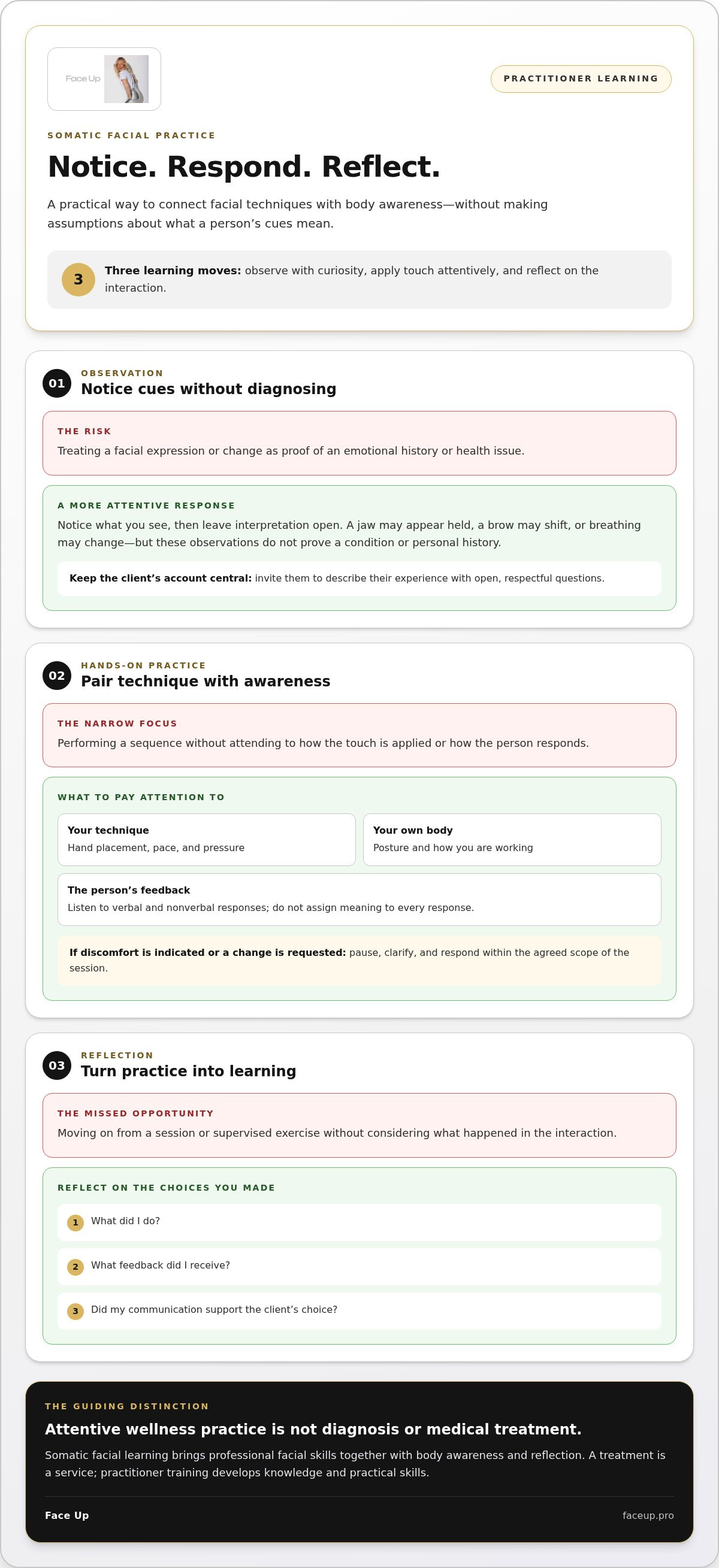
Somatic facial therapy training can develop more than a catalogue of hand movements. It brings together three useful areas of learning: observing without jumping to conclusions, applying facial techniques with awareness, and reflecting on how your choices shape an interaction. The emphasis is on working attentively, not interpreting every sensation or expression as evidence of a particular condition.
Somatic awareness matters in facial education because touch is more than a sequence of movements. It’s an interaction that calls for attention, choice, and clear communication. This perspective helps connect ideas about awareness and sensation with practical decisions: how a practitioner approaches touch, checks in, and adapts respectfully.
Reading Facial Tension with Curiosity and Care
Observation starts with noticing, not diagnosing. A practitioner might observe that the jaw appears held, the brow shifts, or the person’s breathing changes during a technique. These observations don’t prove an emotional history or health issue. They’re reminders to stay present, avoid assumptions, and give the client space to describe their experience.
The phrase “memory maps” can work as a metaphor for how facial patterns may feel connected to a person’s lived experience. It isn’t a clinical map or a way to decode someone’s past. In practice, curiosity means asking open, respectful questions and treating the client’s account, rather than the practitioner’s interpretation, as central.
Connecting Practical Techniques with Somatic Awareness
Practical learning and somatic awareness can be developed side by side. While practising a facial technique, a learner can attend to hand placement, pace, and pressure, while also noticing their posture and the client’s verbal or nonverbal feedback. If the client indicates discomfort or asks for a change, the practitioner can pause, clarify, and respond within the agreed scope of the session.
This approach doesn’t require practitioners to assign meaning to every response. Instead, it makes technique more considered: learners can reflect on what they did, what feedback they received, and whether their communication supported the client’s choice. A technique may be part of a wellness-focused facial experience, but it shouldn’t be presented as resolving a physical or emotional condition.
Building Reflective Practice
Reflection turns practice into professional learning. After a session or supervised exercise, consider: Was my touch clear and appropriate? Did I explain what I was doing? Did I invite feedback and respond to it? These questions can identify useful learning points without judging the client or claiming a particular result.
Over time, observation, practice, and reflection can support a more intentional approach to facial work. Face Up™ offers professional training within a wider focus on facial wellness and self-connection. Its program includes a curriculum and practical assessments, providing a structured setting for developing and reviewing applied skills.
How Does Somatic Facial Training Compare with Other Professional Learning?
Course names can sound similar even when the learning aims differ. Compare what the course centres on, what learners practise, and how the material relates to your professional work. Broad massage education, general facial courses, and somatic facial therapy training can all support professional development, but they aren’t interchangeable by default.
This table is a general comparison, not a universal curriculum. Course content varies, so look at the stated learning objectives and practical components to understand what a specific program teaches.
| Learning emphasis | Practical focus | Intended professional context |
|---|---|---|
| Broad massage education | Massage principles and, in somatic approaches, possible attention to movement or body patterns | Practitioners seeking broader bodywork knowledge |
| General facial courses | Facial techniques and treatment approaches, according to the course curriculum | Beauty and facial-care practice |
| Somatic facial learning | Facial work considered alongside body awareness, client experience, and practitioner reflection | Practitioners interested in a somatic perspective on facial practice |
Somatic Massage Education and Facial-Specific Learning
Broad somatic massage education may explore movement awareness, coordination, posture, or patterns of holding across the body. That wider perspective can be useful for practitioners whose work includes bodywork. Facial-specific learning narrows the practical focus to the face and considers how somatic awareness can inform facial touch, observation, and communication.
Neither focus is inherently better. The useful question is whether the course content matches the work you want to develop. This guide covers facial therapy training, not general somatic therapy or clinical mental health preparation. A course title alone doesn’t establish its scope or qualification.
Continuing Education, Specialist Courses, and Professional Training
Continuing education describes learning undertaken to build or refresh professional knowledge; a specialist course may concentrate on a particular topic or method. Professional training can provide a focused pathway into applying a specific approach. These labels can overlap, so assess the learning itself rather than assuming a label establishes course depth, assessment, credit eligibility, or recognition.
Start with your learning objective. Do you want to explore facial techniques, add a body-awareness perspective, or pursue structured learning in a particular method? Then compare the curriculum, practical components, and assessment. Face Up™ Training is a professional learning path with a curriculum, practical assessments, and professional accreditation. For more detail on its related pathway, see the Face Up Method certification guide.
How Can Practitioners Apply Somatic Facial Learning Thoughtfully?
New learning is most useful when it has a clear place in your existing practice. Somatic facial therapy training can offer ideas to explore, but integrating them thoughtfully means moving from study to practice with intention, reflection, and clear communication. The goal isn’t to promise a particular result or move beyond your professional scope. It’s to consider how facial techniques and body awareness may inform the way you work.
Set a Learning Goal That Fits Your Existing Practice
Begin by naming what you want to develop. You might want to refine facial techniques, understand somatic principles, or bring both interests together. A focused goal helps connect learning to your day-to-day work without assuming it will create a business advantage or a specific client outcome.
Use this sequence to make your learning goal practical:
- Identify your focus. Write down what you want to learn and how it relates to your current professional interests.
- Study the principles. Review how the course material frames facial work, awareness, and practitioner responsibility.
- Practise deliberately. Work with techniques in the learning context, noticing your pace, touch, and posture while following the instruction.
- Reflect on the process. Consider what felt clear, what needs more practice, and how you responded to feedback.
- Integrate gradually. Decide which elements fit your existing services, and explain any changes to clients before applying them.
Bring New Learning into Client Work Responsibly
Clear explanations help clients understand what a session involves. Describe the type of facial work, invite questions, and make room for clients to express preferences or ask for an adjustment. Pay attention to comfort throughout. Don’t interpret facial tension or a client’s response as proof of a health condition, emotional history, or hidden cause.
Reflective practice can support careful integration. After a session, note which techniques you used, how you communicated, and whether you stayed aligned with the agreed focus. This helps identify areas for continued learning without turning client feedback into a promised outcome. For related jaw-focused context, the TMJ massage therapy guide explores jaw tension. Facial therapy training itself shouldn’t be presented as diagnosing or treating a medical condition.
Keep the boundary clear: professional facial learning can inform wellness-focused practice, but it isn’t a substitute for clinical assessment or treatment. To explore a structured learning pathway that brings facial work and somatic principles together, explore Face Up™ professional training.
Explore Face Up™ Training as a Somatic Facial Learning Path
For beauty professionals and therapists interested in bringing facial work and somatic awareness together, Face Up™ Training offers a professional learning path within a broader approach to facial wellness and self-connection. It’s practitioner education with a curriculum, practical assessments, and professional accreditation. These elements give learners a structured way to engage with the method and review applied skills, rather than relying on technique practice alone.
A structured pathway combines a learning framework with practical assessment, giving learners a setting to demonstrate and review applied skills. Professional accreditation is also part of the program. It doesn’t promise a particular career outcome or imply recognition by a specific external body.
What Is the Face Up™ Training Approach?
Face Up™ connects facial work with a somatic perspective, bringing attention to wellness and self-connection alongside practical learning. Facial techniques aren’t presented in isolation from the experience of the person receiving touch. The approach invites practitioners to consider how they engage with facial work and how awareness can inform a more intentional practice.
Keep the learning pathways distinct. Face Up™ Training is professional education for practitioners. The Jaw Release by Face Up™ workshop and self-practice sessions offer other ways to engage with Face Up™; they aren’t the same as completing professional training. Choose based on whether you’re seeking practitioner development or a personal practice experience.
Take the Next Step in Your Professional Learning
Beauty professionals and therapists exploring facial somatic work may find this pathway relevant if they want to deepen their understanding of facial practice within a wider wellness perspective. As you assess it, consider how the approach connects with your professional interests and what kind of learning you want. The curriculum, practical assessments, and professional accreditation are concrete elements to weigh in your decision.
Somatic facial therapy training brings professional learning and body-aware facial work into closer conversation. To decide whether it fits, identify the skills you want to develop, consider how they relate to your practice, and review the training pathway with those goals in mind.
Explore Face Up™ Training to see how its professional learning path aligns with your development goals.
Let Your Next Learning Step Reflect Your Practice
Choosing somatic facial therapy training can be a considered way to explore how facial practice, body awareness, and professional development might align with your work. Let your interests guide the next step: decide what you want to learn, how it relates to your current practice, and the kind of approach you want to cultivate.
Face Up™ has been featured in Vogue, Elle, The Daily Telegraph, Marie Claire, SPA+CLINIC, Professional Beauty, and Mamamia. As you explore the brand’s perspective, keep your professional intentions at the centre. A considered learning choice can open space for fresh ideas while respecting the experience and skills you already bring to your work.
Ready to explore professional learning in facial somatic work? Explore Face Up™ Training and consider how it fits your development goals.
Frequently Asked Questions
What is somatic facial therapy training?
Somatic facial therapy training is professional education that brings facial techniques together with awareness of sensation and bodily experience. A learner might study how to approach facial touch while considering pace and pressure, rather than treating the session as a personal ritual. It supports professional understanding; it isn’t medical treatment or diagnosis and doesn’t promise physical or emotional change.
Who is somatic facial therapy training for?
Somatic facial therapy training may interest beauty professionals and therapists who want to explore facial work through a somatic lens. Start with a professional interest, such as bringing greater awareness to facial care or exploring how facial practice relates to wellness and self-connection. Consider whether that focus complements your existing work and the kind of professional learning you want.
How is somatic facial therapy training different from a facial massage course?
Somatic facial learning brings attention to body awareness and the client’s experience alongside facial techniques. A facial massage course may focus on massage skills, though its content depends on the curriculum. To compare courses, look at what learners are expected to study and practise, not just the title. Neither label alone establishes that courses have equivalent content or outcomes.
Does somatic facial therapy training include practical assessment?
Face Up™ Training includes practical assessments alongside a curriculum and professional accreditation. Practical assessment gives the program a way to include applied work as well as study. Assessment formats and pass criteria vary by program, so don’t assume a specific format or what a particular result represents.
Can beauty professionals use somatic facial training in an existing practice?
Beauty professionals can consider how learning may inform their approach to facial work, keeping it relevant to their existing services and professional scope. For example, a practitioner might explain the focus of a session more clearly or make room for client preferences. Training doesn’t guarantee business growth or a particular client response, and a new approach won’t suit every service or setting.
Is professional training the same as facial self-practice?
No. Face Up™ Training is practitioner-focused education, while self-practice sessions are for personal exploration. They serve different purposes: one supports professional learning, and the other offers an individual way to engage with facial practice. Exploring techniques for yourself isn’t the same as completing practitioner training.


