
The certificate with the most specific wording may not be the training that best prepares you for practice. If you’re comparing a buccal massage certification Australia offers, focus on whether the course teaches and assesses the techniques you want to use, not just what its certificate is called.
Course pages don’t always explain whether practical buccal techniques are demonstrated, practised and assessed, or what a certificate means for your existing qualifications, scope of practice and insurance. If you’re based in Sydney, compare online learning with locally accessible options, but don’t assume an in-person course is available nearby.
This guide explains how to assess a course’s curriculum, delivery, practical assessment and post-course support, and what to verify before enrolling. It also covers the Face Up Method Certification as a broader facial sculpting and somatic bodywork pathway, rather than assuming it’s a standalone buccal qualification. Use these checks to compare training options in Sydney or elsewhere in Australia.
Key Takeaways
- Compare a buccal massage certification Australia pathway by the skills it teaches and assesses, not certificate wording alone.
- Check the syllabus for direct instruction in the buccal techniques you intend to practise, plus guided practice and feedback.
- Before enrolling online or in person, ask about supervision, practice arrangements, assessment and post-course support.
- Clarify what a course credential represents and whether it fits your qualifications, professional scope and insurance needs.
- Consider the Face Up Method Certification as a broader facial sculpting and somatic bodywork programme, and verify whether its current curriculum covers your desired buccal techniques.
Buccal massage certification in Australia: what practitioners are actually choosing
Choosing a buccal massage certification Australia offers is different from booking a treatment as a client. Training should explain the techniques, give you appropriate opportunities to practise, and help you assess whether they fit your existing qualifications and professional scope. A course title alone won’t tell you whether you’ll gain usable, assessed skills.
What does buccal massage training teach?
Buccal massage generally refers to working with cheek-area facial muscles, sometimes by accessing them through the inside of the mouth. Course terminology varies, so ask for the syllabus instead of assuming “facial sculpting” or “intraoral” means the same thing across providers. Confirm whether the course teaches external techniques, intraoral techniques or both, and how each is practised and assessed.
Practical learning should also address relevant anatomy, hygiene procedures, informed consent and clear client communication. These topics help practitioners understand the work they’re being taught and make considered decisions about client comfort and their own limits. A course in general facial massage may cover external touch and overlapping areas, but that doesn’t establish that it teaches buccal techniques.
Be cautious about claims that buccal massage produces specific physiological or lasting cosmetic effects. It’s also useful to distinguish it from manual lymphatic drainage, a separate technique. Manual lymphatic drainage, which aims to encourage the natural drainage of the lymph, has its own context and terminology. A reference about that practice doesn’t establish the effects of a buccal massage course or treatment.
What does a course certificate mean in Australia?
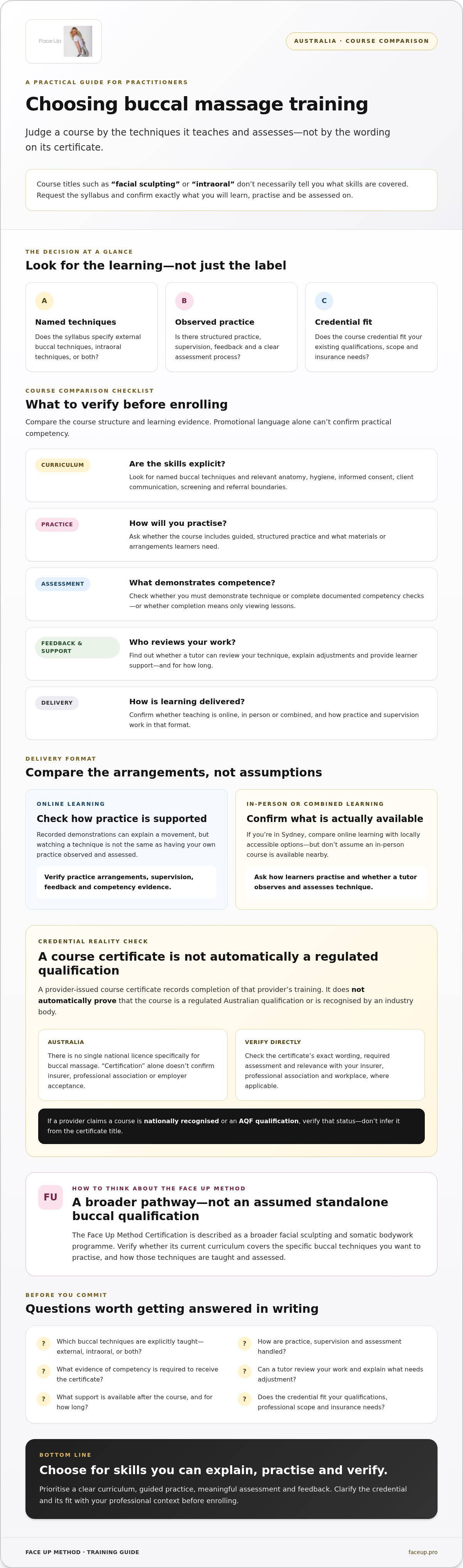
A provider-issued course certificate records completion of that provider’s training; it isn’t automatically a regulated Australian qualification or proof of industry recognition. Australia has no single national licence specifically for buccal massage, so “certification” alone doesn’t confirm that an insurer, professional association or employer will accept the training.
Before enrolling, check the credential’s exact wording and ask what assessment is required to receive it. Then confirm its relevance directly with your insurer, professional association and workplace, where applicable. If a provider describes a course as nationally recognised or an Australian Qualifications Framework (AQF) qualification, verify that status rather than inferring it from the certificate title.
Make your decision based on the skills you want to develop, the practical assessment offered and how the training aligns with your existing practice. If the course information leaves any of these points unclear, ask for written details before enrolling.
How to compare buccal massage courses: curriculum, practice, and assessment
Once you know what you want to learn, compare the course structure rather than relying on promotional language. A useful outline names buccal techniques and explains how learners practise them. “Facial sculpting” may describe a broader programme, but it doesn’t confirm that intraoral work is taught or assessed. For a buccal massage certification Australia course, ask the provider to clarify the exact curriculum before you enrol.
| What to compare | What to verify |
|---|---|
| Curriculum | Are buccal techniques named? Do modules cover relevant anatomy, demonstrations, hygiene, consent, client communication, screening and referral boundaries? |
| Guided practice | Does the course include structured practice, and what materials or arrangements do learners need? |
| Assessment | Must you demonstrate technique or complete documented competency checks, or is completion based on viewing lessons? |
| Feedback | Can a tutor review your work and explain what needs adjustment? |
| Support | What access to tutors and learner support is included, and for how long? |
| Delivery format | Is teaching online, in person or a combination, and how are practice and supervision handled? |
These details help you judge practical training without assuming one format suits everyone. Recorded demonstrations can explain a movement, but watching a technique isn’t the same as having your own practice observed and assessed. Ask what evidence of competence is required and whether feedback is individual, live or provided after submission.
Online learning may reduce travel and offer flexibility, but check whether you’ll have suitable practice arrangements and tutor guidance. For in-person training, consider travel, scheduled attendance and the amount of supervised practice. If you’re comparing Australian qualifications with short-course specialisation, training.gov.au’s Diploma of Beauty Therapy listing provides official qualification information. Don’t assume a private short course is equivalent.
Claims about confidence or client results aren’t substitutes for clear learning outcomes and assessment criteria. Ask for the syllabus and assessment details in writing if they’re not published. If you’re also considering a broader facial sculpting and somatic bodywork pathway, review the Face Up Method Certification and confirm whether its current curriculum covers the specific buccal techniques you want to learn.
Choosing a buccal massage course for Sydney or Australian practice
Being able to enrol from Sydney doesn’t mean a course includes Sydney-based teaching. Providers may offer online training to Australian learners without running local in-person sessions, so check the current delivery schedule rather than inferring availability from Australian marketing. Choose a format based on how you’ll practise, the supervision you need and whether the assessment suits your learning needs.
What should Sydney practitioners verify before enrolling?
Ask the provider whether any in-person component is held in Sydney or whether the training is fully online. For online courses, clarify whether live supervision is available, how practice is arranged, which time zone applies to scheduled sessions, how to contact tutors and how assessment works. Request details of the documents you’ll receive on completion and the provider’s exact description of the credential.
These checks matter because “available in Australia” doesn’t necessarily mean local classes, live feedback or an Australian qualification. The National Training Register’s entry for SIBBFAS404A can help you review nationally recognised treatment standards in the context of facial treatment training. It doesn’t establish that a particular course teaches buccal massage or that its certificate will be accepted for your intended work.
Will the training fit your existing practice?
Consider the techniques you plan to offer, your current qualifications and the clients you work with. Ask your insurer, professional association or employer whether they accept the course for those specific services. Don’t assume a buccal course is locally accredited or legally required simply because it uses the word “certification.” Check applicable requirements and your professional obligations directly, particularly if the training includes intraoral techniques.
Keep education claims distinct from treatment claims. A course may teach massage techniques without establishing that they treat a medical condition. For additional context, see this guide to TMJ massage therapy, and assess whether the course’s teaching and claims match your intended scope of practice.
If you’re weighing a focused buccal course against a broader professional pathway, the facial sculpting certification guide offers another point of comparison. Face Up Method Certification is a broader facial sculpting and somatic bodywork programme, not a confirmed standalone buccal qualification. Review its current curriculum and verify whether it covers the techniques you want before deciding if it fits your practice.
Questions to ask before paying for buccal massage training
Before choosing a buccal massage certification Australia course, turn unanswered questions into a short written checklist. Clear responses make it easier to compare the training with your practice needs and give you a record of the provider’s explanation.
- Syllabus: Does the outline explicitly name buccal techniques, and what topics and learning outcomes are covered?
- Educator: What relevant experience does the tutor have, including teaching the techniques advertised?
- Practice and assessment: How will you practise, what must you demonstrate, and how will your skills be reviewed?
- Support: Who answers technique questions, and how can learners contact them?
- Certificate: What is the exact certificate title, who issues it, and what does the provider mean by any accreditation or recognition claim?
- Terms: What are the prerequisites, course inclusions, access period and refund conditions?
If the course page doesn’t answer a curriculum question, ask the provider to clarify it in writing before paying. Testimonials can describe learners’ experiences, but they don’t show whether buccal techniques are directly taught or how practical competence is assessed. Check for published learning outcomes and assessment criteria as well.
How can you assess the course provider?
Review the educator’s background against the specific techniques in the syllabus, not just general experience in beauty, massage or facial work. Check that the course explains what learners should be able to do and how their skills will be evaluated. Ask who provides support and how technique questions are handled, especially for online learning. A prompt, specific answer is more useful than a broad assurance about confidence or results.
What should you confirm about the certificate?
Request the exact certificate title and issuing organisation. If the provider uses terms such as “accredited,” “recognised” or “certified,” ask what each means and which organisation is responsible. Then confirm acceptance directly with the insurer, professional association or employer whose requirements matter to your work. A provider’s description alone can’t establish that another organisation recognises the training.
Read the current terms before committing. Check whether the course has prerequisites, what learning materials and tutor support are included, how long you can access the content, and what happens if you need to withdraw. Keep the answers with the course outline so you can compare providers on the same basis.
If a broader facial sculpting and somatic bodywork pathway also fits your goals, explore the Face Up Method Certification. Review its current curriculum and credential information, and confirm whether it covers the specific buccal techniques you’re seeking before enrolling.
Is the Face Up Method Certification the right next step?
The Face Up Method Certification may suit practitioners looking for a broader framework in facial sculpting and somatic bodywork. Don’t treat it as a confirmed standalone buccal massage certificate: check the current curriculum for the specific techniques you want to learn, including whether it covers intraoral work and how those skills are assessed.
Programme information describes a curriculum, practical assessments and professional accreditation. These are useful points to investigate, but they don’t establish that a particular buccal technique is included or that the credential meets an Australian insurer’s, employer’s or association’s requirements. If your priority is a dedicated buccal massage certification Australia pathway, compare the programme with that goal before deciding.
Who may benefit from a broader facial sculpting pathway?
This pathway may be worth considering if you want to expand beyond a single technique and explore facial sculpting alongside somatic bodywork. Its fit depends on your existing practice, the services you plan to provide and the programme’s confirmed content. Compare the learning outcomes with your goals rather than assuming a broader method includes every specific technique or suits every practitioner.
What should you confirm with Face Up before enrolling?
Check the current programme information and ask Face Up whether its modules cover the buccal techniques you’re seeking, what practical assessment involves and what support is available. Also confirm the current delivery format and enrolment availability for Australian learners. Face Up offers global digital professional training, but verify the arrangements for the programme you’re considering rather than assuming a particular schedule or format.
Ask for a clear explanation of the professional accreditation wording, including what it represents and who recognises it. Then check its relevance with the organisations that set requirements for your practice. Don’t assume it’s an Australian government qualification or that it will be accepted automatically.
If the curriculum and professional requirements align with your goals, explore the Face Up Method Certification and review the current programme information before taking the next step.
Choose training that fits your practice
A suitable buccal massage certification Australia option should clearly teach the techniques you want to use, assess practical skills and align with your existing practice. Before enrolling, verify the syllabus, supervision and assessment arrangements, certificate wording, and whether your insurer, association or employer accepts the training for your intended work.
For a broader facial sculpting and somatic bodywork pathway, the Face Up Method Certification includes a curriculum, practical assessments and professional accreditation, according to the programme information. Face Up offers globally accessible digital professional training, but confirm current delivery details, accreditation wording and whether the curriculum covers your desired buccal techniques. Professional accreditation shouldn’t be assumed to mean an Australian government qualification or automatic recognition.
If that wider approach suits your goals, explore the Face Up Method Certification and review the current programme information. Confirm the details that matter to your practice before deciding whether it’s the right next step.
Frequently Asked Questions
Is buccal massage certification required to practise in Australia?
There’s no single national licence specifically for buccal massage in Australia, but requirements can vary by practice setting. Check the laws and professional standards that apply in your state or territory, and confirm that your work fits your qualifications, scope and insurance. If techniques involve intraoral contact, ask about hygiene procedures and verify any relevant requirements with the appropriate authorities and professional organisations.
Can I study buccal massage online in Sydney?
You can investigate online training while based in Sydney, but check that the current course teaches the techniques you want. Online availability doesn’t mean a provider runs in-person sessions in Sydney or offers live supervision. Before enrolling, confirm the delivery format, Australian learner support, time zones for scheduled teaching, practice arrangements and how practical skills are assessed. Ask the provider to confirm current enrolment availability.
What should a buccal massage certification course include?
A suitable course should clearly describe its curriculum, including whether buccal techniques are taught externally, intraorally or both. Look for relevant anatomy, demonstrations, hygiene, consent, client communication and guidance on screening or referral boundaries. Check how you’ll practise and whether assessment involves demonstrating skills and receiving feedback. A broad facial massage or sculpting course title alone doesn’t confirm that specific buccal techniques are included.
How do I know whether a buccal massage certificate is recognised in Australia?
Ask the provider for the certificate’s exact title, issuing organisation and a written explanation of any accreditation or recognition claim. A provider-issued certificate doesn’t automatically establish recognition by Australian employers, insurers or professional associations, or make it a nationally recognised qualification. Check directly with the organisation whose requirements matter to your work, and verify any claim of formal qualification through the relevant official register.
Does the Face Up Method Certification teach buccal massage?
The Face Up Method Certification is a broader facial sculpting and somatic bodywork programme, not a confirmed standalone buccal massage certificate. The programme information describes a curriculum, practical assessments and professional accreditation, but review the current modules and ask Face Up whether they cover your desired buccal techniques and how those skills are assessed. Confirm current delivery details and clarify what the accreditation wording means before enrolling.
Can a facial massage practitioner add buccal massage to their services?
Possibly, but a general facial massage background doesn’t automatically establish that you’re prepared or covered to provide buccal techniques. Compare the course content with your existing qualifications and intended services, then check directly with your insurer, professional association and employer, if relevant. Confirm any applicable state or territory requirements and whether intraoral work is within your scope. Base your decision on verified training and professional guidance, not the certificate title alone.
What is the difference between buccal massage training and a facial massage course?
Buccal massage training should identify the cheek-area techniques it teaches and explain how learners practise and are assessed. A general facial massage course may focus on external massage and broader techniques without covering intraoral work. Read the module descriptions and ask the provider to confirm the exact content. Don’t assume that terms such as “facial sculpting” or “advanced facial massage” mean buccal methods are included.
How can I compare buccal massage courses before enrolling?
Compare the published syllabus, tutor experience, guided practice, assessment, feedback, learner support and delivery format. Ask whether buccal techniques are explicitly taught, what practical work is required and how competency is checked. Review prerequisites, access period, inclusions and refund terms in the current course conditions. If key details are missing, request written answers. These checks help you assess buccal massage certification Australia options against your practice needs rather than relying on promotional claims.


