
The course with the most impressive title may not be the one that moves your practice forward. Choosing among upskilling courses for estheticians 2026 starts with a more useful question: what capability do you need next?
It’s easy to see why the choice can feel complicated. Some programs prepare you for a licence or advanced licence, while others build specialist skills for practitioners who already meet local requirements. A polished course description doesn’t always make its hands-on relevance, assessment, or recognition clear.
This guide will help you compare practical training paths and decide which one fits your professional goals, whether you’re considering advanced treatments, manual techniques, or a holistic approach such as facial sculpting and somatic bodywork. You’ll learn what to look for in course content, practical assessment, delivery format, and learner support, and how to check requirements and recognition where you work.
Rather than collecting certificates because a skill is trending, you’ll be able to build a location-aware learning plan around the next step you actually want to take.
Key Takeaways
- Choose upskilling courses for estheticians 2026 by identifying the capability your practice needs next, not by chasing a trend or adding certificates.
- Distinguish training for initial or advanced licensing from specialist development designed for already-qualified practitioners.
- Compare course content, instructor experience, practical work, assessment, feedback, and follow-up support before enrolling.
- Check local requirements and recognition with the relevant authority or employer. Course completion alone may not meet licensing or workplace expectations.
- For a specialist path in facial sculpting and somatic bodywork, consider how the Face Up Method Certification’s curriculum and practical assessments align with your goals.
Upskilling Courses for Estheticians in 2026: Start With Your Practice Goals
The most useful course isn’t necessarily the one with the broadest syllabus or the most impressive certificate. Upskilling is targeted learning for practitioners who already have foundational training and want to strengthen a specific capability. It differs from initial esthetics education, which prepares learners to enter the profession and may be tied to local licensing requirements.
Start with a brief skills audit before exploring upskilling courses for estheticians 2026. Note where you feel confident and where you hesitate: treatment technique, client communication, hygiene and safety routines, or the business skills needed to explain and manage a service. Look for patterns in client requests and questions you find difficult to answer. These can point to a learning need more clearly than a trending course title.
Three types of professional learning
- Continuing education: Learning that updates or extends professional knowledge. Whether it’s required for renewal depends on your location.
- Specialist training: Focused instruction in a particular technique or area of practice, often intended to build on existing experience.
- Formal credentials: Qualifications or licences issued or recognized by an authorized body. A private course certificate may document completion without being a formal credential.
Which professional goal should your next course support?
Match the learning format to the outcome you want. Adding a service may call for structured instruction and supervised practice; refining a familiar technique may benefit from focused demonstrations and feedback. If client conversations are the challenge, look for training in consultation and communication rather than more treatment steps.
Before browsing, write one observable outcome, such as demonstrating a technique in a consistent sequence or explaining a service’s limits clearly. A specific priority makes course comparisons more relevant and gives you a way to review your progress afterward.
Is upskilling the same as qualifying as an esthetician?
No. Advanced training generally builds on existing knowledge, though each provider sets its own entry criteria. Esthetics roles and training pathways can vary by location. The licensed professionals who are experts in improving skin overview offers general context, not a substitute for local guidance.
A course certificate shows what you completed; it doesn’t automatically authorize you to perform a service where you work. Before offering a newly learned treatment, check with the relevant regulator whether your licence, scope of practice, and any additional requirements allow it. Confirm the rules in your jurisdiction rather than assuming a course’s recognition is universal.
Explore Esthetician Upskilling Courses by Skill Area and Format
Once you’ve named a learning goal, compare courses by the capability they teach and how they teach it. The Employment of skincare specialists outlook from the U.S. Bureau of Labor Statistics projects 7% growth from 2024 to 2034. That context may make professional development feel timely, but it doesn’t mean every popular specialty will suit your practice or lead to a particular career outcome.
- Advanced facial techniques: Focused study may cover manual approaches such as facial sculpting or other specialist techniques. Look for clear instruction, opportunities to practise, and feedback suited to your current skill level.
- Holistic approaches: Courses in facial work and somatic bodywork may appeal if you want to explore how tension and relaxation relate to your approach to client care. Check the method, intended scope, and practical requirements.
- Client care: Consultation, communication, and professional boundaries can strengthen the client experience without adding a new treatment to your menu.
- Practice management: Business-focused learning may address service descriptions, client processes, or other operational skills. Compare the syllabus with the specific task you want to improve.
Some services are invasive or regulated. Before training for one, verify local authorization and any separate education requirements with the relevant regulator. A course provider’s description alone may not establish that you’re permitted to offer the service.
Which course subjects can expand an esthetician’s skills?
Short workshops can provide a concentrated introduction or help refine one technique. A structured certification programme may offer a broader curriculum and formal assessment, while continuing-education pathways can support ongoing learning across topics. None is automatically best. Choose based on the skill, depth of practice, and evidence of learning you need. Match the format to the skill: theory can be taught online, but hands-on techniques need meaningful practice and feedback.
Should you choose online, in-person, or blended training?
Online study can offer scheduling flexibility and replayable theory. In-person learning allows live demonstration and may make it easier to practise with direct observation. Blended courses can combine both, but the label alone doesn’t explain how practical work is handled. Ask who observes your technique, how it’s assessed, and whether you receive specific corrections before applying the training in practice.
Delivery and practical requirements vary by provider. Before enrolling, confirm the current format, equipment or practice expectations, feedback process, and prerequisites. If facial sculpting and somatic bodywork align with your learning goal, explore the Face Up Method Certification as one specialist training option, then compare its current curriculum and assessment with your needs.
How to Compare Esthetician Courses Beyond the Certificate
A certificate can document completion, but it doesn’t tell you how much you practised, what you can demonstrate, or whether the training is relevant to your goals. Compare upskilling courses for estheticians 2026 by the learning experience and recognition you need, not just the credential’s title.
Use this checklist to compare providers side by side. Ask for details directly, especially when course pages use broad terms such as “accredited,” “professional,” or “hands-on.”
| What to compare | Questions to ask |
|---|---|
| Syllabus | Are topics, learning outcomes, and service boundaries clearly described? |
| Instructor experience | What relevant experience and teaching background does the instructor have? |
| Practice | How much guided practice is included, and what does it involve? |
| Assessment | Is there an assessment? What skills or knowledge must learners demonstrate? |
| Feedback | Will an instructor observe your work and explain how to improve it? |
| Follow-up support | What resources or learner support are available after the course? |
Separate different kinds of recognition. A course completion certificate records that you finished a provider’s programme. Professional accreditation refers to recognition by an accrediting body, while a government-issued licence or legally recognized qualification has a different status. Employers may assess training according to their own criteria. A certificate alone can’t guarantee competence, client demand, or business results.
What evidence shows a course teaches practical competence?
Look for observable learning outcomes, guided practice, clear assessment criteria, and a defined way to receive corrections. Ask whether you can observe the technique, practise it, and have your work reviewed by an instructor. Testimonials and polished descriptions may offer context, but they aren’t substitutes for a transparent curriculum. For a closer look at one specialist pathway, read the facial sculpting certification guide.
How should you verify accreditation and local relevance?
Ask who issues a credential and what any stated accreditation or recognition means in practice. Confirm prerequisites, delivery format, assessment standards, and current recognition claims with the provider. Then check the relevant regulator’s guidance for the services you plan to offer. Don’t assume a credential travels across regions or countries; verify portability with the appropriate authority. The Professional Beauty Association (PBA) can also be a starting point for industry resources, but local requirements still need to be checked with the relevant regulator.
Build a Practical 2026 Upskilling Plan for Your Esthetics Career
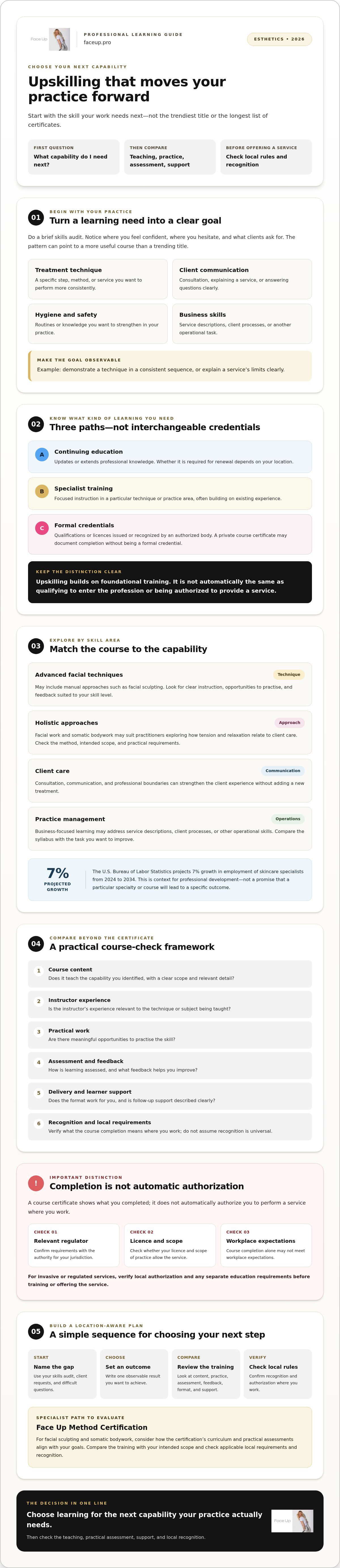
A course is more likely to serve your practice when it fits into a clear learning plan. Use these five steps to move from a general interest to a practical next action. Keep your educational choice separate from your legal scope: completing training does not itself change what you’re authorized to offer.
- 1. Audit your skills. Note what feels consistent and where you need more knowledge, practice, or feedback.
- 2. Set one outcome. Describe what you want to be able to do or explain by the end of training.
- 3. Shortlist courses. Compare each course’s outcomes, prerequisites, practice components, and assessment against that goal.
- 4. Verify requirements. Check current rules with the regulator relevant to the location where you practise, and confirm course details with the provider.
- 5. Schedule practice. Set aside time for learning, deliberate practice, feedback, and review before enrolling.
Before the course begins, record a baseline. For a technique, note which steps you can demonstrate without prompts; for consultation skills, identify which client questions you can answer clearly. Choose observable evidence of progress, such as completing a sequence accurately during practice or explaining the service’s limits in your own words. This gives you something concrete to revisit after training.
How do you turn a learning goal into a course shortlist?
Compare the outcome you want with the syllabus, entry requirements, practical components, and assessment method. Check whether the course schedule fits your work and whether you can make time to practise afterward. If the course description doesn’t explain who assesses your work or what a credential represents, contact the provider with specific questions before committing.
How can you apply new learning responsibly?
Build in deliberate practice and seek feedback before considering a newly learned technique for regular client sessions. Confirm that the service is permitted under the requirements where you practise, and communicate clearly with clients about what the service involves. A course can support learning, but it doesn’t expand local authorization on its own.
After practice, review your baseline and note what has improved, what still needs correction, and what evidence supports your assessment. Then decide whether you need more practice, additional guidance, or a different learning goal. This keeps upskilling courses for estheticians 2026 connected to professional development rather than certificate collection.
If facial sculpting and somatic bodywork fit your next learning goal, explore the Face Up Method Certification and review its current curriculum and assessment alongside your local requirements.
Consider the Face Up Method Certification for Facial Sculpting and Somatic Bodywork
Among the upskilling courses for estheticians 2026, the Face Up Method Certification is a specialist option for practitioners interested in combining facial sculpting with somatic bodywork. The method focuses on releasing deep muscular and emotional tension in the face and neck as part of a natural rejuvenation approach. It may suit practitioners looking to develop a focused way of working with facial tension rather than seeking broad esthetics training.
The programme includes a curriculum, practical assessments, and professional accreditation. These elements help clarify what learning and assessment are involved, but accreditation does not automatically mean a credential is recognized by every employer or regulator. Consider the programme alongside your goals, existing experience, and the requirements where you intend to practise.
Who may want specialist training in facial sculpting?
Practitioners who want to develop a dedicated facial sculpting approach may find this method relevant, particularly if they’re curious about the relationship between facial and neck tension and somatic bodywork. For additional context on jaw tension and related advanced techniques, explore specialized educational resources on localized muscular release. Whether the certification fits depends on your background, its prerequisites, your intended services, and what local professional rules permit.
What should you confirm before enrolling?
Review the current curriculum and prerequisites directly with Face Up. Ask how practical assessments work, what learners need to demonstrate, and what feedback is provided. Confirm the current delivery format, availability, and the exact meaning of the programme’s professional accreditation. These details can change, and recognition may differ across locations, so check with the relevant regulator or employer if local acceptance matters to your plans.
Once you’ve assessed your goals and requirements, you can Explore the Face Up Method Certification and decide whether this focused pathway belongs in your professional development plan.
Choose Your Next Skill With Confidence
The right upskilling courses for estheticians 2026 begin with a clear professional goal. Identify the capability you want to build, then compare course content, practical learning, assessment, and support rather than relying on a certificate title alone. Before applying a newly learned service, check the requirements where you practise; training doesn’t automatically change your authorized scope.
If facial sculpting and somatic bodywork match your direction, the Face Up Method Certification offers a focused learning path. Its programme includes a curriculum, practical assessments, and professional accreditation. Face Up also provides digital professional training to a global audience. Recognition can differ by jurisdiction, so confirm what the accreditation means locally and review current programme details before deciding.
Explore the Face Up Method Certification to see whether this specialist pathway aligns with your goals and requirements. Choose your next step based on the skills your practice genuinely needs.
Frequently Asked Questions
What are the best upskilling courses for estheticians in 2026?
The best course is the one that develops a capability your practice needs. Compare upskilling courses for estheticians 2026 by learning goal: advanced facial techniques, holistic approaches, client communication, or business skills. Then review the syllabus, prerequisites, practical learning, assessment, and instructor feedback. A specialist workshop may suit a focused technique, while a broader programme may fit a larger development goal. Check local requirements before training for a regulated service.
Can estheticians take advanced courses without a licence?
Sometimes, but entry requirements vary by provider and programme. A course may accept learners without a current licence, while another may require relevant professional experience or existing credentials. Ask the provider what prerequisites apply and whether the programme is intended for qualified practitioners. Being allowed to enrol doesn’t establish that you’re authorized to offer a service. Check the relevant regulator’s rules for your location and intended practice before providing a newly learned treatment.
How do I choose an esthetics course that is worth it?
Choose by matching the course to a specific, observable learning goal. Review the syllabus, instructor experience, practice opportunities, assessment criteria, feedback, and learner support. Confirm what the certificate represents and whether its recognition matters to your employer or regulator. Ask the provider about unclear details before enrolling. A course is a stronger fit when its teaching approach and practical requirements align with the skill you want to build and the time you can commit.
Are online esthetician upskilling courses effective?
Online courses can be effective for theory, demonstrations, and material you may want to revisit. Their suitability depends on what you’re learning and how the provider supports practical skills. For hands-on techniques, ask how practice is observed, assessed, and corrected, and whether feedback comes from an instructor. Check the delivery format, practical requirements, and learner support before enrolling. An online label alone doesn’t show whether a course offers enough applied learning for your goal.
Does a course certificate allow me to offer a new esthetic service?
No, a course certificate doesn’t automatically authorize you to offer a new service. It usually records completion of a provider’s training, which is different from a government-issued licence or legal permission to practise. Requirements depend on your location and the service involved. Before adding a treatment, check with the relevant regulator whether your existing credentials and scope of practice allow it. If you work for an employer, confirm their requirements as well.
What should an advanced esthetics course include?
A well-described advanced course should explain its learning outcomes, syllabus, prerequisites, instructor experience, and intended audience. For practical techniques, look for guided practice, a clear assessment process, and specific feedback on performance. Training should also clarify professional boundaries and what the course credential represents. Ask what support is available after the course and how practical work is evaluated. These details help you judge whether the programme offers relevant learning, not just a certificate.
Is facial sculpting training suitable for practicing estheticians?
It may suit practicing estheticians who want to develop a focused approach to facial sculpting and are interested in somatic bodywork. The Face Up Method Certification combines these areas and focuses on releasing deep muscular and emotional tension in the face and neck. The programme includes a curriculum, practical assessments, and professional accreditation. Before enrolling, review current prerequisites and programme details, then verify whether the training fits your intended practice and local professional requirements.


