

What if the most polished course description tells you the least about how prepared you’ll feel working with clients? A somatic facial therapy course may use familiar language around sculpting, touch, or nervous system awareness, yet the techniques, opportunities to practise, feedback, and professional expectations can differ considerably.
Before committing, look beyond the method name. Find out what you’ll learn, how you’ll practise, whether your skills will be assessed, and what the training does and doesn’t allow you to offer professionally.
This guide gives you practical criteria for comparing course structure, hands-on learning, instructor feedback, assessment, and ongoing support. It also explains what to verify about scope of practice, insurance, and business readiness, since requirements depend on your existing qualifications and location. Use the questions here to compare providers and decide whether a course fits your goals. A certificate or course title alone doesn’t guarantee a particular credential or permission to practise, so confirm what completion means and what steps you’ll need to take next.
Key Takeaways
- Course names can sound alike while teaching different approaches, so compare stated learning outcomes rather than relying on modality labels.
- When evaluating a somatic facial therapy course, check whether learning includes supervised practice and specific instructor feedback, not demonstrations alone.
- Use a consistent comparison framework to assess intended audience, practice format, assessment, and resources available after training.
- Confirm how your existing qualifications, location, planned services, and insurance policy affect what you can offer professionally.
- Explore the Face Up Method Certification as one training option, and verify its current details against your goals and professional boundaries.
What does a somatic facial therapy course teach, and what does it not?
Course names often overlap. “Somatic,” “facial sculpting,” and “facial therapy” may appear in similar descriptions, but those labels alone don’t tell you which techniques are taught or how much hands-on practice is included. Start with the syllabus, learning outcomes, and entry requirements. Look for named techniques and specific descriptions of what learners will practise, rather than broad promises about a method.
A somatic facial therapy course is training that may combine face-focused techniques with attention to bodily sensations and the client’s experience; the term doesn’t describe one universally defined curriculum. The word “somatic” can refer to different approaches. For background on one distinct approach, read this overview of Somatic Experiencing, then check whether a course teaches that approach, draws on broader somatic ideas, or uses the term differently.
How is somatic facial therapy different from adjacent training?
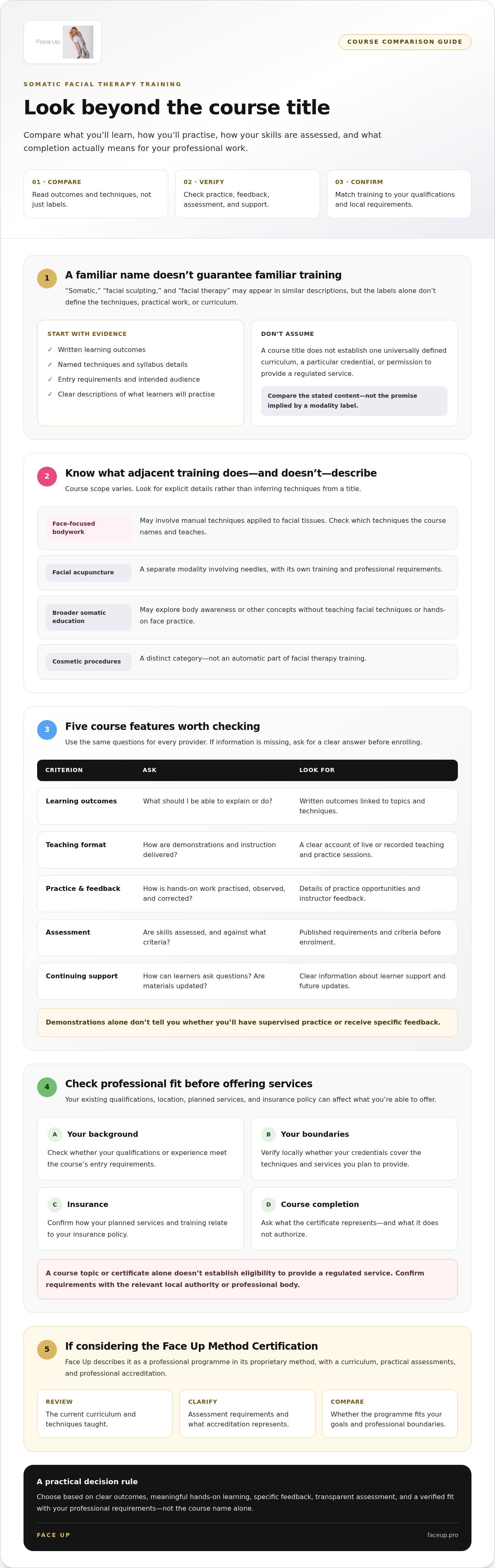
Course scope varies, so don’t infer content from a title. Face-focused bodywork may involve manual techniques applied to facial tissues, while facial acupuncture is a separate modality involving needles and its own training and professional requirements. Broader somatic education may explore body awareness or other concepts without teaching facial techniques or hands-on face practice. Cosmetic procedures are another distinct category, not an automatic part of facial therapy training.
Before enrolling, look for explicit descriptions of techniques, practice opportunities, and intended outcomes. Face Up offers the Face Up Method Certification, a professional programme in its proprietary method. The programme includes a curriculum, practical assessments, and professional accreditation. Ask Face Up for current details about the curriculum, assessment requirements, and what the accreditation represents rather than inferring them from the certification name.
Who might consider this type of course?
Facialists, massage practitioners, and holistic wellness professionals may explore additional training when it aligns with their existing work and professional goals. Check both sides of the fit: whether the course accepts your background, and whether its prerequisites and content suit your education and the services you’re permitted to provide where you practise.
- Review entry requirements: Check whether prior qualifications or experience are expected, and whether your current background meets them.
- Check your professional boundaries: Confirm locally whether your existing credentials cover the techniques and services you plan to offer.
- Clarify what completion means: Ask the provider what the course certificate represents and what it does not authorize.
A course topic is an area of study, not a guaranteed professional qualification or licence. Completing training alone doesn’t establish that you’re eligible to provide a regulated service. Verify requirements with the relevant local authority or professional body before practising.
Which course features matter most in somatic facial therapy training?
A strong course description should show what you’ll learn and how you’ll develop practical skills, not just introduce a method. Use the checklist below to compare the information providers publish. If a detail is missing, ask for a clear answer before enrolling.
| Criterion | Question to ask | Evidence to request |
|---|---|---|
| Learning outcomes | What should I be able to explain or do by the end? | Written outcomes linked to course topics and techniques. |
| Teaching format | How are demonstrations and instruction delivered? | A clear description of live or recorded teaching and any practice sessions. |
| Practice and feedback | How is hands-on work practised, observed, and corrected? | Details of practice opportunities and how instructor feedback is provided. |
| Assessment | Are skills assessed, and against what criteria? | Published assessment requirements and criteria before enrolment. |
| Continuing support | How can learners ask questions, and are materials updated? | Clear information about learner support and future course updates. |
How much practical learning and feedback should you look for?
There’s no single format every learner needs, but you should know how practice works before signing up. Ask whether you practise techniques yourself, whether anyone observes that practice, and how corrections are delivered. If practice involves a partner, clarify how it is organised and whether an instructor can see or review your work. A recorded demonstration can help you revisit a technique, but access to video lessons alone doesn’t show that your practical competency has been assessed.
For hands-on work, transparent prerequisites and assessment criteria help you judge whether the training fits your experience and what the provider expects you to demonstrate. If a course mentions assessment, ask what is assessed, who evaluates it, and whether you’ll receive specific feedback. Don’t assume that a certificate indicates a practical skills assessment unless the provider explains what was evaluated and how.
What should a transparent course description include?
Look for stated learning outcomes, entry requirements, delivery details, practice expectations, and a clear explanation of what completion represents. The description should also tell you how to raise questions, what learner support is available, and whether course materials may be updated. If those details aren’t published, ask for them before committing, especially if you need to plan around work or other study.
For broader professional resources, Associated Skin Care Professionals (ASCP) may be a useful reference for estheticians. Keep that separate from course-specific support: an industry resource doesn’t verify a training provider’s curriculum or assessment.
Use these questions to review the Face Up Method Certification as one option. Face Up describes its professional certification programme as including a curriculum, practical assessments, and professional accreditation. Verify the current curriculum, delivery, assessment process, and support directly with Face Up.
How can you compare somatic facial therapy courses fairly?
Compare what providers can show you, not what a course title suggests. Marketing labels, testimonials, and the word “certification” don’t establish that two programmes teach the same skills or carry the same professional recognition. Use the table to record published details, then note any unanswered questions. This makes it easier to compare like with like instead of relying on the most appealing description.
How do facial sculpting, acupuncture, and somatic courses compare?
These may be distinct learning pathways. Facial sculpting courses may focus on manual techniques for the face; acupuncture training concerns needle-based practice; broader somatic education may address body awareness or mind-body concepts without teaching facial techniques. A course may combine elements, but don’t assume it does. Check which techniques are included, and whether any require separate qualifications where you practise.
| Pathway or criterion | Audience and focus | Practice, feedback, assessment, and resources: questions to ask | Self-fit |
|---|---|---|---|
| Facial sculpting or face-focused bodywork | Who is the course designed for, and which facial techniques are included? | How is practice taught and observed? What feedback or assessment is provided? Are resources available after completion? | Does it build on your prior training and suit the services you intend to offer? |
| Facial acupuncture | Does the syllabus specifically teach acupuncture, and what prerequisites apply? | What practical instruction and assessment are included? Which qualifications must learners already hold? | Does this pathway match your professional background and local requirements? |
| Broader somatic education | Does the course address general somatic principles, facial work, or both? | Is learning primarily conceptual, experiential, or hands-on? How are skills assessed, and what post-course materials are provided? | Does the format meet your client-related learning goals and fit your available study time? |
Unknown details are questions to put to the provider, not proof of a course’s weakness. For context on body psychotherapy and somatic practice, you can consult the United States Association for Body Psychotherapy (USABP). This doesn’t establish that a specific course is recognised or suitable for your work.
Which evidence is useful when assessing a provider?
Look for the instructor’s relevant background, clearly stated learning outcomes, and a concrete explanation of how learners receive feedback. Ask for sample assessment criteria or an example of the feedback process, if available. Testimonials can offer personal perspectives, but they don’t prove universal results, practical competency, or professional recognition.
If a provider claims accreditation or a recognised credential, check who awards it, what the claim means, and whether it matters in your location. Your comparison should also reflect your prior training, preferred learning format, intended clients, and the time you can commit. For more context on Face Up’s approach, see this facial sculpting certification guidance, then verify current programme details directly with the provider.
What should practitioners verify about scope, insurance, and business readiness?
Training is only one part of preparing to offer a service. Before adding techniques to your practice, check how they fit your existing qualifications, local professional requirements, planned client services, and insurance cover. These details vary by location and policy, so confirm them with the relevant local authorities, professional bodies, and insurer rather than relying on a course description.
Course completion alone does not establish insurance eligibility or local authorisation to provide a service. Treat both as separate checks before you work with clients.
How should you check professional liability insurance?
Describe the exact techniques and services you plan to provide when speaking with a qualified insurer. Broad phrases such as “facial therapy” may not tell an insurer enough to confirm whether a particular activity is covered. Ask about policy limits, exclusions, claims conditions, and whether your existing qualifications or additional training affect eligibility. Request the relevant terms in writing and review them carefully. This is due diligence, not legal advice.
Requirements can differ between jurisdictions and professional roles. Verify your scope with the appropriate regulator or professional body where you intend to practise. Don’t assume that insurance cover, a course certificate, or another practitioner’s experience automatically applies to your situation.
How can you assess whether training fits your practice?
Map the course’s stated learning outcomes against your current qualifications, intended services, and the needs of your clients. Identify any gaps before enrolling, then ask the provider what prerequisites apply and whether further training, supervision, or insurance checks may be appropriate before you offer a new service.
- Identify the services: Write down the techniques and client services you intend to provide.
- Confirm your scope: Check whether your existing qualifications and local requirements cover those activities.
- Ask insurers: Explain the specific techniques and services, and ask what your proposed policy covers.
- Document conditions: Keep policy wording, exclusions, requirements, and relevant confirmations together for reference.
If your clients are also interested in jaw-related services, consider whether that falls within your professional scope and review specialized somatic and manual therapy guidance as background, not as a substitute for local checks.
Considering a somatic facial therapy course as part of your professional development? Review the Face Up Method Certification and verify current programme details alongside your own scope and insurance requirements.
Is the Face Up Method Certification a suitable next step?
A suitable training choice should match your professional goals, prior education, preferred way of learning, and the services you may be permitted to provide. Before deciding, consider what the course teaches, how practice and feedback work, what completion represents, and whether the training fits your professional boundaries. Use those points to assess any somatic facial therapy course, including training in a proprietary method. Similar labels don’t necessarily mean similar training.
Who might want to investigate this proprietary method?
Practitioners exploring facial sculpting and somatic bodywork training may wish to learn more about the Face Up Method Certification. Face Up offers this professional training programme and was founded by Olga Newman. The programme includes a curriculum, practical assessments, and professional accreditation. Consider whether its stated approach fits your goals, then compare the current course information against the same criteria you would use for other programmes.
Don’t assume that a method’s name tells you its full curriculum, practice expectations, or intended audience. Confirm those details directly, and assess them alongside your existing qualifications, local scope of practice, and the client services you hope to offer. A certification title alone doesn’t establish that you can practise in every location or provide every service associated with facial or somatic work.
What should you ask before enrolling?
Request clear answers before committing. If a detail isn’t published, treat it as a question to resolve rather than filling in the gaps with assumptions. Ask what the certification signifies and whether its stated recognition is relevant to your professional plans and location.
- Prerequisites: Who is eligible, and what prior qualifications or experience are expected?
- Curriculum and format: What topics and techniques are included, and how is the training delivered?
- Practice and assessment: What opportunities are there to practise, receive feedback, and demonstrate learning?
- Support: What learner support or course updates, if any, are available?
- Certification and boundaries: What does completion represent, and what does it not authorise you to do?
Review the Face Up Method Certification information, then contact Face Up with any unanswered questions about current eligibility, curriculum, learning format, practice expectations, assessment, or certification terms. Clear answers can help you decide whether this training is a considered next step for your professional development.
Choose training with clarity and confidence
The right somatic facial therapy course is the one whose content, practice and feedback, and expectations align with your professional goals. Compare evidence rather than labels, and check separately whether your qualifications, local scope, and insurance support the services you plan to offer. A course certificate alone doesn’t settle those questions.
Face Up offers the Face Up Method Certification. Founded by Olga Newman, a specialist in somatic bodywork and facial sculpting, Face Up is one option to explore. Before deciding, verify the current curriculum, eligibility, learning format, practice expectations, assessment, and what certification represents.
Explore the Face Up Method Certification and bring any unanswered questions directly to Face Up. A careful next step can help you choose training that fits your practice and move forward with greater confidence.
Frequently Asked Questions
What is a somatic facial therapy course?
A somatic facial therapy course is training that may combine face-focused techniques with principles related to bodily awareness and the client’s experience. There’s no single curriculum implied by the label, so course scope differs by provider. Before enrolling, review the syllabus, stated learning outcomes, practical components, and prerequisites. The course name alone doesn’t establish that completion gives you a professional qualification, licence, or authority to work within a particular clinical scope.
Is somatic facial therapy the same as facial acupuncture?
No, somatic facial therapy and facial acupuncture describe distinct approaches, though individual course descriptions may use overlapping language. Facial acupuncture training may involve separate qualifications or jurisdiction-specific rules. Read each syllabus to identify the methods taught, entry requirements, and stated professional boundaries. Don’t assume that a course covering one approach teaches the other, or that completing one type of training qualifies you to perform a different modality.
How do I choose a somatic facial therapy course?
Compare the learning outcomes, practical experience, instructor feedback, assessment criteria, prerequisites, and learner support. Ask what you’ll be expected to do by the end and how the provider evaluates learning, especially for hands-on techniques. Check whether the course fits your existing qualifications and intended work, and clarify what completion represents. If important details are unclear, request written answers from the provider before enrolling so you can make a considered comparison.
Does a somatic facial therapy course qualify me to practise?
Not automatically. Completing a course doesn’t by itself establish legal permission, professional recognition, or eligibility for insurance cover. Those questions depend on the services you plan to provide, your existing qualifications, and where you practise. Before offering a service, check with relevant regulators and professional bodies in your jurisdiction, and ask your insurer about cover. Review the provider’s exact certification wording, too, so you understand what completion does and doesn’t represent.
Do I need liability insurance after somatic facial therapy training?
Ask an insurer whether your proposed client services and specific techniques are covered under the policy you’re considering. Explain your qualifications and the setting in which you’ll work, since policy terms, exclusions, and requirements can vary. Don’t assume that completing a course creates insurance eligibility or that a general policy covers every technique. For guidance relevant to your circumstances, contact insurers and professional organisations directly and review policy wording before beginning client work.
Can I take a somatic facial therapy course online?
Possibly, but delivery formats vary by provider, so check exactly what online learning includes. Ask whether the course offers demonstrations, opportunities for supervised practice, instructor feedback, assessment, and learner support, where relevant to its stated outcomes. Watching a recorded technique can help explain a method, but it isn’t the same as demonstrating practical competency or receiving feedback. Confirm how the format supports the skills you want to learn before choosing an online programme.
What is the difference between somatic facial therapy and facial sculpting training?
The terms don’t establish that two courses teach the same methods or outcomes. Some training may focus on facial sculpting techniques, while another course may include somatic principles; providers define and combine these approaches differently. Compare each syllabus, stated learning outcomes, practical work, and intended practitioner audience. Ask the provider to explain how it defines its method and what course completion represents, rather than relying on the title to infer equivalence.


