

The best time of day for facial exercises may be the time you’re least likely to skip. A morning routine can fit naturally after waking, while evening practice may suit a quieter wind-down. The more useful question is which window gives you enough time and attention to practise comfortably.
If you’ve found conflicting advice, you’re not alone. Evidence on facial exercises is still developing, and current research doesn’t establish one universally superior hour. Consistency and comfort are more practical guides than trying to match your routine to a perfect moment.
This guide will help you choose a time that fits your day, understand what the evidence does and doesn’t say about timing, and create a gentle routine you can repeat. We’ll compare morning, evening, and daytime practice, then cover ways to make your chosen time manageable. If a little structure helps, Face Up’s app subscription includes guided facial exercises and somatic practices for self-practice.
Key Takeaways
- The best time of day for facial exercises is a practical choice: use your schedule, comfort, and energy to find a time you can repeat.
- Use your sleep-wake rhythm as a scheduling cue, not as proof that morning or evening practice is more effective.
- Compare morning, evening, and daytime options by considering interruptions, energy, and how easily each fits an existing habit.
- Build a gentle routine by choosing a cue, setting a realistic time, starting comfortably, and reviewing how the practice feels.
- Guided Face Up app rituals can add structure to self-practice at a time that works for you.
Best time of day for facial exercises: what matters most?
There’s no universally established best hour for facial exercises. Choose a time that feels comfortable and is realistic to repeat. Look at your actual day: when do you have a few unhurried minutes, a place to focus, and the energy to follow the movements? A routine that fits ordinary days is more practical than searching for a supposedly perfect time on the clock.
Timing advice in a nutshell: practise when it suits your schedule, and focus on a gentle, repeatable routine rather than expecting a particular hour to produce better results. Your preference can help make practice convenient; it isn’t proof that morning or evening has a special effect.
Is morning or evening better for facial exercises?
Either can work as a scheduling choice. Morning practice may fit after waking or alongside another part of your routine, while evening practice may be easier to pair with a quieter wind-down. Consider when you have privacy and can practise without rushing. If neither window is dependable, choose a regular opening elsewhere in the day, such as a break between tasks.
What does the evidence say about the ideal time?
Research on facial exercises and research on exercise timing answer different questions. A study that examines facial changes after a programme may offer information about the exercises, but it doesn’t show that morning is better than evening unless it directly compares those schedules. Claims that one hour improves results need evidence specific to timing.
Your sleep-wake cycle can still help you choose a convenient cue. The body’s daily rhythm describes recurring patterns over roughly 24 hours, but using that idea to plan a routine isn’t proof that one practice window delivers superior facial-exercise outcomes. Treat your own energy and availability as practical guides, not guarantees.
Keep the technique comfortable and gentle, and adjust the timing if you feel rushed or often forget to practise. Instead of asking, “Which hour is best for everyone?” ask, “When can I make this a calm, repeatable part of my day?”
How your daily rhythm can shape a facial-exercise routine
Your sleep-wake rhythm can help you identify a convenient window, but it doesn’t establish that one time of day produces better results. Treat it as a scheduling cue: notice when you’re alert, have a little privacy, and can practise without squeezing the session between competing demands.
The most practical time is one you can return to comfortably. A session that fits your energy and surroundings is easier to keep than one planned for an idealized version of your day. If mornings are hectic or evenings often run late, try a quieter opening instead, such as a break between tasks.
Consider what tends to get in the way. Fatigue can make it harder to focus on gentle movements, while a rushed schedule or frequent interruptions can make practice feel like another obligation. You don’t need a perfectly quiet setting, but choosing a moment with enough space to pay attention can make a routine more manageable.
Morning practice: a simple start to the day
If you already have a steady morning habit, such as getting ready, you could place facial exercises alongside it. Choose a moment when you have enough time to move gently without racing the clock. If you’re tired or running behind, move practice to another convenient time rather than forcing it into a stressful start.
Evening practice: a quieter moment for self-care
Evening may suit you if the day’s demands have eased and you prefer a slower, less interrupted routine. You might link practice to an existing wind-down habit, but practise before bed only if it feels comfortable and doesn’t disrupt your sleep. Facial exercises are a self-practice option, not a treatment for sleep problems or emotional distress.
Try one time window for a while, then assess how it works in real life: Is it easy to remember? Do you feel present, or are you rushing? A guided routine can add structure if deciding what to practise feels like a barrier. Explore Face Up guided self-practice rituals to bring facial exercises and somatic practices into a schedule that suits you.
Morning vs evening facial exercises: choose by comfort and consistency
The best time of day for facial exercises depends on how well a practice window fits your real schedule. Compare options by convenience, interruptions, energy, and how easy each is to repeat. This is a guide to finding a routine that fits, not a promise that practising at a particular hour will lead to different results.
| Practice time | Convenience and interruptions | Energy and habit fit |
|---|---|---|
| Morning | Can be easy to remember when linked to getting ready, though busy starts may interrupt practice. | May suit people who feel alert and have a predictable morning routine. |
| Evening | May offer a calmer moment, but plans or end-of-day fatigue can get in the way. | Can pair with a wind-down habit if practice feels comfortable before bed. |
| Daytime | A break between tasks may work when mornings and evenings are crowded. | Useful if there’s a regular pause in your day and a private, comfortable place to practise. |
When morning practice may fit best
Choose morning if your routine is fairly predictable and you feel alert enough to focus. You could link a brief session to a familiar step in getting ready, without setting a strict duration or adding pressure to an already full start. Keep movements gentle, and stop or adjust anything that feels uncomfortable. If you’re rushing, another time may be a better fit.
When evening or daytime practice may fit better
Evening may suit you if you prefer a slower pace and tend to have fewer interruptions later in the day. If practising before bed feels stimulating or inconvenient, move the session earlier or choose a daytime break instead. Try a schedule in your usual routine, then keep the option that feels easiest to sustain.
A general facial routine and a jaw-focused concern aren’t necessarily the same thing. If your interest is specifically jaw tension, read this guide to TMJ massage therapy for information focused on that area. For everyday facial exercises, use comfort and consistency to choose a time window.
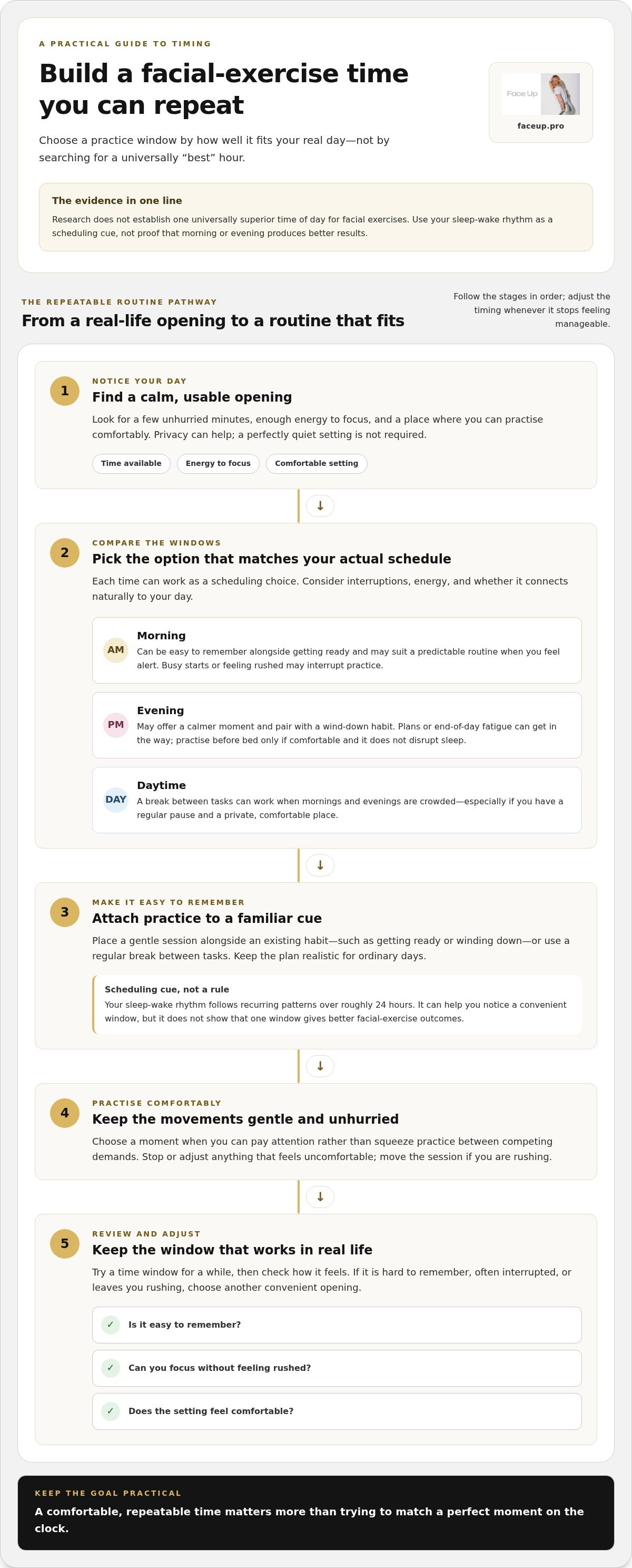
How to build a facial-exercise routine you can keep
A routine is easier to maintain when it has a clear place in your day and feels comfortable to do. Rather than setting a rigid daily target, start with a manageable plan and adjust it to fit your schedule. The best time of day for facial exercises is one you can return to without rushing or forcing the practice.
- Choose a cue. Attach practice to something you already do, such as finishing your morning routine or taking a break after work. A familiar cue can make it easier to remember.
- Pick a time, plus a backup. Choose a regular window that usually works, then decide what you’ll do if it’s unavailable. For example, if mornings become hectic, move the session to a convenient pause later in the day.
- Begin gently. Start with a simple, comfortable practice rather than trying to do more than feels manageable. Use controlled movements and avoid force or excessive repetition.
- Review how it feels. Notice whether the timing and movements feel comfortable, calm, and realistic to repeat. Adjust the plan based on that experience, not just whether you completed it.
Choose a time and cue that already belong to your day
A stable cue can be more useful than relying on motivation alone. You might practise after washing up in the morning or during a regular daytime pause. Keep a brief note of whether the routine felt comfortable and manageable; this gives you a better guide for refining it than simply marking a session as done. If your preferred window doesn’t work, use your backup without treating a schedule change as failure.
Keep practice gentle and responsive
Facial exercises should feel controlled, not forced. If a movement causes pain, increased jaw tension, or unusual discomfort, stop or modify it rather than pushing through. For persistent pain or ongoing jaw symptoms, seek advice from an appropriate healthcare professional.
You can practise facial exercises without tools. If your interest is specifically jaw-focused practice, the TMJ massage therapy guide above offers more information on that topic.
If guided structure would help you follow a routine, explore Face Up’s guided self-practice rituals and choose a time that fits your day.
Make facial exercises part of a guided Face Up self-practice ritual
A guided routine can make it easier to know what to practise, especially if you find it hard to begin without a clear sequence. Face Up’s app subscription offers a library of guided facial exercises and somatic practices. Use a guided ritual to structure your self-practice, then choose a time that fits your day.
The app doesn’t determine the best time of day for facial exercises, and using a guide isn’t evidence that morning, evening, or another hour produces better results. Its practical value is direction: a planned session may help you return to a routine without having to work out each step from scratch.
How guided rituals can support consistency
Think first about when you can practise comfortably, then place a guided ritual into that window. You might use it after getting ready in the morning, during a quiet evening pause, or at a flexible point in the day. If your usual time becomes busy, shift the practice rather than treating the schedule as fixed. A routine should support your day, not compete with it.
Keep your expectations grounded. Follow the guidance at a comfortable pace, and adapt your schedule as your daily commitments change. The aim is to make self-practice feel clear and repeatable, not to follow a specific time because it’s said to be uniquely effective.
Choose your next step based on your routine
Start with the time that feels realistic and comfortable, whether or not it matches someone else’s schedule. If you’re looking for jaw-focused self-practice, the Jaw Release Course is a learning option centred on the jaw; it isn’t a promise of medical outcomes. For a broader guided routine, choose an app ritual that fits the time you have available.
With a suitable time and structure in place, you can build a practice around your own rhythm without waiting for a perfect hour. Explore Face Up guided self-practice for a guided way to begin.
Choose a rhythm that works for you
The best time of day for facial exercises isn’t a universal hour. Morning, evening, or a pause during the day can all be practical choices when the timing fits your energy, privacy, and schedule. Focus on gentle movements and a routine you can comfortably return to, rather than chasing a timing rule or expecting one perfect moment to deliver results.
Start by linking practice to a familiar part of your day, then adjust if it feels rushed, inconvenient, or uncomfortable. A flexible plan is often easier to sustain than a strict target. If guided structure would help, the Face Up app subscription includes guided facial exercises and somatic practices. For jaw-focused self-practice, Face Up also offers the Jaw Release Course.
Explore Face Up guided self-practice rituals and find a starting point that feels right for your routine. Begin gently, stay responsive to what feels comfortable, and let consistency grow at your own pace.
Frequently Asked Questions
Is morning or evening the best time for facial exercises?
Neither morning nor evening has been established as the best time for everyone. Choose the window that fits your schedule, feels comfortable, and is easiest to repeat. Morning might work if you have a steady start to the day; evening may suit a calmer routine. If both are difficult, a daytime pause is another option. The practical choice is the one you can sustain without feeling rushed.
Can I do facial exercises before bed?
Yes, you can practise before bed if it feels comfortable and doesn’t interfere with winding down or getting to sleep. Keep the movements gentle, and choose a different time if the routine feels stimulating, rushed, or uncomfortable late at night. Facial exercises aren’t a treatment for sleep problems. If practising before bed consistently disrupts your rest, move the session earlier or try a daytime window instead.
How often should I do facial exercises?
There isn’t one schedule that’s right for everyone, and a strict daily target isn’t necessary to begin. Start with a manageable pattern you can follow comfortably, then review whether it fits your life and feels sustainable. Keep movements gentle rather than adding repetitions to make up for missed practice. If you’re following a guided programme, use its instructions while adjusting your routine if anything feels uncomfortable.
Do facial exercises work better in the morning?
Current evidence doesn’t establish that facial exercises work better in the morning. Research on exercise outcomes doesn’t necessarily compare morning and evening practice, so it can’t prove that one time is superior unless timing is directly studied. Choose morning if it’s convenient and you feel ready to focus, not because the clock guarantees a particular result. A comfortable, repeatable schedule is a more practical guide.
Can facial exercises make jaw tension worse?
They can feel uncomfortable if movements are forced, too intense, or unsuitable for you. Stop or modify any movement that causes pain, increased jaw tension, or unusual discomfort; don’t push through it. If pain or jaw symptoms persist, seek advice from an appropriate healthcare professional. For a jaw-focused self-practice option, Face Up’s Jaw Release Course addresses jaw tension, but it isn’t a substitute for medical advice or a guarantee of results.
What should I do if I keep forgetting my facial-exercise routine?
Attach practice to a reliable cue, such as finishing a familiar morning task or taking a regular break, and set a reminder if that helps. Choose a backup time for days when your usual window is disrupted. Keep the routine manageable, and consider guided practice if deciding what to do makes it harder to start. Face Up’s subscription app includes guided facial exercises and somatic practices for self-practice.


