
What if the most significant barrier to your vocal range isn't a lack of technique, but a physical "vocal cage" of tension locked within your jaw? You've likely felt that restrictive sensation where your voice seems trapped in your throat or your resonance fades after a short rehearsal. It's a common hurdle; research from The Clarós Clinic indicates that over 87% of professional singers experiencing vocal fatigue also suffer from persistent muscle pain. When your body stores performance stress in the jaw and neck, it creates a physical wall that even the best warm-up cannot scale.
We believe that true vocal freedom is a somatic experience. You deserve a path to performance that feels effortless and expansive. In this guide, we'll explore the somatic benefits of intraoral massage for singers and how this specialized practice releases deep-seated tension to enhance your resonance and emotional expression. We will examine the connection between jaw release and vocal stamina, providing a clear roadmap to unlocking your most authentic sound through professional, body-based care.
Key Takeaways
- Identify how the "vocal cage"—a web of tension in the jaw, tongue, and floor of the mouth—pins down the larynx and restricts your natural resonance.
- Understand the unique benefits of intraoral massage for singers, specifically how the buccal technique accesses deep muscle attachments to improve tone clarity and soft palate flexibility.
- Distinguish between basic jaw massage and the Face Up Method™ somatic approach, which creates a professional, meditative environment to de-armour the nervous system.
- Learn the essential guidelines for safe intraoral self-work, including the importance of consistency, hygiene, and pressure in your daily vocal ritual.
- Explore how a non-invasive, somatic commitment allows you to reclaim an expanded vocal state and authentic emotional expression.
The 'Vocal Cage': How Deep Facial Tension Limits Your Performance
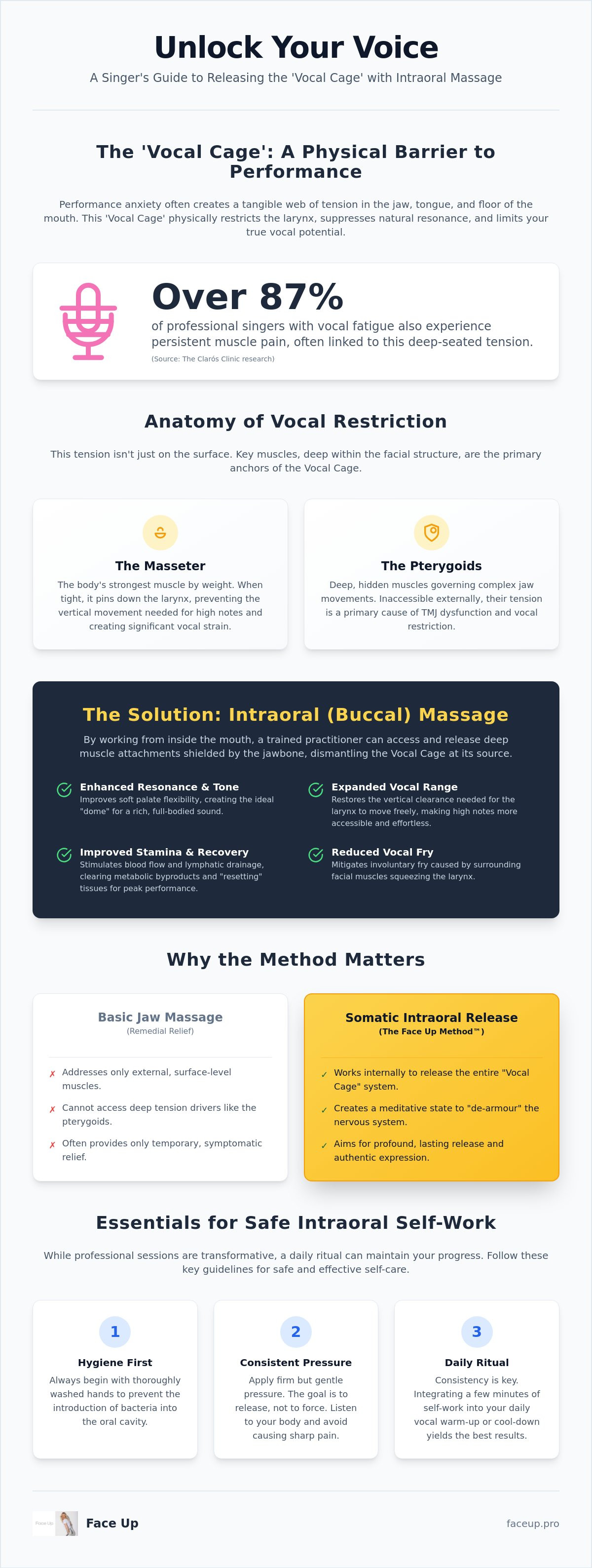
Performance anxiety often manifests as a physical barrier we call the 'Vocal Cage.' This isn't just a metaphor for stage fright; it's a tangible, interconnected web of tension spanning the jaw, the tongue, and the floor of the mouth. When these structures tighten, they create a restrictive environment that suppresses your natural resonance. One of the primary benefits of intraoral massage for singers is the ability to dismantle this cage from the inside out, addressing tissues that external touch simply cannot reach. By releasing these internal anchors, you allow the vocal mechanism to function with the fluidity it was designed for.
The masseter, recognized as the strongest muscle in the human body based on weight, plays a central role in this constriction. When chronically tight, it can effectively pin down the larynx, preventing the subtle movement required for dynamic vocal shifts. This physical locking often mirrors a psychological state of 'holding back,' where a performer subconsciously clenches the jaw to maintain control under pressure. We call this somatic 'armouring.' It is a protective layer the body builds in response to stress, but it ultimately stifles your authentic expression. The science of voice instruction teaches us that vocal production is a holistic process, yet the face and neck are often where the most restrictive armouring occurs.
The Masseter and Your Vocal Range
Hitting high notes requires a specific degree of vertical space and laryngeal freedom. A tight masseter pulls the jaw upward and backward, often leading to compensatory jaw protrusion that causes significant vocal strain. The masseter muscle acts as a primary anchor of the vocal cage by exerting downward pressure that limits the necessary elevation and tilt of the larynx during high-frequency singing. By releasing this muscle through targeted work, you restore the vertical clearance needed for an expansive, effortless range.
Beyond the Surface: The Pterygoid Connection
True vocal freedom requires addressing the lateral and medial pterygoids. These muscles reside deep within the jaw structure and govern the complex grinding and side-to-side movements of the mandible. Because they are tucked behind the bone, they are entirely inaccessible via traditional external massage. Chronic tension here is a leading cause of temporomandibular joint (TMJ) dysfunction, which can make every rehearsal feel like an uphill battle. Understanding the benefits of intraoral massage for singers means recognizing that internal access is the only way to effectively de-armour these hidden drivers of vocal restriction and joint discomfort.
The Science of Intraoral (Buccal) Massage for Vocalists
The buccal technique involves a practitioner working from within the oral cavity to manipulate muscle attachments that are physically shielded by the jawbone. This internal access is what unlocks the true benefits of intraoral massage for singers, as it allows for the precise release of the buccinator and the deep fibers of the masseter. Beyond simple relaxation, this manual intervention stimulates localized blood flow and encourages lymphatic drainage throughout the vocal tract. This process clears metabolic byproducts that accumulate during high-intensity performance, effectively "resetting" the tissues for your next rehearsal. It's a professional standard for those who require their instrument to remain in peak condition across demanding tour schedules.
By addressing extrinsic laryngeal tension, this method also helps mitigate the involuntary 'vocal fry' that often plagues tired performers. While some use fry as a stylistic choice, it's frequently a symptom of the larynx being squeezed by surrounding facial muscles. Recent research on vocal tension and fatigue suggests that myofascial release can significantly improve voice quality and pitch range by removing these physical obstructions. If you're looking to explore these techniques firsthand, our Somatic Bodywork Session offers a dedicated environment for this specialized release, ensuring your voice remains as expansive as your talent.
Releasing the Soft Palate for Enhanced Resonance
The levator veli palatini is the primary muscle responsible for lifting the soft palate to create the resonant "dome" required in professional vocal pedagogy. When this area is rigid, your tone can sound thin or overly nasal. Intraoral work provides a unique opportunity to manually encourage flexibility in the palate, allowing it to become more responsive to your artistic intentions. Singers often describe the sensation following a session as an "open throat" or a "cathedral of sound," where the resonance feels effortless rather than manufactured. This increased mobility ensures that the soft palate can quickly adapt to different vowels and registers without the sluggishness caused by chronic tension.
The Vagus Nerve and the Somatic Response
The oral cavity is one of the most highly innervated areas of the body, making it a powerful gateway to the nervous system. Buccal massage often stimulates branches of the vagus nerve, which helps shift the body from a "fight or flight" state into "rest and digest." For a performer, a regulated nervous system is just as vital as technical skill. This is why many vocalists experience a profound emotional release during a session; as the physical armouring dissolves, the body finally feels safe enough to let go of stored performance stress. This somatic response doesn't just improve your tone; it anchors your performance in a state of calm, global readiness, allowing for a more authentic connection with your audience.
Remedial Relief vs. Somatic Release: Why the Method Matters
Standard remedial massage often treats the body like a series of pulleys and levers. While this approach provides temporary relief for jaw pain, it misses the deeper somatic layer where performance anxiety and vocal identity are stored. One of the key benefits of intraoral massage for singers within our proprietary ecosystem is the shift from "fixing" a dysfunctional joint to "expanding" your expressive capability. We don't just aim to stop the clicking or the discomfort; we aim to unlock a level of resonance that was previously inaccessible due to chronic guarding.
Many vocalists hesitate when they first hear about buccal work. The idea of a practitioner working inside the mouth can feel invasive or simply "weird" to those accustomed to traditional therapies. However, a Face Up Method™ session is designed as a meditative, professional environment. It's a sanctuary of calm efficiency where hygiene and consent are the foundational standards. This isn't a clinical procedure; it's an invitational somatic journey that facilitates global readiness for your next performance, ensuring you feel grounded and open before you ever hit the stage.
Moving Beyond the 'Mechanical' View of the Voice
Treating the voice as a machine ignores the fact that our faces are maps of our emotional histories. Every high-stakes audition, difficult rehearsal, or moment of stage fright leaves a trace in the musculature of the jaw and throat. While medical institutions recognize the value of manual therapy for vocal strain to alleviate physical symptoms, the Face Up philosophy integrates this with emotional de-armouring. By combining facial sculpting with deep-tissue release, we help performers reclaim their vocal identity. When you release the physical tension, you also release the psychological weight of "holding back," leading to a visible and audible transformation in confidence.
The Role of a Certified Face Up Practitioner
A practitioner's role goes beyond anatomical knowledge. It requires a high standard of empathy and a global-minded approach to professional wellness. Our practitioners are trained to understand the specific physiological and emotional demands placed on professional singers. If you're a bodyworker or vocal coach looking to elevate your practice, you can explore our Facial Sculpting Certification: Master the Face Up Method™ in 2026. This program ensures that practitioners can provide a holistic, non-invasive experience that respects the delicate balance of the vocal mechanism. Choosing a certified professional ensures that the benefits of intraoral massage for singers are delivered with the precision and integrity your instrument deserves.
Integrating Intraoral Techniques into Your Daily Ritual
Consistency transforms temporary relief into a permanent state of professional readiness. For professional singers, the vocal mechanism is under constant demand, which means a one-off massage, while beneficial, cannot fully dismantle years of somatic armouring. To truly experience the long-term benefits of intraoral massage for singers, these techniques must become a staple of your daily maintenance. By integrating small, intentional releases into your morning routine or pre-performance warm-up, you train your nervous system to remain open and responsive even under the pressure of a live audience.
Safe self-practice begins with impeccable hygiene and a refined sense of touch. Always wash your hands thoroughly and ensure your fingernails are trimmed to avoid irritating the delicate mucosal lining of the mouth. The goal is therapeutic release, not aggressive manipulation; pressure should feel like a "useful" ache rather than sharp pain. Timing is also critical. While a deep session is excellent for recovery days, your pre-performance ritual should focus on gentle activation and grounding rather than intense deep-tissue work. This ensures you don't over-fatigue the muscles before you need them most.
Many performers find that using their hands provides the best biofeedback, allowing them to feel exactly where the tension resides. However, specialized tools can offer a level of consistency and reach that fingers sometimes lack. If you're considering adding a physical aid to your routine, you can explore our guide on Choosing the Best TMJ Massage Tool to find a solution that aligns with your somatic needs. For those ready to commit to a structured path, our Jaw Release Course provides the comprehensive training needed to master these techniques at home.
A 5-Minute Jaw Release Ritual
- Step 1: External Warming. Use your fingertips to make slow, circular motions over the masseter muscles just below your cheekbones. Breathe deeply, allowing the warmth of your hands to soften the surface tissue.
- Step 2: Internal Pterygoid Sweeping. Place a clean thumb inside your mouth, reaching toward the back of the upper molars. Gently sweep along the internal shelf of the jaw to address the lateral pterygoids.
- Step 3: Soft Palate Lift. Using a very light touch, encourage a sense of "doming" in the soft palate. Visualize the throat opening as you release the internal anchors of the vocal cage.
The Face Up App: Your Digital Vocal Mentor
Maintaining a somatic practice while on the road can be challenging. The Face Up App Subscription acts as a digital mentor, providing guided rituals that fit into a busy touring schedule. The app allows you to track the connection between facial ease and vocal quality, helping you identify which techniques yield the best results for your specific voice. This daily somatic maintenance ensures that your instrument remains resilient, allowing you to focus on the artistry of your performance rather than the physical limitations of tension.
The Face Up Approach: Reclaiming Your Authentic Voice
Reclaiming your voice is a journey of somatic expansion. When you dismantle the physical barriers of the jaw, you don't just improve your range; you release the artist within. The benefits of intraoral massage for singers culminate in this profound transformation from a constricted, guarded state to one of effortless expression. We focus on a high-standard, non-invasive approach that respects the delicate balance of your instrument. By integrating form and function, we ensure that your face reflects the same ease and clarity that your audience hears in your performance. This isn't just about vocal maintenance; it's about de-armouring the body to allow your most authentic sound to emerge without resistance.
Our commitment to natural rejuvenation means we prioritize the body's innate ability to heal and adapt when given the right stimulus. Releasing the jaw is a proactive act of professional integrity. It signals to your nervous system that it's safe to let go of the "vocal cage" we've discussed in previous sections. When the masseter and pterygoids are no longer pinning down your larynx, you gain a sense of global readiness that carries you through even the most demanding tours. This somatic freedom is the foundation of a sustainable career, allowing you to focus on the narrative of your music rather than the physical limitations of your body.
From the Auckland Studio to the Global Stage
The Face Up Method™ began in our Auckland studio as a specialized blend of somatic bodywork and facial sculpting. Founder Olga Newman envisioned a world where holistic vocal health was a standard requirement for the modern performer, moving beyond transactional treatments toward a proprietary ecosystem of care. This vision has since expanded into a global community of professionals who value transparency and results. Today, you can find a reliable, high-standard partner in your wellness journey through our global practitioner directory listing. Whether you are performing in a local theatre or on an international stage, our certified providers offer the calm efficiency and expertise needed to keep your voice in peak condition.
Your Next Steps to Vocal Freedom
Your path to an expanded vocal state begins with a single, intentional choice. We encourage you to start by implementing a daily ritual, allowing your body to slowly unlearn the habits of tension that have held you back. For a deeper understanding of how these techniques balance the entire head and neck region, you can read The Ultimate Guide to TMJ Massage Therapy. When you are ready to master these skills and take full ownership of your vocal health, we invite you to Explore the Jaw Release Course and Face Up App. Reclaiming your authentic voice is a journey we are honoured to facilitate, providing you with a clear path toward professional advancement and artistic freedom.
Embrace Your Full Resonance
True vocal mastery requires a body that feels safe and open. Throughout this guide, we've explored how the "vocal cage" of facial tension restricts your tone and how specialized buccal techniques dismantle these internal barriers. Recognizing the profound somatic benefits of intraoral massage for singers allows you to move beyond temporary relief toward a state of permanent vocal expansion. It's about more than just hitting the right notes; it's about performing with a sense of calm efficiency and global readiness every time you step into the spotlight.
We invite you to enter our proprietary ecosystem for professional wellness. Whether you are seeking a reliable partner through our certified global practitioner directory or looking for self-mastery via our specialized Jaw Release Course, we provide a clear path forward. We are dedicated to redefining beauty and performance through somatic bodywork that respects the integrity of your instrument. Start your journey to vocal freedom with the Face Up App and experience the ease of a voice that is truly unburdened. Your most authentic sound is waiting to be heard, and we're here to help you release it.
Frequently Asked Questions
Is intraoral massage painful for singers?
Intraoral massage shouldn't be painful; instead, it should feel like a deep, therapeutic release of long-held tension. You might experience a "useful ache" when a practitioner addresses chronic guarding in the masseter or pterygoids, but sharp pain is never the goal. Most singers find the process deeply relaxing as the physical armouring begins to dissolve, leaving the jaw feeling light and mobile.
How often should a professional singer get an intraoral massage?
A professional singer typically benefits from a monthly Somatic Bodywork Session combined with daily home maintenance. High-intensity performers on tour may require more frequent sessions to manage the cumulative impact of vocal fatigue and performance stress. Integrating these techniques into a regular schedule ensures your instrument remains resilient and ready for the global stage at all times.
Can intraoral massage help with performance anxiety?
Yes, intraoral massage is highly effective for managing performance anxiety by stimulating branches of the vagus nerve. This stimulation triggers a "rest and digest" response, helping to ground the nervous system before a high-stakes show. By releasing the physical "vocal cage," you also let go of the emotional weight stored in the jaw and face, allowing for a more authentic connection with your audience.
What is the difference between buccal massage and TMJ massage?
Buccal massage is a specific internal technique, while TMJ massage is a broader focus on the temporomandibular joint. Buccal work is one of the primary benefits of intraoral massage for singers because it accesses deep muscles like the pterygoids that external TMJ massage cannot reach. Our method focuses on a holistic somatic release rather than just mechanical relief of joint clicking.
Can I perform intraoral massage on myself safely?
You can perform intraoral massage on yourself safely if you follow professional guidelines regarding hygiene, pressure, and anatomy. Our Jaw Release Course provides the structured training necessary to master these techniques at home without risking irritation to the delicate oral mucosa. Always ensure your hands are clean and your movements remain gentle and intentional to avoid over-stimulating the tissues.
How soon after a session will I notice a difference in my singing voice?
Many vocalists notice an immediate sense of ease and "openness" in their throat directly after their first session. While tone clarity and resonance often improve instantly, the cumulative benefits for vocal stamina and high-note access become more pronounced over several weeks of consistent practice. It's a progressive journey toward total vocal freedom and technical reliability.
Will intraoral massage change the shape of my face or jawline?
Intraoral massage can refine your appearance by reducing lymphatic congestion and relaxing overactive jaw muscles that create a "heavy" look. While it doesn't change your underlying bone structure, it often results in a more sculpted and lifted jawline by releasing the tension that causes puffiness. This rejuvenation of both form and function is a core part of our commitment to holistic health.
Is this treatment suitable for musical theatre performers and opera singers alike?
This treatment is exceptionally suitable for both musical theatre performers and opera singers who require maximum resonance and range. Whether you're navigating the belting requirements of a modern score or the technical demands of a classical aria, the benefits of intraoral massage for singers apply across all genres. Every professional instrument deserves a tension-free environment to achieve its full expressive potential.


