

What if the persistent tightness in your brow isn't just a physical habit, but a somatic "shield" your nervous system has constructed to navigate daily stress? You aren't alone if you feel like your face has become a rigid mask, marked by deepening horizontal furrows or those stubborn "11" lines between your eyes. While many people look toward temporary fixes, understanding how to release tension in the forehead requires a deeper, more integrated approach that honors the connection between your emotions and your anatomy.
It's exhausting to carry the weight of the world on your brow, especially when traditional relaxation methods barely scratch the surface. We're here to help you move past the cycle of tension headaches and facial fatigue. In this guide, you'll discover the professional somatic techniques and manual rituals needed to dissolve deep forehead tension and restore facial harmony naturally. We'll examine why your muscles hold onto these patterns and provide a clear path toward a softer, more authentic expression through the principles of the Face Up Method®. Welcome to a new standard of facial well-being and professional self-care.
Key Takeaways
- Recognize how the forehead acts as a somatic shield, protecting the nervous system from emotional stress through chronic muscle contraction.
- Identify the specific roles of the frontalis and corrugator muscles in creating deep furrows and how to address them at the source.
- Learn why somatic release offers a functional alternative to neurotoxins by restoring muscle proprioception rather than simply freezing expression.
- Master a professional five-step ritual that teaches you how to release tension in the forehead using the proprietary Face Up Method® approach.
- Implement daily micro-rituals and ergonomic adjustments to prevent stress from accumulating in your facial muscles during the workday.
Understanding Forehead Tension: More Than Just a Headache
Forehead tension is more than a fleeting feeling of stress; it's a chronic, sustained contraction of the epicranium and the delicate muscles of the upper face. At Face Up, we view this persistent state as a "Somatic Shield." This is a physiological defense mechanism where the body uses the brow to buffer against emotional stimuli or perceived threats. While a temporary furrow is a natural response to a difficult task, chronic tension leads to several structural changes:
- Fascial adhesions that restrict natural muscle movement.
- The formation of deep horizontal furrows and vertical "11" lines.
- A persistent feeling of "heaviness" or pressure in the brow area.
These fascial adhesions create a rigid environment where the tissue becomes dense and restrictive. This makes it difficult to remember how to release tension in the forehead without targeted, professional intervention that addresses the tissue quality rather than just the muscle movement.
From the Face Up perspective, this rigidity represents a significant blockage of vital energy and lymphatic flow. When the forehead is perpetually active, it restricts the natural movement of fluids that nourish the skin and clear metabolic waste. This stagnation contributes to a dull, tired appearance that often persists long after the initial stressor has disappeared.
The Physical and Emotional Cost of a 'Tight' Face
The impact of a tight brow extends far beyond aesthetics. Chronic contraction is a primary driver of tension-type headaches (TTH), creating a band-like pressure that can radiate across the entire skull. There is also a powerful neurological feedback loop at play. When your brow is furrowed, your brain receives signals that you are in a state of worry or distress. This keeps your nervous system in a high-alert state. By learning how to release tension in the forehead, you effectively break this loop, signaling to your brain that it's safe to down-regulate and find calm.
The Holistic Chain: How the Jaw and Neck Influence Your Forehead
Your face doesn't function in isolation. The forehead is deeply integrated into a holistic chain of tension that often begins in the jaw or the base of the skull. Many individuals struggling with brow furrows are also dealing with undiagnosed TMJ issues. We recommend exploring our Ultimate Guide to TMJ Massage Therapy to understand how jaw misalignment pulls on the upper facial structures. This connection is physically anchored by the occipitofrontalis, a two-part muscle connected by a fibrous sheet called the galea aponeurotica. The Frontalis muscle at the front is directly influenced by the tension in the occipitalis at the back of your head. If the back of your neck is tight, your forehead will likely follow suit, creating a cycle of tension that requires a global somatic approach to resolve.
The Anatomy of Expression: Muscles That Hold Your Stress
To master how to release tension in the forehead, we must first map the specific architectural players involved in your facial expressions. Your face is a sophisticated landscape of muscles that respond instantly to your internal state. When stress becomes a constant companion, these muscles lose their ability to fully relax, leading to what we call "tension patterns." These aren't just surface level issues; they are deep, functional habits that involve the muscle fibers and the fascia that encases them.
When these muscles remain in a state of hypertonicity, they often trigger Tension headaches, which can feel like a vise-like grip around the forehead and temples. This physical discomfort is the body's way of signaling that the "Somatic Shield" we discussed earlier has become overworked. Understanding the individual roles of these muscles allows us to apply somatic techniques with precision rather than just generalized pressure.
Frontalis: The High-Tension Lifting Muscle
The Frontalis is the expansive muscle covering the forehead, responsible for lifting the eyebrows and wrinkling the brow horizontally. In many cases, this muscle becomes overworked because it is compensating for eyelid heaviness or "tech-neck" posture. Somatically, a chronically lifted brow suggests a state of hyper-vigilance. It's the face's way of staying "wide awake" to scan for potential threats or information. You can identify hypertonicity in your Frontalis if your eyebrows seem perpetually raised even when you feel at rest, or if horizontal lines remain visible when your face is neutral. Understanding these anatomical nuances is a core component of our Face Up Sculpting Treatment, which aims to manually release these deep-seated patterns.
The Corrugators and the 'Grief' or 'Anger' Response
Located just above the bridge of the nose, the Corrugator Supercilii muscles are the "knitters" of the brow. They pull the eyebrows inward and downward, creating the vertical "11" lines. From a somatic perspective, these muscles are deeply tied to emotional pain, intense focus, or internal conflict. We often knit our brows when we are trying to "solve" a problem or suppress a difficult emotion. The Corrugator Supercilii serves as the primary driver of the 'concentrated' facial mask, pulling the eyebrows inward and downward to signal intense focus or internal distress. Over time, this contraction can feel like a physical knot that refuses to untie.
Working alongside the Corrugators are the Procerus and the Depressor Supercilii. The Procerus sits on the bridge of the nose and pulls the skin between the eyebrows down, often creating a "scrunch" effect. Together, these muscles interact with the facial fascia to create a rigid structure. When you learn how to release tension in the forehead, you aren't just stretching a muscle; you are teaching this entire fascial network to soften, allowing for a more fluid and authentic range of expression.
Somatic Release vs. Botox: A New Paradigm for Facial Freedom
When faced with persistent furrows, many individuals ask: "Why not just get Botox?" It's a valid question in a culture that often prioritizes immediate, visible results. However, neurotoxins function by temporarily paralyzing the muscle, which essentially silences the communication between your nervous system and your face. While this creates a smooth surface, it fails to address the underlying somatic root of the contraction. Learning how to release tension in the forehead through manual techniques ensures that you aren't just masking a symptom, but actually resolving the structural and emotional patterns that caused the tension initially.
A "frozen" face is fundamentally different from a "relaxed" face. Relaxation implies a state of supple readiness and healthy muscle proprioception, which is the ability to feel and control your own facial movements. Botox often disrupts this sensory feedback loop, leaving the tissue feeling numb or disconnected. In contrast, somatic practices like Progressive Muscle Relaxation (PMR) encourage you to engage with your muscles consciously. By tensing and then intentionally releasing, you rebuild the neural pathways that allow for genuine, lasting ease without the need for periodic injections.
The Feedback Loop: How Muscle Movement Affects Emotion
The Facial Feedback Hypothesis suggests that our facial expressions don't just reflect our emotions; they actively influence them. When you paralyze the muscles involved in frowning or squinting, you might inadvertently dampen your ability to process the associated emotions. Some research suggests this can lead to a subtle sense of emotional disconnection or a "flattening" of affect. The Face Up Method™ philosophy centers on regaining control through heightened awareness. We believe in teaching you how to release tension in the forehead so that your face remains a dynamic, expressive part of your identity rather than a static mask. It's about freedom of movement, not the absence of it.
Finding creative outlets for emotional expression can complement your somatic practice; for instance, you can discover Art Therapy to explore how artistic workshops help in releasing the internal stress that often manifests as physical tension.
Choosing a Natural Path to Rejuvenation
Manual sculpting offers a suite of benefits that neurotoxins simply cannot replicate. Through targeted touch, we stimulate circulation and encourage lymphatic drainage, which clears metabolic waste and brings fresh oxygen to the tissues. This process creates a vibrant, natural glow that comes from cellular health, not just muscular stillness. For professionals who are ready to move beyond the needle and offer a more holistic approach, our Facial Sculpting Certification provides the comprehensive training needed to master these advanced somatic techniques. Choosing this path means investing in the long-term vitality of the skin and the resilience of the nervous system, creating results that look as good as they feel.
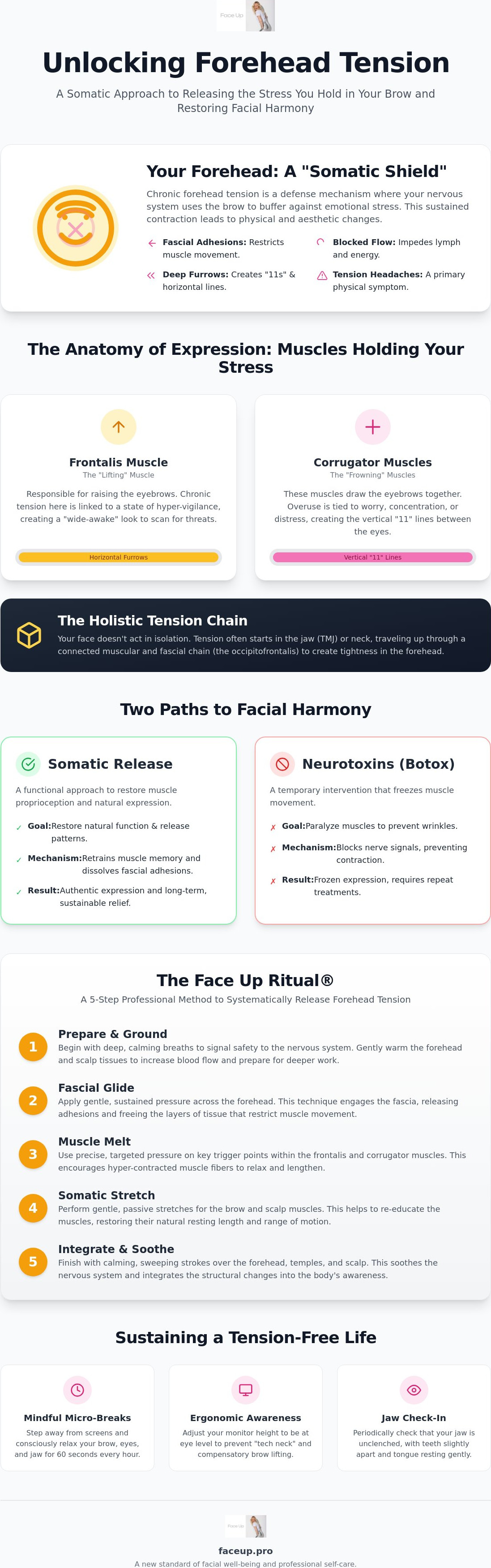
The Face Up Ritual: 5 Steps to Release Forehead Tension
Moving from anatomical theory into practical application requires a shift in how you interact with your own body. While many online forums suggest simple temple rubbing for relief, a professional somatic approach requires a structured sequence that addresses the nervous system first. This ritual is designed to melt the "Somatic Shield" we identified earlier, using specific manual techniques to restore fascial fluidity. When you understand how to release tension in the forehead through this method, you're doing more than just relaxing; you're retraining your tissue to reside in a state of ease.
Step 1 & 2: Preparing the Nervous System and the Occipital Base
Before you touch your face, you must signal to your brain that the "threat" is gone. We begin with deep diaphragmatic breathing, focusing on long, slow exhales. This simple act switches your body from a sympathetic state of hyper-vigilance to a parasympathetic state of "rest and digest." Without this physiological shift, your muscles will likely resist the manual work you're about to perform.
Once grounded, we move to the "Occipital Anchor." Place your fingertips at the base of your skull, where the neck meets the head, and apply gentle, circular pressure to release the tension band that often accumulates here. The Occipitalis muscle is the 'secret key' to forehead relaxation because its chronic contraction pulls the entire epicranial sheet backward, forcing the brow to lift in compensation. By softening the back, you create the necessary slack for the front to finally let go.
Step 3, 4, & 5: Manual Sculpting and Integration
With the foundation set, we move to "The Ironing." Place the heels of your palms at the center of your forehead and move them slowly toward your temples with firm, melting pressure. This technique targets the Frontalis muscle, smoothing out horizontal furrows and encouraging fascial unwinding. The key is to move at a "glacial pace," allowing the heat from your hands to soften the tissue as you go.
For the vertical "11" lines, we use "The Pinch." Using your thumb and forefinger, gently grasp the tissue at the inner corner of your eyebrows where the Corrugators reside. Hold the tissue with a firm but kind pressure, waiting for a "pulse" or a softening sensation before moving slightly outward along the brow line. This targeted release breaks up the deep-seated "anger" or "focus" patterns held in these specific fibers.
The final step is integration. A single session provides immediate relief, but lasting change comes from consistent practice. To maintain this newfound softness, we recommend using the Face Up App for daily guided rituals that prevent tension from re-accumulating during your busiest hours. Transitioning these techniques into a habit ensures that you don't just find temporary comfort, but actually transform your facial landscape for the long term.
Ready to deepen your practice? Start your journey toward a tension-free face today by subscribing to the Face Up App for exclusive, professional-grade somatic routines.
Beyond the Ritual: Sustaining a Tension-Free Life
Mastering the manual techniques of the Face Up Method® is a significant milestone, yet the true secret to lasting facial harmony lies in your daily habits. Our modern environment is often at odds with a relaxed brow. Between high-pressure deadlines and the physical toll of screen time, the "Somatic Shield" can easily reform. Sustaining relief requires a proactive approach that integrates micro-rituals into your professional and personal life, ensuring you don't have to relearn how to release tension in the forehead every single evening.
One of the primary culprits of recurring tension is "tech-neck." When you lean forward to look at a screen, your neck muscles tighten, which pulls on the epicranial fascia and forces your forehead to contract for balance. Additionally, your internal biochemistry plays a supporting role in muscle health. Proper hydration is essential for fascial glide, while magnesium serves as a natural calcium blocker, helping your muscle fibers relax after they have fired. Without these foundational elements, even the best manual rituals may feel like an uphill battle against your own biology.
Daily Habits for Facial Harmony
We recommend implementing a "Jaw-Forehead" check-in every ninety minutes. Because the facial muscles are so closely linked, a clenched jaw almost always leads to a furrowed brow. By consciously softening your jaw, you create a ripple effect of relaxation that travels upward. This somatic awareness is the hallmark of a modern professional who values both productivity and well-being. For those looking for supplemental support between sessions, using a TMJ Massage Tool can provide the necessary mechanical advantage to keep the lower face relaxed, which in turn prevents the forehead from overcompensating.
The Journey to Mastery with Olga Newman
For many, discovering the power of somatic release is just the beginning of a deeper calling. If you are a beauty or wellness practitioner, you have the opportunity to bring this level of profound relief to your own clients. The Face Up Method®, developed by Olga Newman, offers a professional certification that bridges the gap between traditional aesthetics and deep somatic bodywork. This proprietary system combines the structural benefits of buccal massage with the nervous system regulation of somatic therapy.
By joining our global ecosystem, you gain access to a community of like-minded facilitators dedicated to high standards of professional integrity. Whether you seek to enhance your current practice or embark on a new career path, our certification provides a clear, well-governed journey toward mastery. We invite you to Join the Face Up Community and start your journey today. Together, we can redefine facial rejuvenation as a holistic practice of freedom, awareness, and lasting relief.
Embrace a New Standard of Facial Ease
Your journey toward a softer, more expressive face begins with the realization that your forehead is a dynamic reflection of your internal state. We've explored how the "Somatic Shield" forms and why understanding the anatomical interplay between the jaw and the brow is vital for lasting relief. By shifting your focus toward how to release tension in the forehead through conscious manual work, you choose a path of functional freedom over temporary paralysis. This non-invasive, holistic approach doesn't just smooth lines; it restores the vital flow of energy and lymph throughout your entire facial structure.
Founded by somatic bodywork specialist Olga Newman, the proprietary Face Up Method™ has helped professionals globally reclaim their natural radiance. True rejuvenation is a daily practice, not a one-time event. To support your progress, we invite you to Discover the Face Up App for Daily Somatic Rituals. Here, you'll find the guided support needed to integrate these rituals into your modern lifestyle. It's time to let go of the mask of stress and rediscover the clarity and calm that reside just beneath the surface. Your most authentic expression is waiting.
Frequently Asked Questions
Can forehead tension cause dizziness or blurry vision?
Yes, chronic forehead tension can contribute to dizziness or temporary visual disturbances. This often occurs when trigger points in the frontalis or temporalis muscles refer pressure to the orbital area, affecting how your eyes perceive focus and depth. While these symptoms are usually benign responses to muscular strain, persistent dizziness should always be evaluated by a healthcare professional to rule out underlying neurological conditions.
How often should I perform forehead release exercises?
You should perform a dedicated release ritual once daily, preferably in the evening to decompress from the day's stress. Additionally, integrating 30-second micro-releases every 90 minutes during work hours prevents the "Somatic Shield" from reforming. Consistency is more important than duration when retraining the nervous system and learning how to release tension in the forehead permanently.
Why does my forehead feel tight even when I'm not stressed?
Your forehead may feel tight due to established muscle memory and fascial adhesions that persist even after a stressor has passed. Chronic habits, such as squinting at screens or "tech-neck" posture, keep the muscles in a state of hypertonicity. Over time, the tissue loses its ability to return to a neutral state without intentional manual intervention to break the cycle of contraction.
Can releasing forehead tension actually reduce the appearance of wrinkles?
Yes, somatic release techniques can significantly soften the appearance of horizontal furrows and vertical "11" lines. By manually addressing the hypertonic muscles that pull on the skin, you allow the tissue to smooth out naturally. Unlike temporary solutions, this approach improves the underlying health of the fascia and skin through better circulation and lymphatic drainage, creating a more youthful glow.
What is the difference between a tension headache and a migraine?
A tension headache typically presents as a steady, band-like pressure around the forehead and temples. In contrast, a migraine is often characterized by intense throbbing on one side of the head, often accompanied by sensitivity to light or sound and nausea. Understanding this distinction is crucial, as tension headaches respond exceptionally well to the somatic rituals and manual techniques discussed in this guide.
Is it safe to massage my forehead if I have had Botox recently?
You should generally wait at least 24 to 48 hours after neurotoxin injections before massaging the area to prevent the product from migrating to unintended muscles. However, once the product has settled, gentle somatic work can help maintain tissue health and prevent the feeling of "heaviness" often associated with a frozen brow. Always consult your specific practitioner for personalized post-procedure instructions.
How do I know if my forehead tension is somatic or purely physical?
Forehead tension is likely somatic if it fluctuates based on your emotional state or nervous system arousal. If the tightness intensifies during difficult conversations or periods of high focus, it is a somatic response designed to protect you. Purely physical tension is more often related to direct mechanical strain, such as poor ergonomics or eye strain from an outdated vision prescription.
Can a jaw massager help with forehead tension?
Yes, a jaw massager can be an effective supplementary tool for those learning how to release tension in the forehead. Because the facial muscles operate in a holistic chain, releasing the masseters and jaw fascia often creates an immediate "slack" in the upper face. Softening the lower third of the face signals the nervous system to let go of the brow's defensive mask.


