

What if the persistent ache in your temples isn't just a sign of a long day, but a somatic message from a muscle that holds the key to both neurological calm and a natural facial lift? You've likely felt that heavy, dragging sensation across your brow or the sharp pressure of a tension headache that seems to resist every standard remedy. It's frustrating when chronic jaw clenching or eye strain makes you feel like your face is physically weighted down, often adding years to your reflection. We understand that this tension is more than just a physical burden; it's a barrier to feeling your best in a fast paced world.
By mastering professional self-massage for temporalis muscle, you can unlock deep-seated tension and rediscover the vibrant, lifted contours of your face. This article explores the somatic connection between your temple muscles and your nervous system, providing you with practical techniques to achieve immediate relief and a clearer, more open expression. You'll learn how to release the emotional roots of your physical stress while naturally rejuvenating your eye and brow area for a more rested, professional appearance. We invite you to explore this gateway to better facial health and a more regulated, calm state of being.
Key Takeaways
- Identify the somatic link between psychological stress and the "armouring" of the fan-shaped temporalis muscle.
- Learn how to prime your nervous system for a parasympathetic shift to ensure your facial tissues are receptive to deep release.
- Master professional techniques, including the 'Temple Sweep' and 'Myofascial Pin and Stretch', through guided self-massage for temporalis muscle tension.
- Understand the structural connection between forward head posture and the fascia of the jaw and heart.
- Discover how to naturally restore the 'Cat Eye' lift to your brow by releasing chronic muscular pull.
Understanding the Temporalis: The Somatic Connection to Tension
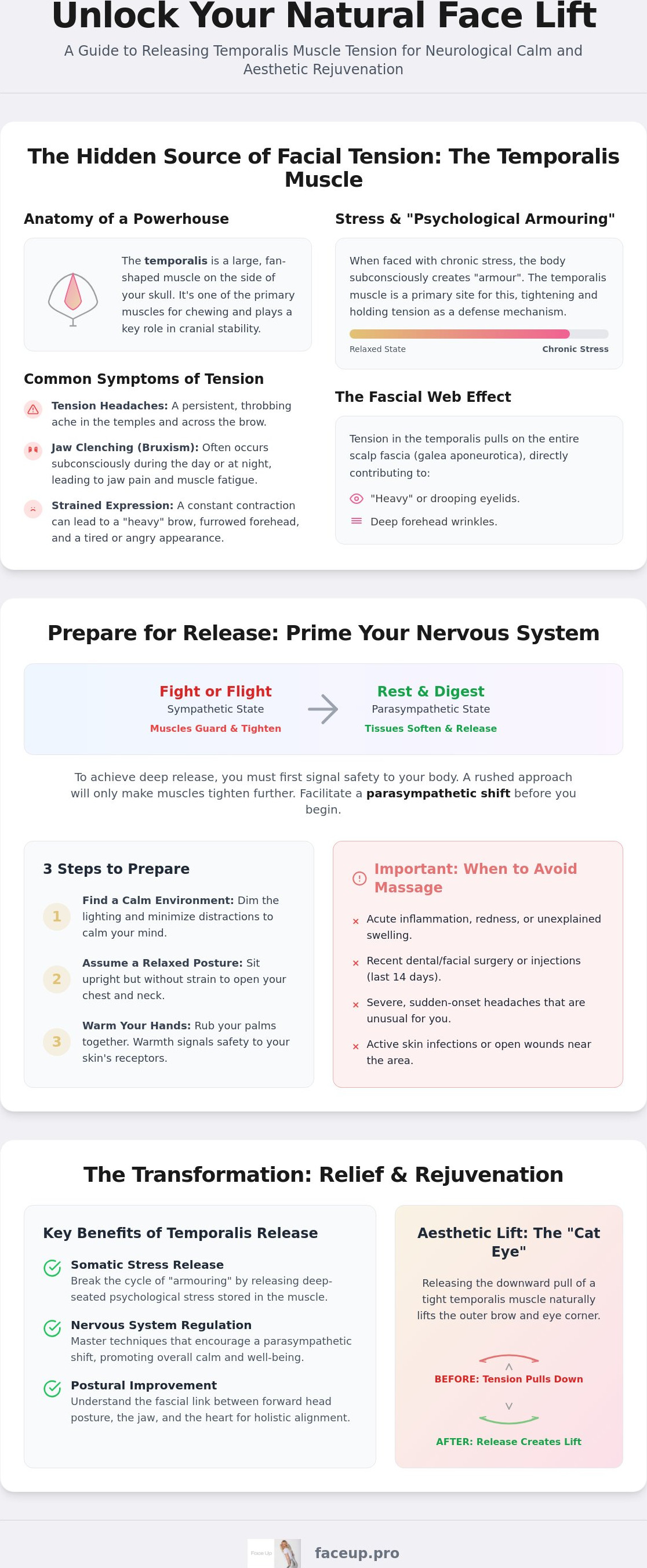
To truly master self-massage for temporalis muscle relief, one must first understand the profound role this muscle plays in our physical and emotional architecture. The temporalis muscle is a sophisticated, fan-shaped structure that originates on the side of the skull and inserts into the jaw. It's one of the most powerful muscles of mastication, responsible for closing the jaw and maintaining cranial stability. However, its function extends far beyond simple mechanics. In the Face Up Method™, we recognize the temporalis as a primary site where the body "armours" itself against external pressure and internal stress.
This psychological armouring is a subconscious survival mechanism. When we encounter chronic stress, we tend to clench our teeth and tighten our brow, causing the temporalis to remain in a state of constant contraction. A hypertonic temporalis doesn't just cause physical discomfort; it changes how you present to the world. Common symptoms include persistent tension headaches, nocturnal clenching, and a perpetual "angry" or strained brow expression. By learning to release this area, you aren't just easing a muscle; you're signaling to your nervous system that it's safe to let go.
The Fascial Web: How Your Temples Affect Your Entire Face
The temporalis does not exist in isolation. It is deeply integrated into the galea aponeurotica, the dense layer of fibrous tissue that covers the upper part of the cranium. When your temples are tight, they pull on this entire fascial cap, which can lead to "heavy" eyelids and deep forehead wrinkles. Fascia is the biological fabric that holds emotional memory. When this fabric becomes restricted, it limits the natural mobility of your facial features, making you look tired or older than you feel. Focusing on self-massage for temporalis muscle health helps restore elasticity to this entire web, allowing for a more open and refreshed appearance.
Temporalis vs. Masseter: The Jaw's Power Dynamic
In the specialized field of tmj massage therapy, we observe a constant synergy between the temporalis and the masseter. These two muscles work together to manage the immense force of the jaw. If the masseter is overworked from clenching, the temporalis often compensates, leading to that familiar throbbing at the temples. You can't effectively treat one without addressing the other. Identifying which muscle is your primary tension driver is essential. For many, the temporalis is the "silent partner" that maintains the tension long after the jaw has supposedly relaxed. Restoring balance between these two powerhouses is the key to lasting relief and structural facial symmetry.
Preparing Your Nervous System for Somatic Release
Effective self-massage for temporalis muscle relief begins long before your fingers touch your skin. Most people make the mistake of jumping straight into deep pressure while their nervous system is still in a high alert state. This approach often triggers a "guarding" response, where the muscle tightens further to protect itself. To achieve a true somatic release, you must first facilitate a parasympathetic shift. This transition from "fight or flight" to "rest and digest" allows the cranial fascia to soften, making the underlying muscle fibers accessible for deeper work.
Preparation is an act of intention. Cold hands or a rushed mind will only create superficial friction rather than deep muscular change. Before you begin your ritual, ensure your environment supports this shift. Dim the lighting, sit with an upright but relaxed posture, and take a moment to warm your hands. This physical warmth isn't just for comfort; it signals to the thermoreceptors in your skin that it's safe to relax. If you feel frantic, your muscles will mirror that state, resisting even the most technically perfect massage.
Safety is paramount in any professional somatic practice. While most people benefit from these techniques, there are specific times when you should pause. You should avoid performing self-massage for temporalis muscle if you are experiencing any of the following:
- Acute inflammation, redness, or unexplained swelling in the temple area.
- Recent dental surgery, jaw injections, or facial procedures within the last 14 days.
- Severe, sudden onset headaches that differ from your usual tension patterns.
- Active skin infections or open wounds near the massage site.
Breathwork as a Tool for Muscle Softening
Your breath is the most direct bridge to your nervous system. There is a profound neurological connection between the diaphragm and the jaw, mediated largely by the Vagus nerve. When you hold your breath, your jaw clenches; when you let your breath go, your jaw follows. Try this centering exercise: inhale deeply through the nose for four counts, then perform a "jaw-dropping" exhale through a slightly open mouth for six counts. Imagine the tension draining from your temples down into the floor. This simple act prepares the cranial fascia for the manual release to follow.
Hand Placement and Pressure Sensitivity
True release is about "listening" to the tissue rather than forcing it. Instead of aggressive rubbing, use the heel of your hand for broad, grounding pressure, or your fingertips for more specific myofascial work. The goal is to feel the "melt", that subtle moment when the muscle stops fighting your touch and begins to lengthen. If you find yourself wanting to go deeper into these practices, consider exploring the Face Up App Subscription for guided sessions that help you refine this sensory awareness. By focusing on sensitivity over force, you ensure that every movement contributes to lasting structural change rather than temporary relief.
Step-by-Step Self-Massage for Temporalis Muscle Relief
Executing a professional self-massage for temporalis muscle tension requires a systematic approach that respects the layers of your facial anatomy. Rather than applying random pressure, we follow a sequence designed to warm the tissue, release deep adhesions, and restore fluid flow. This method ensures that the release is both profound and sustainable, moving beyond the superficial relief offered by standard massage techniques. By following these five steps, you can transform your daily routine into a powerful somatic ritual.
- Step 1: The Temple Sweep. Begin by using the palms of your hands to perform broad, upward strokes from the tops of your cheekbones toward your hairline. This warms the superficial fascia and prepares the tissue for deeper work.
- Step 2: Deep Myofascial Pin and Stretch. Place two fingers firmly on a tight area of the temple. While maintaining this "pin," slowly drop your jaw. This creates a functional stretch that lengthens the muscle fibers from the inside out.
- Step 3: Trigger Point Release. Use your fingertips to locate specific "hot spots" or knots within the muscle fan. Apply steady, moderate pressure and hold until you feel a pulse or a softening sensation.
- Step 4: The Scalp Lift. Place your fingertips at the very top of the temporalis muscle, near the crown of your head. Gently traction the scalp upward and backward, mimicking a natural face lift while releasing the galea aponeurotica.
- Step 5: Post-Massage Drainage. Conclude by lightly stroking from the temples, down past the ears, and toward the collarbones. This encourages lymphatic drainage, clearing away any metabolic waste released during the session.
Technique 1: The Stationary Melt
Consistency often yields better results than intensity. For the Stationary Melt, rest your elbows on a table and let the weight of your head sink into the heels of your hands at the temples. Hold this position for at least 90 seconds. Visualize the muscle "fanning out" and softening like melting butter. This passive approach allows the deeper layers of the self-massage for temporalis muscle to take effect without triggering a defensive contraction.
Technique 2: The Intra-Cranial Stretch
To reach the deepest fibers, you must coordinate your jaw movement with manual pressure. As you open your mouth to its comfortable limit, use your fingers to glide upward along the side of the skull. If you experience a "clicking" jaw, reduce the range of motion and focus on a slow, controlled opening. For those seeking more precision, using a specialized tmj massage tool can help you access hard to reach areas of the temporalis with professional accuracy.
Integrating Jaw, Neck, and Posture for Lasting Relief
True somatic relief requires acknowledging the "Deep Front Line." This biological pathway connects the tongue, the jaw, and even the fascia surrounding the heart. If you are holding deep emotional stress in your core, that tension travels upward through this fascial chain. It often manifests as persistent temple pressure. This is why simply rubbing your temples is rarely a permanent fix. You must address the internal support system that governs your facial structure.
Your tongue is the internal scaffolding of your face. By practicing proper tongue posture, often referred to as "mewing," you provide a structural base for the maxilla. Rest the entire body of your tongue against the roof of your mouth, keeping your teeth slightly apart and lips sealed. This simple adjustment reduces the stabilization burden on the temporalis muscle, allowing it to remain soft and elongated throughout the day.
Releasing the Masseter: The Temporalis' Partner
Releasing the masseter is a necessary complement to your temple work. While the masseter provides the "strength" for biting, the temporalis acts as the "stabilizer." You cannot have a relaxed temple with a clenched jaw. To release the masseter, place your fingertips on the lower jaw muscle and gently open your mouth. You may notice an immediate emotional shift. Temple tension often correlates with mental overwhelm, while jaw tension frequently holds suppressed frustration. For those ready to master these connections, the Face Up App Subscription provides professional, guided protocols for total facial release.
The Role of the Suboccipitals
The suboccipitals at the base of the skull often mirror the pain felt in the temples. Because of the way our nerves are bundled, tension at the back of the head frequently "refers" pain to the front. Use the "Cradle Technique" by resting the base of your skull in your palms and applying gentle upward traction. This creates a 360-degree release for the head and face. Integrating this with your self-massage for temporalis muscle routine ensures that your progress is structural rather than just symptomatic.
The Aesthetic Transformation: Lifting the Face Naturally
While the structural and neurological benefits of releasing cranial tension are profound, the visual transformation is often what surprises our clients most. Chronic tension in the temporalis acts like an anchor, physically pulling the facial tissues downward over time. When this muscle remains in a state of hypertonic contraction, it shortens, which creates a dragging effect on the brow and the outer corners of the eyes. By consistently performing self-massage for temporalis muscle, you effectively remove this anchor. This allows the lateral face to return to its natural, elevated position without the need for invasive interventions.
This release creates a subtle but powerful restoration of the "Cat Eye" effect, specifically by lifting the tail of the brow. Beyond the structural lift, the manual stimulation significantly improves localized microcirculation. Increased blood flow and lymphatic movement help clear a "congested" eye area, reducing the appearance of puffiness and dark circles. The result is a brighter, more alert expression that reflects a state of internal calm and professional vitality. It's a testament to the idea that true beauty is a byproduct of a regulated nervous system and healthy, mobile tissue.
For professionals who are inspired by these results and wish to bring this somatic expertise to their own clients, we offer a path toward mastery. Our facial sculpting certification provides an in-depth curriculum that covers the Face Up Method™ in its entirety. This training empowers you to facilitate deep structural changes that go far beyond superficial skincare, positioning you as a leader in the evolving landscape of regenerative aesthetics.
The Face Up Ritual: 5 Minutes to Rejuvenation
Consistency is the cornerstone of any somatic practice. We recommend a condensed 5-minute daily ritual that can be easily integrated into your morning or evening skincare application. Using your facial oil or serum provides the necessary glide for self-massage for temporalis muscle work, making the practice feel like a seamless part of your self-care. We encourage you to track your progress; look for a more "open" eye area and a softer brow line after just seven days of dedicated practice. These small, daily movements accumulate into significant, long-term structural improvements.
Taking the Next Step in Your Somatic Journey
If you're ready to deepen your practice, our ecosystem offers several pathways for progression. The Face Up App Subscription provides a library of guided daily rituals that ensure you're performing these techniques with precision and presence. For those struggling with chronic, deep-seated clenching, our Jaw Release Course offers a permanent solution by addressing the underlying somatic patterns of the masseter and temporalis. You may also consult our Practitioner Directory Listing to find a certified professional for deep buccal and somatic work, ensuring your journey toward facial health is supported by expert guidance.
Embrace a New Standard of Facial Vitality
You've discovered that the tension held in your temples is more than a physical discomfort; it's a somatic signal that impacts your overall well-being and facial structure. By integrating self-massage for temporalis muscle relief into your daily routine, you're not just easing a headache. You're actively participating in a regenerative process that lifts the brow and calms the nervous system. This holistic approach, founded by somatic bodywork specialist Olga Newman, focuses on both emotional and physical release to create lasting change.
The Face Up Method™ provides a clear path forward for those seeking a professional standard of self-care. You're now part of a global community of practitioners and individuals who prioritize integrity and proactive management of their health. Whether you're correcting your posture or refining your massage technique, every movement brings you closer to a more balanced and vibrant version of yourself. We invite you to continue this journey toward a clearer, more lifted expression.
Release your jaw and lift your face with the Face Up App; start your ritual today
Frequently Asked Questions
How often should I perform self-massage for the temporalis muscle?
You should perform this massage once daily for approximately three to five minutes to maintain tissue elasticity and prevent tension build up. If you are experiencing high levels of stress or acute headaches, practicing twice daily, once in the morning and once before bed, can provide more consistent relief. Consistency is more effective than occasional intense sessions, as it helps retrain the nervous system to remain in a parasympathetic state.
Can temporalis massage really help with my migraines?
Practicing self-massage for temporalis muscle relief can significantly reduce the frequency and intensity of tension triggered migraines. While it is not a medical cure for neurological migraine conditions, releasing the hypertonicity in the temples removes a major physical trigger. By softening the "armouring" effect around the cranium, you decrease the overall load on your nervous system, which often leads to fewer episodes and a higher threshold for pain.
Is it normal for my temples to feel sore after a self-massage session?
Mild tenderness or a "bruised" sensation is a common response as the tissue begins to release stored metabolic waste and chronic adhesions. This sensation should dissipate within twenty-four hours and is often followed by a feeling of lightness and increased mobility. However, if you experience sharp or radiating pain, you should reduce the pressure in your next session. Always listen to your body's resistance and aim for a "melt" rather than a forced release.
Why does my jaw click when I massage my temples?
Your jaw may click during the massage because the temporalis is a primary stabilizer of the temporomandibular joint. When you release this muscle, the joint often undergoes a subtle structural realignment. If the clicking is painless, it is generally a sign of the tissue lengthening. However, if the clicking is accompanied by discomfort, you should limit your range of jaw movement during the stretch and focus on stationary pressure until the joint stabilizes.
Can I do this massage if I've recently had Botox in my masseters?
You should wait at least fourteen days after receiving Botox in your masseters before beginning any deep facial work. Once the injections have settled, performing self-massage for temporalis muscle tension is highly beneficial. Because Botox weakens the masseter, the temporalis often overcompensates to stabilize the jaw. Massaging the temples helps prevent this secondary tension from developing, ensuring your facial structure remains balanced and relaxed throughout the duration of your treatment.
What is the best time of day to perform this somatic ritual?
The ideal time for this somatic ritual depends on your primary goal. Performing the massage in the evening helps down regulate your nervous system and prevents nocturnal clenching, leading to better sleep quality. Conversely, a morning session is excellent for achieving a "lifted" look and reducing overnight puffiness. Many professionals find that a quick three minute "Temple Sweep" during the workday provides a necessary mental reset and prevents tension from accumulating.
Are there any side effects to releasing cranial tension too quickly?
Releasing deep cranial tension too aggressively can sometimes lead to temporary lightheadedness or a "healing crisis" as the body processes released toxins. This is why we emphasize the parasympathetic shift and slow, mindful movements. If you feel dizzy, stop the massage and take several deep breaths while grounding your feet on the floor. Gradual progression allows your nervous system to integrate the structural changes without triggering a defensive or overwhelmed response.
Can I use a gua sha tool for temporalis massage?
You can use a gua sha tool to enhance the "Temple Sweep" and improve superficial circulation. A smooth edge is particularly effective for gliding over the galea aponeurotica to reduce forehead tension. However, for the deeper myofascial pin and stretch techniques, your hands provide superior sensory feedback. Using your fingers allows you to feel the subtle "melt" of the muscle fibers, which is essential for the somatic listening required in the Face Up Method™.


