

If you’re wondering how to get certified in face massage, start by separating a course certificate from professional accreditation and local permission to practise. A certificate can show that you completed training or met a course’s assessment requirements, but it does not automatically authorise you to offer treatments.
This distinction matters when you compare courses, especially if one offers flexible online study or focuses on a single technique. Look beyond the movements themselves: consider the curriculum, how you’ll practise, what feedback you’ll receive and how your learning will be assessed. Requirements for offering treatments also vary by location, so plan to check the rules that apply to your work.
This guide maps the path from choosing training to developing a responsible practice. You’ll learn how to compare course content and practical feedback, what to consider about local requirements and scope of practice, and how focused training differs from broader professional recognition. If you’re drawn to holistic facial work, Face Up™ Training offers a professional learning pathway that brings facial sculpting together with a somatic perspective.
Key Takeaways
- Learn how to get certified in face massage by choosing training that fits your experience and the work you intend to offer.
- Compare courses by their coverage of anatomy, technique, contraindications, practice, feedback and assessment.
- Understand what a course certificate demonstrates, and why it may not replace accreditation or local permission to practise.
- Define your service scope and describe your training accurately. Review the professional and insurance requirements that apply in your jurisdiction.
- Explore Face Up™ Training as a holistic facial-work pathway combining facial sculpting with a somatic approach.
What Does Face Massage Certification Actually Mean?
If you’re a beauty professional, therapist or bodywork practitioner adding facial work, it’s reasonable to find the credentials confusing. Course providers may use “certificate,” “certification” and “accreditation” in different ways, while local rules have their own terms. Start by finding out what a credential represents. It may be evidence that you completed a course or met its assessment requirements.
That evidence can demonstrate focused learning in a technique such as facial sculpting or massage. It does not automatically mean you’ve met every requirement to offer paid treatments. The broader practice of Massage provides useful context, but facial techniques still call for relevant training and an understanding of appropriate practice.
A course certificate records what you completed; local rules determine whether you may practise and what you may offer.
Certificate, accreditation, and licence: how are they different?
A certificate commonly documents course completion or a successful assessment. Accreditation usually refers to recognition of a course or training provider by an external body, but its meaning and standing depend on who grants it. A licence, where required, is permission governed by the relevant jurisdiction. These terms are not interchangeable, and you should not assume one course credential will be accepted everywhere.
Before enrolling, read what the credential verifies and what it does not. Separately review the current requirements where you plan to work. Rules in the United States, for example, can vary by state, while professional qualification frameworks in the United Kingdom follow a different structure. Consult the official regulator for your location and intended services.
Who might pursue face massage training?
Training may suit beauty professionals who want to broaden their facial services, massage or bodywork practitioners adding focused techniques, and holistic practitioners developing a hands-on practice. Career changers can also explore this path, though they may need foundational preparation before specialist study. Entry requirements depend on the course, and professional practice is also subject to local rules.
Clarify what you want the learning to support. Are you adding one technique to an established service, developing broader facial skills, or beginning professional training from the ground up? Your answer can help you decide whether a specialist course is a sensible next step or whether you first need a more comprehensive foundation.
In practical terms, how to get certified in face massage starts with separating your learning goal from the question of permission to practise. A course can develop your knowledge and provide evidence of achievement, but it cannot automatically expand your professional scope or replace local qualifications, registration or insurance conditions. Treat these as related, but distinct, parts of your career plan.
How to Get Certified in Face Massage: The Learning Path
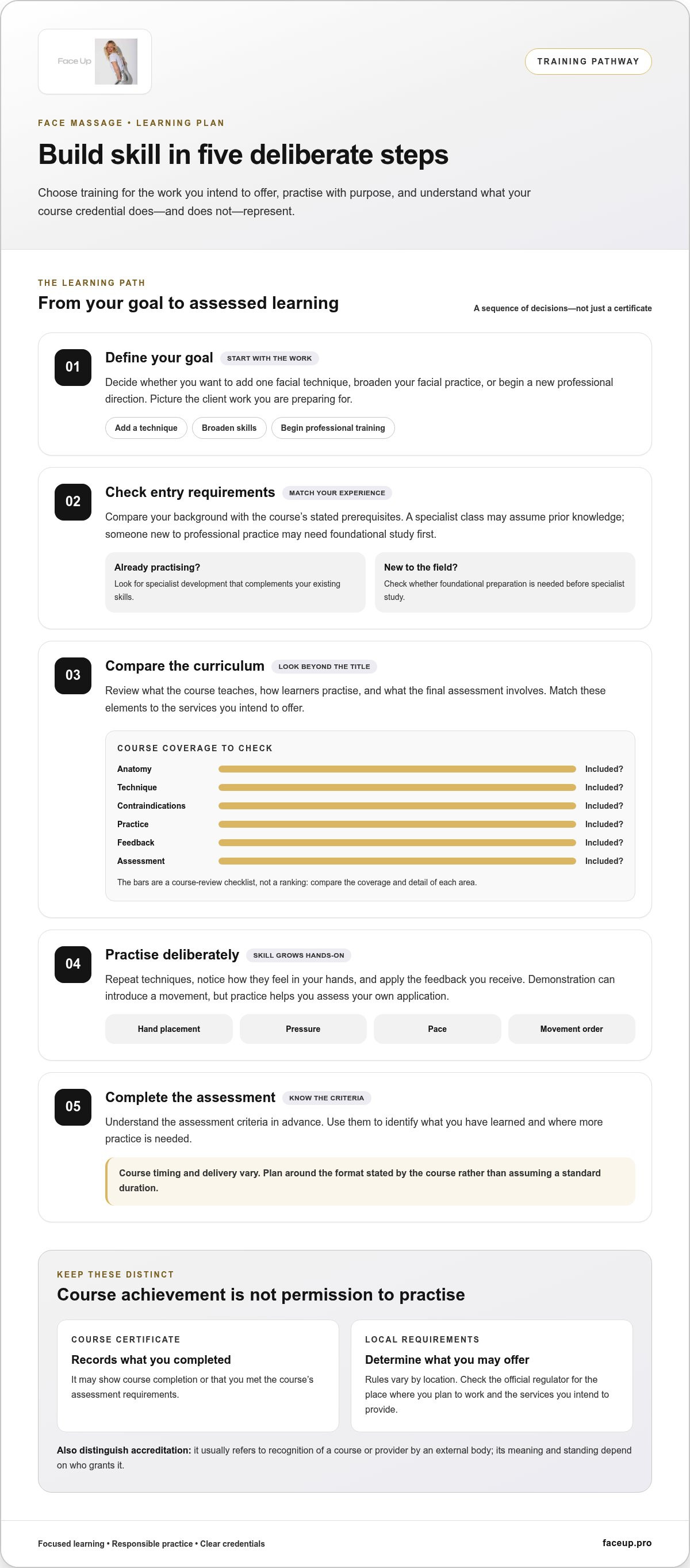
A practical answer to how to get certified in face massage is to treat it as a sequence of decisions, not simply a search for a certificate. Start with the work you hope to do. Then choose learning that suits your background and gives you opportunities to develop confident, responsible hands-on skills.
- Define your goal. Decide whether you want to add one facial technique to an existing service, broaden your facial practice or begin a new professional direction. Picture the client work you’re preparing for.
- Check entry requirements. Compare your experience with the course’s stated prerequisites. A specialist class may assume prior knowledge, while someone new to professional practice may need foundational study first.
- Compare the curriculum. Look beyond the course title. Review what it teaches, how learners practise and what the final assessment involves. Match those elements to the services you intend to offer.
- Practise deliberately. Repeat techniques, pay attention to how they feel in your hands and apply the feedback you receive. A demonstration can introduce a movement, but it cannot show whether you are applying pressure or positioning your hands appropriately.
- Complete the assessment. Understand the criteria in advance and use them to identify what you’ve learned and what needs more practice. Course timing and delivery vary, so plan around the stated format rather than assuming there is a standard duration.
Choose a course that matches your background and goals
Introductory training may suit learners who need core concepts and a gradual entry into facial work. Established beauty, massage or bodywork practitioners may prefer specialist development that complements their existing skills. Neither route is automatically right for everyone. Compare the stated audience, learning outcomes and entry criteria, then consider whether the techniques align with the services you plan to provide.
Include professional requirements in your planning. The Oregon Esthetician Licensing Requirements page, for example, illustrates why it’s useful to consult the regulator responsible for your area. A course’s learning scope and local rules are separate considerations.
Build skill through practice and assessment
Manual skills develop through practice, not observation alone. Guided practice and instructor feedback can help you notice details that are difficult to judge independently, such as hand placement, pressure, pace and the order of movements. Clear assessment criteria also give you a practical way to review your progress. If you study online, look for details about how the course supports practice and feedback alongside demonstrations.
Use feedback to refine specific skills. If a sequence feels awkward, for instance, revisit the transition between movements rather than repeating the whole routine unchanged. Assessment can show that you’ve met a course’s learning standards; it does not establish universal professional recognition or replace requirements where you practise.
For practitioners drawn to facial sculpting with a somatic perspective, Face Up™ Training is a professional learning route to explore as you compare approaches and decide which one fits your practice.
How to Compare Face Massage Courses With Confidence
A course title can sound impressive while leaving important questions unanswered. Use the same criteria to compare your options, then look closely at what you’ll learn, how you’ll practise and what completion represents. A focused workshop in one technique may be useful for an experienced practitioner, but it is not necessarily equivalent to broader facial massage education.
What should a face massage curriculum cover?
Look for a clear account of facial anatomy and muscles, hand positioning, pressure, movement and how techniques fit into a treatment sequence. A responsible curriculum should also address contraindications and explain how to adapt the work to individual needs. Specialist methods may require additional focused instruction, so check that the course scope matches the techniques you want to learn.
A well-rounded course description makes clear what you’ll learn, how you’ll practise, how your skills will be assessed and what the training does and does not prepare you to offer.
| Area to compare | What to look for |
|---|---|
| Anatomy | Coverage of relevant facial structures and muscles, explained at a level suited to the course. |
| Technique | Specific movements, positioning, pressure and treatment flow, rather than a list of technique names alone. |
| Contraindications | Guidance on when to adapt, pause or avoid a technique, and how to consider individual needs. |
| Practice | Opportunities to work through the techniques, not just watch demonstrations. |
| Feedback | Useful guidance that helps you refine your approach and address areas that need more practice. |
| Assessment | Transparent criteria showing how learning is evaluated and what successful completion means. |
What makes practical learning meaningful?
Demonstrations help you see a technique, but they cannot show whether your own hand placement, pressure or sequence is appropriate. Guided practice and specific instructor feedback can help you notice and refine those details. If the course is online, look for a clear explanation of how you’ll practise and receive feedback. You should understand the assessment expectations before you begin, not encounter them as a surprise at the end.
Match the method to the work you want to do
Think beyond the course format and consider the approach itself. Face Up’s method combines facial sculpting with a somatic bodywork perspective, looking beyond buccal work to facial tension and bodywork. Buccal-focused training may suit a practitioner seeking that particular specialism; a broader holistic approach may better align with a different direction. The Face Up Method certification guide offers more context on the method.
Consider Face Up™ Training as a next learning step
For practitioners drawn to holistic facial work, Face Up™ Training offers professional training within a wider ecosystem that includes self-practice, bodywork and live events. Explore the approach and consider how it fits your interests and professional direction at Explore Face Up™.
Prepare for Responsible Face Massage Practice After Training
Completing a course is a milestone, but it’s only one part of building a responsible practice. Understanding how to get certified in face massage helps you plan your learning. Before offering a service, define what your training prepares you to do, how you’ll describe it and which local professional requirements apply. Your scope should be clear to you and to the people considering a treatment.
Responsible practice combines relevant training with clear boundaries, honest communication and a commitment to keep learning.
Check local requirements before offering services
Rules and professional expectations can differ by country, state, region, practitioner background and type of service. A technique covered in a course does not automatically fall within every practitioner’s permitted scope. Consult the official regulator or relevant professional body for your location, focusing on the rules that apply to your qualifications and intended work.
Include insurance in your planning. Ask your insurer or professional association what cover applies to the treatments you intend to provide, and keep a record of the guidance. Do not assume an existing policy or credential automatically covers a new technique. If requirements are unclear, get guidance from the relevant local authority before adding the service to your practice.
Translate training into clear client communication
Describe your education accurately. State the course or method you studied and explain the techniques you use in plain language. Avoid implying that a course certificate is a licence, an externally accredited qualification or a medical credential unless that description is accurate and applies to your specific credential.
Before a session, make space to discuss what the client is seeking, explain the nature and limits of the service, and invite them to share relevant concerns. Agree on boundaries, including comfort with touch and pressure, and be prepared to adapt or pause. Clear communication helps both practitioner and client understand what the session involves.
Keep claims measured. Rather than promising to treat a condition or guarantee a cosmetic result, explain your approach and the experience you offer. Describe facial massage in terms of its techniques and purpose without presenting it as a substitute for medical advice or care. If a client raises a concern outside your training or scope, do not attempt to diagnose it. Encourage them to seek appropriate advice from a qualified professional.
- Keep your course records and note the areas your training covered.
- Practise techniques within your training and revisit feedback as your skills develop.
- Reflect on sessions and identify where further education may be useful.
- Refer or signpost when a client’s needs fall beyond your competence or service scope.
Professional learning doesn’t end when a course is complete. Continued practice, reflection and further study can help you maintain a thoughtful approach as your work develops. A clear scope is not a limitation to hide. It helps set trustworthy expectations and support a considered client experience.
Choose a Learning Path That Grows With Your Practice
Your next step is to turn interest into a deliberate learning plan. Think about the kind of practitioner you want to become, the clients you hope to serve and the approach you want to bring to your work. Those questions can help you choose training for the skills and professional direction you want to develop, not just the certificate.
If you’re considering how to get certified in face massage as part of a holistic practice, explore an approach that brings facial sculpting together with somatic bodywork. Face Up™ Training offers a professional training pathway in this area. Face Up has also been featured in Vogue, Elle, The Daily Telegraph, Marie Claire, SPA+CLINIC, Professional Beauty and Mamamia.
Explore Face Up™ Training and choose a learning path that fits your practice. Take the next step with curiosity and care, and let your learning continue to shape a thoughtful, grounded practice.
Frequently Asked Questions
Is face massage certification required to practise professionally?
Not necessarily as a separate credential, but local rules may require a licence or other qualification before you can offer paid facial treatments. A course certificate alone does not establish permission to practise. Requirements depend on where you work and the services you provide. Before accepting clients, check with the relevant official regulator and make sure your professional credentials cover the planned treatment.
Can I get certified in face massage online?
Yes, some training is available online, but formats and assessments vary by course. If you’re researching how to get certified in face massage online, look for a clear plan for practising techniques and receiving useful feedback, not just recorded demonstrations. Consider whether the course lets you repeat movements, ask questions and demonstrate what you’ve learned. Completing an online course does not automatically meet local practice requirements.
What qualifications do I need before taking a face massage course?
That depends on the course. Some specialist training is designed for established beauty or massage practitioners, while introductory courses may welcome learners without professional experience. Read the entry criteria and learning outcomes carefully. If you’re new to the field, consider whether you need foundational study in anatomy, skin care, hygiene or client communication before taking a technique-specific course. Course admission does not necessarily qualify you to offer treatments professionally.
Does a face massage certificate qualify me to work in every country?
No. A certificate records achievement under a particular course, but countries set their own professional rules, and requirements may also vary within a country. A credential that supports your work in one location might not be sufficient elsewhere. Before relocating or treating clients across borders, review current requirements from the relevant local regulator or professional body, including any rules tied to your background and specific services.
Can I practise face massage on clients while I am still training?
Do not assume you can offer treatments to paying clients during training. A course may include practice with peers or models, but that differs from working professionally. Before practising on anyone, follow the course instructions and check local rules, your existing scope of practice and any insurance conditions. If those points are unclear, pause client sessions until you have reliable guidance and appropriate preparation.
Do face massage practitioners need professional insurance?
Insurance requirements vary by location and work setting, so there isn’t one answer for every practitioner. An employer, venue, professional association or local regulator may set conditions for cover. Contact your insurer or relevant professional body and describe the exact techniques you intend to use, including facial work. Keep a record of the response, and review your cover if your services or practice circumstances change.
How can I keep developing my face massage skills after certification?
Continue learning through deliberate practice, reflection and relevant further education. After a session, note which movements felt clear, where you needed to adapt and what questions came up. Seek informed feedback and revisit course materials when appropriate. You can also explore related approaches if they fit your professional scope. Check whether your regulator or professional body sets continuing education expectations for maintaining your credentials.


