

Relaxation isn’t always something you can achieve by telling yourself to calm down. Somatic bodywork for nervous system regulation uses practitioner-guided touch, breath, and body awareness to help you notice physical sensations and explore a calmer response.
When tension persists, it can help to look beyond relaxation techniques alone. Somatic bodywork offers a body-focused way to explore ease and awareness, although each person’s experience is different.
Here, you’ll learn what a somatic bodywork session can involve and how breath and attention to bodily cues may support relaxation, ease tension, and relate to nervous system regulation. We’ll also explain how this approach differs from conversation-based support, what hands-on work may involve, and when a professional session could be a useful next step.
Key Takeaways
- Understand how practitioner-guided touch and body awareness differ from a conversation-based approach.
- See how breath and attention to physical sensations may support a greater sense of calm.
- Learn why relaxation, pain, and tension can feel different from person to person.
- Explore what to expect from a professional session and when it may suit your needs.
What is Somatic Bodywork?
Somatic bodywork combines practitioner-guided touch with attention to sensation, breath, and movement. The focus is how your body feels in the moment, not simply how it looks or performs.
Hands-On Touch and Body Awareness
During a session, a practitioner may use gentle touch and invite you to notice sensations such as pressure, ease, or muscle tension. This pairing brings internal cues into the experience rather than applying force to achieve a predetermined correction. Somatic movement also draws attention to how posture and motion feel, supporting embodiment: a clearer sense of being present in your body.
Body Scans and Conscious Breathing
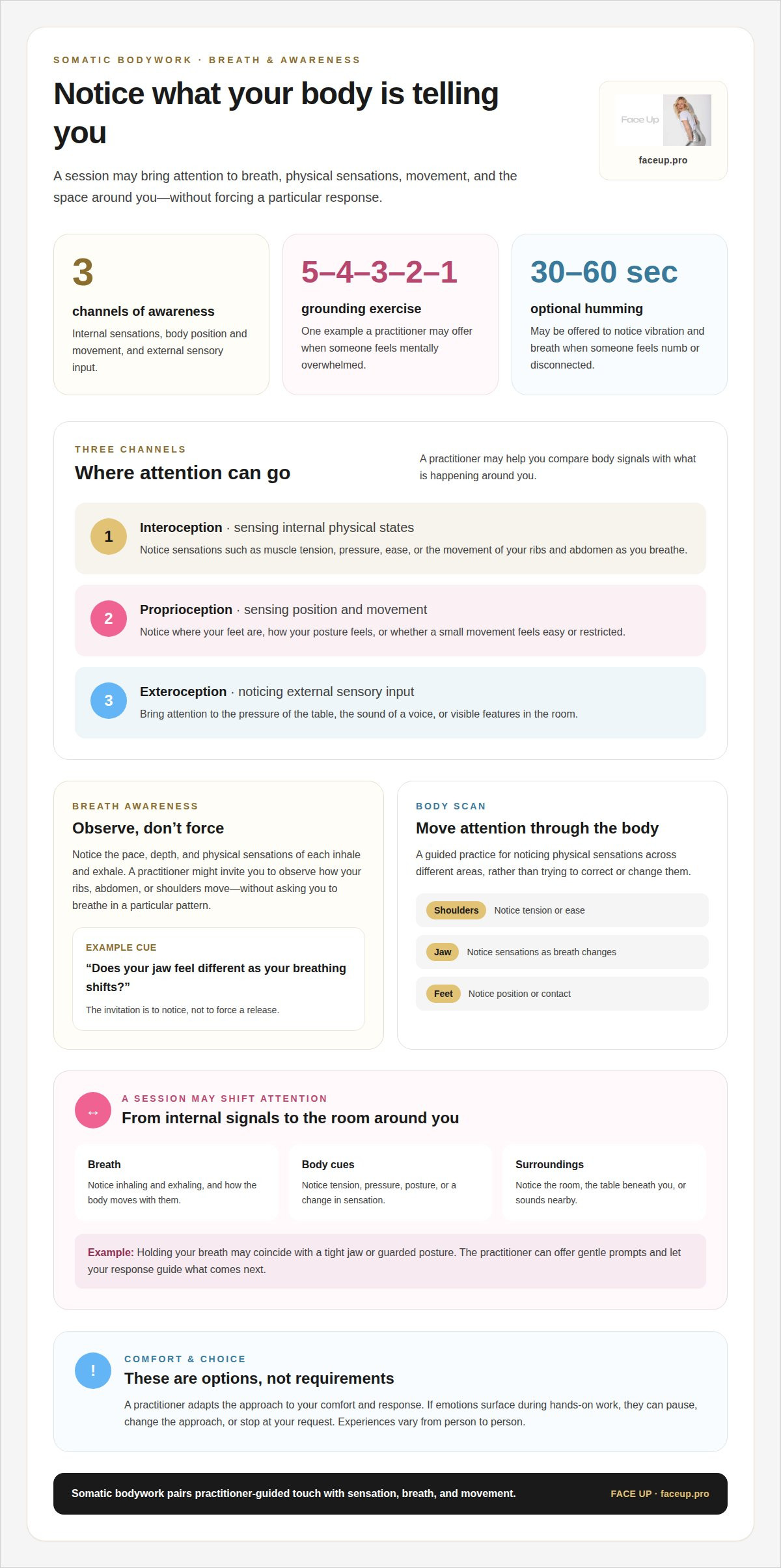
A body scan is a guided practice for noticing physical sensations across areas such as the shoulders, jaw, or feet. Conscious breathing brings attention to inhaling and exhaling, linking the breath with changing bodily sensations. Together, these practices can make the mind-body connection more noticeable. For example, a practitioner may invite you to notice whether your jaw feels different as your breathing shifts, without asking you to force a release.
Comparisons With Other Approaches
Somatic bodywork is hands-on and focused on sensation. Somatic experiencing is a distinct approach, while massage therapy commonly centres on touch and muscle work. Psychotherapy is generally conversation-based, and somatic coaching may use discussion to explore posture, breath, and internal signals. Methods can overlap, but their formats and aims differ. A useful distinction is what happens during the session.
Look for relevant training, clear consent practices, and a practitioner who explains their scope; check whether any license applies to their stated profession and location. Fees depend on session length, practitioner training, location, and the work involved, and are given after a quote request. Insurance coverage depends on your plan and the service’s billing category. There’s no universal session count or schedule: goals, response, and the practitioner’s approach shape frequency. To find a local fit, search by location and the specific modality, then assess those credentials and practices.
Breath and awareness techniques
During a session, a practitioner may guide your attention between breathing, muscle sensations, and the room around you. This links internal signals with external experience, rather than treating breath as an isolated technique.
Breathing and breath awareness
Conscious breathing means noticing the pace, depth, and physical sensations of each inhale and exhale. A practitioner might invite you to observe how your ribs, abdomen, or shoulders move, without asking you to breathe in a particular pattern. In a three-dimensional breathing session, attention includes the structures that support breathing, helping you notice where movement feels easy or restricted.
These observations can help the practitioner understand what’s happening in the moment. For example, holding your breath may coincide with a tight jaw or guarded posture. Rather than forcing a release, the practitioner can offer gentle prompts and let your response guide the next part of the session. Breath awareness may also be relevant when chronic tension makes subtle changes harder to notice.
Channels of awareness
Somatic work can draw on several channels: interoception, sensing internal physical states; proprioception, sensing body position and movement; and exteroception, noticing external sensory input. A practitioner may ask you to notice pressure from the table, the position of your feet, or the sound of a voice. Comparing these signals can increase awareness of how your body relates to its surroundings.
For someone feeling mentally overwhelmed, a practitioner may use orienting, directing attention to visible features in the room, or a 5-4-3-2-1 grounding exercise. For numbness or disconnection, humming for 30-60 seconds may be offered as a gentle way to notice vibration and breath. These are examples, not requirements; the practitioner adapts the approach to your comfort and response.
If you’re considering hands-on support, a somatic bodywork session can bring breath and body awareness together with practitioner-guided touch.
Potential effects on relaxation, pain, and tension
Somatic bodywork focuses on physical sensations and movement patterns that may accompany stress, discomfort, or muscle tension. The practitioner can adjust touch and pace in response to you, supporting relaxation and a clearer sense of what feels tense. Experiences vary: during hands-on work, some people notice deeper breathing, shifting sensations, or emotions coming into awareness.
Emotional and trauma-related tension
Protective responses can include bracing, shallow breathing, or pulling away from touch. A body-focused session attends to these present-moment signals without requiring a detailed conversation about traumatic experiences. If emotions surface, the practitioner can pause, change the approach, or stop at your request. This emphasis on choice can help you stay with what feels manageable, rather than being pushed to revisit difficult material.
Somatic practices may also help you notice the difference between emotional activation and physical tension. For example, a clenched jaw may occur alongside anxiety, concentration, or an effort to hold back emotion. Noticing a connection is an observation, not a diagnosis or proof of trauma. Bodywork can complement other support, but it doesn’t replace mental health care when that care is needed.
Neck and shoulder tension
Neck and shoulder tension can be explored through gentle touch, small movements, and attention to posture. A practitioner might notice whether your shoulders lift as you breathe or whether turning your head feels restricted. Trigger-point release using props, rooted in the Feldenkrais Method, is one approach described for addressing shoulder and neck tension and posture. The aim is to respond to your body’s cues, not force a particular position.
For facial or jaw tension, a body-awareness approach can help you reconnect with sensations around clenching and release. A practitioner may invite you to notice how your jaw feels at rest, while speaking, or as your breathing changes. Comfort and pain responses differ between people, and ongoing or severe pain calls for appropriate medical assessment. Bodywork offers a way to explore tension, not a guarantee of pain relief.
Somatic bodywork and nervous system regulation
The nervous system helps the body respond to possible demands and threats. Stress can show up as muscle bracing, restless movement, or difficulty settling. Somatic bodywork approaches regulation through present sensations and responsive touch, rather than asking your body to relax on command. The idea is practical: notice your body’s response, respect its protective signals, and adjust the work accordingly.
During a session, a practitioner can notice whether touch feels welcome, neutral, or uncomfortable to you. For example, a shoulder that tightens under pressure gives useful information about your response. The practitioner can pause, lighten their touch, or invite you to try a different position. Permission and trust help create conditions for settling while keeping you involved in decisions about the session.
Regulation doesn’t mean feeling calm all the time. It can mean noticing activation sooner and having more room to respond. You might recognize that your jaw clenches during a stressful conversation, or that your breath changes when you feel overwhelmed. Body awareness can make these patterns easier to identify. Massage may focus mainly on muscle work; somatic bodywork also attends to how sensations, movement, and protective responses change during touch.
For the nervous system, down-regulation describes a shift toward a less activated state. Gentle, responsive contact and awareness of support, such as the table beneath you, can bring attention to what’s happening now. This does not erase stress or guarantee healing. It offers a structured way to explore sensations without overriding boundaries, and to notice whether your body feels more settled, unchanged, or in need of a pause.
For guided support that brings touch and body awareness together, book a Somatic Bodywork Session.
Face Up: Somatic Bodywork Session
Face Up’s Somatic Bodywork Session offers practitioner-guided support for exploring tension and body awareness through touch. The approach focuses on releasing deep muscular and emotional tension in the face and neck, without invasive procedures. It may suit you if you want professional support rather than relying only on self-practice, or if jaw and facial tension are an important part of your experience.
A session offers space to notice how touch and bodily sensations relate to your comfort and relaxation. It isn’t a substitute for medical or mental health care, but it can complement your broader wellbeing practices. If you’re ready to explore this approach, contact Face Up about a Somatic Bodywork Session.
Choose a next step that fits your needs
Choose your next step based on the support you’re looking for. For guided, hands-on care, explore a Somatic Bodywork Session. For jaw-focused learning, try the Jaw Release Course; the Face Up App Subscription supports daily self-practice rituals. Practitioners interested in learning the method can explore Face Up Method Certification.
Somatic bodywork for nervous system regulation is best approached as an attentive process, not a demand for instant calm. Consider what kind of support feels useful now, whether professional bodywork or a structured way to build awareness over time. Let your needs guide the choice.
Contact Face Up to discuss a suitable next step. You can move forward at a pace that feels considered and manageable.
Frequently Asked Questions
Do somatic therapy exercises actually work?
Somatic exercises may help you notice bodily patterns and build awareness, but their effects vary from person to person and practice to practice. Their usefulness depends partly on whether an exercise fits your needs and feels manageable. For example, you may find it useful to notice jaw clenching during a demanding workday. An exercise isn’t a guaranteed treatment for pain, anxiety, or trauma.
What Happens in a Session?
A session typically begins with a conversation about your goals, comfort, and areas of concern. The practitioner may then guide touch, movement, or attention to physical sensations, adapting the approach to your responses. You can share feedback during the session, including what feels helpful or uncomfortable. The practitioner should respect your boundaries and make space to pause or change direction.
What if a client feels nothing or feels worse after somatic exercises in a session?
Feeling little or noticing discomfort is useful feedback, not a sign that you’ve failed. Tell the practitioner what you’re experiencing, even if the answer is “nothing.” They can pause, adjust the approach, or end the exercise. If distress or worsening symptoms continue after the session, seek support from an appropriate health professional rather than pushing through more exercises.
What is somatic bodywork, and how is it used for nervous system regulation?
Somatic bodywork for nervous system regulation is a practitioner-guided approach that brings attention to physical sensations and responses during touch or movement. Rather than assuming a sensation means the same thing for everyone, the practitioner responds to your cues and boundaries. The work can help you observe how your body reacts in the moment, but it doesn’t promise a specific emotional or physical outcome.
What techniques are commonly used in somatic bodywork sessions?
Techniques may include gentle hands-on touch, small movements, body scans, conscious breathing, and grounding or orienting practices. The practitioner chooses among these based on your focus and responses. For instance, a session focused on jaw tension may involve noticing how your jaw feels at rest and during movement, while another may emphasize broader body awareness. Practitioners don’t all follow the same fixed sequence.
What does research say about somatic bodywork for stress, anxiety, and trauma?
Interpret research findings in relation to the specific method studied and the outcome measured. Somatic bodywork, somatic coaching, and other body-based approaches aren’t interchangeable, so findings about one shouldn’t automatically be applied to another. Claims that a practice can resolve trauma or treat anxiety need evidence specific to those outcomes. Consider bodywork supportive care, not a replacement for mental health treatment.


