

Regulation isn’t about staying calm all the time. Polyvagal Theory offers a framework for understanding how the autonomic nervous system shifts in response to cues of safety and danger, and how connection can support a return to balance. In bodywork, this perspective helps explain why a practitioner’s presence and pacing can matter alongside touch.
If you’ve heard of the ventral vagal state or social engagement but found the ideas hard to connect, think of them as parts of a broader framework. Applying polyvagal theory in bodywork means considering how autonomic states, unconscious safety cues, and interactions with others shape a person’s experience.
This article outlines the theory’s core principles, the role of ventral vagal regulation in social engagement, and how facial expression, voice, and breathing can contribute to co-regulation. It also explains how these ideas can inform bodywork without reducing every response to a single nervous-system state.
Key Takeaways
- Notice how a person’s responses and surroundings may inform whether touch feels welcome, and let that awareness guide the pace of bodywork.
- Understand how ventral vagal regulation relates to flexible physiological responses and the capacity for social connection.
- Recognize how facial expression, voice, and breathing can shape cues of safety and support co-regulation.
- Explore the theory’s organizing principles to understand how autonomic states, perception, and connection fit together in bodywork.
What is Polyvagal Theory?
Polyvagal Theory describes how autonomic circuits respond to signals from the body, environment, and other people. In bodywork, the framework can help practitioners consider a person’s state before deciding whether and how to use touch.
Autonomic States and Physiological Regulation
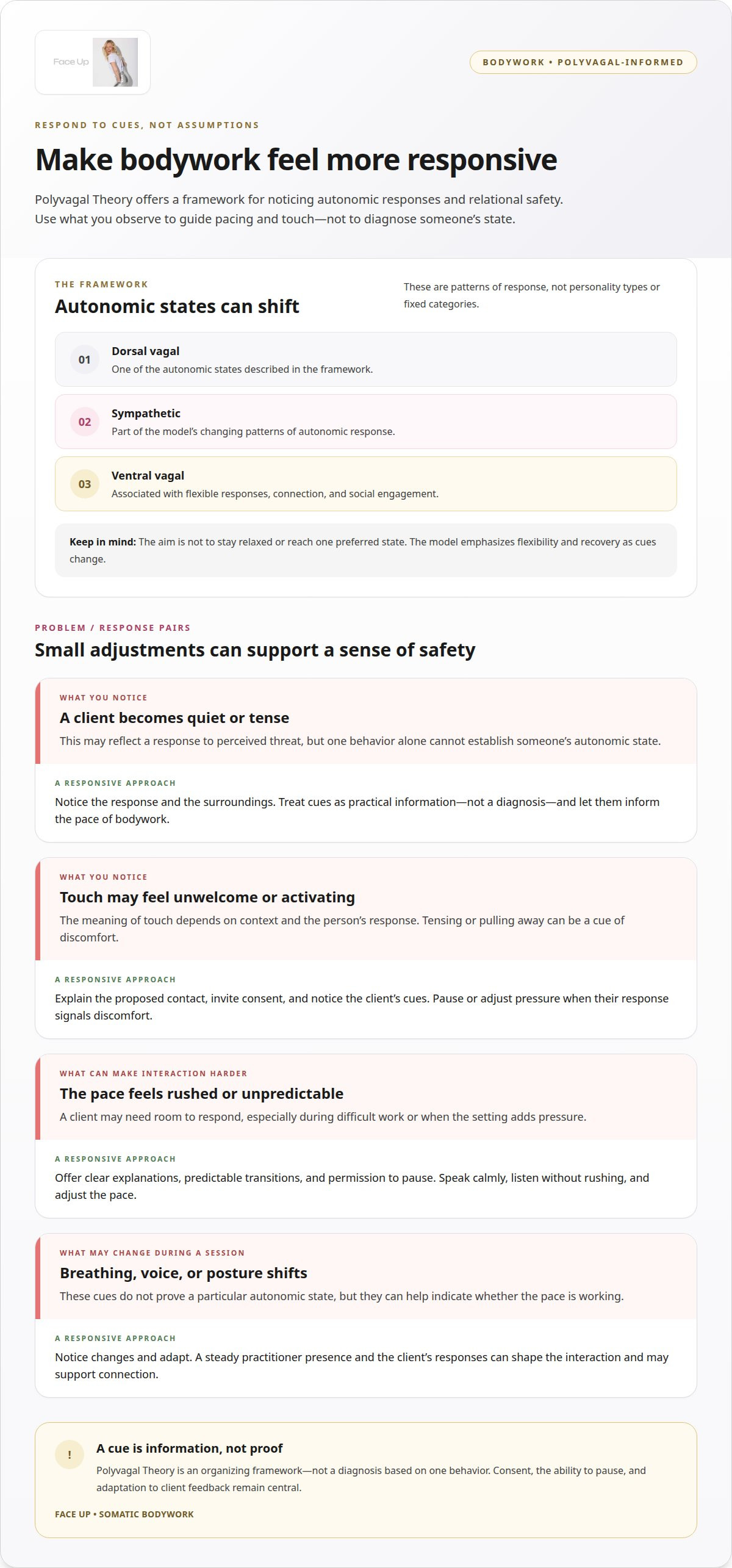
The autonomic nervous system regulates functions such as heart rate, digestion, and emotional responses. Polyvagal Theory considers these functions alongside changing autonomic states, rather than treating a person’s responses as purely voluntary. A client who becomes quiet or tense may be reacting to perceived threat, but one behaviour alone cannot establish their state. This distinction matters when trauma may influence responses to touch or the treatment setting.
Hierarchical Organization of Autonomic Circuits
Polyvagal Theory describes autonomic circuits as organised hierarchically, with dorsal vagal, sympathetic, and ventral vagal states. These are not personality types or fixed categories, but patterns of autonomic response that may change as cues shift. For bodywork, the model encourages attention to flexibility and recovery, rather than expecting someone to remain relaxed throughout a session.
Touch and Autonomic Regulation
Touch provides sensory input that may influence autonomic regulation, but its meaning depends on context and the person’s response. Porges described deep abdominal massage as producing an acute response that continued afterward. This does not establish a universal effect. Before touching, a practitioner can explain the proposed contact, invite consent, and notice cues such as tensing or pulling away. In polyvagal theory in bodywork, pausing or adjusting pressure respects the client’s cues without diagnosing their nervous system.
Polyvagal theory in bodywork differs from massage therapy in its emphasis on autonomic responses and relational safety, while somatic therapy is a broader body-oriented approach. These practices can overlap, but their names alone do not explain how a session is delivered.
A key limitation is that observable behaviour does not prove a specific autonomic state. The theory offers an organising framework, not a diagnosis based on one cue.
Touch may feel unwelcome or activating, so consent and the ability to pause are important. A practitioner should adapt contact when a client signals discomfort.
To find a practitioner nearby, look for relevant bodywork training and a clear explanation of consent, scope, and how they adapt touch to client feedback.
Ventral vagal regulation and social engagement
In Polyvagal Theory, ventral vagal regulation supports flexible responses that make social engagement possible. A therapist’s pace and the environment can influence whether interaction feels manageable.
The Polyvagal Ladder and Emotional Regulation
The Polyvagal ladder describes movement among dorsal vagal, sympathetic, and ventral vagal states. In this model, survival responses may include withdrawal or flight, while ventral vagal regulation supports connection and flexible engagement. The ladder is not a score or a demand to reach one preferred state. It helps explain why emotional regulation can involve shifting states and gradually returning to connection, rather than forcing calm.
Therapist Self-Regulation and Co-Regulation
Therapist self-regulation means noticing one’s own responses and maintaining a steady presence during therapy. Co-regulation describes how people can influence one another’s autonomic states through interaction. A therapist who speaks calmly, listens without rushing, and adjusts their pace offers cues that may support connection. This can matter during difficult work: the practitioner’s steadiness may help a client stay engaged without treating every sign of distress as something to suppress.
Safe Environments for Co-Regulation
A supportive setting reduces avoidable pressure and gives clients room to respond. Clear explanations, predictable transitions, and permission to pause can help someone feel more oriented during a session. A therapist can also notice changes in breathing, voice, or posture and adapt. These cues do not prove a particular autonomic state, but they offer practical information about whether the pace is working.
The vagus nerve contributes to cardiac regulation, and the ventral vagal complex supports behaviours including breathing, swallowing, and vocalising. Porges described a study in which lifting the pelvis increased cardiac vagal tone; this finding does not make pelvic movement a universal intervention. Rhythm and cues of safety matter more than simply increasing stimulation.
For an applied bodywork experience, explore a Somatic Bodywork Session that gives attention to pacing and the client’s responses.
Co-regulation through facial expression, voice, and breathing
Polyvagal Theory treats facial expression, vocalisation, listening, and autonomic regulation as connected parts of social engagement. These cues may shape how an interaction feels, especially when someone senses threat.
Slow Breathing and Extended Exhales
Slow breathing with a comfortable, unhurried exhale is one way to bring attention to the breath. A morning practice might involve breathing in for four seconds and out for six, while noticing whether the rhythm feels manageable. Another option is to breathe slowly for one minute. These are examples, not requirements: forcing a longer exhale can feel uncomfortable and is not necessary for meaningful practice.
Vocal Sounds and Voo Breathing
Vocal exercises use sound during exhalation, such as humming, singing, or saying “voo” after a deep breath. Sound gives attention a clear focus and connects breathing with vocalisation. Stephen Porges’s framework emphasises social engagement cues, including voice and listening, but a vocal exercise is not a guaranteed way to change autonomic state or mental health.
Facial expression also contributes to social signalling. A receptive expression, gentle tone, and attentive listening can make an exchange feel different from a fixed gaze or hurried speech. During a bodywork conversation, a practitioner might explain a movement, pause, and let the client respond before continuing. These actions provide context, not proof that someone feels safe.
Breathing exercises can be adapted to the moment. One nighttime pattern described in the article uses an inhale for four seconds, a pause for seven, then an exhale for eight. If counting creates strain, return to an easy, natural rhythm. What matters is how the person experiences the exercise, not whether they complete a set pattern.
These practices are ways to notice breath and sound, not substitutes for care addressing trauma or other mental health needs. During a session, consent and feedback help determine whether quiet breathing, humming, or no exercise feels appropriate.
Polyvagal theory’s organizing principles
Polyvagal Theory is most useful as an organising framework, not a checklist for labelling people. Its principles connect autonomic circuits, unconscious detection of safety cues, and social interaction to explain how physiological states may shift during bodywork.
Hierarchy: The theory describes autonomic responses as a sequence moving from dorsal vagal to sympathetic and then ventral vagal organisation. This hierarchy helps explain why someone might shift from withdrawal to mobilisation, such as feeling numb before noticing stress and wanting to move. It does not mean everyone follows a fixed path or must reach one preferred state. The practical takeaway is to consider changing responses, rather than treating one posture or mood as the whole story.
Neuroception: Neuroception is the nervous system’s continuous, subconscious evaluation of cues that may signal safety or danger. It depends on a person’s state: a sound that feels ordinary during connection may feel threatening during heightened stress. In bodywork, a door closing, unexpected touch, or change in the practitioner’s voice may become relevant signals. The concept encourages attention to context and the person’s response, rather than assuming that the same cue means the same thing to everyone.
Co-regulation: People can influence one another’s autonomic states through interaction. A practitioner’s measured pace, clear explanation, and responsive pauses may support connection while a client processes sensation. These actions do not prove that a particular circuit is active; they offer a respectful way to respond to what is happening. Together, the three principles link neural circuits, physiological states, and observable behaviour without treating them as interchangeable.
For bodywork, the clearest application is to observe, explain, and adapt: notice a response, make the next step understandable, then allow room for feedback. This keeps the theory practical without turning it into a diagnosis or a promise about mental health. Explore bodywork informed by these principles as a way to connect the framework with hands-on practice.
Face Up: Somatic Bodywork Session
Face Up’s Somatic Bodywork Session offers hands-on support for exploring facial and neck tension through bodywork. It may suit someone interested in how physical sensation and emotional experience relate, with comfort and personal feedback kept central to the session.
Polyvagal Theory can offer a lens for noticing responses, but it is not a diagnosis or a promise of a particular outcome. Face Up’s approach focuses on releasing deep muscular and emotional tension in the face and neck through non-invasive bodywork. Explore the Somatic Bodywork Session if you’re considering this approach to facial and neck tension.
Bring these ideas into your next step
Use polyvagal theory in bodywork as a lens for thoughtful practice, not a script that dictates how everyone should respond. The next step depends on your needs: you might want guided hands-on support, a way to practise independently, or training for your professional work.
Face Up offers a Somatic Bodywork Session, a Face Up app subscription, and the Jaw Release by Face Up™ course, alongside Face Up™ Training for practitioners. Each provides a different way to engage with Face Up’s approach to facial and somatic work. Choose the path that best fits what you’re looking for, whether you want to explore a session or develop your professional practice.
Contact Face Up to discuss bodywork and take a considered next step at your own pace.
Frequently Asked Questions
So, what are the three main “modes” your nervous system switches between?
Polyvagal Theory describes dorsal vagal, sympathetic, and ventral vagal patterns of autonomic response. These are not fixed personality types or a simple ranking of good and bad states. Someone might feel withdrawn, become mobilised by stress, and later feel more socially engaged. The framework describes possible shifts, but one behaviour alone cannot identify someone’s autonomic state.
What is co-regulation?
Co-regulation is the process by which people influence and help stabilise one another’s autonomic states. During a difficult conversation, for example, one person might speak steadily, listen, and allow pauses instead of responding urgently. These interaction cues can affect how the exchange feels. Co-regulation does not mean one person controls another’s response; it describes their shared influence during an interaction.
What is neuroception?
Neuroception is the nervous system’s subconscious, ongoing detection of cues that may indicate safety or danger. It is different from consciously deciding whether a situation is safe. A sudden sound, for instance, may feel startling, while a familiar voice may feel reassuring. A person’s current state can shape how they interpret these signals, so the same cue may not feel the same to everyone.
What is the “ventral vagal” state?
The ventral vagal state describes autonomic organisation associated in Polyvagal Theory with flexible regulation and social engagement. It supports physiological conditions for connection, including behaviours such as vocalising, listening, breathing, and swallowing. In everyday life, someone might follow a conversation and respond with facial expression and voice. The term describes a theoretical state, not a diagnosis based on appearance.
What is the Vagus Nerve?
The vagus nerve extends from the brainstem to organs throughout the body and contributes to autonomic regulation. Its effects are not simply a one-way signal to relax: vagal activity can slow the heart rate, while related responses may also accompany a racing heart and defensive reactions. This range is a reminder to understand bodily sensations in context, rather than read them as a single emotional message.
What is polyvagal theory, and how does it relate to bodywork?
Polyvagal Theory is a framework for understanding how autonomic circuits, bodily states, and social cues interact. In bodywork, it can encourage practitioners to notice how a person responds as an interaction unfolds, rather than assuming touch means the same thing to everyone. The theory can inform observation and pacing, but it does not diagnose a client or establish that a particular technique will produce a specific response.


