

The course with the longest list of techniques isn’t necessarily the one that best prepares you for client work. When comparing a facial sculpting course Australia-wide, weigh the teaching approach, practical learning and fit with your professional scope alongside the techniques named in the course description.
Good training should build skills and confidence while making clear what its certificate represents. Method-specific certification and nationally recognised qualifications aren’t interchangeable. Before enrolling, find out what the course teaches, how learning is assessed and how the skills may apply to your practice.
This guide explains what to look for in professional facial sculpting education, how to assess its relevance in Australia and how to approach client work responsibly. It also introduces the Face Up Method, which combines facial sculpting with somatic bodywork, and its structured certification, including curriculum, practical assessments and professional accreditation. Use the guidance to decide whether this style of training fits your direction and identify a considered next step.
Key Takeaways
- Look beyond course labels: compare the method, curriculum, practical learning and assessment to find training that fits your professional goals.
- Assess a facial sculpting course Australia practitioners are considering for its relevance to their work. Don’t assume it provides a particular qualification or scope of practice.
- Distinguish method-specific certification, private training and nationally recognised qualifications. These terms don’t mean the same thing.
- Make online learning purposeful by setting goals, planning study time, practising appropriately and reflecting on progress.
- Explore how Face Up Method Certification brings a holistic facial sculpting and somatic bodywork approach together with curriculum, practical assessments and professional accreditation.
What Does a Facial Sculpting Course in Australia Teach?
Facial sculpting education teaches hands-on methods that work with facial tissues and muscular tension through guided touch and movement. A facial sculpting course Australia practitioners consider may teach one defined method or combine several approaches. The course name alone won’t tell you what learners practise, how skills are assessed or what the training prepares them to do.
Course terminology can overlap, but the approaches aren’t interchangeable. Facial massage generally describes manual techniques applied to the face, while sculpting commonly refers to more targeted hands-on work shaped around a particular method. Buccal techniques involve working with the inside of the cheek as well as the outer face. Somatic approaches bring attention to bodily sensation and the client’s experience. A course may focus on one of these or include them in a broader framework.
Read the course description for details about how the approach is taught. Don’t assume a technique name tells the full story. Useful questions include:
- Which hands-on approach is being taught, and how is it distinct from other techniques?
- How does the course introduce facial anatomy and guide practitioner touch?
- What opportunities are there to practise and receive feedback?
- How does the teaching address differences in client needs and experience?
Learning outcomes and client experiences depend on the method, instruction, practitioner practice and individual context. Training can help you develop a structured approach to hands-on work, but it shouldn’t be treated as a promise of a particular result for every client.
How Is Facial Sculpting Different from a Standard Facial Course?
A treatment-focused beauty course may teach a sequence for delivering a facial service. Facial sculpting education focuses more specifically on hands-on methods, including how touch, pressure and movement are applied within a particular approach. Familiarity with facial anatomy can help practitioners understand the areas they’re working with, while thoughtful touch supports controlled, attentive practice. Neither should be presented as proof of a clinical outcome.
Course titles don’t establish qualification level or professional recognition. A class labelled “sculpting” could have a different structure and assessment from another course using the same word. Read the learning description closely. Separate the skills being taught from the credential attached to the training.
Where Do Somatic Principles Fit into Facial Work?
Somatic awareness means paying attention to bodily sensation and the client’s experience during a session. In facial work, this can inform the pace and quality of practitioner touch, encouraging a responsive approach rather than treating every face as though it needs the same sequence. It doesn’t mean diagnosing or treating medical or psychological conditions.
The Face Up Method brings facial sculpting and somatic bodywork together in a holistic approach focused on releasing facial and neck tension without invasive procedures. Its emphasis on touch and awareness offers practitioners a defined method to explore while keeping the client’s individual experience in view.
How to Evaluate Facial Sculpting Course Content and Practical Learning
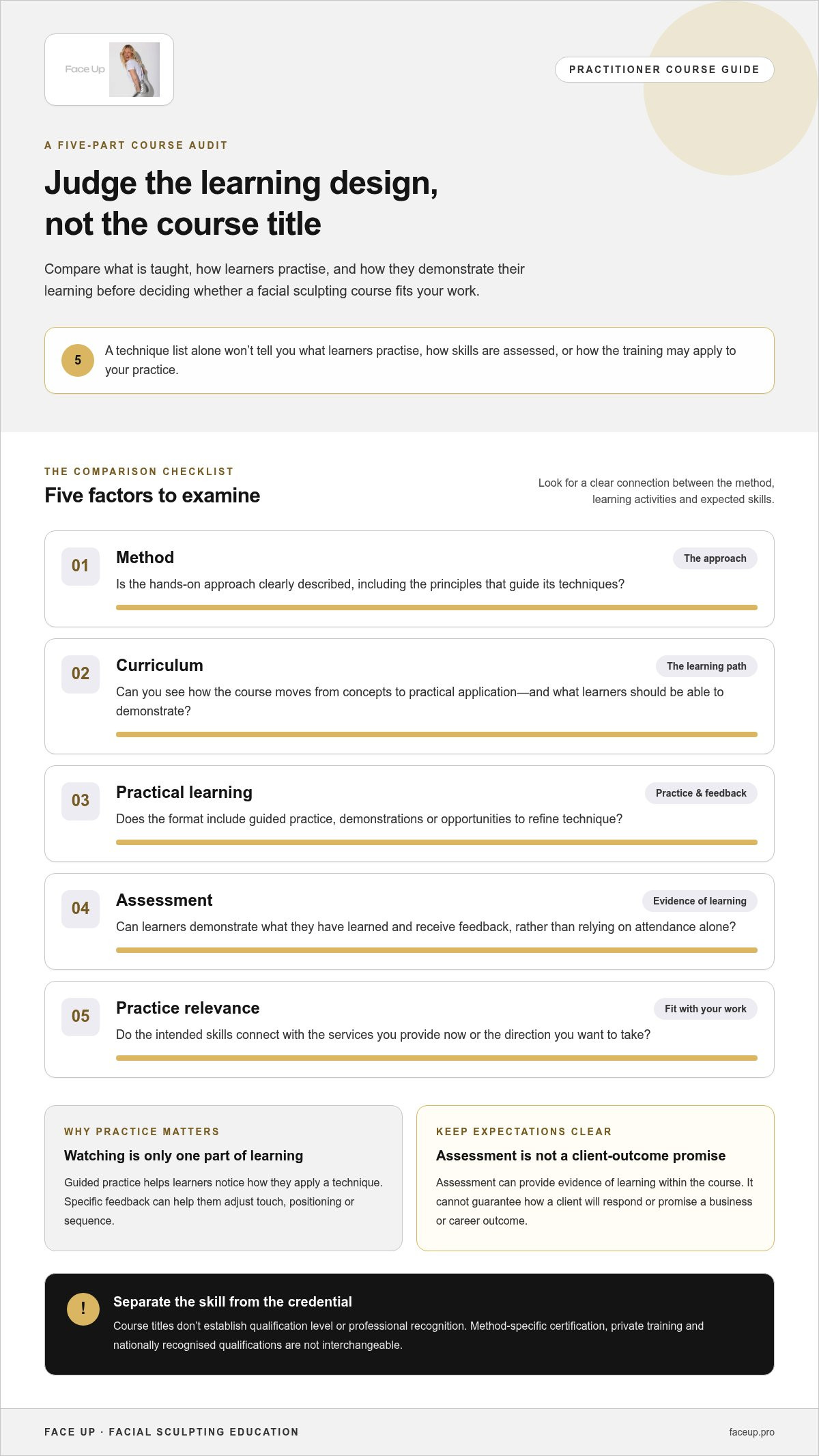
A course page can name appealing techniques without explaining how they’re taught. To judge whether a facial sculpting course Australia practitioners are considering could support their work, look for a clear connection between the method, the learning activities and the skills learners are expected to develop.
Assess a course by its learning design, not its title alone. A useful description explains what learners will study, how they’ll practise and how their learning will be assessed. Be cautious of language that promises specific client results or career outcomes without explaining the learning behind those claims.
Use this checklist to compare course content with your goals:
- Method: Is the approach clearly described, including the principles that guide its hands-on techniques?
- Curriculum: Can you see how the course progresses from concepts to practical application, and what learners should be able to demonstrate?
- Practical learning: Does the format include guided practice, demonstrations or opportunities to refine technique?
- Assessment: Is there a way to demonstrate what you’ve learned and receive feedback, rather than relying on attendance alone?
- Practice relevance: Do the intended skills connect with the services you currently provide or the direction you want to take?
Hands-on skills develop through more than watching a demonstration. Guided practice lets you notice how you apply a technique, while specific feedback can help you adjust touch, positioning or sequence. Assessment can provide evidence of learning within the course. It can’t guarantee how a client will respond or promise a particular business or career outcome.
What Should a Practitioner Look for in Course Design?
A structured curriculum should make the method understandable and its learning outcomes visible. Look for a progression that explains the approach, gives learners opportunities to practise and clarifies what assessment is intended to demonstrate. Practical assessment can show how a learner applies course material in a learning setting. It isn’t a forecast of client results. Consider whether the course focus complements your existing services or takes your practice in a different direction.
How Can You Assess Whether the Training Fits Your Practice?
Start with the clients you work with and the skills you want to develop. For example, decide whether you’re looking for a hands-on approach to complement an existing facial service or exploring the subject primarily for personal interest. Both can be worthwhile, but they call for different expectations about practice and application. Before enrolling, write down questions about terminology, assessment and how you intend to use what you learn.
- Which specific skills do I want to develop?
- How will those skills relate to my current services and professional goals?
- What will the course assess, and what will it leave outside its scope?
For practitioners drawn to a structured, holistic approach, the Face Up Method Certification combines facial sculpting and somatic bodywork with curriculum, practical assessments and professional accreditation.
Facial Sculpting Certification in Australia: What Recognition Does It Mean?
The word “certification” can describe different kinds of education. A method-specific certificate may recognise completion of a provider’s own training, while a nationally recognised qualification belongs to Australia’s formal education and training framework. Both can involve study and assessment, but they don’t carry identical recognition or establish the same professional scope.
Use this comparison as a starting point. Then check the course’s exact credential and relevant Australian information for your state or territory.
| Training type | What it generally refers to | What to check |
|---|---|---|
| Method-specific certification | Education focused on a defined approach, with a certificate awarded by the method’s provider. | The curriculum, assessment and exact title awarded. Don’t assume it is an AQF qualification. |
| Private training | A course delivered by a private provider, which may award a certificate of completion or another provider-issued credential. | What participation or assessment the certificate represents, and whether it has external recognition. |
| Nationally recognised qualification | A formal qualification within the Australian education and training system, aligned with the applicable framework and training product. | Search the National Register of VET for the registered training organisation and training product. Check current official guidance on the AQF and relevant regulator. |
Is a Private Facial Sculpting Certification the Same as an AQF Qualification?
No. A private method certification and an Australian Qualifications Framework (AQF) qualification are different categories. Don’t describe a provider-issued certificate as an AQF qualification unless it is one. ASQA regulates registered training organisations in its jurisdiction, while the National Register of VET provides information about registered organisations and nationally recognised VET products. Check current official sources, including the relevant state or territory regulator where applicable, before making a formal recognition claim.
The Face Up Method Certification is method-specific professional training in Face Up’s proprietary facial sculpting and somatic bodywork approach. It includes curriculum, practical assessments and professional accreditation. This describes the training and its components; it doesn’t claim Australian government accreditation or equivalence to an AQF qualification.
How Should Practitioners Describe Their Training Responsibly?
Use the exact course and certificate title you completed, and describe the provider and method accurately. Avoid wording that could imply a certificate grants a regulated professional title, expands your existing scope or qualifies you to provide services beyond your training. Keep technique education distinct from medical advice, diagnosis or treatment claims.
If you’re comparing a facial sculpting course Australia-wide, understand what its recognition means before relying on a credential for a specific purpose. A practical verification sequence is:
- Record the exact course title and the credential awarded.
- Identify whether the provider describes it as method-specific training or an AQF qualification.
- For a claimed VET qualification, verify the organisation and training product using the National Register of VET.
- Consult current Australian and relevant state or territory official information if recognition affects your work.
How Australian Practitioners Can Fit Online Facial Sculpting Training into Practice
Digital training can give practitioners in Australia access to a method developed beyond their local area without requiring them to relocate. Make online learning a planned part of professional development, not a shortcut from watching a demonstration to offering unfamiliar hands-on work. Build time for study, practice and reflection around your existing commitments.
A practical sequence can help turn learning into considered progress:
- Define your learning goals. Identify the skills or perspective you want to develop and how they connect with your professional direction.
- Schedule study time. Set aside regular, realistic periods to engage with course material and revisit concepts rather than trying to absorb everything at once.
- Practise within the training guidance. Use the learning activities as directed. Don’t present educational exercises as clinical treatment or work beyond your existing training.
- Reflect on progress. Note what feels clear, what needs more practice and what questions you want to resolve before applying new learning.
How Can Online Learning Support Hands-On Skill Development?
Online study can introduce a structured method and let learners revisit material as they build understanding. Face Up Method Certification includes a curriculum and practical assessments, giving learners a framework for study and an opportunity to demonstrate learning. Deliberate practice matters: pause to consider how you’re applying a technique, use assessment to identify learning needs and don’t rush to offer unfamiliar techniques simply because you’ve completed a lesson.
Face Up provides digital training globally, making its proprietary facial sculpting and somatic bodywork approach accessible to practitioners based in Australia. As you plan a learning pathway, distinguish personal exploration from education intended to shape your professional services. If career planning is part of your goal, consider how the training relates to your longer-term direction, while describing credentials and scope accurately.
How Does Facial Sculpting Fit within Australian Professional Practice?
Before applying new learning, consider your existing training, the service you intend to provide and whether the client understands and consents to the hands-on work. Stay within your professional boundaries. Don’t frame facial sculpting education as medical advice, diagnosis or treatment. Requirements and expectations can depend on the work and jurisdiction, so use current official Australian or state and territory information when making decisions about your specific practice.
Jaw-focused techniques may sit near other areas of facial bodywork, but similar terminology doesn’t make different approaches equivalent. Keep the distinction clear in your learning notes and service descriptions, especially when discussing the jaw or surrounding areas with clients.
If you’re ready to explore a structured global method while based in Australia, explore Face Up Method Certification and consider how its curriculum and practical assessments could fit your learning goals.
Explore Face Up Method Certification for a Holistic Sculpting Approach
For practitioners seeking more than a collection of standalone techniques, the Face Up Method offers a defined approach to facial sculpting and somatic bodywork. Face Up Method Certification is professional education in this proprietary method, giving learners a structured way to engage with its principles and practical application.
The certification includes a curriculum, practical assessments and professional accreditation. Together, these elements provide a learning structure: the curriculum guides study, while practical assessment gives learners a way to demonstrate their learning. The credential relates to the Face Up Method. It shouldn’t be confused with an Australian government-recognised qualification or treated as expanding a practitioner’s existing professional scope.
What Distinguishes the Face Up Method Approach?
The method brings facial sculpting and somatic bodywork together. Rather than presenting facial work as isolated movements, Face Up’s holistic approach focuses on releasing facial and neck tension while attending to the client’s experience. Somatic awareness informs how a practitioner engages with touch. It doesn’t make a session a substitute for medical or psychological care, or a means of diagnosing or treating a condition.
The method was founded by Olga Newman, a specialist in somatic bodywork and facial sculpting. This connection between facial work and bodily awareness gives the training a distinct framework for practitioners to consider. As with any hands-on education, what a learner takes into practice depends on their engagement with the curriculum and assessment, as well as continued attention to professional boundaries.
What Is the Next Step for Practitioners in Australia?
Before choosing training, bring your comparisons together. Consider whether the method fits your professional direction, whether the learning structure gives you a clear path through the subject and whether practical assessment supports your development. Then reflect on how the skills relate to your existing training and the services you’re qualified and prepared to provide.
This can help distinguish a genuine fit from a course title that simply sounds relevant. A holistic method may appeal if you want to explore the relationship between facial sculpting, neck tension and somatic bodywork. If your goal is different, identifying that now can make your next education decision more focused.
A facial sculpting course Australia practitioners choose should make its approach and learning structure clear enough to compare with their goals. Face Up Method Certification offers one method-specific pathway, with curriculum, practical assessments and professional accreditation. Consider whether its holistic framing aligns with the way you want to develop your practice, while keeping your professional boundaries in view.
If the approach resonates with your goals, explore Face Up Method Certification and decide whether this structured, method-specific training fits your professional direction.
Choose a Learning Path That Moves Your Practice Forward
Your next step is to decide what kind of practitioner you want to become. A facial sculpting course Australia practitioners choose should align with that direction, offering a method and learning structure relevant to the work they want to develop. Consider whether a holistic approach to facial work fits your values and professional goals.
Face Up Method Certification brings facial sculpting together with somatic bodywork through a curriculum, practical assessments and professional accreditation. Its digital training is available globally, so practitioners can explore the method while based in Australia. These elements offer a clear starting point for considering how the approach may fit your learning plans.
If this direction feels aligned, take a closer look at the certification and decide whether its approach suits your practice. Explore Face Up Method Certification at your own pace. Thoughtful learning can be a meaningful next step in shaping the professional work you want to offer.
Frequently Asked Questions
Can I complete a facial sculpting course online from Australia?
Yes. Online study can make facial sculpting education accessible while you’re based in Australia. Face Up provides digital training globally, including its Face Up Method Certification. Before beginning, set aside focused study time and approach practical learning within the course’s guidance. Online access to learning doesn’t automatically change what services you’re qualified or prepared to provide.
Is facial sculpting certification the same as an Australian nationally recognised qualification?
No. A provider’s method-specific certification and an Australian nationally recognised qualification are different credentials. The title “certification” alone doesn’t establish that a course is an AQF qualification. If you need a nationally recognised VET credential, check the exact training product and provider against the National Register of VET. Use current official Australian information when recognition matters for your work or further study.
Do I need beauty therapy experience before taking a facial sculpting course?
Entry requirements depend on the individual course, so don’t assume that every facial sculpting programme requires beauty therapy experience or that none do. Read the stated prerequisites and consider your familiarity with hands-on client services. If you’re new to this work, think about whether you’re comfortable learning through practical activities and how the course expectations align with your existing training. Don’t present course completion as a substitute for experience you don’t have.
What is the difference between facial sculpting and buccal massage training?
Facial sculpting training focuses on hands-on approaches to the face, with specific techniques varying by method. Buccal massage training focuses on techniques that work inside the cheek as well as externally. These terms describe different training emphases, though a course may cover more than one approach. Before choosing, check which areas and techniques are taught and whether intraoral work is part of the learning you’re seeking.
Can a facial sculpting course qualify me to treat TMJ disorders?
No. A facial sculpting course doesn’t, by itself, qualify you to diagnose or treat a temporomandibular disorder (TMD), sometimes referred to as a TMJ disorder. Learning hands-on facial or jaw techniques isn’t a replacement for relevant healthcare qualifications. Keep your service descriptions within your existing professional scope. If a client reports jaw pain or other health concerns, don’t present facial sculpting as medical treatment or as a substitute for appropriate healthcare advice.
How do I choose a facial sculpting course that fits my practice?
Start with the work you want to develop. If your current services involve hands-on facial care, for example, consider whether the course teaches an approach that complements those services and suits your client context. Compare the method, learning activities and assessment, then note any questions about how the skills fit your goals and professional boundaries. A facial sculpting course Australia practitioners choose should make its learning focus clear enough for you to assess that fit.
What does practical assessment mean in facial sculpting training?
Practical assessment means demonstrating learning through an applied task, rather than relying only on reading or course attendance. Depending on the programme, the assessment may involve showing how you apply the taught approach against its learning expectations. Face Up Method Certification includes practical assessments. These provide a structured opportunity to demonstrate learning, but they don’t guarantee a particular client response or replace the practitioner’s judgement about appropriate, in-scope work.


