

The harder you try to make your face look relaxed, the more closely you may monitor every expression. Reducing facial tension before a presentation can start with a gentler approach: notice what’s happening, then give your jaw and face room to soften without forcing a change.
If your jaw is clenched or your cheeks feel tight as speaking time approaches, you’re not alone. You don’t need an elaborate routine or a forceful massage to respond. A brief, discreet pause can help you notice how you’re holding your face, even if it doesn’t change how you feel instantly.
This guide offers a simple sequence that combines comfortable breathing, jaw awareness, and a grounded check-in with your expression. You’ll also learn how to fit the practice into preparation you’re already doing, and when ongoing discomfort calls for professional health advice. The aim isn’t to perform calmness, but to meet the moment with a little more ease.
Key Takeaways
- Jaw, brow, or mouth tension can have different contributors, so one sign alone doesn’t explain its cause.
- Try an optional five-minute sequence: pause, notice, soften, breathe comfortably, and return to your opening.
- Adapt reducing facial tension before a presentation to your setting, available time, privacy, and comfort.
- Repeated face-checking or forceful massage may become distracting. You don’t need to erase every sign of tension to present effectively.
- Face Up’s somatic approach, Jaw Release Course, and guided self-practice offer ways to explore facial awareness beyond presentation day.
Why Facial Tension Can Show Up Before a Presentation
You might notice your jaw tightening, brow drawing together, or lips pressing closed as speaking time approaches. The sensation can become more obvious when you’re rushing to finish preparations, rehearsing your opening, or wondering how you look to an audience or camera. Noticing tension doesn’t mean anything is wrong, and one sensation alone can’t reveal its cause.
Facial tension is a felt sense of tightness, pressure, or effort in the face; it describes a sensation, not a diagnosis. Stress or concentration may play a part for some people, while habits such as clenching can also contribute. Teeth grinding and clenching are associated with Bruxism, but a tight jaw before a presentation isn’t enough to conclude that you have this condition.
Which facial areas might feel tight?
Sensations vary. You might notice pressure near your jaw, temples, forehead, or lips, or simply become aware that your mouth is held firmly closed. The masseter muscles along the sides of the jaw help with chewing; the temporalis muscles at the temples also assist jaw movement. Feeling tightness in these areas doesn’t establish that a muscle or joint is damaged. Treat the sensation as a cue to observe, not a diagnosis.
Why does it matter before you speak?
An uncomfortable or tight face can draw your attention inward. You may start checking your expression, adjusting your mouth, or wondering whether your voice will sound different. That self-consciousness can feel distracting when an audience is waiting, a camera is on, or you have little time left to prepare. It doesn’t determine how well you’ll present, and you don’t need to interpret every sensation as a problem.
Rushing can leave little space to notice how you’re holding your face. Rehearsing while repeatedly evaluating your expression may keep your attention on that sensation instead of your message. For reducing facial tension before a presentation, start by noticing what feels tight without trying to force it away.
The aim is comfort and awareness, not a flawless expression or guaranteed confidence. Your face can still show signs of nerves while you communicate clearly. If a sensation is persistent, painful, or concerning, a brief pre-presentation reset isn’t a substitute for professional health advice.
A Gentle Five-Minute Routine for Reducing Facial Tension Before a Presentation
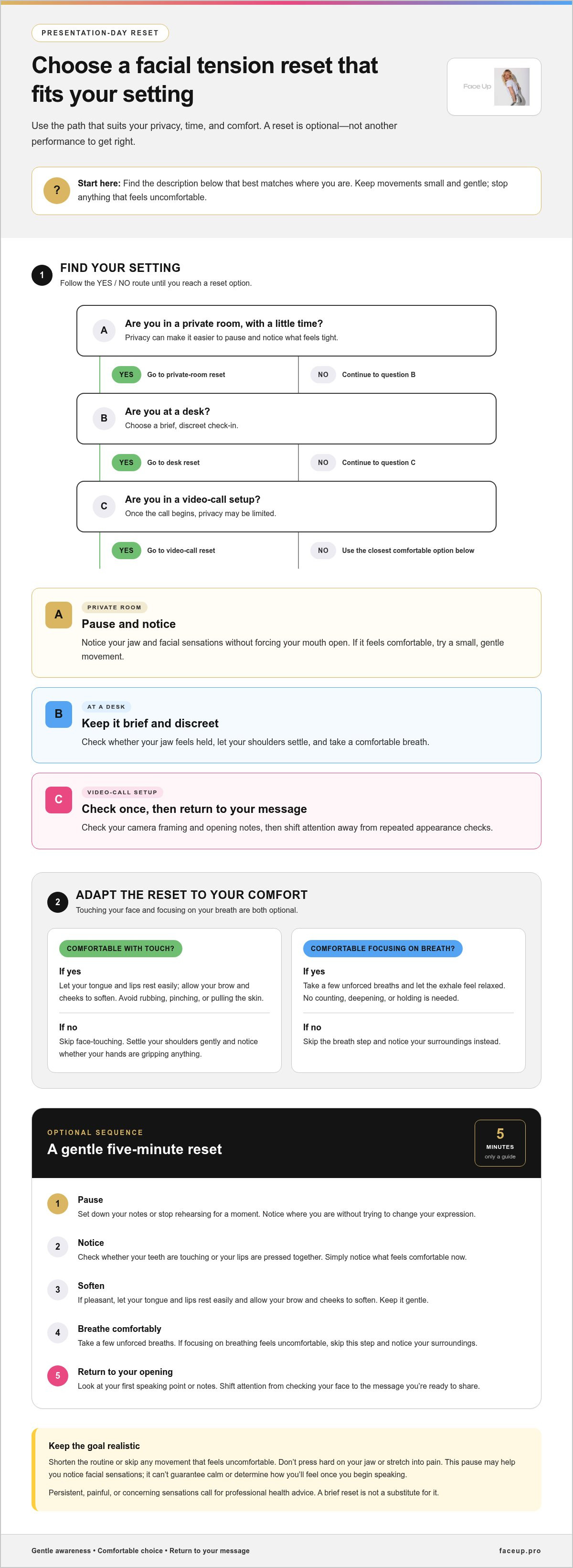
Use this as a flexible pause, not another task to get perfect. Five minutes is only a guide: shorten the routine or skip any movement that feels uncomfortable. Keep everything small and easy. Don’t press hard on your jaw or stretch into pain.
- Pause. Set down your notes or stop rehearsing for a moment. Notice where you are without trying to change your expression.
- Notice. Check whether your teeth are touching or your lips are pressed together. You don’t need to open your mouth or find an ideal resting position. Simply notice what feels comfortable now.
- Soften. If it feels pleasant, let your tongue and lips rest easily and allow your brow and cheeks to soften. Avoid rubbing, pinching, or pulling the skin. If you’d rather not touch your face, gently settle your shoulders and check whether your hands are gripping anything.
- Breathe comfortably. Take a few unforced breaths and let the exhale feel relaxed. There’s no need to count, deepen your breath, or hold it. If focusing on breathing feels uncomfortable, skip this step and notice your surroundings instead.
- Return to your opening. Look at your first speaking point or notes. Shift your attention from checking your face to the message you’re ready to share.
Keep the reset gentle and adaptable
MedlinePlus includes relaxation among its self-care tips for bruxism. For a pause before presenting, keep the focus on comfortable awareness rather than forceful manipulation. A brief routine can help you notice facial sensations, but it can’t guarantee calm or determine how you’ll feel once you begin speaking.
If you notice discomfort, stop that movement. The routine should feel optional and manageable, not like a test you have to pass before taking the stage. Choose only the steps that suit your setting. For example, you might take a quiet breath and glance at your opening line while waiting to be introduced.
For gentle jaw awareness beyond presentation day, the Face Up Jaw Release Course offers a structured way to continue exploring through self-practice.
Choose a Pre-Presentation Tension Reset That Fits Your Setting
The most useful reset is one that suits your surroundings and feels comfortable. Touching your face is optional. You might prefer a quiet moment to move gently, or a discreet check of your posture and jaw at your desk. Choosing an approach to match the setting makes reducing facial tension before a presentation feel manageable, rather than like another performance to get right.
| Setting | Time and privacy | A comfortable option |
|---|---|---|
| Private room | A little more privacy, if time allows | Notice your jaw and facial sensations; try a small, gentle movement only if it feels comfortable. |
| At a desk | Brief and discreet | Check whether your jaw feels held, let your shoulders settle, and take a comfortable breath. |
| Video-call setup | Limited privacy once the call begins | Check your camera framing and opening notes, then shift attention away from repeated appearance checks. |
In a backstage area or quiet room
If you have privacy, pause long enough to notice your jaw without forcing your mouth open. Let your lips rest comfortably or try a small, easy facial movement, then return to your notes. Keep the reset short enough to leave time for water, presentation setup, and a final glance at your opening. Avoid vigorous massage or experimenting with an unfamiliar technique just before you speak. For broader jaw-related education, see this guide to TMJ massage therapy.
At your desk or on camera
Choose a no-touch option if that’s easier: notice whether your teeth are touching, let your shoulders settle, or take a comfortable breath. Healthline’s overview of facial exercises for tension relief offers further background, but you don’t need to add exercises to your last-minute preparation. On a video call, check the frame and make sure your notes are ready. Then look toward the conversation instead of scrutinising your face on screen.
A massage tool isn’t necessary for an immediate reset. If you’re curious about tools for jaw-related self-care, explore the topic at another time rather than treating a new tool as something to try before presenting.
Common Mistakes That Can Make Facial Tension More Distracting
You don’t need to erase every sign of tension to speak effectively. A presenter can feel nervous or notice a tight jaw and still communicate clearly. Trying to hold your face in a perfectly relaxed expression may focus more attention on it, particularly if you keep checking your reflection or camera preview for signs of improvement.
For some people, repeated face-checking or forceful massage can add distraction or discomfort rather than ease. A short reset is an invitation to notice, not a test of whether you’ve relaxed enough. The aim of reducing facial tension before a presentation is comfortable awareness, not control over every expression.
Avoid forcing your face to relax
Hard pressure on the jaw, aggressive stretching, or a sudden new routine can feel unpleasant, particularly when you’re already focused on the upcoming talk. There’s no need to press, pull, or hold your face in a fixed pose. If a movement feels awkward, let it go and return to a comfortable position. Stop any self-care movement that causes pain or increases discomfort.
Repeatedly checking whether your brow, mouth, or jaw looks relaxed can also shift attention away from your opening and toward self-monitoring. Make one gentle check, then return to something useful: your first point, your notes, or the person you’re speaking with. Your expression doesn’t have to look perfectly calm for you to begin.
Know when self-care is not enough
Brief, temporary tightness before speaking is different from symptoms that persist or interfere with daily activities. Seek guidance from a qualified health professional if discomfort is persistent, severe, worsening, or limits movement or function. This article can’t identify the cause of facial sensations, and it shouldn’t be used to label them as a jaw disorder, anxiety, or trauma.
The routine described here is general wellbeing education, not diagnosis or treatment. If a movement doesn’t feel right, skip it. If symptoms concern you, professional health advice is more appropriate than trying to solve them with a last-minute facial exercise.
For ongoing learning about jaw awareness, explore the Face Up Jaw Release Course. Guided self-practice offers a way to notice facial and body sensations over time, without promising a particular result or replacing health care.
Build a Repeatable Facial Reset with Face Up Self-Practice
A short reset before a presentation can be a starting point, not a new obligation. Exploring facial and body awareness at a quieter moment may help you notice which cues feel comfortable and which you’d rather leave out. There’s no need to practise every day or expect a particular result. The point is to find an approach that feels workable, so you’re not learning an unfamiliar routine in the moments before you speak.
Practise before presentation day
Try a simple version on an ordinary day, when there’s no audience waiting. Pause, notice how your jaw and face feel, and choose one gentle cue, such as settling your shoulders or letting your lips rest comfortably. Afterward, consider what felt natural and what felt distracting. Keep the parts that suit you and skip the rest. This low-pressure exploration can make reducing facial tension before a presentation feel less like a last-minute experiment.
Keep your routine flexible. On one occasion, you might prefer a brief body-awareness check; on another, you may simply return to your notes. Practising is an option for becoming familiar with your own responses, not a requirement or a substitute for professional advice if you have ongoing symptoms.
Explore guided Face Up self-practice
Face Up’s somatic approach brings facial sculpting together with body awareness. Its guided self-practice offers an educational way to explore how sensations in the face and body register for you, without presenting the practice as a cure for presentation anxiety or a promise of a specific outcome. The Face Up App provides guided rituals for daily self-practice, while the Jaw Release Course focuses on jaw tension.
Guidance can give you a framework to follow while leaving room to adapt or pause if a movement doesn’t feel comfortable. You might try a ritual on a non-presentation day, then decide whether any part feels useful in your personal reset. There’s no need to carry a full practice into the minutes before a talk.
If you’d like to explore guided facial and somatic self-practice, explore Face Up. Start with an approach that feels comfortable, and leave out anything that doesn’t.
Carry a Gentler Reset Into Your Next Presentation
Reducing facial tension before a presentation doesn’t mean eliminating every sign of nerves. A brief pause to notice your face, soften what feels comfortable, and return your attention to your opening can be enough. Adapt the reset to your setting and skip any movement that feels uncomfortable. The goal is awareness and ease, not a perfect expression or guaranteed confidence.
If you’d like to explore facial awareness beyond presentation day, Face Up brings facial sculpting and somatic bodywork together in its approach. The Face Up App offers guided rituals for daily self-practice, and the Jaw Release Course focuses on jaw tension. These are optional ways to continue exploring, not substitutes for professional health advice when symptoms persist or concern you.
Explore Face Up guided self-practice and choose a gentle next step that feels right for you. Begin with one comfortable moment of noticing, then let your attention return to what you came to say.
Frequently Asked Questions
How do I relax my face quickly before a presentation?
Pause for a moment and notice whether your teeth are touching, your lips are pressed together, or your brow feels tense. Let your face settle into a comfortable position without forcing your mouth open or trying to create a particular expression. A few easy breaths and a glance at your opening notes can help redirect your attention. Reducing facial tension before a presentation is about gentle awareness, not guaranteeing that nerves disappear.
Can facial massage reduce tension before public speaking?
Gentle facial massage may feel soothing for some people, but it isn’t necessary and won’t work the same way for everyone. If you choose to touch your face, use light pressure and stop if you feel pain, irritation, or increased discomfort. Avoid trying a new or vigorous massage just before speaking, when an unfamiliar sensation could distract you. A no-touch reset, such as easing your shoulders and noticing your jaw, is another option.
Why do I clench my jaw before a presentation?
Jaw clenching before a presentation can have several possible contributors, including stress, concentration, or an established habit. A single episode doesn’t identify the cause or mean you have a health condition. When you notice your teeth together, allow your jaw to rest in a comfortable way without forcing it open. If clenching or related discomfort happens often or affects daily activities, consider seeking advice from a qualified health professional.
What breathing technique can I use before presenting?
Try a few unforced breaths and let each exhale feel easy and unhurried. You don’t need to count, take unusually deep breaths, or hold your breath. Keep your attention on breathing only if that feels comfortable; otherwise, notice your feet on the floor or look over your opening notes. The purpose is to give yourself a moment to settle, not to guarantee calm or change how you’ll perform.
Should I stretch my jaw before a presentation?
You don’t need to stretch your jaw before presenting. If a small, gentle movement feels comfortable, you can try it without pushing your mouth wider or holding a stretch. Stop if it feels awkward, painful, or increases discomfort, and return to a position that feels natural. Avoid aggressive stretching or experimenting with an unfamiliar technique right before speaking. If jaw movement is persistently limited or painful, seek guidance from a qualified health professional.
When should I seek help for facial or jaw tension?
Seek advice from a qualified health professional if facial or jaw symptoms are persistent, severe, worsening, or limit movement or everyday function. A short pre-presentation routine can support general awareness, but it can’t diagnose the cause or replace assessment and care. Don’t assume that tension alone means you have a jaw disorder, anxiety, or another condition. If symptoms concern you, professional guidance is more appropriate than trying to manage them with facial exercises alone.


