
A completion certificate and continuing education credits are different outcomes of buccal massage training. Buccal massage training online may combine self-paced lessons with live, supervised practice and offer a completion certificate, continuing education credits, or both. The right fit depends on the techniques taught and the credential you need.
It’s reasonable to want more than a video demonstration when learning facial and intraoral techniques. Good training should explain the methods and safety considerations as well as show how movements are performed, so you understand what you’re learning and what the course recognizes.
This guide outlines how online training can cover buccal and French sculpting massage, what to look for in safety instruction, and how completion certificates differ from continuing education credits. You’ll also see how Face Up’s practitioner education relates to facial sculpting, helping you consider a next step that suits your professional goals.
Key Takeaways
- Look for training that connects facial, neck, décolleté, and intraoral techniques, so you can understand how the methods work together in practice.
- Distinguish a certificate of completion from continuing education credits, and match the credential to your professional development needs.
- Prioritize clear instruction on sanitation, safe practice, and situations when intraoral massage should be postponed or avoided.
- Compare self-paced lessons with supervised practice to choose a learning format that supports your confidence and skill development.
Facial, neck, décolleté, and intraoral massage techniques
Buccal massage training teaches practitioners to work inside the mouth alongside external facial techniques. An online course may demonstrate a 20-30-minute routine, covering facial sculpting, neck and décolleté work, and intraoral movements.
Intraoral Massage and Buccal Sculpting
Compare how a course sequences external sculpting and intraoral work. One treatment format allocates 30 minutes to buccal massage, with 15 minutes on each side. A broader facial massage can combine French sculpting, myofascial techniques, and buccal work in a 60-90-minute session. These timings help students understand how individual techniques can fit into a complete service.
Look for demonstrations that make each transition visible, from the face to the mouth and back. The core French sculpting massage takes about 40 minutes, while the combined sculpting and buccal segment takes about 20 minutes. Burmese head massage may be added for 10-15 minutes. Such examples clarify how advanced training can build a longer sequence, while a standalone buccal routine remains distinct.
Facial Anatomy and Technique Adaptation
Anatomy instruction should connect named muscles to the movements being demonstrated. For example, the masseter lies along the jaw, while the buccinator forms part of the cheek wall. Students should see how a technique changes between external contact over the cheek and an intraoral approach. This helps them understand the area being addressed instead of memorizing a sequence without context.
Assessment and adaptation matter, too. A useful lesson shows a practitioner observing and palpating facial tissue before choosing a movement, then adjusting contact based on the area and the client’s response. For example, work around the jaw may differ from work across the décolleté. Intended effects may include relaxation and the release of muscular tension, rather than a promised change in appearance. Look for education that explains the technique and purpose behind each adjustment.
Continuing education credits and certificates
Compare the credential a course awards with its learning format and credit hours. A completion certificate and continuing education credits serve different purposes.
In the United States, requirements vary by state and by the work performed. A course certificate records training, but it is not, by itself, a professional license.
Credits and Certificate Options
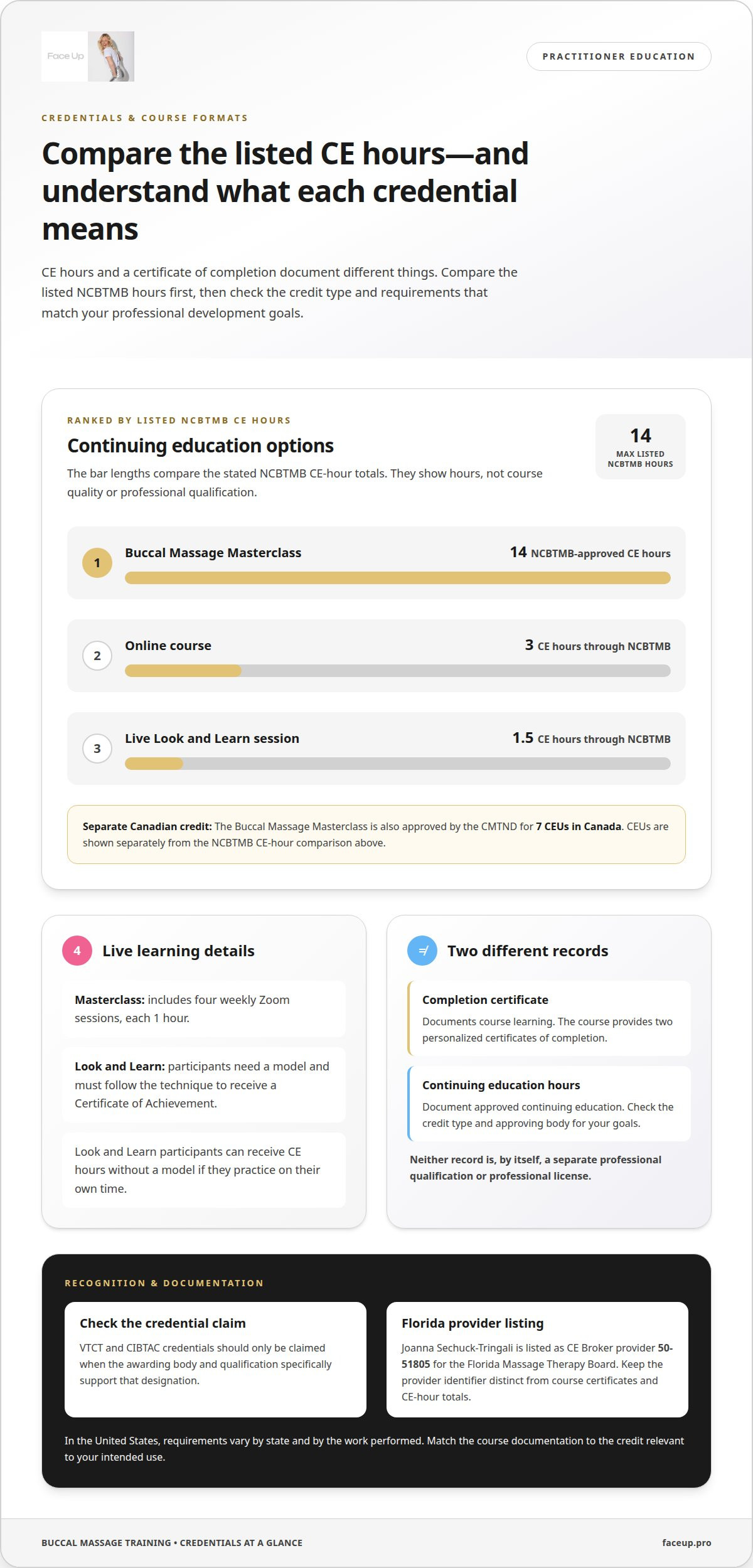
The online course provides 3 CE hours through NCBTMB, while the live Look and Learn session offers 1.5 CE hours through NCBTMB. The Buccal Massage Masterclass includes 14 NCBTMB-approved continuing education hours and is approved by the CMTND for 7 CEUs in Canada. Compare the credit type and approving body with your own education goals.
Live options can add guided learning. The Masterclass includes four 1-hour weekly Zoom sessions. Look and Learn participants need a model and must follow the technique to receive a Certificate of Achievement. They can receive CE hours without a model if they practice on their own time.
Certification Recognition
The course provides two personalized certificates of completion. A completion certificate documents course learning, while CE hours document approved continuing education. Neither should be mistaken for a separate professional qualification. VTCT and CIBTAC credentials should only be claimed when the awarding body and qualification specifically support that designation.
Online programs can include live instruction, practice, and feedback, but formats vary. Look for a clear explanation of how learners demonstrate techniques and meet certificate requirements. The available facts describe live sessions and model-based practice, but do not specify how long certificate processing takes. Timing can depend on completing course requirements and the program’s issuing process, so distinguish course completion from the later delivery of a certificate.
For Florida-related documentation, Joanna Sechuck-Tringali is listed as CE Broker provider 50-51805 for the Florida Massage Therapy Board. Keep that provider identifier distinct from a course completion certificate or CE-hour total, and check that the provider listing matches the documentation relevant to your intended credit.
Intraoral safety, sanitation, and contraindications
Safe intraoral practice starts with a clear routine, not pressure or speed. A strong online course demonstrates preparation, hygiene, client communication, and how to stop when discomfort occurs. Students need to see each step clearly, including how the practitioner keeps hands clean and uses appropriate barriers before working inside the mouth. These skills can build confidence, but video lessons alone don’t replace supervised practice.
Sanitation instruction should show the steps before and after contact: prepare the workspace, manage gloves or other barriers, and clean reusable equipment according to its instructions. A useful lesson explains how the practitioner avoids moving from an unclean surface to intraoral contact. Look for specific demonstrations, not just a brief mention of hygiene. A personalized consultation should also identify relevant health history before treatment begins.
Contraindications matter. Course guidance advises waiting two weeks after Botox in the forehead or around the eyes before buccal massage. It advises waiting a month after fillers, and lists recent Botox or fillers within less than 14 days as a contraindication. These are distinct timing points in the guidance; students should learn to recognize them and explain when treatment must be postponed.
Training should also explain how to respond when a client reports recent therapy, oral discomfort, or difficulty tolerating contact. For example, a practitioner can pause, ask how the client is feeling, and avoid continuing through pain. The aim is controlled technique, not forceful release. Clear demonstrations help learners distinguish routine communication during a session from a reason to stop.
Before choosing an online course, assess whether safety is covered throughout the lessons or only in a short introduction. Look for demonstrations of hygiene, contraindication screening, client consent, and adaptations for discomfort. A course that integrates these points with practical methods gives learners a more complete foundation for intraoral work and facial massage.
Online buccal and French sculpting massage training
Online programs vary in lesson structure, practice opportunities, and how they combine buccal work with French sculpting. Compare the teaching format and course content to decide which best supports your goals.
Curriculum, Duration, and Cost
One online buccal massage course has 15 lectures and a total length of 54 minutes. Its practical section lasts 47 minutes, while its FAQ section lasts 8 minutes. The course teaches a routine lasting 20-30 minutes, suitable as a standalone service or an add-on. These details help you compare depth, pacing, and how facial muscles are addressed.
Cost depends on the curriculum, course access, and whether live teaching or supervised practice is included. Compare these elements rather than treating duration alone as a measure of value. Buccal massage training online may offer self-paced learning followed by live sessions, while another program may focus on recorded demonstrations. The key is to match the format to the skills you want to develop.
Equipment and Practice Materials
Requirements depend on the practice format. For a Look and Learn session, participants need a model and must follow along with the technique to receive a Certificate of Achievement. A practice partner is therefore central to that specific learning experience. Before enrolling, review the course’s stated materials and distinguish model-based practice from watching demonstrations.
For instructor credentials, look for a named qualification or continuing education provider status. For example, Joanna Sechuck-Tringali is an NCBTMB continuing education Approved Provider, provider number 1001744. Reviews are most useful when they describe specific teaching, practice guidance, or feedback, rather than offering only general praise. Use those details to judge whether the instructor’s approach fits your learning needs.
To continue building facial sculpting skills, explore guided facial sculpting education.
Live masterclass options include September 14 - October 5, 2026, on Mondays from 8-9 PM EST, and November 23, 2026 → December 14, 2026, on Mondays from 8-9 PM EST.
Face Up
Face Up offers pathways for practitioners developing facial sculpting skills and for people exploring facial wellness. For professional training, Face Up Method Certification provides a route into its method. The Jaw Release Course and Face Up App Subscription support guided learning and personal practice. Face Up Sculpting Treatment offers a practitioner-led experience for those seeking hands-on facial sculpting rather than professional education.
Choose the direction that fits your goal: professional development, self-practice, or treatment. Each serves a different purpose. A course or app isn’t a substitute for hands-on treatment, and treatment isn’t practitioner training.
Contact Face Up to discuss the option that best fits your next step.
Turn Your Learning Into a Clear Next Step
Choosing buccal massage training online is one part of shaping your professional direction. Next, decide how you want to apply what you learn: deepen your facial sculpting practice, build a broader approach to bodywork, or keep developing your understanding of facial techniques. Let that goal guide the training path you pursue.
Face Up offers professional education through Face Up Method Certification, alongside the Jaw Release Course and Face Up App Subscription for guided learning and personal practice. Consider which direction aligns with your current work and the skills you want to develop next. A thoughtful choice can help you move forward with intention instead of collecting training without a clear purpose.
For a conversation about your professional learning direction, contact Face Up about training. Take your next step at a pace that feels considered and purposeful.
Frequently Asked Questions
What is the Qualification?
A course certificate confirms learning or completion; it isn’t automatically a professional license or a nationally recognized qualification. Face Up Method Certification is professional certification in Face Up’s facial sculpting method, while a buccal massage course may award its own completion certificate. Treat these credentials as distinct, and match the qualification to the work you intend to perform and the professional requirements that apply to you.
Why Intra-oral Massage?
Intraoral massage gives practitioners access to cheek and jaw muscles from inside the mouth, complementing external facial techniques. This can be relevant when a client’s goal involves jaw tension rather than facial relaxation alone. For example, a practitioner may combine external sculpting with careful intraoral work, choosing the method according to the treatment plan instead of assuming one approach suits every client.
Which reputable online buccal massage courses are available in the United States?
Options described for US learners include a self-paced online buccal massage course and a Buccal Massage Masterclass led by Joanna Sechuck-Tringali. The Masterclass is identified as approved for continuing education through NCBTMB. Compare the course scope, instructor credentials, practical learning format, and exact credential awarded. A course name or completion certificate alone doesn’t establish that a program meets every practitioner’s professional needs.
What are the risks and contraindications of buccal massage, and how should they be taught?
Intraoral work can cause discomfort or irritation if pressure, hygiene, or client communication is poorly managed. Training should demonstrate consent, clean practice, screening for contraindications, and how to pause when a client reports pain or distress. It should also teach learners to recognize situations where treatment must be postponed. A useful lesson explains these decisions through practical demonstrations, not just a written warning.


