
A high number of contact hours alone doesn’t show what a course prepares you to do. When assessing a certificate in natural aesthetics, look at accreditation, stated learning hours, time to complete the program, and how instruction is delivered. These details help you understand a course’s structure without treating one figure as proof of quality.
It’s reasonable to want clear answers before committing to professional training. This guide explains how to interpret accreditation and contact hours, what program duration can tell you, and how online learning, webinars, and in-person instruction fit together. You’ll have a practical framework for understanding a course’s format and scope, and for distinguishing natural, non-invasive facial work from medical aesthetics training.
Key Takeaways
- Assess accreditation and contact hours together to understand what a course formally recognizes and how much instruction it includes.
- Compare program timelines and teaching formats to see how online learning, webinars, and in-person sessions fit your schedule.
- Distinguish natural aesthetics training from medical procedure courses, since their subject matter and practical focus can differ.
- Review admission criteria in light of the training offered, especially when a program includes hands-on instruction.
Program duration and instructional format
Duration and delivery shape the learning commitment, while contact hours show the documented volume of instruction. For a natural aesthetics course, distinguish facial sculpting education from training in aesthetic medicine procedures.
Program Length
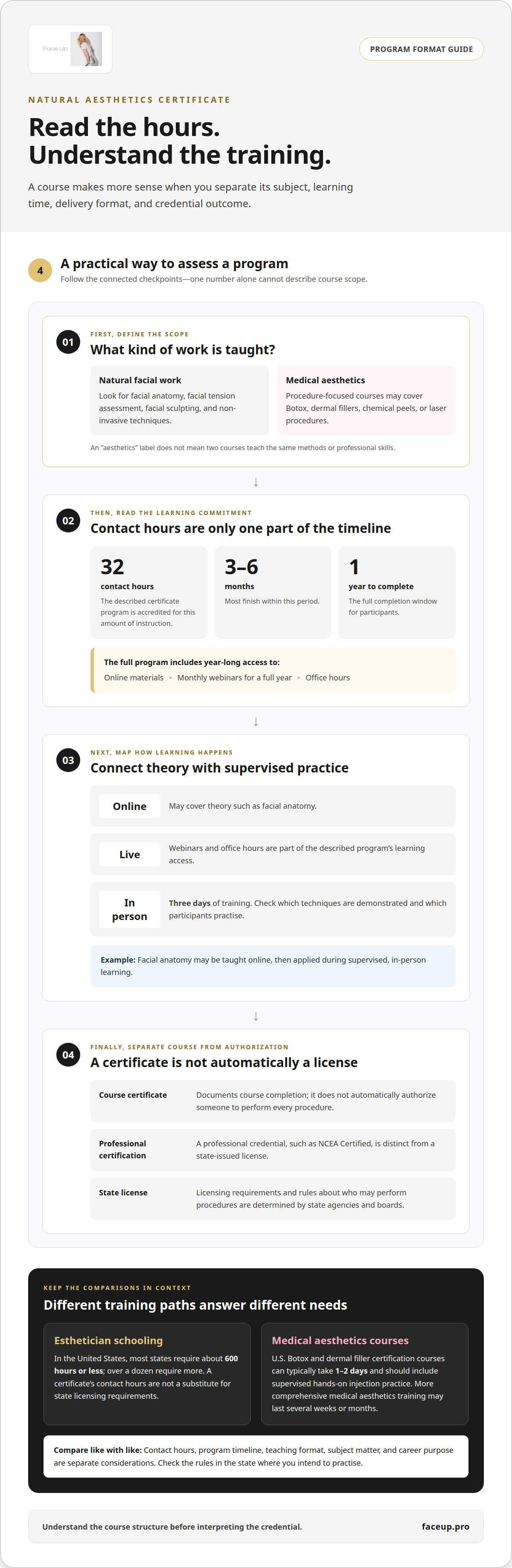
The described certificate program is accredited for 32 contact hours and includes monthly webinars for a full year. Participants have 1 year to complete it, although most providers finish in 3-6 months. The complete program also includes one-year access to online materials, webinars, and office hours. These timelines show the difference between the expected pace and the full completion window.
In-person training lasts three days, so consider how those sessions fit alongside online learning. Check what the hours cover: facial anatomy, hands-on techniques, and professional development each serve different learning goals. A longer schedule alone doesn’t show whether the content is advanced or relevant to your career.
A natural aesthetics certificate differs from a cosmetology or esthetician program, which is tied to state licensing pathways. In the United States, most states require about 600 hours or less of esthetician schooling, while over a dozen require more. A certificate’s contact hours shouldn’t be treated as a substitute for those requirements.
Instructional Format
Look for a clear explanation of how online study, live webinars, office hours, and in-person sessions work together. A blended format can pair theory with practical instruction. Find out which techniques are demonstrated and which participants practise. For example, facial anatomy may be taught online and then applied during supervised, in-person learning.
That distinction matters when comparing natural facial work with medical aesthetics courses. U.S. Botox and dermal fillers certification courses can typically take 1 to 2 days and should include supervised hands-on injection practice. More comprehensive medical aesthetics training may last several weeks or months. These formats address different professional skills.
Nurses seeking continuing education or international learners should also note the course’s intended audience and instructional language. A certificate records course completion, but it doesn’t automatically authorize someone to perform every procedure. In the United States, state rules determine who may perform procedures and under what conditions. Treat format, contact hours, and career purpose as separate considerations.
Which schools offer natural aesthetics certificates in the United States?
In the United States, natural aesthetics training may be offered through specialist aesthetics programs, esthetics schools, and professional education providers. These routes don’t all award the same credential. A course completion certificate, professional certification, and state-issued license represent different outcomes. Identify the credential and issuing organization before deciding whether a program fits your goals.
The National Coalition of Estheticians, Manufacturers/Distributors & Associations (NCEA) illustrates this distinction. NCEA Certified is a professional certification, while a credential required by law to practise is a license obtained through a state agency. An NCEA credential and a course certificate aren’t interchangeable with a state license.
Medical aesthetics providers may focus on procedure-specific education for licensed professionals. Their courses can cover injectables or other medical procedures rather than natural facial techniques. A course title alone doesn’t establish its scope. Read the curriculum description for the methods taught, practical instruction, intended participants, and certificate issuer.
Use these steps to compare programs:
- Identify the issuer: distinguish the school, training provider, professional certifier, and licensing agency.
- Match the subject: separate natural facial work from medical aesthetics training, such as injectable education.
- Review the curriculum: look for specific topics, learning format, and any hands-on component.
- Understand the outcome: determine whether the credential documents course completion, professional certification, or licensure.
For example, a certificate in facial techniques can document completion of that education, but it isn’t automatically a license to perform medical procedures. State medical, nursing, or cosmetology boards set rules about who may perform procedures and under what conditions. The state where you intend to practise is therefore essential when comparing U.S. programs.
Choose a program for its fit, not its school label alone. A program focused on natural facial techniques serves a different learning goal from a medical aesthetics course, even when both use the word “certificate.”
Explore specialist aesthetics programs, esthetics schools, and professional education providers. Compare each program’s curriculum and issuing organization: a course-completion certificate is distinct from professional certification or state licensure.
What courses and treatments are included in a natural aesthetics certificate program?
Course content depends on whether a program teaches natural facial methods or medical aesthetics. Foundational medical aesthetics training commonly covers Botox, dermal fillers, chemical peels, and laser procedures. These subjects involve different techniques from non-invasive facial work, so a shared “aesthetics” label doesn’t mean two courses teach the same skills.
For a natural facial program, examine the curriculum for specific methods and learning outcomes. Useful topics to look for include facial anatomy, assessment of facial tension, practitioner technique, and guided practice. These are examples, not a universal syllabus. A course should make clear which methods it teaches and whether practice is demonstrated, observed, or performed by participants.
- Facial anatomy: how facial structures relate to the techniques taught.
- Natural techniques: the specific hands-on or self-practice methods included.
- Practice format: whether learners observe demonstrations or take part in supervised practice.
- Scope: whether the program focuses on non-invasive work or medical procedures.
Compare the treatment content with your intended professional role. A course centred on facial release and sculpting doesn’t provide the same instruction as an injectable course covering Botox or dermal fillers. Medical aesthetics training may also include chemical peels and laser procedures. Keep these categories distinct when reviewing lesson descriptions, practical sessions, and the certificate’s stated scope.
For a natural approach to jaw tension, the Jaw Release Course is a separate learning option, not a medical-procedure qualification. A Face Up Sculpting Treatment is a treatment, not a course module or professional credential. Distinguishing courses, treatments, and qualifications helps clarify what each experience is designed to provide.
Before enrolling, map each course topic to a skill you want to develop. If your goal is facial sculpting, for example, prioritize explicit instruction and practice in relevant techniques. If a curriculum lists injectables, peels, or lasers, assess it as medical aesthetics education, not as evidence of natural-method training.
What are the admission requirements for natural aesthetics certificate programs?
Entry criteria depend on a course’s subject and practical components. A program teaching non-invasive facial techniques may have different prerequisites from medical aesthetics training involving injections or other procedures. Before applying, identify the intended learners, required credentials, and whether instruction includes hands-on practice.
For hands-on training, participants must hold an active, valid professional license in the state where training takes place. Medical aesthetics education also generally requires a relevant active professional license, procedure-specific education, and clinical practice. A course certificate alone doesn’t authorize someone to perform every aesthetic procedure. In the United States, state rules govern who may perform procedures and under what conditions.
Potential medical aesthetics practitioners include physicians, dentists, nurse practitioners, physician assistants, and registered nurses. Licensed practical nurses and licensed vocational nurses may have more limited supervised roles. Depending on state regulations, nurse practitioners and physician assistants may perform most aesthetic procedures independently or under physician supervision. These distinctions make a course’s practical scope important when assessing eligibility.
Some credentials set their own admission standards. For example, CANS applicants must hold a current U.S. nurse practitioner or advanced practice registered nurse license. DCNP applicants must have a master’s degree in nursing and national nurse practitioner certification. These criteria apply to those credentials, not automatically to every natural aesthetics course.
Use this quick distinction when reviewing admissions information:
- Natural facial techniques: identify any stated prerequisites and whether the course teaches non-invasive methods.
- Medical procedures: match the required professional license to the procedure and state where training occurs.
- Hands-on sessions: confirm that eligibility includes the required active, valid state license.
CPR or BLS certification is recommended for medical aesthetics practitioners. Continuing education and regular attention to applicable state regulations also matter in that field. If your interest is natural facial learning rather than medical procedures, explore natural facial learning options as a next step.
Face Up
Face Up offers learning and practice options for people interested in natural facial techniques, rather than medical aesthetics procedures. If you’re assessing a certificate program, the Face Up Method Certification may be relevant to your professional learning goals. The Jaw Release Course and Face Up App Subscription provide other ways to engage with facial self-practice, while the Face Up Sculpting Treatment is a treatment, not a credential.
These options serve different purposes, so consider whether you’re seeking practitioner education, guided self-practice, or a treatment experience. Understand a course or certification according to its own scope; it doesn’t replace any license required for procedures in your jurisdiction. Explore Face Up™ Training to find an option that aligns with your interests.
Choose a learning path that fits your practice
Turn your course research into a clear professional direction. Decide whether you want to deepen your natural facial practice, build skills for practitioner work, or pursue personal learning. That goal can guide you in assessing a certificate’s relevance and deciding what you hope to apply after training.
A certificate in natural aesthetics can be one part of your development. Its value to your work depends on how the learning fits your experience, professional scope, and intended practice. Keep your boundaries and the methods you want to develop central as you plan your next steps. This makes the decision more purposeful than choosing by title alone.
Face Up can be a point of conversation as you consider natural facial learning and professional development. If you’re ready to discuss how its approach may align with your goals, contact Face Up about the certificate. Take the next step at a pace that feels right, with a clearer sense of the direction you want to pursue.
Frequently Asked Questions
What is a certificate in natural aesthetics?
A certificate in natural aesthetics records completion of training focused on non-invasive approaches to facial appearance and wellbeing. Course content varies, so the certificate’s title alone won’t tell you which techniques were taught. One course may focus on facial sculpting, while another covers medical procedures. Read the curriculum and credential description to understand the training’s actual scope.
How long does a natural aesthetics certificate program take?
Completion time depends on the course schedule, delivery format, and your pace through the learning materials. In the program described in this guide, most providers finish in 3-6 months, with 1 year allowed for completion. When planning, consider how live sessions and any in-person training fit your calendar, since scheduled components may shape your pace more than self-directed study.
Is a natural aesthetics certificate accredited or recognized by employers?
Accreditation and employer recognition are separate considerations. Accreditation describes a program’s relationship to an accrediting body; an employer decides whether a particular credential suits a role. Find out which organization issues the certificate and what accreditation or contact-hour status applies. For a job application, describe the course content and skills accurately rather than assuming the credential guarantees acceptance or professional standing.
Does a natural aesthetics certificate qualify graduates for an esthetician license?
No. Completing a course certificate doesn’t by itself grant an esthetician license. A state agency issues licenses, and education requirements vary by state. A facial-method course certificate and state-required esthetician schooling, for example, serve different purposes. If you plan to work in a particular state, follow that state’s licensing pathway to understand which education and credentials apply to your intended work.
How can I verify a natural aesthetics program’s credentials and avoid scams?
Start by matching the program’s exact name to its issuing organization and stated accreditation body. Review written information about the curriculum, contact hours, completion requirements, and credential awarded. If a program claims to meet state licensing requirements, compare that claim with the relevant state agency’s published rules. Be cautious of unclear credential descriptions or promises that a course automatically authorizes procedures.


