

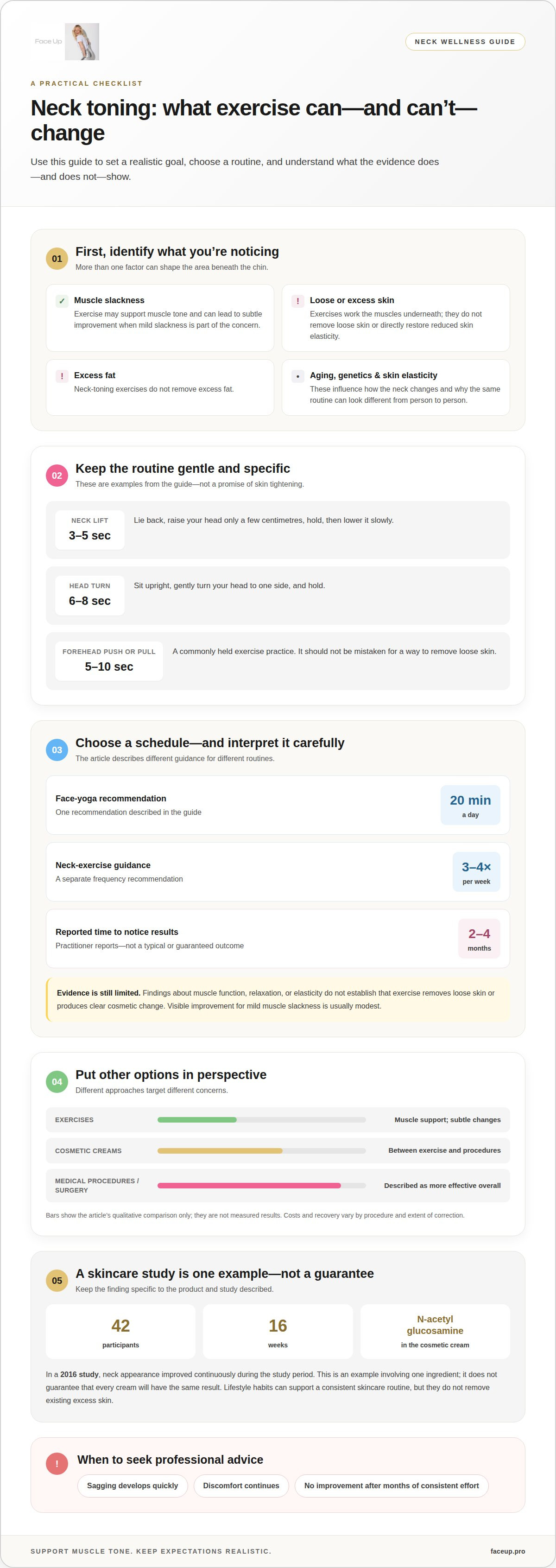
Neck toning exercises for turkey neck may improve muscle tone and create subtle changes, but they cannot remove loose or excess skin. Their effect depends partly on whether the appearance comes from mild muscle slackness or changes in skin elasticity, aging, or genetics.
If you hope consistent practice will tighten the skin beneath your chin, it is understandable to want a clear answer. Exercises can support the muscles, but visible results are usually modest, and the evidence is still developing.
This guide explains what research suggests about face yoga and neck exercises, which movements are commonly used, and how aging, genetics, and skin elasticity can shape what you notice. It also explores how exercises may fit into a broader approach to facial and neck wellness, and when they may not address the changes that concern you.
Key Takeaways
- Identify whether muscle slackness or changes in the skin are contributing more to the appearance beneath your chin.
- Set realistic expectations: exercises may support muscle tone, but they don’t remove excess skin or fat.
- Learn what early evidence suggests about face yoga, where the findings remain limited, and why visible changes can be modest.
- Explore how gentle neck movements fit into a consistent routine, and which signs suggest it’s time to seek professional advice.
Can You Treat Turkey Neck?
Neck exercises may improve muscle tone, but they cannot remove excess skin or fat. The right approach depends on whether skin laxity, muscle slackness, or both contribute to the change.
Factors Behind Turkey Neck
Turkey neck describes loose-looking skin and bands beneath the chin, often influenced by aging, genetics, and reduced skin elasticity. These factors matter because strengthening the muscles underneath does not necessarily tighten the skin above them. Excess fat can also contribute. Understanding the likely cause helps set realistic expectations before choosing exercises, skincare, or professional treatment.
Exercises Compared With Professional Treatments
Neck exercises work the muscles, while procedures may target skin laxity or other tissue changes. Exercises can offer subtle improvement when mild muscle slackness contributes, but surgery and medical procedures are described as more effective overall. Cosmetic creams fall between exercises and procedures. A forehead push or pull is commonly held for 5-10 seconds, but that practice shouldn’t be mistaken for a way to remove loose skin.
Treatment costs depend on the procedure and the extent of correction. Recovery varies too: nonsurgical treatments and surgery involve different processes, so there is no single timeline for every option.
For skincare, a 2016 study followed 42 participants using cosmetic cream containing N-acetyl glucosamine over a 16-week period; neck appearance improved continuously. That finding offers one ingredient example, not a guarantee for every cream. Lifestyle habits can support a consistent skin-care routine, but they don’t remove existing excess skin.
Seek professional advice if sagging develops quickly, discomfort continues, or months of consistent effort bring no improvement.
Aging, genetics, and skin elasticity
Aging, inherited traits, and skin elasticity influence how the neck looks and responds to exercise. They also help explain why the same routine can lead to different visible changes for different people.
As skin changes with age, it may become less able to return to a smooth, firm appearance. Folds or looseness can appear on the neck even when the underlying muscles are active. Exercises target muscle function, not all the tissues that shape the area. Consider whether your concern is mainly muscle tone, skin laxity, or a combination.
Genetics influence how skin and facial features change over time. Two people following the same neck routine, for example, may notice different levels of definition beneath the chin. That does not mean one person is exercising incorrectly. Visible results also depend on inherited characteristics and the condition of the skin and muscles.
Skin elasticity describes how readily skin stretches and returns toward its previous shape. When elasticity is reduced, working the muscles alone may not remove sagging or excess skin. Neck exercises may support muscle tone, but they do not necessarily tighten loose skin. This distinction helps set a realistic goal: better muscle support is different from tighter skin.
Start by considering the changes you want to address. If mild slackness in the neck muscles is your main concern, a regular exercise routine may support subtle improvement. If loose skin is the dominant feature, exercises will not directly correct it. Because the area beneath the chin can reflect both factors, assessing muscle definition and skin laxity separately helps clarify what exercise can reasonably target.
For a consistent routine, guided facial and neck practice can help bring focused movement into daily self-care. Keep the aim specific: support muscle tone, rather than expect exercises to reverse age-related changes in skin elasticity.
Evidence for neck-toning exercises
Evidence for neck toning exercises for turkey neck remains limited. Research suggests possible changes in neck-muscle function, but it does not establish clear cosmetic results.
Exercises for Neck Tone
Neck-toning exercises activate muscles through controlled movement and resistance, which may support muscle function. A face-yoga study reported increased elasticity and relaxation in superficial neck muscles, alongside improved tone and elasticity in functional neck muscles. These findings suggest potential benefits, but do not show that exercises remove loose skin. For mild muscle slackness, visible improvement is typically modest.
Exercise Frequency and Possible Results
Practice guidance varies by routine: one face-yoga recommendation is 20 minutes a day, while neck exercises are recommended 3-4 times per week. Consistency matters because occasional practice gives muscles less regular stimulation. Face-yoga practitioners cited in the material report seeing results in two to four months, but those reports don’t establish a typical outcome for everyone.
The difference between muscle response and appearance matters. A study may measure elasticity or relaxation in neck muscles, while a person notices changes in definition or skin. Those outcomes are not interchangeable. If you are considering neck toning exercises for turkey neck, remember that more research is needed to confirm whether face yoga supports neck muscles and their appearance as people age.
Use progress over time to judge whether a routine suits your goal. For example, track whether neck movements feel more controlled, rather than expecting a dramatic change in loose skin. If you follow a daily face-yoga practice, keep its 20-minute recommendation separate from the 3-4-times-weekly exercise guidance. Neither schedule proves that excess skin will tighten.
What exercises can help tone the neck and reduce the appearance of turkey neck?
Five simple movements work the neck through lifting, turning, stroking, and resistance. They may support muscle tone, but cannot remove loose skin or excess fat.
- Neck lift: Lie back and raise your head only a few centimetres. Hold for 3-5 seconds, then lower it slowly.
- Head turn: Sit upright and turn your head gently to one side. Hold for six to eight seconds, then repeat on the other side.
- Downward neck stroke: Use light strokes down the neck. Repeat the downward movement twice more, keeping the motion controlled.
- Chin and collarbone stretch: Lift your chin while directing your gaze upward. Hold the position for four deep breaths.
- Neck resistance: Place a hand against the side of your head and press gently into it. Hold for 30 seconds, then repeat on the other side.
A tongue movement can also engage the area: tap your tongue against the roof of your mouth 30 times during the exercise. Keep your posture steady as you do it, rather than jutting your chin forward.
These movements are commonly recommended 3-4 times per week. Choose a controlled pace and focus on the intended movement, not on forcing a stronger stretch. Regular practice can support muscle tone, while changes in skin laxity or excess fat require different approaches.
Use guided facial movement practice to explore a structured approach to exercising the face and neck.
Face Up
Face Up takes a holistic approach to facial and neck wellness through facial sculpting and somatic bodywork. For guided support beyond self-directed exercises, Face Up Sculpting Treatment focuses on releasing deep muscular and emotional tension in the face and neck without invasive procedures.
This approach may suit people seeking hands-on support for facial tension and muscle care. It does not remove excess skin, and neck exercises or sculpting should not be expected to reverse skin laxity. The right next step depends on whether your priority is muscular tension, regular self-practice, or changes that require medical treatment.
Explore Face Up’s approach to facial and neck wellness and choose the support that fits your goals.
Choose a Practice That Fits Your Next Step
Choose your next step according to the kind of support you want. The Face Up App Subscription offers guided facial rituals for regular self-practice. The Jaw Release Course focuses on jaw release, while Face Up Method Certification is designed for practitioners developing their professional practice.
Exercises may be one part of your routine, but your goals can extend beyond muscle tone. If you are exploring neck toning exercises for turkey neck, consider whether you want ongoing self-practice, support with jaw tension, or professional training. Each option serves a different purpose, so choose the one that matches the support you are seeking.
For a considered conversation about your options, contact Face Up to discuss your options. Take the next step at a pace that feels right for you.
Frequently Asked Questions
Can exercises tighten a sagging neck?
Exercises can strengthen neck muscles, but they cannot reliably tighten sagging skin. If muscle slackness contributes to a soft-looking contour, controlled practice may support subtle improvement. Loose skin is a different concern: stronger muscles do not remove it. Set a muscle-focused goal, such as maintaining control during head turns, rather than expecting exercise to change every feature beneath the chin.
How do you perform neck lifts, chin tucks, and jaw exercises safely?
Use a comfortable range of motion and move slowly. For a chin tuck, sit upright and gently glide your chin backward without tipping your head. For a neck lift, raise your head only slightly while lying down, then lower it with control. For jaw movement, keep your teeth unclenched and avoid forcing your jaw forward. Stop if a movement causes pain.
Can neck exercises tighten loose skin or reduce a double chin?
Neck exercises do not tighten loose skin or remove excess fat, so they cannot reliably eliminate a double chin. They work the muscles beneath the skin and may support a modest change in muscle definition. Better control during a head turn, for example, is a muscular change, not proof that skin has tightened. Keep these outcomes separate when deciding whether a routine is meeting your goal.
What causes turkey neck, and which factors make it worse?
Turkey neck can reflect changes in skin elasticity, aging, inherited traits, muscle slackness, and excess fat beneath the chin. These factors can overlap, so the visible contour may have several causes. Someone, for instance, may notice loose skin alongside reduced muscle definition. Exercises address muscle activity, while skin laxity and excess fat involve different tissues. Understanding the contributing factors helps clarify what exercise can address.
Are neck-toning exercises backed by scientific evidence?
Evidence suggests possible benefits for some muscle-related changes, but does not establish that exercises remove turkey neck. Face-yoga research has reported changes in neck-muscle function, while more research is needed to clarify effects on appearance as people age. What a study measures matters: muscle relaxation or elasticity does not automatically mean visibly tighter skin. Treat exercise as muscle practice, not a proven skin-tightening method.
What are the risks of neck exercises, and who should avoid them?
Forceful movements or pushing through pain can make a routine uncomfortable. Move with control, stay within a comfortable range, and stop if pain or persistent discomfort develops. If you have an existing neck injury, current symptoms, or discomfort that continues after stopping, pause the exercises and seek professional advice before restarting. Sharp pain is not a sign that a movement is working.


