
What if the most profound results you could offer your clients didn't come from a needle, but from understanding the somatic architecture of the human face? As clients increasingly move away from invasive procedures, many practitioners find themselves stuck in a cycle of repetitive, low-value treatments that fail to differentiate them in a crowded local market. You've likely felt the pressure of a shifting industry where the demand for genuine alternatives to Botox is no longer a trend; it's a requirement for professional longevity. This is why natural facelift practitioner training has become the essential next step for those seeking to elevate their practice.
Our 2026 guide provides the clear path you need to transition into the world of advanced somatic facial sculpting. By joining the Face Up Method ecosystem, you'll learn to bridge the gap between traditional aesthetics and deep tissue release. We'll explore how to master proprietary sculpting techniques and navigate the new 2026 regulatory landscape, including the mandatory practitioner registration standards taking effect this July. You're about to discover how a recognized professional accreditation can revitalize your career and provide the high-value, transformative results your clients are searching for.
Key Takeaways
- Identify the 2026 market shift where clients are moving away from "frozen" injectable results toward holistic, multi-modal facial rejuvenation.
- Discover the somatic connection between emotional stress and physical tension in the jaw and brow to provide deeper, more lasting results.
- Evaluate natural facelift practitioner training by looking for programs that offer anatomical depth rather than basic, one-day workshops.
- Align your career pivot with your professional goals by auditing instructor expertise in both facial sculpting and somatic bodywork.
- Explore how the Face Up Method™ serves as a proprietary ecosystem to help you transition into a high-value, accredited facial sculpting practice.
The Rise of Natural Facelift Practitioner Training in 2026
The year 2026 marks a definitive turning point for the global aesthetics industry. We've moved beyond the era of heavy injectables toward a more nuanced, health-first approach. Consumers are increasingly reporting fatigue with the "frozen" aesthetic, seeking instead to reclaim their natural expressions and facial vitality. This cultural shift has fueled a surge in demand for natural facelift practitioner training, a multi-modal discipline that treats the face as a living, breathing landscape rather than a canvas for temporary fillers. It's about moving from a purely transactional beauty model to a proprietary ecosystem of care.
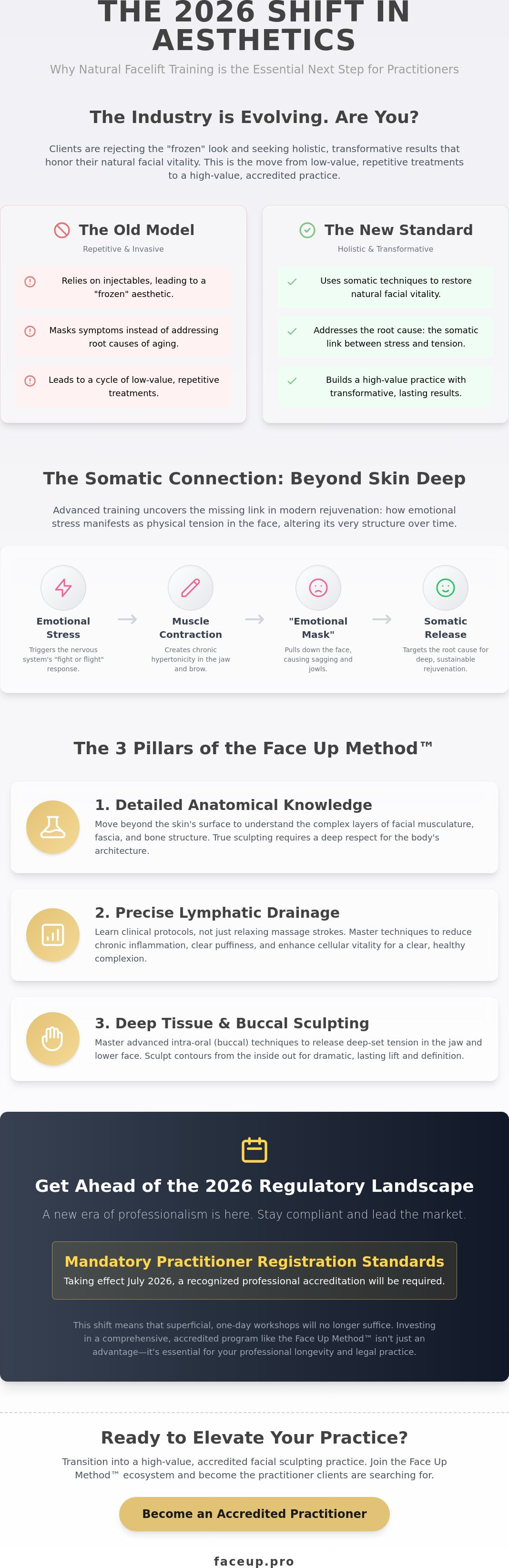
Instead of simply masking the signs of aging, this advanced training focuses on the underlying biological structures. It relies on three primary pillars: detailed anatomical knowledge, precise lymphatic drainage, and deep tissue sculpting. By mastering these areas, practitioners provide results that are both visible and sustainable. The foundational principles of Facial toning have evolved; they're now part of a sophisticated somatic framework that addresses how the face holds tension and reflects internal well-being. This isn't just a trend. It's a professional evolution that prioritizes longevity and tissue health over quick, artificial fixes.
Why Traditional Aesthetics are Evolving
The conversation is changing from "fixing" flaws to "restoring" tissue health. Clients today are more informed. They understand that a youthful appearance is tied to blood flow, muscle tone, and cellular vitality. This is why they're asking for treatments that integrate wellness and somatic therapy. Natural lifting fills a vital gap. It offers more significant results than a basic facial but avoids the downtime and risks associated with surgical intervention. It's a bridge to longevity that respects the body's natural processes while delivering a refined, professional outcome.
The Core Competencies of a Professional Practitioner
Becoming an expert in this field requires more than a weekend workshop. You must understand the complex layers of facial musculature far beyond the skin's surface. High-level training, such as the Face Up Method Certification, ensures you master intra-oral (buccal) techniques that sculpt the lower face from the inside out. You'll also learn to integrate advanced lymphatic protocols. These aren't just for relaxation; they're clinical tools used to reduce chronic inflammation and puffiness. Practitioners who embrace this level of natural facelift practitioner training are the ones who will lead the market, providing the high-value, transformative experiences that 2026 clients demand.
The Somatic Connection: Beyond Basic Facial Massage
While traditional aesthetics focuses on the skin's surface, advanced natural facelift practitioner training explores the deeper relationship between the nervous system and facial architecture. Somatic facial therapy serves as the "missing link" in modern rejuvenation. It acknowledges that the face isn't just a collection of muscles; it's a reflection of our internal emotional state. When we experience chronic stress, our nervous system signals facial muscles to contract, leading to persistent tension in the brow and jaw. Over time, this hypertonicity doesn't just create wrinkles; it actually alters the way the face hangs, contributing to what many perceive as premature sagging.
Understanding this connection is vital for practitioners who want to move beyond temporary "glows." Scientific reviews regarding the effectiveness of facial exercises and manual therapies highlight that consistent, structured stimulation can indeed influence muscle tone. However, the somatic approach goes further by addressing the "why" behind the tension. By shifting the nervous system from a state of "fight or flight" into "rest and digest," we allow the facial tissues to soften and reorganize. This deep release is far more effective than surface-level massage, as it targets the root cause of structural aging.
Releasing the 'Emotional Mask'
We often refer to chronic facial tension as the "emotional mask." This is particularly evident in the jaw, where Temporomandibular Joint (TMJ) issues can pull down the entire lower face, creating jowls and a heavy appearance. By working with the vagus nerve, we can induce a state of deep relaxation that transforms the face's resting expression. Somatic release triggers natural collagen production by reducing the cortisol-driven degradation of skin proteins. For those interested in mastering these specific techniques, our Jaw Release Course offers a specialized entry point into this profound work.
Integrating Bodywork into Facial Treatments
A successful "facelift" doesn't stop at the chin. The neck and décolleté act as the structural foundation for the face. If the fascia in the neck is tight, it acts like a tether, pulling the facial features downward. Integrating bodywork techniques allows for a comprehensive fascia release that provides immediate, visible lifting. You can learn more about the connection between facial tension and emotions to understand how localized release impacts global facial health. This holistic perspective is a core component of high-level natural facelift practitioner training, ensuring your results are as structural as they are aesthetic.
Evaluating Training Programs: Mastery vs. Workshops
The aesthetics market is currently saturated with "express" workshops that promise to teach complex facial sculpting in a single afternoon. While these short sessions might provide a basic routine, they often lack the anatomical depth required to deliver consistent, professional results. True natural facelift practitioner training is an immersive process that moves beyond simple hand movements. It requires a deep dive into the structural layers of the face, including muscle attachment points, fascial planes, and the delicate balance of the lymphatic system. Mastery isn't about memorizing a sequence; it's about developing the "clinical eye" to assess a client's unique facial architecture and adapt your technique accordingly.
What to Look for in a Curriculum
A comprehensive curriculum should bridge the gap between relaxation and clinical results. Look for programs that include intra-oral (buccal) massage, as this is essential for addressing lower-face sagging and deep-seated tension in the masseter muscles. The training must also prioritize lymphatic dynamics to ensure you aren't just moving skin, but effectively clearing metabolic waste. Finally, a mastery-level course should dedicate time to the business of aesthetics. Learning how to position your services and manage client expectations is what transforms a skilled technician into a successful business owner.
Accreditation and Professional Standing
As regulatory frameworks in regions like the UK become more stringent in 2026, holding a recognized accreditation is no longer optional. Clients are looking for practitioners who can demonstrate Continuing Professional Development (CPD) and adherence to international standards. Choosing a proprietary system provides immediate market differentiation. It signals to your clients that you've moved beyond generic techniques to master a verified, high-standard protocol. You can Master the Face Up Method™ in 2026 to align your practice with these global standards and join a community dedicated to professional integrity and somatic excellence. This level of natural facelift practitioner training ensures you are prepared for the administrative and clinical requirements of a modern aesthetics landscape.
5 Steps to Choosing Your Natural Facelift Certification
Selecting the right natural facelift practitioner training is a strategic decision that influences your brand's trajectory for years to come. It's not merely about adding a new service to your menu; it's about choosing a professional ecosystem that supports your evolution as a specialist. As we navigate the regulatory shifts of 2026, the certification you hold serves as your primary credential of quality and safety. To ensure your investment yields the highest return, you must evaluate potential programs through a lens of both clinical excellence and business sustainability.
Step 1 & 2: Alignment and Expertise
First, determine if you're looking for a simple service addition or a complete career pivot. If your goal is to differentiate yourself in a crowded local market, the method must align with your core brand values of integrity and holistic health. Audit your instructor's background with a critical eye. They should demonstrate a sophisticated understanding of somatic therapy and deep tissue work rather than just basic esthetics. Ask direct questions about their anatomical training and their experience in managing complex facial tension. A ratio of one instructor to every six students ensures that each practitioner receives the precise manual correction required for advanced sculpting.
Step 3, 4, & 5: Scope and Growth
The technical scope of the curriculum is what provides your competitive edge. A mastery-level program must include intra-oral (buccal) techniques and detailed lymphatic protocols to address the structural causes of aging. Once you've mastered the hands-on skills, you need a framework for growth. Look for programs that offer a practitioner directory listing and comprehensive marketing kits. These tools are essential for lead generation and for explaining the nuances of "somatic lifting" to a curious client base. This professional support is what allows you to justify premium pricing; you're selling a specialized, high-result treatment backed by a recognized method.
By following these steps, you ensure that your training provides more than just a certificate; it provides a clear path to professional longevity. You'll be able to guide your clients through complex concerns, perhaps by referencing a Somatic Guide to Lasting Jaw Relief to explain how your new skills address the root causes of facial sagging and tension. This level of expertise transforms your practice into a destination for those seeking genuine, non-invasive rejuvenation.
Are you ready to transition from traditional aesthetics to advanced somatic sculpting? Apply for the Face Up Method Certification today and join our global community of elite practitioners.
The Face Up Method™: The Gold Standard for Practitioners
The Face Up Method™ represents the culmination of somatic expertise and structural aesthetics. It serves as a proprietary environment where practitioners transition from being service providers to becoming recognized leaders in facial rejuvenation. Unlike generic natural facelift practitioner training that focuses solely on surface-level aesthetics, our method integrates deep somatic bodywork. This approach ensures that every treatment addresses the physiological and emotional roots of facial aging. By joining this ecosystem, you gain access to a global community of specialists who prioritize integrity, clinical precision, and transformative client outcomes.
Positioning yourself within a verified system is essential as we move into the regulated landscape of 2026. The Face Up Method™ isn't just a technique; it's a professional standard that signals global readiness and a commitment to high-level care. It provides the administrative and clinical framework needed to navigate complex client requirements with confidence. This specialized community allows you to move beyond transactional beauty treatments and offer a holistic experience that resonates with the modern, health-conscious consumer.
What Sets the Face Up Method Apart?
The primary differentiator lies in our focus on the "release" before the "lift." We prioritize clearing deep muscular and emotional tension in the jaw and neck to create a neutral foundation for sculpting. Our proprietary protocols are designed to deliver visible structural changes after the first session, providing the immediate results that modern clients demand. Beyond the treatment room, practitioners utilize the Face Up App Subscription to provide clients with ritual support and "homework." This extends the value of your work, fostering a collaborative relationship that ensures long-term results and high client retention.
Your Path to Certification
Earning the Face Up Method Certification is a rigorous but rewarding journey. The curriculum spans from advanced facial anatomy to the nuances of intra-oral sculpting and lymphatic dynamics. We maintain global standards of excellence through a structured assessment process that verifies your technical precision and somatic understanding. This isn't a passive learning experience; it's an active entry into a professional facilitator role. Once certified, you're listed in our Practitioner Directory, connecting you with a global audience seeking verified expertise.
The industry is moving toward a healthcare-led model that values specialized knowledge and accredited skills. By choosing this level of natural facelift practitioner training, you aren't just learning a new skill; you're future-proofing your career. You'll have the tools to offer Somatic Bodywork Sessions and specialized Face Up Sculpting Treatments that traditional clinics cannot replicate. It's time to elevate your professional standing and join a community that values deep tissue health as much as visible beauty.
Join the next Face Up Method Certification intake and begin your journey toward becoming a master of somatic facial sculpting.
Lead the Future of Somatic Facial Sculpting
The transition toward somatic facial therapy represents more than a clinical shift; it's a commitment to a higher standard of professional integrity. By prioritizing tissue health and nervous system regulation over temporary masks, you position yourself as a leader in a rapidly evolving industry. High-quality natural facelift practitioner training provides the foundation needed to deliver these transformative results while meeting the rigorous regulatory requirements of 2026. This journey is about evolving from a traditional aesthetician into a specialized facilitator of holistic rejuvenation.
Mastery involves a proprietary somatic sculpting method that combines advanced buccal and lymphatic training to address the face's structural and emotional layers. As a certified professional, you don't just gain a new skill; you enter a global ecosystem that includes a practitioner directory listing to support your business growth and lead generation. It's time to move beyond the limitations of repetitive treatments and embrace a career path that offers both clinical excellence and professional longevity. Your clients are waiting for the genuine, non-invasive results that only a master practitioner can provide.
Apply for the Face Up Method™ Professional Certification and secure your place in the future of advanced facial aesthetics. We're excited to support your journey into this specialized professional landscape.
Frequently Asked Questions
What is the difference between a facial massage and a natural facelift?
Facial massage primarily focuses on relaxation and surface-level circulation, whereas a natural facelift involves the structural sculpting of muscles and fascia. It targets the deep architecture of the face to provide a visible lift and address sagging. While massage is a component, the facelift uses specific protocols like intra-oral release to reorganize tissue and improve long-term muscle tone for a more defined appearance.
Do I need to be a licensed aesthetician to take natural facelift training?
Professional requirements vary significantly by jurisdiction, so you should check your local regulations before enrolling. Many advanced programs, including our natural facelift practitioner training, are designed for professionals in the beauty, massage, or wellness sectors who want to expand their clinical scope. However, some regions may require specific licensing to perform certain intra-oral or deep tissue techniques legally within a commercial setting.
Is buccal massage included in most practitioner training programs?
Buccal, or intra-oral, massage is often considered an advanced module and isn't always included in basic workshops. Comprehensive certifications, such as the Face Up Method™, prioritize this technique because it's essential for releasing deep masseter tension and sculpting the lower face. You should verify that your chosen curriculum covers this specific skill if you want to offer high-value, structural results that differentiate your practice from traditional clinics.
How long does it take to become a certified natural facelift practitioner?
The duration depends on the depth of the curriculum, with comprehensive certifications often spanning several months to ensure professional mastery. For example, some live online trainings run for six months to allow practitioners to digest complex anatomy and somatic principles. Short weekend workshops exist, but they rarely provide the time needed for the practical assessments and mentorship required to achieve a high standard of clinical excellence.
Can I learn these advanced sculpting techniques online?
You can master advanced sculpting techniques through high-quality hybrid or online programs that include detailed video theory and practical assessments. Modern natural facelift practitioner training utilizes high-definition digital modules to teach anatomy and technique. To ensure excellence, these programs often require practitioners to submit recorded practical work or attend live digital sessions for manual correction and feedback from experienced instructors within a proprietary ecosystem.
What is the typical ROI for adding facial sculpting to my treatment menu?
Adding facial sculpting allows you to command premium pricing because it's a specialized, high-results treatment that serves as an alternative to injectables. Practitioners often find that these sessions generate higher revenue per hour than traditional facials due to their transformative nature. By offering a proprietary method and being listed in a practitioner directory, you can attract a niche clientele seeking long-term tissue health rather than temporary fixes.
How does somatic therapy integrate with facial rejuvenation?
Somatic therapy addresses the nervous system's role in facial tension and aging. By releasing the "emotional mask" held in the muscles, you allow the face to soften and return to a more youthful, relaxed state. This integration ensures that results aren't just aesthetic but structural. It targets the root cause of muscle contraction and sagging rather than just treating the skin's surface, leading to more sustainable rejuvenation.
What tools are required for professional natural facelift training?
The primary tools for professional training are your hands, as the method relies on the precision of manual touch. Most advanced programs focus on manual techniques, including intra-oral work that requires professional-grade gloves for hygiene and safety. While some practitioners use gua sha or rollers for surface work, a mastery-level course emphasizes the somatic connection and the ability to manipulate deep tissue without relying on external devices.


